The U.S. space agency announced that its next destination in Solar System exploration will be Titan, Saturn's moon.
The mission is named Dragonfly (Libélula) and would be launched in 2026 to arrive at the icy satellite in 2034. The craft will fly over a dozen locations searching for prebiotic chemical processes. With Dragonfly it will be the first time NASA uses a vehicle composed of eight rotors that allow the craft to fly like a large drone. Thanks to the moon's dense atmosphere, four times greater than Earth's, it will also be the first vehicle to fly all its scientific payload to new locations.
The characterization we have of Titan is similar to our planet in a primitive period and can provide clues about how life originates on a world. During its almost 3 years of scheduled mission, Dragonfly will explore diverse environments from organic dunes to the surface of an impact crater where there once was liquid water and complex organic materials key to life. With its equipment, the properties of the atmosphere and surface, as well as below the ground, can be investigated.
"With the Dragonfly mission, NASA will once again do what nobody else can do" said Jim Bridenstine, Administrator of the Agency. "Visiting this mysterious ocean world could revolutionize what we know about life in the universe", he added.
The mission is possible thanks to data previously collected by the Cassini probe, such as the choice of a calm weather period and a safe place to land, as well as scientifically interesting locations. Dragonfly will land in the dune field known as "Shangri-La", with a landscape similar to the dunes in Namibia. The probe will explore the region making "frog leaps", that is, short flights of up to 8 kilometers, stopping to take samples. Finally it will reach the area of the Selk crater, where there is evidence of a past of liquid water, organics - complex molecules containing carbon with hydrogen, oxygen and nitrogen - and energy, which together make a sort of "recipe for life". It is planned that the vehicle will fly 175 kilometers, almost double the distance traveled to date by all the rovers on Mars.
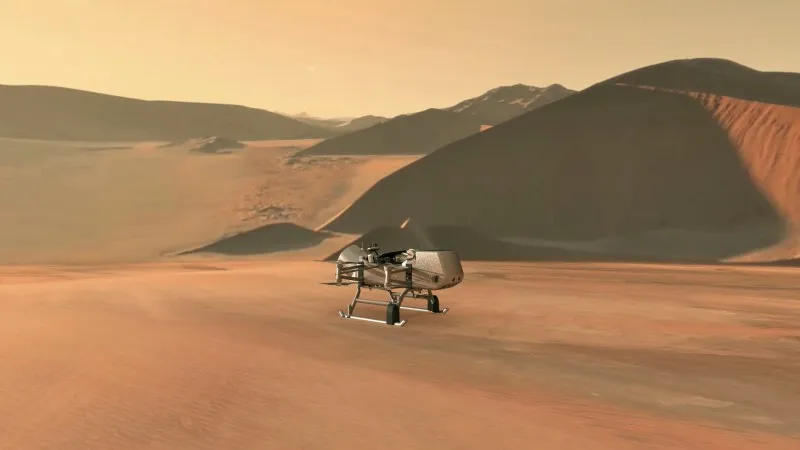
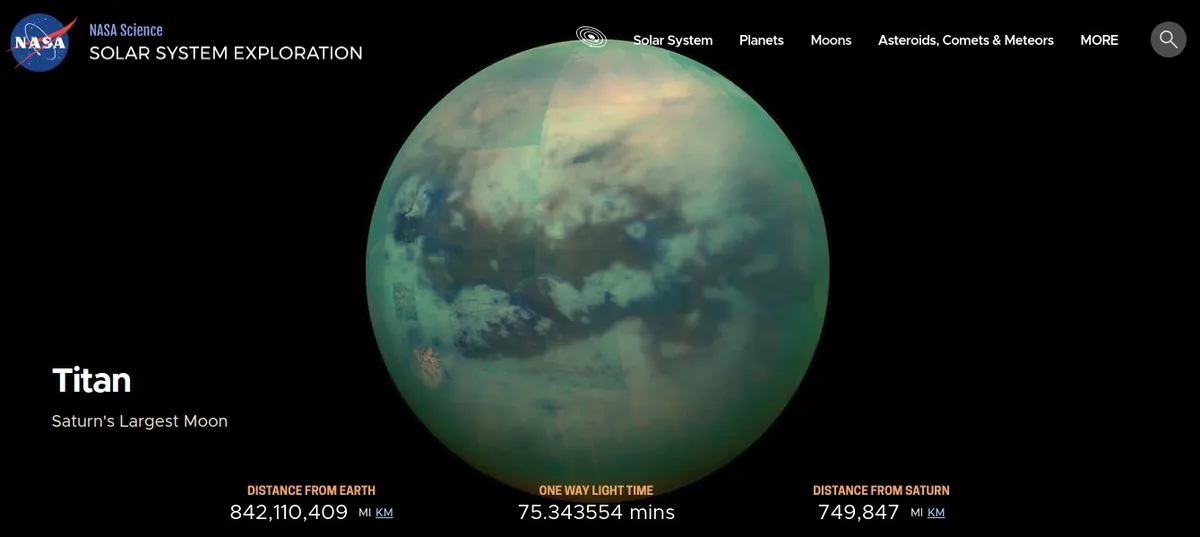
The Saturnian satellite has a nitrogen-based atmosphere, like ours, with the difference that there the clouds and rain are of methane. Other organics form in the atmosphere and fall as light snow. The moon is larger than Mercury and the second largest in the solar system, after Jupiter's moon Ganymede. While it orbits the ringed giant, it is located 1,400 million km from the Sun, with a surface temperature of -179 degrees Celsius. The pressure is 50% greater than on Earth.
Dragonfly was selected as part of the New Frontiers program, which includes the New Horizons mission to Pluto; Juno, to the Kuiper belt, and OSIRIS-REx to the asteroid Bennu. The principal investigator in charge is Elizabeth Turtle, of Johns Hopkins University.
Although the existence of intelligent life outside Earth (within the Solar System) can be ruled out, in the Sun's neighborhood it is possible that simple life exists, in the form of microorganisms, or that it has existed and fossil remains can be found, or that it is being produced. In any of those three scenarios, the generation of biological life could be better understood and it would, without a doubt, be a major discovery.
Also the European Space Agency has a similar mission planned, regarding scientific objectives, to Jupiter's moons: JUICE.
Animated illustration of the Libélula descent
DID YOU KNOW...?
Titan and its slow rain
The combination of a very dense atmosphere with gravity similar to our world makes rain on Titan slower than here. While on Earth rain falls at about 9 meters per second, it has been calculated that on Saturn's moon it does so at 1.6 meters per second, six times slower. The size of the drops is considered "Titanic", 50% larger than at home.
Visits to Titan
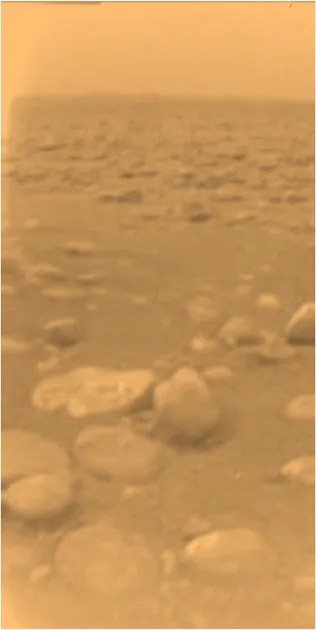
Four spacecraft passed by this moon: Pioneer 11, Voyager 1 and 2, and Cassini. On January 14, 2005 the Huygens probe (from the Cassini mission) descended successfully onto the surface and took photos like the one shown here.
Synchronous rotation
The same face of the satellite always looks at Saturn, like our moon, since the rotation period and the orbital period are equal. Saturn's moon takes 16 days to orbit the planet and the same time to rotate on its own axis.
Discovery
We owe the discovery of the moon to Christiaan Huygens in the 17th century.
Sources and related links
- NASA Solar System: Titan
https://solarsystem.nasa.gov/moons/saturn-moons/titan/overview - NASA New Frontiers
https://planetarymissions.nasa.gov - ESA JUICE
http://sci.esa.int/juice/
About the images
Illustrations: Credits: NASA/JHU-APL.
Photo: ESA/NASA/JPL/University of Arizona.