The IAU (International Astronomical Union) approved the official name of the small asteroidal satellite that will be the target chosen by NASA for the DART mission.
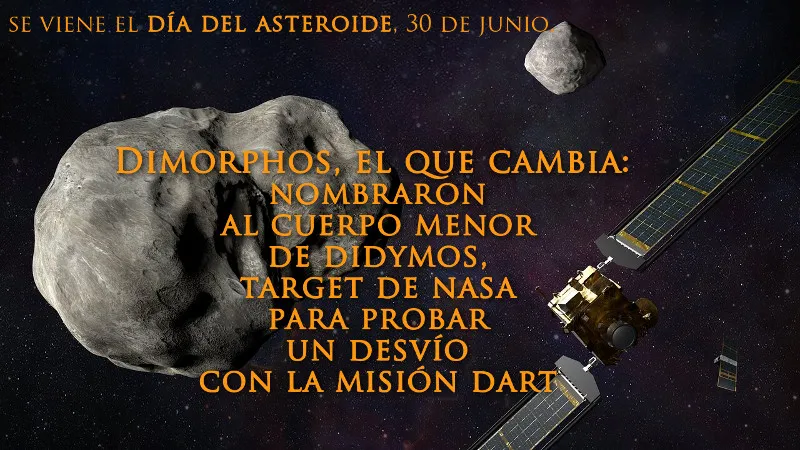
In July 2021, within a year, NASA will launch the DART (Double Asteroid Redirection Test) mission. It will be a technology demonstration to deflect a small body in the binary system of the asteroid known as Didymos and will be followed in 2024 by the European Hera mission. In recognition of the importance of this little moon of the asteroid in those missions, the IAU named it: Dimorphos.
Together, the DART and Hera missions and the international collaboration AIDA (Asteroid Impact and Deflection Assessment) will demonstrate the deflection technology that could be used to protect Earth from dangerous asteroids. Didymos is not a risk to our world, but it is the most easily reachable asteroid of its size, with a primary body 780 meters in diameter. The smaller body is about 160 meters.
It was discovered in 1996 by Joe Montani of the University of Arizona, but only a few years later, in 2003, it was known to be a binary system. At that time it was named, by suggestion of the discoverer, as Didymos, which in Greek means "twin". To refer to the smaller body, names like Didymos B and Didymoon were used. When it was chosen to be the target of AIDA, the DART and Hera teams decided to seek a permanent designation. The working group for the nomenclature of small bodies received the following proposal:
"Dimorphos, Greek for 'the one that has two forms', is the smaller member in the system (65803) Didymos. As the target of the DART and Hera space missions, it will be the first celestial object whose shape will be substantially modified by human intervention".
The name was suggested by Kleomenis Tsiganis, a planetary scientist from Greece and a member of the DART and Hera teams.
After its launch next year, DART would reach Dimorphos in 2022 by colliding with the asteroid and creating an intentional impact to change its trajectory. The European Hera probe will be launched two years later to arrive at Dimorphos in 2027 and will conduct a close survey to assess the impact on the shape and orbit of the body.
The impact will be recorded by a CubeSat (LICIACube) provided by the Italian Space Agency that will be carried to Didymos by DART and deployed a few days before the collision. The Hera mission will also deploy two CubeSats that will scan the interior of the structure with a low-frequency radar, which can be compared with previous data.
METEOR SHOWER
The debris from the impact will be multiple and small. Didymos regularly passes near Earth, at 16 times the Earth-Moon distance, every 20 years. The next close pass will be on October 4, 2022, at 10 million km, just after the impact planned for September 30.
The impact will generate up to 100 thousand kg of debris the size of a few centimeters. It is possible that a little of that material will reach Earth and burn up in the atmosphere, generating a meteor shower.
ESA highlights the protection of our planet ahead of Asteroid Day
The United Nations International Asteroid Day, celebrated on June 30, underscores ESA's increasing efforts to secure our future by understanding and addressing the risks posed by near-Earth objects that could collide with our planet.
“The work of ESA and the planetary defense community is a great example of how to address this important danger,” notes Jan Wörner, Director General of ESA. “An asteroid impact constitutes a natural disaster that we could even avoid if we detect its approach with enough advance notice.”
“Even though the probability is low, the joint work of governments and international organizations like the UN demonstrates that it is possible to prepare in advance and mitigate the damage from a planetary threat that can affect us all and anywhere.”
ESA's current activities include:
Detailed design work continues for ESA's first planetary defense validation mission: the Hera spacecraft will fly to the Didymos asteroid pair in 2024 following NASA's DART mission, whose launch is planned for next year, with the aim of deflecting the smaller asteroid.
ESA's continuous asteroid observations have resumed, after the brief pause imposed by the COVID-19 pandemic. Near-Earth asteroids are identified and tracked from several telescopes in Europe and the rest of the world.
ESA's Near-Earth Object Coordination Center in Italy continues to coordinate asteroid observations and assess the risks of newly discovered objects despite the severe effects of COVID-19 in the country.
The first of ESA's fly-eye telescopes, which is being built near Milan, will facilitate automated asteroid detection once operational.
ESA's deep space ground stations have contributed to the communication coverage of JAXA's Hayabusa2 mission, which is currently returning to Earth after collecting samples from an asteroid.
ESA sponsors a Grand Challenge on in-situ resource utilization of the Moon and asteroids, which will allow future explorers to use materials found in space. Temporarily suspended due to the COVID-19 pandemic, this €500,000 prize competition will soon be resumed.
ESA's M-Argo (Miniature Asteroid Remote Geophysical Observer) observer is about to undergo a preliminary requirements review, in which experts will declare this bold mission feasible.
ESA's Comet Interceptor mission, whose launch is planned for the end of this decade, will wait in space until it can investigate a suitable object, perhaps even an interstellar comet.
Asteroid Day
On June 30, 1908, the Tunguska impact wiped out millions of trees in an area of 2,200 km2 in Siberia, just a couple of hours of Earth's rotation from Europe, which would have had catastrophic results if it had happened in a populated area.
Asteroid Day, a United Nations-sponsored awareness day to commemorate this historic date, was founded, among others, by world-renowned astrophysicist and musician Brian May of the rock band Queen, Apollo 9 astronaut Rusty Schweickart, filmmaker Grig Richters, and B612 Foundation President Danica Remy.
Asteroid Day TV, with ESA
This year, all activities to celebrate Asteroid Day will take place online, including a month of programming distributed by the Luxembourg-based Asteroid Foundation and featuring segments from ESA and other major content creators, such as Discovery Science, TED, IMAX, BBC, CNN, ESO, and other educational producers.
Asteroid Day TV will broadcast Asteroid Day LIVE from Luxembourg starting at 12:00 CEST on June 30, featuring five hours of newly produced segments from ESA and Asteroid Day in English.
ESA also plans to broadcast new segments in Dutch, French, German, Italian, and Spanish. These will premiere before June 30.
All segments will be broadcast to the public via AsteroidDay.org, through satellite operator SES, and to other networks via satellite and digital CDN through RTL's Broadcasting Center Europe (BCE).
The segments will also be available via ESA WebTV and ESA's YouTube channel.
ESA Programming
ESA's Asteroid Day 2020 segments in various languages will premiere on Asteroid Day TV (with frequent repeats until July 4) as follows:
Italian June 24, 17:00-18:00 CEST
German June 25, 17:00-18:00 CEST
French June 25, 18:30-19:30 CEST
Dutch June 26, 11:00-12:00 CEST
Spanish June 26, 17:00-18:00 CEST
English June 30, 12:00-13:00 CEST and 18:00-19:00 CEST
More information at https://asteroidday.org/broadcast-schedule/
NEW IAU MEMBERS
The IAU announced the welcome of 373 individual members and 203 junior members, formally accepted into the Union. Thus, the total number of members rises to 14136 from 107 countries.
The announcement indicates a website to view the list of new members. While browsing the list, I found some Argentines, namely:
Colazo, Marcelo Eduardo (CONAE)
Cécere, Mariana Andrea (IATE)
Fernández López, Manuel (IAR)
Paz, Dante Javier (IATE)
Stasyszyn, Federico Andrés (IATE)
Vasquez, Alberto Marcos (IAFE)
Juniors
Jofré, Jorge Emiliano (OAC)
Supán, Jorge Leonardo (IAFE)
Congratulations!
Sources and related links
- IAU Approves Name of Target of First NASA and ESA Planetary Defence Missions
https://www.iau.org/news/pressreleases/detail/iau2007/?lang - This NASA Mission May Cause an Artificial Meteor Shower
https://www.nytimes.com/2020/05/13/science/meteor-shower-nasa-dart.html?smid=nytcore-ios-share - ESA highlights the protection of our planet ahead of Asteroid Dayhttp://www.esa.int/Newsroom/Press_Releases/La_ESA_destaca_la_proteccion_de_nuestro_planeta_de_cara_al_Dia_del_Asteroide
- Asteroid Day
https://asteroidday.org/ - ESA
www.esa.int - The IAU welcomes over 500 new Individual and Junior Members
https://www.iau.org/news/announcements/detail/ann20024/?lang
About the images
Opening image: NASA/Johns Hopkins APL/Steve Gribben
Animation: Paul Wiegert.