World Space Week is celebrated between October 4 and 10 and International Observe the Moon Night on the 20th. They are two good excuses for space to unite us.
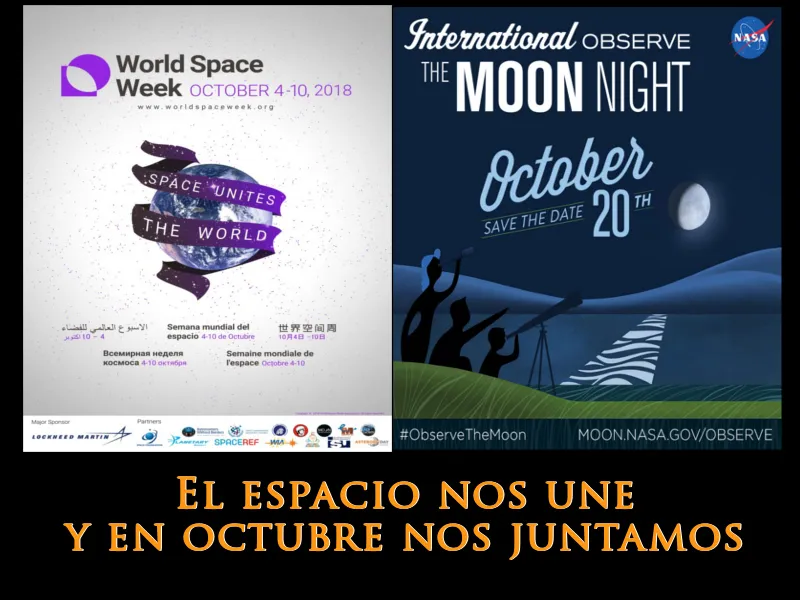
World Space Week
October 4 – 10
What is World Space Week?
World Space Week is an international celebration of the contribution of science and technology to the improvement of the human condition. The United Nations declares it annually from October 4 to 10. During World Space Week, events and educational programs related to space take place. There are synchronized events that attract media coverage, which helps educate the public about space. The dates of World Space Week commemorate key space milestones: on October 4, 1957, Sputnik I, the first man-made Earth satellite, was launched. The Outer Space Treaty took effect on October 10, 1967.
Where and how is World Space Week celebrated?
World Space Week is open to everyone. Government agencies, companies, non-profit organizations, teachers, and individuals celebrate World Space Week. They organize public events, school activities, advertising, and web pages. To find information about it taking place in your country, please visit www.spaceweek.org. The United Nations organizes World Space Week globally with the help of the World Space Week Association. In many places around the world, there are national coordinators.
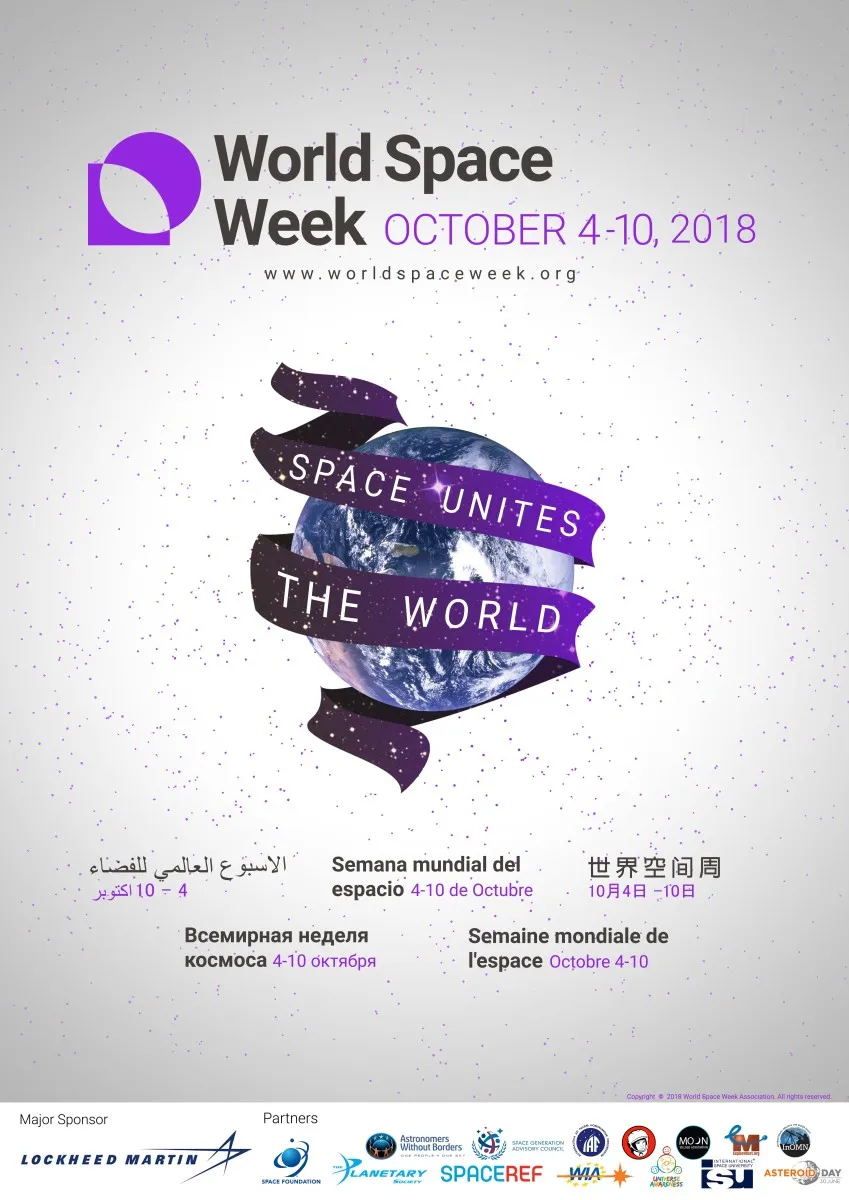
World Space Week http://www.worldspaceweek.org/about/introduction-spanish/
From the Argentine coordination of the event, they tell us:
Argentina has participated in WSW since 2007. In this 2018 edition, we aim to reach the entire country in order to bring science and technology closer to society, particularly to young people. Developed nations are so precisely because of the investment they have made over decades in science and technology, and in this context, the space area has always been an undisputed protagonist. This is an excellent opportunity not only to bring the fascination of space to the general public but also to intensify scientific outreach and awaken new vocations in children and young people.
From the Argentine national coordination of WSW, we invite you to join efforts so that our country is one of the undisputed protagonists in the present 2018 edition. In this sense, we intend for various activities to be carried out in all provinces of the national territory. Offering an event within the framework of the largest space celebration in the world is also a very nice opportunity to showcase each of our institutions at the national and international level. Thus, you will be able to use the WSW logos, upload your event to the official website, and of course, count on our support.
We invite all of you to join the 2018 Argentina World Space Week, and in this way, once again bring closer and share among all of us the wonders that the cosmos holds.
A warm greeting and let's start planning each of our events!
Lic. Diego Bagú
Director Planetario Ciudad de La Plata
National Coordinator WSW Argentina
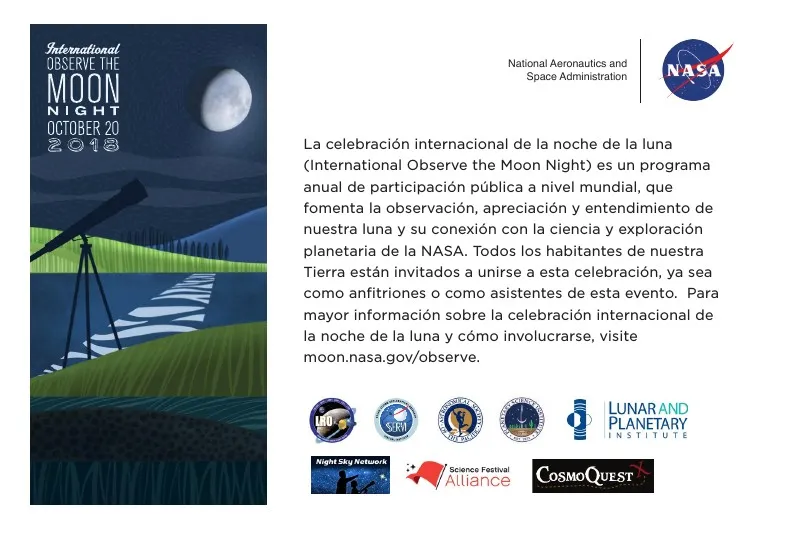
International Observe the Moon Night
The event is organized by NASA and its name in English is International Observe the Moon Night, abbreviated as IOMN, which has been celebrated annually since 2010.
The event takes place between September and October and the date is chosen so that the moon is in its crescent phase. This year it will be October 20.
In the Southern Hemisphere, the crescent phase is denoted when the illuminated part of the visible face of the natural satellite is shaped like the letter C. When the moon is in the middle of the sky, the illuminated part is towards the west, meaning that near the west the Sun must be, which illuminates the Moon. If the Sun is in the west, it is because it is setting, meaning it will be approximately 18 h. If the Moon is in the middle of the sky at 18 hours, it implies that it rose 6 hours earlier (approximately), that is, at noon, and will set 6 hours later, at 24 h.
Since the first quarter will be on October 16, these values change. They are fairly good approximations for the date of the first quarter, but before and after they are not so good.
Let's see: According to the Naval Hydrographic Service, on October 16 the Moon will rise at 11:46 and set at 01:27, which coincides with the approximation made earlier.
But on the 20th, the Moon will rise at 15:23 and set at 04:05.
The occasion is propitious this year to remember the 50th anniversary of Apollo 8.
The purpose of the initiative is to encourage astronomical observation in general through the astronomical object easiest to see with the naked eye and which is dazzling with binoculars and small telescopes.
And what it's about is not sharing the event over the internet, but living the personal and community experience of going out to observe with our own eyes.
Naval Hydrographic Service http://www.hidro.gov.ar/Observatorio/REluna.asp
IOMN https://moon.nasa.gov/observe-the-moon/annual-event/overview/