Does Trump's announcement of returning to the Moon have scientific objectives?
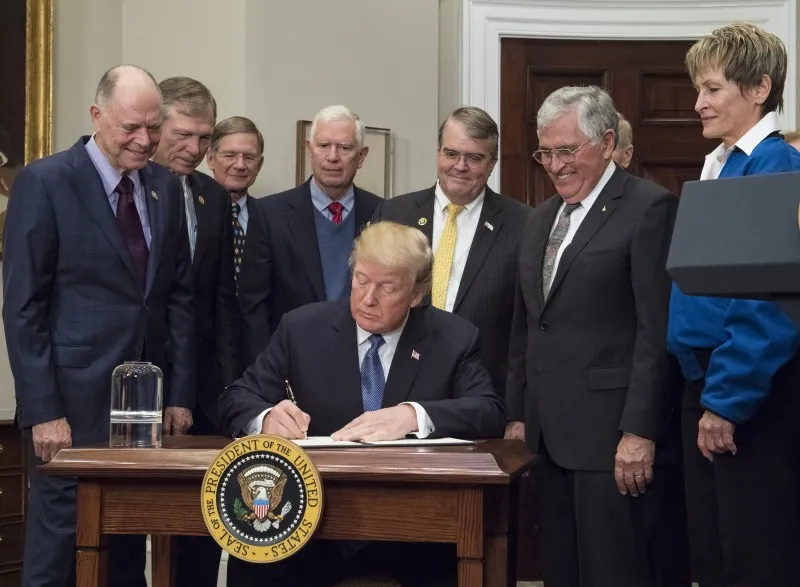
On December 11, 2017, the 45th anniversary of the descent of the Apollo 17 mission astronauts on the Moon was commemorated. In 1972, Gene Cernan and Harrison "Jack" Schmitt set foot on the satellite and it was the last time humans achieved it. That day -this year- Trump signed Space Policy Directive 1 (SPD1), a space policy directive that modifies the previous one, from Obama.
Why didn't other countries continue trying? Why didn't the US keep doing it?
The first question lies in the fact that the "Space Race" between the USA and the USSR was the continuation of the Cold War by other means. That is to say, its objectives were not fundamentally scientific, but political. Nationalism is not something new, and even less so for the United States. The supposed "national unity," which is nothing more than a feeling generated in the population, has been used to divert attention from other matters. Not only space exploration was used for those objectives, but it is also very common to do the same with sports. American nationalism runs through the two major political parties almost equally, both Democrats and Republicans.
Once the objective of reaching the Moon (before the post-Stalin Soviets) was achieved, the nationalist feeling in the population began to diminish. The little attention paid by the population and the media to the Apollo 13 mission is an example of that, which only changed when they communicated to Houston that they had a problem.
Just like in sports, nobody wants to come in second. Russia, which had led the space race for several years, with Sputnik and Gagarin's flight, considered the competition concluded the very moment Armstrong uttered his famous words.
Since then, for the United States as for any other country, putting humans on the Moon has been prohibitively expensive, as it also was during the 60s-70s, from an economic point of view, with the difference that during the space race the expenditure of billions of dollars was justified with that political objective, while since it started being achieved, that justification was difficult to sustain. And if it was difficult from then on for the USA, imagine for other countries with smaller budgets.
"Sending a manned spacecraft to the Moon was excessively costly and there really hasn't been a truly scientific justification to sustain it," explains to BBC Mundo Michael Rich, professor of Astronomy at the University of California, Los Angeles.
The different administrations of the United States, including those of Bush and Obama, made this clear. George Bush had the plan to return with astronauts to the Moon by 2020 -the Constellation program- which was canceled in 2009 by Obama on the grounds that an additional 3 billion dollars per year were needed to fulfill it.
The efforts of the United States then focused on creating a transportation system, to be used in different ways: the Space Launch System (SLS) which only by 2020 would achieve unmanned launches, to later achieve human flights in 2023. Meanwhile, development shifted strongly to the private sector.
Therefore, before continuing, it would be worth asking whether the SPD1 will have appropriate funding in next year's budget, to be evaluated in the US Congress in February-March.
Secondly, the succinct and ambiguous language of the SPD1 leaves more than doubts. Let's see:
Section 1 says:
Presidential Policy Directive 4 of June 28, 2010, is modified as follows: the paragraph beginning with "Set far-reaching exploration milestones" is deleted and replaced with:
"Lead an innovative and sustainable exploration program with commercial and international partners to enable human expansion across the Solar System and to bring back to Earth new knowledge and opportunities. Beginning with missions beyond low Earth orbit, the United States will lead the return of humans to the Moon for long-term exploration and utilization, followed by human missions to Mars and other destinations."
And that's it. Section 2 is legal-administrative considerations.
Therefore, it is an ambiguous statement. In fact, it does not explicitly say that the objective is to put humans on the Lunar surface. The "return of humans to the Moon" could be orbital and not surface.
HUMANS AND ROBOTS
China has already placed spacecraft on the Moon, without crew (Chang'e 3). In times when the advancement of innovation in replacement of jobs is discussed, it is absurd to think of space missions with humans when they can perfectly well be carried out by robots. The trips to the Moon, from the preparation missions (Mercury-Gemini) to the Apollo ones, were "relatively" simple: The moon is close, a few days of travel. In terms of energy (fuel) and time of exposure to radiation, they were feasible.
The trip to Mars is technologically and scientifically challenging for both reasons.
Could a base on the Moon improve the situation?
There are those who think a lunar base could be used to generate fuel. It has also been suggested that a facility could be used to study and improve human capabilities to protect themselves from radiation.
If both China and other countries have shown interest in reaching the Moon to conduct mining, the United States, in general terms, surely foresees a benefit for private companies, whether to extract minerals or simply to obtain funds from the budget for building rockets and other necessary items. The "return to the Moon" if before had more political than scientific reasons, now has economic reasons.
SCIENTIFIC POLICY AND TRUMP
The current president of the United States was harshly questioned regarding his scientific policy, particularly for his denialism on the climate issue. One reading of the SPD1 is that the US wants to do science, but the funds to do so should not, according to Trump, endanger the oil industry. According to SpaceNews, from the company Lockheed Martin it was declared that SPD 1 "will foster a new and thriving space economy." Needless to say, the main beneficiaries of that new economy will be the owners of companies that have no problem replacing workers with robots, but say they are interested in sending -unnecessarily- people to the Moon. As long as it's business for them...
CONCLUSION
It's hard to know anything with Trump, because he says one thing and then changes. Climate denialism has economic origins, while the president seems to need political support, which is declining. Without JFK's charisma, the magnate seeks a national sentiment to rebound in the polls. Rulers are specialists in making grand announcements that later become unenforceable due to lack of funds, but which nonetheless -limitedly- drive a nationalist, patriotic sentiment in the local population. In any case, private companies will try to make a killing. Science? Fine, thanks. Since 1776 the United States has had a motto: explore and conquer. That's why the first thing they did on the Moon was plant the famous flag, which wasn't fluttering, but was scientifically designed with the necessary materials to stand upright. For that, science has been used: for political and economic ends.
Both NASA and ESA (the European agency) have planned missions to explore, without crews, moons of the Solar System: the goal is to better characterize those worlds where, according to information already obtained, simple life could arise. With better data, a future landing mission on those satellites could be designed to discover microbial life, if it exists. Discovering life, even microbial, outside Earth does not encourage nationalisms, but it would be scientifically praiseworthy.
Patriotic sentiment is necessary when one people is exploited by another. There, the search for freedom in the form of political sovereignty makes sense. The United States freed itself from England. One would have to see what the inhabitants of Puerto Rico say about that. Freedoms for some, but not for others.
Beyond political sovereignty, nationalisms are deceptive, false. We people have equal rights, regardless of the place we were born, lifestyle, facial features, national identification, or language. Political borders are an illusion that encourages xenophobia under the false presumption that those inside have rights and those outside do not, as Trump has done since coming to power. Meanwhile, according to the newspaper El País, "the billionaire has presented a tax reform that seeks to square the circle: lower taxes for the richest and reduce the burden on companies while relieving the middle classes."
That is the horizon of the United States Government, if we don't get stuck in the 'luna de Valencia' [a Spanish idiom for a pipe dream]. Everything else is a space fable, a tall tale.
Sources and related links
- NASA: New Space Policy Directive Calls for Human Expansion Across Solar System
https://www.nasa.gov/press-release/new-space-policy-directive-calls-for-human-expansion-across-solar-system - TRUMP POLICY PROMISES MOON, MARS, AND BEYOND — WILL THIS TIME BE DIFFERENT?
https://spacepolicyonline.com/news/trump-policy-promises-moon-mars-and-beyond-will-this-time-be-different/ - Trump formally establishes lunar landing goal, but without details
http://spacenews.com/trump-formally-establishes-lunar-landing-goal-but-without-details/ - Presidential Memorandum on Reinvigorating America's Human Space Exploration Program
https://www.whitehouse.gov/the-press-office/2017/12/11/presidential-memorandum-reinvigorating-americas-human-space-exploration - Space Policy Directive 1 – Return to the Moon
https://theness.com/neurologicablog/index.php/space-policy-directive-1-return-to-the-moon/ - Why no country has sent a person to the Moon again since the United States launched Apollo XVII in 1972
http://www.bbc.com/mundo/noticias-42315962 - Trump launches a powerful tax cut without clarifying who will pay the cost
https://elpais.com/internacional/2017/09/27/estados_unidos/1506530669_981600.html
About the images
Credit: NASA/Aubrey Gemignani