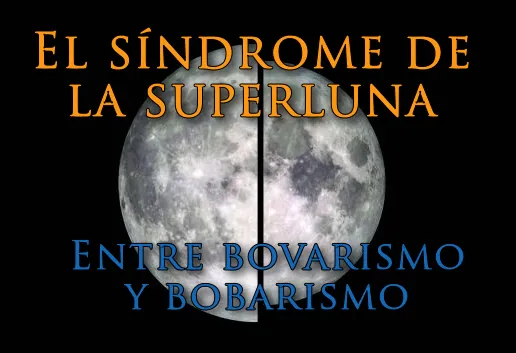
What is a supermoon? Between bovarism and bobarism.
The term "supermoon" was coined by an astrologer, Richard Nolle, in 1979. It is, in its origin, an astrological, anti-scientific concept. In fact, this obscure character predicts earthquakes during eclipses and supermoons, which has no scientific backing.
However, in astronomy, terms from antiquity are still used, as long as they are redefined. For Nolle, a supermoon is a full (or new) moon that occurs when the natural satellite is at 90% of perigee or less. Perigee is the point in the lunar orbit closest to Earth, since the Moon's path around the planet is elliptical.
So every month the Moon is at a point closer to the center of the Earth and at another time each month, it is at a point farther away (apogee).
NASA takes Nolle's definition, from which it is possible that in a single year there are 3-4 supermoons.
Let's examine better how things are, so we can reach some conclusion in the end.
DEFINITIONS
I just said that every month there is a perigee, meaning the Moon will be at a point closer to Earth in its orbit.
To avoid confusion, we will call this concept "Monthly Perigee".
This monthly perigee is, therefore, a distance. That distance changes every month. If we now consider all the months of a year and even several years, we will see that some "historical perigee" is smaller, meaning there is a maximum possible approach of the Moon towards Earth.
That minimum distance or maximum approach is 221,438 miles or 356,369 km.
So if we take the previous definition, a supermoon will be such if it is at 90% of the historical perigee or less. Although that 90% is arbitrary. It could be 99%, in which case it would be an "extreme perigee".
Regardless of the distance calculation, be it 90 or 99%, there is the issue of timing.
For example, let's look at the recent case of May 7:
The monthly perigee for May occurred on the 6th when the satellite's distance was 223,479 miles, 359,654 km.
However, the full moon occurred on May 7, when the distance at that moment to Earth was 224,432 miles, 361,188 km.
MEDIA HISTORY OF THE SUPERMOON
The term supermoon had a resurgence in 2011, when the Moon was at 356,575 km, on March 19, just 50 minutes after the Full Moon. It was the closest approach in that phase since 1993.
The concept went viral in postmodern times, where what is felt matters more than objective reality. The truth matters little, and even less to the media, whose business is to "sell" shocking news in unsigned articles. This is exactly what newspaper websites like Página/12 do, a newspaper in whose opinion columns journalists say that work is very important and valuable, even though later they publish web articles without an author. There, scientific work is valued, despite the fact that -simultaneously- they publish articles about an astro-illogical concept without discernment. Water and oil coexist there. And all of it, validated because NASA uses this concept, under the assumption that it is a good excuse for astronomy outreach.
The excuse is good, it is valid, but it is not effective. If we analyze what is published for "supermoons", we will find little explanation and no calculation of anything. Neither distance nor time matters.
As if that weren't enough, the concept is used that if something is closer and reflects sunlight, then it will look bigger and brighter. Even from Slooh, an internet observatory, images like the following are disseminated:
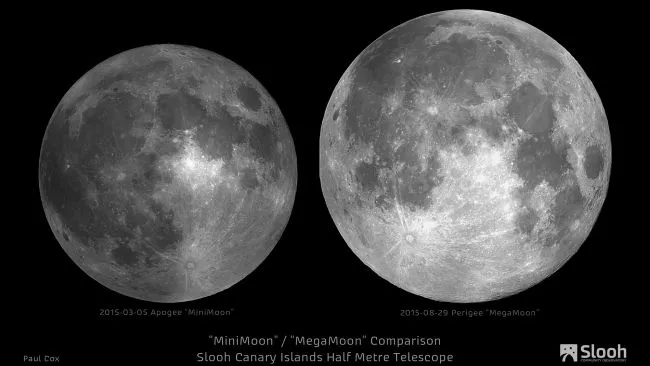
Here we see a comparison between the "minimoon" at apogee on March 5, 2015 and the "supermoon" at perigee on August 29 of the same year. The problem is that if we are going to compare apogee with perigee, it's something we can do every month, since they are two points in all lunar orbits. However, only a few times will those points coincide with full moons.
If we take the concept of "extreme perigee", used in Farmer's Almanac, the Moon should be at 356,425 km or less. "Between the years 1500 and 2500, this condition is found only 14 times, or on average, once every 71 years". There they also indicate that the last time the full moon was that close was on January 15, 1930 (at 356,425 km). The next time will be on December 6, 2052, at 356,420 km.
As if this weren't enough, there is the "Full Moon Illusion" by which the Moon appears much larger to us when it rises or sets on the horizon and we have some object in the distance to serve as a comparison, like trees or buildings. This happens even if the Moon is not at perigee.
If you want to know when there is a full moon and when, in each monthly orbit, perigee occurs, you can consult a good website, a perigee "calculator", indicated below.
When it is said that during a supermoon the satellite is seen up to 30% brighter and 14% larger, it is a true fact when considering the maximum possible approach, but it is not equally valid for every full moon at perigee, since in all cases the distance is variable, not always the same. The key is the word "up to".
In most cases, when the full moon coincides with perigee, the moon is barely perceived as 7% larger and 15% brighter than another full moon not at perigee.
It's like seeing the obelisk from 1000 meters away and then seeing it from 900 meters. On the second occasion we will see it slightly larger. Yes, it's true, but it's no big deal. There is no real justification for the super moon, unless we do the math. That is precisely what is not done. Truth is not in fashion. Now, fake news are published in the same way bread is produced. And the only reason is that people buy it.
SUPERMOON AS A DILUTER
In Farmer's Almanac they say that defining a supermoon as a full moon that coincides (more or less) with the monthly perigee or within 90% has the consequence that there will be three or four annual supermoons and that this dilutes the concept. Instead, they consider a single annual supermoon, as that full moon which has the annual perigee closest to Earth.
Let's think about this: If a person is born on January 1, 2000, then on January 1, 2020 they will have celebrated their 20th birthday. But, if they want, they can celebrate their birthday every day, since on January 2, 2020, 20 years will have passed since they were 1 day old. And on January 3 also 20 years since they were two days old, and so on. Does it make sense?
In a couple of weeks, in Argentina, May 25 will be celebrated. It is celebrated once a year, not every month.
NASA's idea of using the supermoon as an excuse for outreach is potentially good, but effectively bad. The word "syzygy" exists to refer to the alignment of three bodies, as happens in eclipses and which, therefore, can be applied to full moons. Of course, it's not as "attractive" a word as supermoon. The fact is, ultimately, supermoon is a marketing term.
On the JPL/NASA site, where it is explicitly stated that the supermoon can be an excuse for outreach, it is commented that many of the supermoon photographs are an inadequate representation of what is seen with the naked eye. It would be really very instructive if every time a supermoon is talked about, it was explained why it is NOT a supermoon. Which is exactly what does not happen.
On the other hand, observers know that it is preferable to observe the Moon in its quarters, to appreciate the "terminator," the line that separates the illuminated part from the part in shadow.
It also seems, from the way the supermoon is narrated, that it is a phenomenon that must be seen no matter what because it only happens once. Everything happens only once. It is the frequency of the unrepeatable. Paradoxically, that unique event repeats itself several times a year.
They say that even the most lucid ideas become stupid if repeated many times. The supermoon is a mass consumption product, a commodity produced on an industrial assembly line of nonsense to sell advertising. This product is promoted as if it were an offer, a discount: "+30% brightness free." They also tell us, as if they were banks, that the only way to get that saving is by buying.
"Now, 30% savings for a limited time. It's today or never," repeats the mantra on every occasion. A rehash, a remake, a meme. Then, reality is different from expectations. It's like the Madame Bovary syndrome or Bovarism. It's also Bobarism: a silly idea.
RELATIVE SIZE CALCULATION
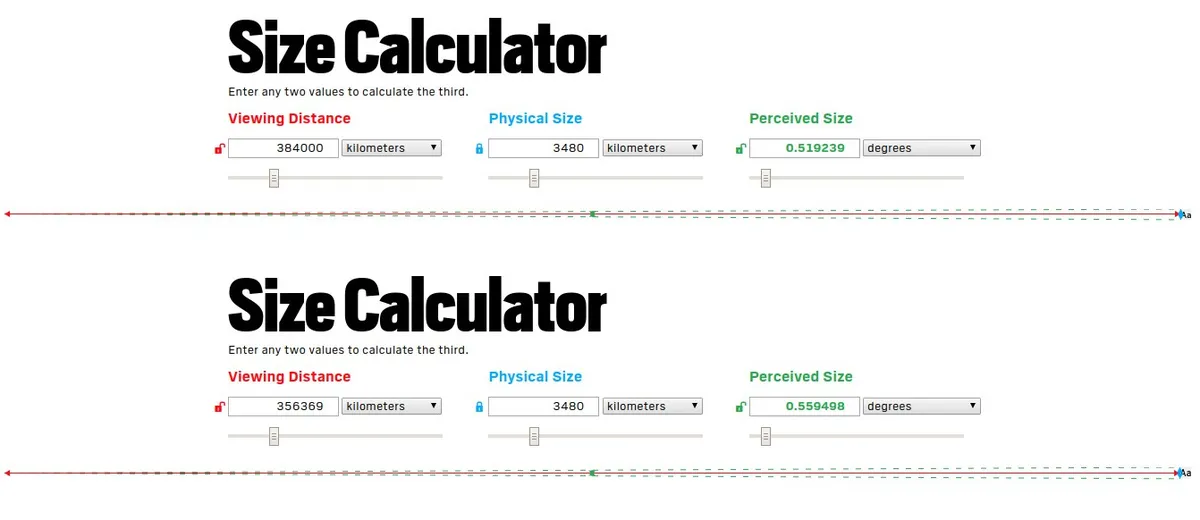
There is an online tool to calculate the angular size of an object of a certain size seen from a certain distance. We use it with the Moon:
At average distance -384,000 km-, the Moon whose diameter is 3480 km, is perceived with an angular size of 0.519239º (size A).
We change the distance at which the moon was on May 7 (not the 5th), that is, 361,200 km: 0.552015º.
At the distance of 356,369 km, the angular size will be 0.559498º (size B).
The difference between size A and B is 0.04º.
Let's do this with the obelisk. It measures 68 m in height.
If we observe it from 1000 m, its angular size will be 3.894613º.
If we observe it from 950 m, its angular size will be 4.099422º.
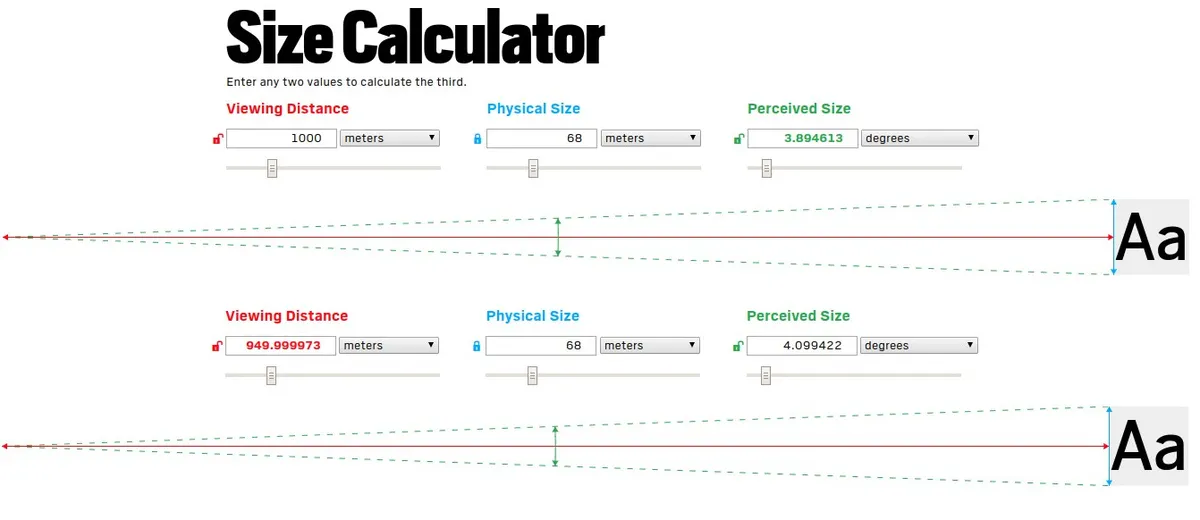
If this is enough to consider a super-obelisk, express your joy every time you are less than 10 blocks from the monument, tweet about it and notify the ghostwriter in online media, they will surely publish it as great unmissable news.
Size Calculator https://sizecalc.com
Sources and related links
Space.com: Will the 'Full Flower Supermoon' of May actually be 'super'? The experts disagree.
https://www.space.com/full-flower-moon-2020-supermoon-really-super-controversy.html
Space.com: 'Supermoon' Dazzles: Biggest Full Moon in 18 Years Amazes Skywatchers https://www.space.com/11179-supermoon-photos-full-moon-2011-skywatchers.html
NASA: The Next Full Moon Is a "Supermoon" Flower Moon https://solarsystem.nasa.gov/news/1220/the-next-full-moon-is-a-supermoon-flower-moon/
Space.com: The 'Supermoon' Syndrome Rises with February's Full Moon https://www.space.com/supermoon-syndrome-february-full-moon-2019.html
Farmer's Almanac: Why We’re Not Calling May’s Full Moon A Supermoon https://www.farmersalmanac.com/supermoon-11971
Lunar Perigee and Apogee Calculator https://www.fourmilab.ch/earthview/pacalc.html
NASA/JPL: What’s a Supermoon and Just How Super Is It?
https://www.jpl.nasa.gov/edu/news/2017/11/15/whats-a-supermoon-and-just-how-super-is-it/
About the images
Images from NASA/Goddard/Lunar Reconnaissance Orbiter and Slooh.com.