On trust or distrust in past discourse. Something about Pi Day and the 140th anniversary of Einstein's birth.
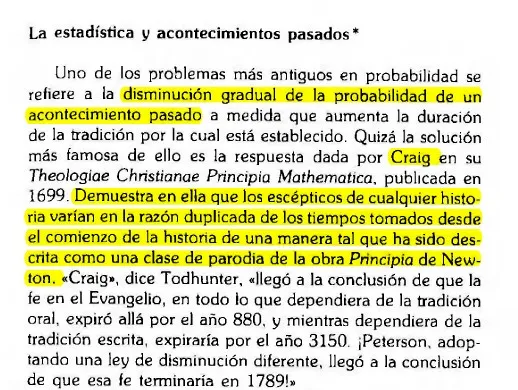
In the book Mathematics and the Imagination, by Edward Kasner & James Newman, it is stated under the title "Statistics and Past Events" (p. 259):
One of the oldest problems in probability concerns the gradual decrease in the probability of a past event, as the duration of the tradition by which it is established increases. Perhaps the most famous solution to this is the one proposed by Craig in his Theologiae Christianae Principia Mathematica, published in 1699. In it, he proves that the distrust of any history varies in the duplicate ratio of the times taken from the beginning of the history, in a way that has been described as a kind of parody of Newton's Principia.
Next to the title of this text is a footnote referring to "John Maynard Keynes, A treatise on probability (New York, Macmillan, 1921, Chap. XVI, 184.)" This text can be obtained, in English, from Project Gutenberg, in pdf format (as I indicate below). Despite that, I will continue with Kasner and Newman's version, in Spanish:
"Craig concluded that faith in the Gospel, insofar as it depended on oral tradition, would expire around the year 880 and while it depended on written tradition, it would expire around the year 3150. Peterson, adopting a different law of decrease, concluded that this faith would end in 1789!".
If A is true, it will be said by Carl Sagan or by anyone: the truth value of a statement does not depend on who says it, objectively.
What the text proposes as "the gradual decrease in the probability of a past event" is actually a calculation of the subjective level of confidence in past discourses, as if time had a truth value.
CRAIG'S INVERSE
If we examine social discourses, we will see that there are those who seem to think the opposite, that is, that the ancient is true, that in antiquity there was wisdom (which was later lost). Flat-Earthers, astrologers, and those who believe in ancestral "wisdoms" hold that position. Is it true? Some ideas have maintained their validity through the centuries, such as Plato's Allegory of the Cave or the medicinal use of some plants. But that validity cannot be extrapolated to everything else.
THE VALIDITY OF IDEAS OVER TIME: ANTI-ENTROPY
From an objective point of view, something similar to what Craig proposes occurs, if such an idea is not a closed system. That is, we could formulate it as an "anti-entropy." In contrast, in a closed system, an idea will not lose validity.
For the system to be closed means that we take it for granted that the idea is true and we will never test it, we will not collect data for that purpose, that is, the idea will not be contrasted with reality.
In contrast, in an open system, the idea will be contrasted with data from reality and, sooner or later, such data will not coincide with the original idea, so we will be forced to change the idea, even if only partially.
It could be formulated as follows:
The validity of such an idea or theory will be equal to the difference between the predicted data (d) and the collected data (dr):
(d1-dr1)+(d2-dr2)+...+(dn-drn)
It could be expressed as a sum of differentials: Σ = Δ1+Δ2+Δ3+...+Δn
If the difference in each case is null, the sum is zero.
That is why it could also be formulated as:
Validity Original Idea= 1-(Δ1+Δ2+Δ3+...+Δn)
If the result is 1, there will be no difference between the predicted and the observed and the idea remains. In any other case, there will be differences and it will be necessary to modify the original idea. The result can be expressed as a percentage. If it is 1, 100% validity.
Even if the variation is very small, over a long period of time, the collection of data slightly different from the original idea will change the idea notably. The longer the time, the more data, the greater the change.
This must be nuanced by several factors: in some cases ideas are virtually closed, not because one does not want to investigate, but because one cannot. For centuries it was not possible to contrast whether other galaxies existed, since there were no instruments to do so. Think of Giordano Bruno or Aristarchus of Samos.
On the other hand, scientific progress is not always linear, that is, with the collection of data we cannot ensure that things will always be known a little better: it is possible to take steps backward.
In contrast, in a closed system, the idea will remain valid, in our subjective perception, without objective contrast. If we formulate a question and answer it without investigation, we turn a hypothesis into a myth. For some, this is preferable, as an idea is chosen and never changed again. There are those who fear change and uncertainty. Reality. Everything that does not coincide with the idea is ignored, hidden under the rug.
ON "OFFICIAL SCIENCE" AND "REBEL SCIENCE"
It is useful to know that from 1930 to the mid-1960s, the scientific consensus in astronomy was based on the Steady State Theory, which postulated that the universe expands, but that matter is simultaneously created in proportional quantity, conserving density. As a consequence, in the past and present the temperature of the cosmos would be the same. That idea thus denied a hot and dense origin. The fortuitous discovery of the Cosmic Microwave Background (CMB) was data that did not coincide (a difference) with that "official consensus."
People sometimes take the side of "the weak," that is, against the strong. Perhaps that is why some view "official science" with suspicion. The logical thing is to take the side of the evidence. If current consensuses have problems (and they do), they will be resolved with more research, which also implies developing alternative theories.
On the other hand, the notion of "the weak" is misleading: are the weak the minority groups? Does the number of people have anything to do with the truth? Currently flat-Earthers are a minority, but before they were the majority. The truth value of ideas does not change according to the number of people for or against. That is subjective validity, not objective validity.
Therefore there are two models:
Either we choose to know how reality is objectively; or we choose to take the data from reality that suit us to force them to fit our preconceptions. The first is science, the second is myth.
PI DAY AND EINSTEIN'S BIRTH
Americans celebrate Pi Day today and since English has become an international language, it is also celebrated in other countries. That's because today's date, written in that language, is 3/14. But it is also an anniversary, the 140th, of Albert Einstein's birth. That is why I thought it appropriate to write a note that had to do with mathematics. And perhaps also with the "relative," which is not the same as the subjective. Percentages are relative values.
A few days ago, a post went viral on Twitter pointing out something very simple and practical:
x% of y is equal to y% of x. The BBC Mundo site wrote a note about it!
Is it true that you can calculate the percentage that way, is that equality valid?
Some will do some tests and will see that it works. But, is it possible to prove it?
Let's do a test and derive a general idea:
50% of 18 = 9.
18% of 50 = 9.
It works. Why?
Very simple:
To calculate 50% of 18 what we do is: 50*18/100.
To calculate 18% of 50 what we do is: 18*50/100.
In general:
x% of y= x*y/100.
y% of x= y*x/100.
The order of the factors does not change the product, therefore x*y/100 = y*x/100.
Now let's do an algebraic calculation, with the following data: today is day number 73 of the calendar.
What percentage of the year will have passed by the end of the day?
What we are asking is:
x% of 365 = 73
Earlier we said how to calculate the percentage, therefore:
x*365/100=73
what is x worth, as a percentage and as a fraction?
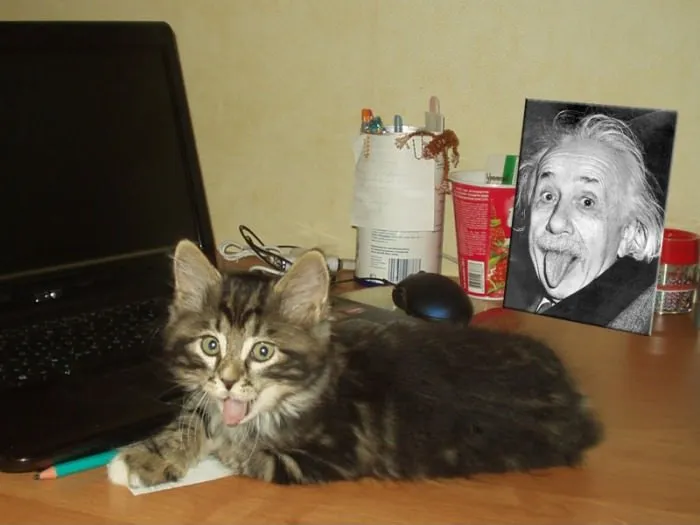
And, please, don't look for the cat's fifth leg!
Sources and related links
Mathematics and the Imagination, by Edward Kasner & James Newman,
Hyspamérica, Buenos Aires, 1985, in Colección Biblioteca Personal Jorge Luis Borges, with a prologue by the Argentine author
A TREATISE ON PROBABILITY (PDF)
https://www.gutenberg.org/files/32625/32625-pdf.pdf
A calculation of the credibility of human testimony https://royalsocietypublishing.org/doi/abs/10.1098/rstl.1699.0079
Theologiae Christianae Principia Mathematica
Joannis Craig
History and Theory
Vol. 4, Beiheft 4: Craig's Rules of Historical Evidence 1699 (1964), pp. 1-31 https://www.jstor.org/stable/2504310?origin=crossref&seq=1#page_scan_tab_contents
The mathematical trick to make calculations more easily that went viral (and that no one taught us in school)
https://www.bbc.com/mundo/noticias-47540941
About the images
ALBERT EINSTEIN'S CAT!
https://iwastesomuchtime.com/59086