Are they 100 crazy cats or is it a major phenomenon?
According to social semiosis, the network of shared discourses, flat-Eartherism is a phenomenon that is growing, but even so, it is limited in the number of people. Furthermore, it is said, those "100 crazies" base themselves on beliefs, so there is no way to make them change their minds, as they will never admit any evidence against them, because they don't care about evidence, but simply decided to believe.
As a consequence, there is nothing to be done and there is no need to respond because it is wasting gunpowder on a chimango.
This point of view has several problems, even if those two facts were true:
1. Those who (still) do not believe that the Earth is flat and immobile, are they sure that the world is quasi-spherical? If they are sure, what do they base it on? If they base it only on images, there is a problem, namely:
Images can be documentary proof of something, but if the only thing we are going to admit as evidence are images, then many scientific investigations would have to be abandoned, since not everything can be proven based on images. You cannot take a picture of the Big Bang. It is quite difficult to prove a murder with a photo or video of the exact moment the crime was committed. To prove that the square root of 2 is an irrational number, no photo or video is needed nor can be had.
2. If those who believe in a flat and immobile Earth cannot be convinced otherwise because they have the certainty of blind Faith, it is likely that there are also many people who for now have doubts. Those people will end up believing in a flat Earth if they cannot contrast that discourse with a better one. If we consider those people, who are not yet flat-Earthers, as "little crazies" or reproach them for doubting the "official discourse," they will feel persecuted and censored, pushing them towards flat-Eartherism. Saying nothing or responding badly is counterproductive. Over time, the "100 crazies" will become 300.
3. Even if flat-Earthers are few now, it is clear that magical and anti-scientific thinking nests there. That thinking is not a minority. The use of weak, fallacious, invalid arguments is commonplace in daily life and therefore is much more widespread. That is a symptom of a lack of scientific education and critical thinking. Critical thinking is not achieved by forcing one to think in a certain way, but the opposite, by inviting doubt about everything. However, doubt is only the beginning, not the end. And its goal is not to force reality to match our previous opinions, but to know what objective reality is like.
4. That this way of thinking is much more widespread is evidenced in the current Argentine political situation:
The "Notebooks Case" formed two sides: those who, based on those documents, believe that an investigation must be carried forward, and those who try to stop it. The latter say that nothing should be investigated because the notebooks are photocopies.
Although it is strange that the originals were destroyed, ultimately what matters is whether the statements in those notebooks are true or not. And that can only be known by conducting an investigation. Does it make sense to investigate? Yes, because what the notebooks say is plausible.
Are those who defend the "cause" people concerned with knowing the truth? No. This was evidenced by a counter-complaint in which a businessman said he was being extorted by a certain someone who, to carry out the maneuver, mentioned the prosecutor investigating the "Notebooks Case."
The person who carried out that maneuver is someone whom prominent journalists and politicians (who are in favor of investigating the notebooks) have presented as an "expert" in this or that thing. They are the same people who before showed great concern about knowing for sure whether this or that person were or were not lawyers. But now we learn that when they used (or were used by) this shady character, they did not care at all whether he was or was not an agent. It is not clear if he is James Bond or Johnny English. There are three possibilities: those journalists and politicians are naive; or they are accomplices; or what is more plausible: they did not care whether he was or was not this or that: the end justifies the means. They have an objective and any resource is valid. They do not care about the truth.
The notebooks prosecutor had a relationship with this shady individual. Doesn't that warrant investigating it? According to those who defend the first cause, this should not be investigated because "it's an operation." Which is the same argument used by those who oppose investigating the notebooks.
Flat-Earthers deny the reality that does not fit their ideas under the argument that there is a conspiracy against them. Operation or conspiracy or campaign are not very different concepts.
There are more flat-Earthers than it seems. Those who are on one side and the other of "the notebooks" are part of the same set: they force the data of reality to match their group interests.
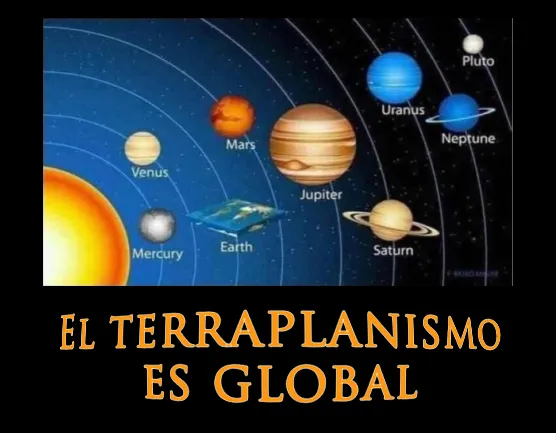
The shape of the planet could be known long before space travel and photography, since Eratosthenes. Flat-Earthers maintain that the other planets are indeed spherical and in motion, except ours, flat and immobile, as if it were a special place.
It is enough to use a small telescope and observe some of the visible planets, such as Mars, Venus, Jupiter and Saturn, to see with our own eyes that they are quasi-spherical, particularly Jupiter which, because it has the Great Spot, with systematic observation we will realize that it changes position, that is, it rotates.
We can also prove that objects of a certain mass, in rotation, tend to be spherical and we can demonstrate it empirically. We can also appeal to the "Foucault Pendulum."
In fact, the change in the definition of planet in 2006 was due to the fact that asteroids had been considered minor bodies (in size and mass) and therefore did not have a quasi-spherical shape. But several exceptions had been found. Therefore, the definition of planet linked to an object that orbits the Sun and was spherical proved unsatisfactory, since some asteroids also had those two characteristics.
It is worth reflecting, to conclude, that it is easy to get angry with flat-Earthers under the argument that they deceive. But there will be many 'convinced' ones or some who are halfway there. Getting angry is human (it happens to me), but counterproductive. We must explain, show the weakness of others' arguments and not be afraid of debate. Perhaps social media is not the best vehicle for that in 280 characters.
It is evidently necessary to promote scientific knowledge and critical thinking throughout society. They are not useful tools only for scientists, but are necessary in daily life. Therefore, scientific knowledge and critical thinking must be part of the entire educational system: from primary school to university. This knowledge is also required for journalists and politicians. It is necessary to show this vital lack in a modern society that uses smartphones, but rejects science and justifies anti-scientific ideas or budget cuts to education and research.
About the images
Illustration published by Micah Brening on G+ Science (on blog Pablo Della Paolera, https://paolera.wordpress.com/2018/04/20/el-sistema-solar-segun-los-terraplanistas/)