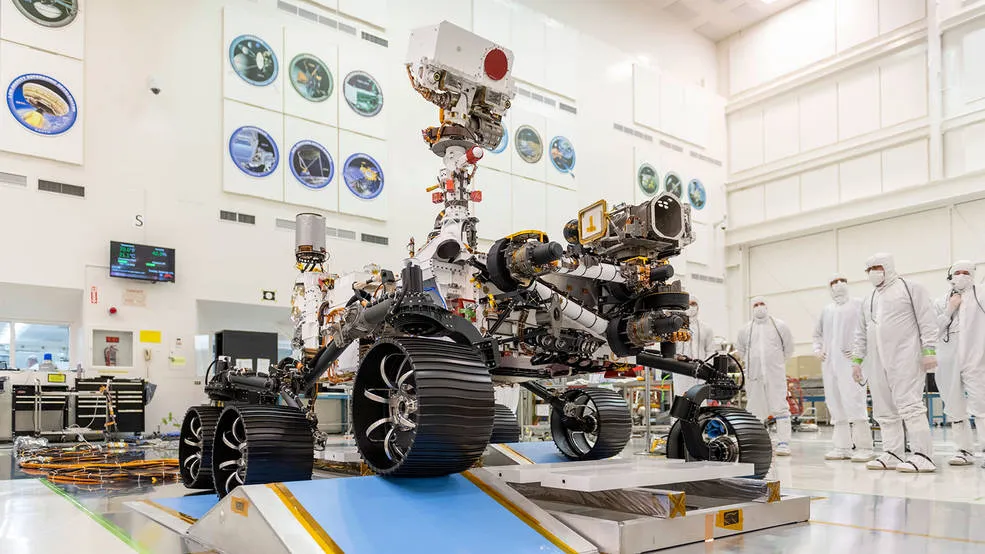
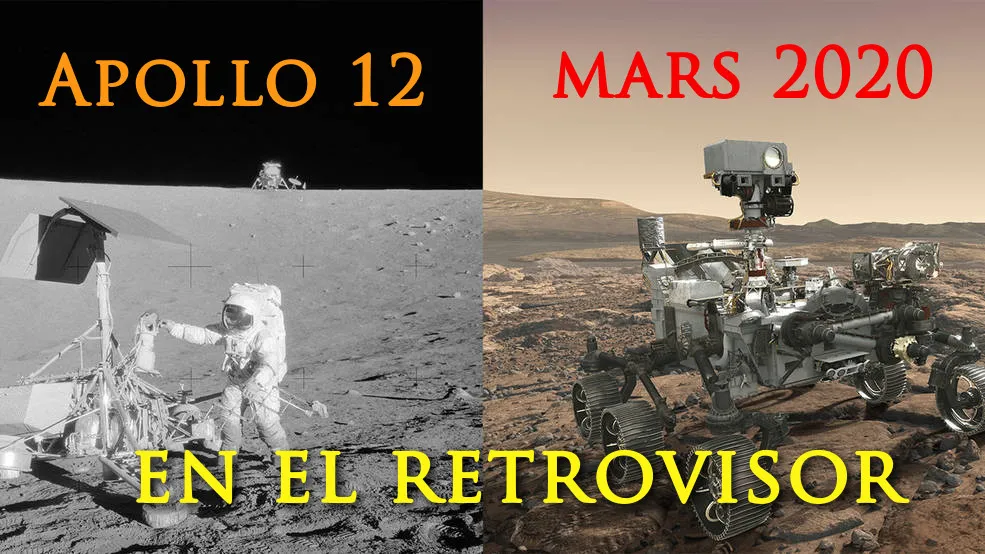
As NASA prepares to send another rover to Mars next year, the agency looks in the rearview mirror at the Apollo 12 mission on its 50th anniversary.
"We members of Mars 2020 feel a special connection with the Apollo 12 crew", said John McNamee, Mars 2020 project manager at JPL. "They achieved the first precision landing, deployed the most advanced set of scientific instruments of the time, and were the first to interact with another spacecraft that arrived at another world. All of that will be part of Mars 2020 as well", he added.
So the Apollo 12 mission can serve as a rearview mirror for the next mission to Mars in at least those three aspects.
THE DESCENT
Let's review: NASA needed the Apollo 12 mission to have a precise lunar landing because the following missions had planned locations in highlands, where mountains, craters and rock fields could ruin everything if the lunar modules deviated from the planned path. And although the first mission had been successful, the landing was 6 kilometers from the chosen site, the Sea of Tranquility.
To test a more precise descent they could have chosen many places, but they finally selected a crater in the Ocean of Storms because the Jet Propulsion Laboratory (JPL) had managed to locate another spacecraft there, two and a half years earlier.
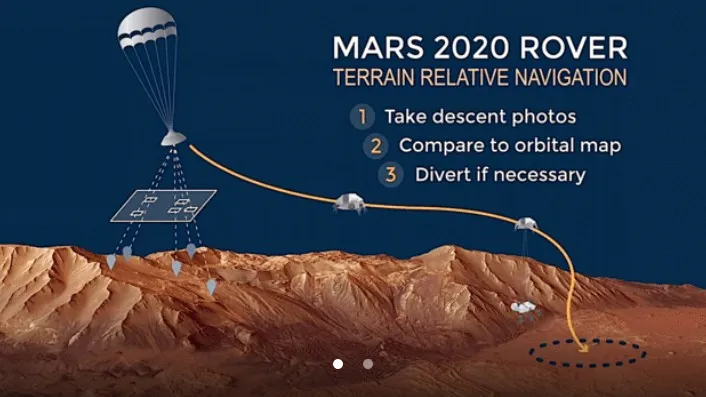
"When Pete and Al managed to set the lunar module Intrepid 160 meters from the Surveyor 3 spacecraft, they gave NASA the confidence to later send Apollo 15 to Hadley Rille, Apollo 16 to the Descartes Highlands and Apollo 17 to Taurus Littrow", recalled McNamee. "We also must be precise with the descent on Mars -not only to pave the way for future missions- but because the landing location of Mars 2020 in Jezero Crater has all kinds of cliffs, dunes and rocks that could negatively affect us", he explained.
Mars 2020 will be the first planetary mission to include terrain relative navigation, a computerized autopilot that uses images analyzed by computer to help avoid hazards and make the descent more precise.
THE INSTRUMENTS
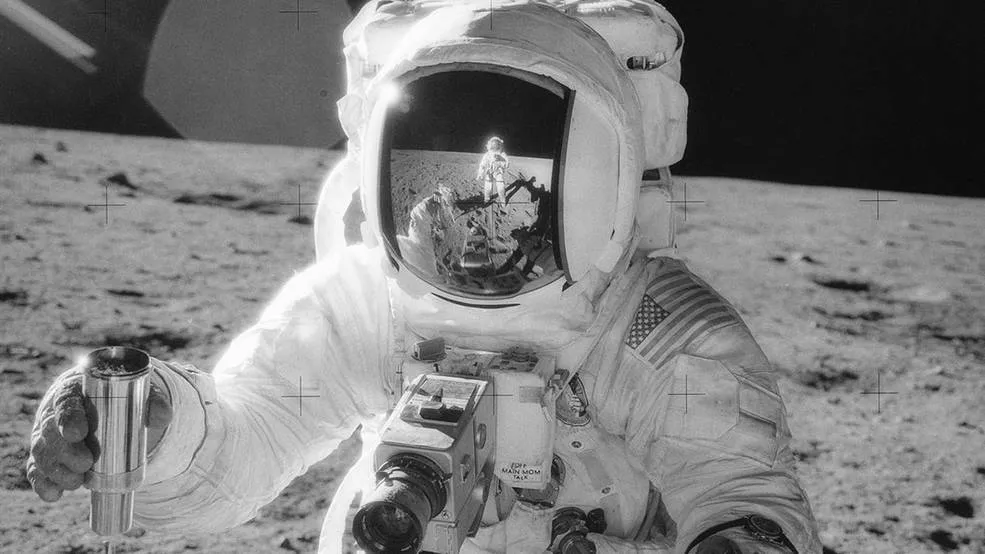
Another similarity between Mars 2020 and the second Apollo commanded by Charles "Pete" Conrad and Alan Bean in November 1969, 50 years ago, will be the scientific equipment.
During their first moonwalk, Conrad and Bean deployed the ALSEP experiment package, which contained a radioisotope thermoelectric generator and the five science instruments (to measure moonquakes, atmosphere, solar wind, dust collector and magnetic field sensor) that were the most advanced of their time. When Mars 2020 arrives at the fourth planet it will also be equipped with the current state-of-the-art instruments.
"The science instruments we carry benefit not only from advances in technologies, but also from the hard lessons learned from those exploration missions, including the Apollos, that preceded us", said Ken Farley, a Caltech scientist on the Martian project. And he added: "Our seven advanced tools will help us acquire the greatest possible information about Martian geology, atmosphere, environmental conditions and potential biological signs".
RETURN TO SENDER
During the second spacewalk, the astronauts reached the Surveyor 3 spacecraft, one of the robotic missions that explored the Moon before humans. They not only collected images and samples of the surface, but also cut parts from the three-legged spacecraft, including the TV camera.
"NASA wanted to see what happened to materials that were exposed to the lunar environment for an extended period. To date, the Surveyor 3 samples, which lasted 31 months in the Ocean of Storms, are our best demonstration of the natural processes that can affect the components of spacecraft left on the Moon", explained McNamee.
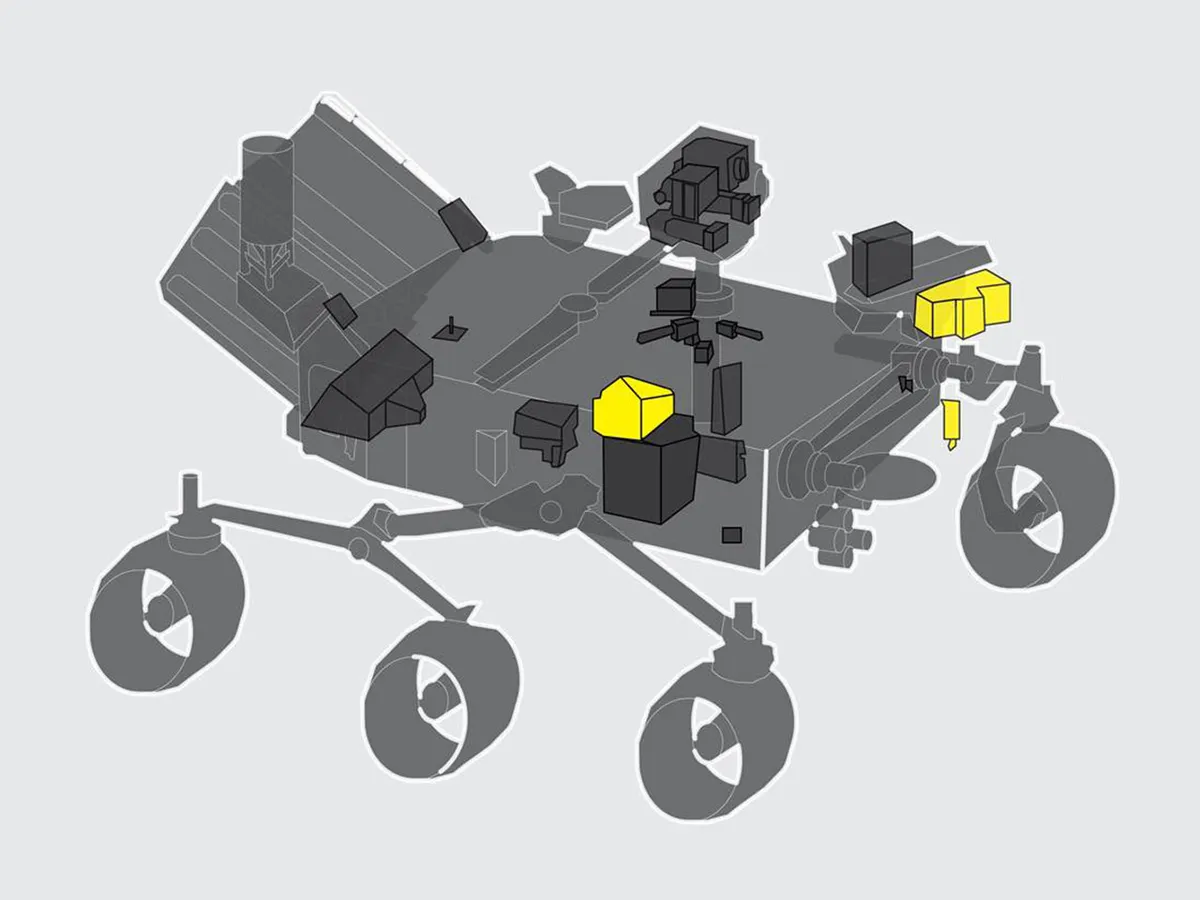
One of the missions of Mars 2020 is to search for signs of past microscopic life. Later missions, still under consideration, would bring those samples to Earth for analysis. To help engineers design spacesuits that protect astronauts, NASA is sending five samples of suit material, along with the SHERLOC instrument (Scanning Habitable Environments with Raman & Luminescence for Organics & Chemicals).
A piece of helmet and four types of fabric are mounted on the instrument. Scientists will use SHERLOC, as well as a visible light camera, to study how the materials degrade from ultraviolet radiation.
Just as the Surveyor missions helped the following Apollo missions, the Mars 2020 project will be of help to the next Martian missions.
"Isaac Newton once wrote: 'If I have seen further it is by standing on the shoulders of Giants'. When Mars 2020 flies, it will allow us to see further into the geological history of the Red Planet and that will be because we are also standing on the shoulders of giants, giants like the Apollo 12 crew", commented McNamee.
The launch period for Mars 2020 opens on July 17, 2020. If all goes well, the spacecraft will land in Jezero Crater on February 18, 2021.
THE APOLLO 12 COMIC
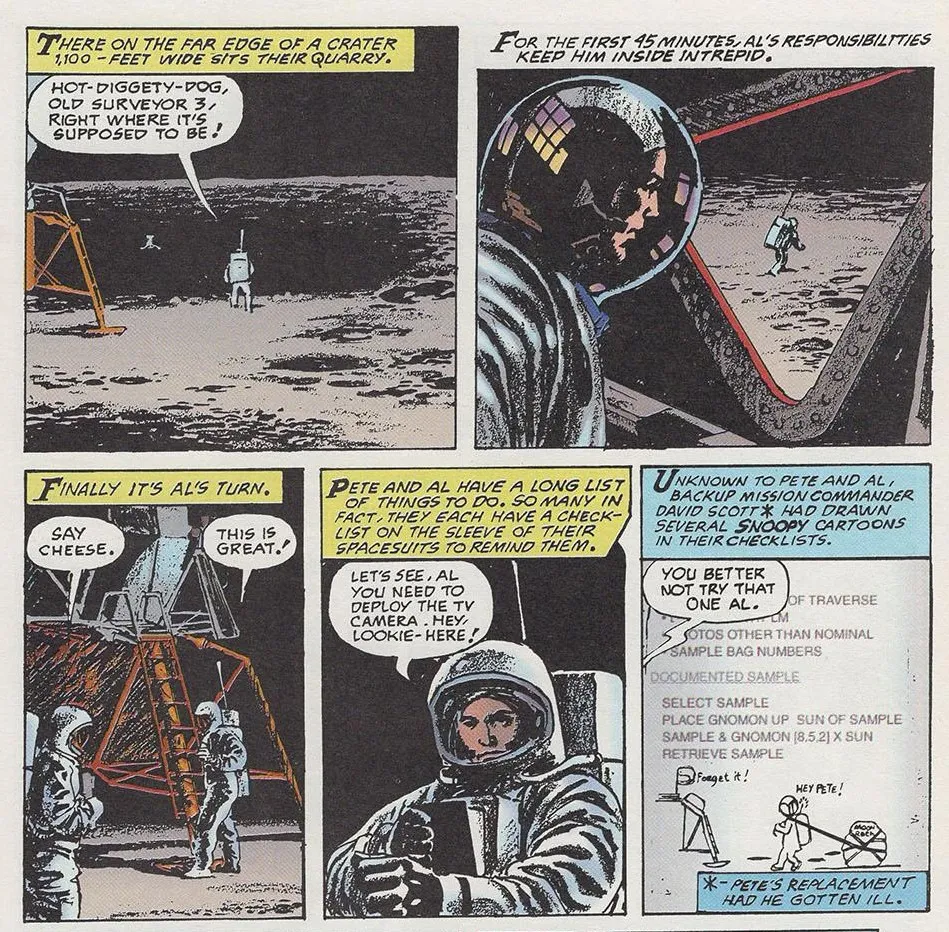
To celebrate the 50th anniversary of the Apollo missions, NASA published a series of images and other materials, including a comic about that second crewed mission to the Moon, which can be downloaded as a pdf file. It's in English.
NASA download site: https://www.nasa.gov/specials/apollo50th/media.html
Sources and related links
- Two of a Space Kind: Apollo 12 and Mars 2020
https://www.nasa.gov/feature/jpl/two-of-a-space-kind-apollo-12-and-mars-2020 - A Neil Armstrong for Mars: Landing the Mars 2020 Rover
https://www.jpl.nasa.gov/news/news.php?feature=7442 - SHERLOC
https://mars.nasa.gov/mars2020/mission/instruments/sherloc/
About the images
Opening image: On the left, Charles Conrad next to the Surveyor 3 spacecraft; the lunar module Intrepid can be seen in the distance. On the right, an illustration of the Mars 2020 rover. Credit: NASA/JPL-Caltech
Images 2 and 4: NASA/JPL-Caltech
Image 3: NASA
Comic Image: NASA/PPG