A review of the conflict between indigenous people and astronomers.
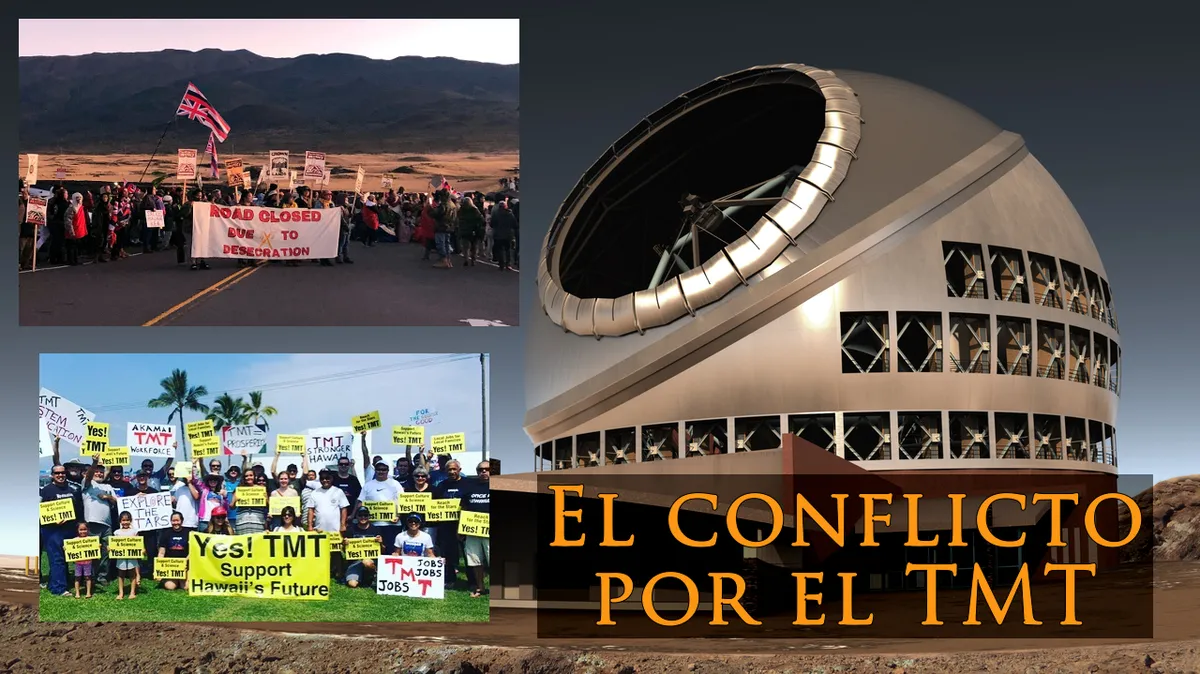
Although the object of study of astronomy is inert objects, not people, in several ways astronomy is also a social science. First, because, like all science, it is carried out by people. And second, because although unlike other sciences, astronomy does not have many social consequences, it does have some. Among them, the cultural clash between modern astronomers and the installation of observatories in localities where indigenous communities live, places that these communities also consider "sacred".
It is worth saying that, at present, the "large visual observatories" (not radio), are about 8 meters in diameter. To give us an idea of these numbers:
A telescope can be a reflector (with mirrors), a refractor (with lenses) or hybrid. Large observatories are usually hybrid, but they can be more easily understood as if they were Newtonian, with a concave parabolic primary mirror and a flat secondary mirror.
There are some factors to consider about telescopes such as diameter or focal length, but we are going to focus on the diameter of the primary mirror to simplify with the phrase "the bigger, the better". Today, with various techniques, it is possible to think somewhat differently, but even today, this simplified idea works.
And to give greater context, it is worth remembering that almost a century ago, the U.S. inaugurated a 100-inch (2.54m) telescope that was, at that time, the largest in the world and with which Edwin Hubble made the great discoveries, the kickstart of modern cosmology.
Argentina never had a telescope as large as that and still does not have one, a hundred years later. That is to say that today, a 2.5-meter observatory is still useful, but developed countries already have telescopes three times larger.
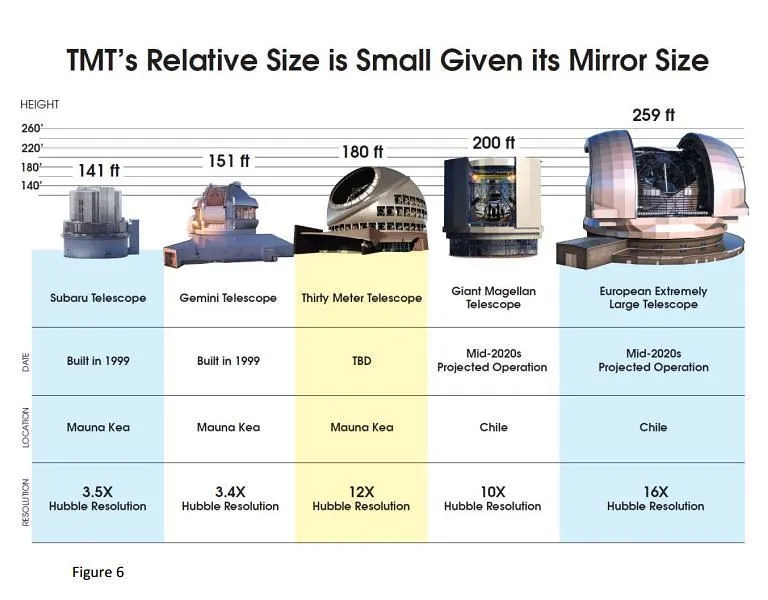
In that context, the U.S. takes another step further in seeking to build a 30-meter diameter beast. There are two other projects of similar magnitude, such as the GMT and E-ELT, both in Chile.
Astronomers say the relative size, in height, of the TMT is small, compared to other large observatories. The Giant Magellan Telescope (24.5m) and the E-ELT (39m) will be taller.
A larger primary mirror implies more light collected, fainter and more distant objects detected, further back in time the object or process that emitted the light. The past is big. Very big. Going from 8-meter telescopes to a 30-meter one is an impressive quantitative and qualitative leap. But scientific progress finds its limits in social interaction. Whatever our position, we cannot ignore the facts that have been occurring.
The excellent site Astrobites.org and its Spanish counterpart, Astrobitos.org, have reviewed the history of interactions between astronomers and indigenous communities in Hawaii and also in Chile.
Here, a historical review and of recent events, although I recommend reading the works published (in English or Spanish) on the sites I just mentioned.
Background
In October 2018, the Supreme Court of Hawaii ruled in favor of the construction of the TMT (Thirty Meter Telescope). The matter had begun in 2009 with the announcement of the construction, and opposition was immediate. After a long judicial process, that Court ruling was obtained.
There had already been tension with locals when NASA planned an interferometer to link the telescopes of the Keck Observatory.
It's that the "white mountain" as "Mauna Kea" is sometimes translated, has great value for astronomical observation. The dormant snowy volcanic peak rises 4200 meters from the Pacific Ocean.
But for locals, it is a sacred place, "the realm of the gods".
However, whose land is it?
HAWAII AND THE U.S.
The islands were a sovereign state until 1893 and annexed as a U.S. territory until 1959 when it was voted to become a new U.S. state. Since its annexation, lands that were not private became public and are known as ceded lands. One part went to the National State and the rest to the Hawaiian state.
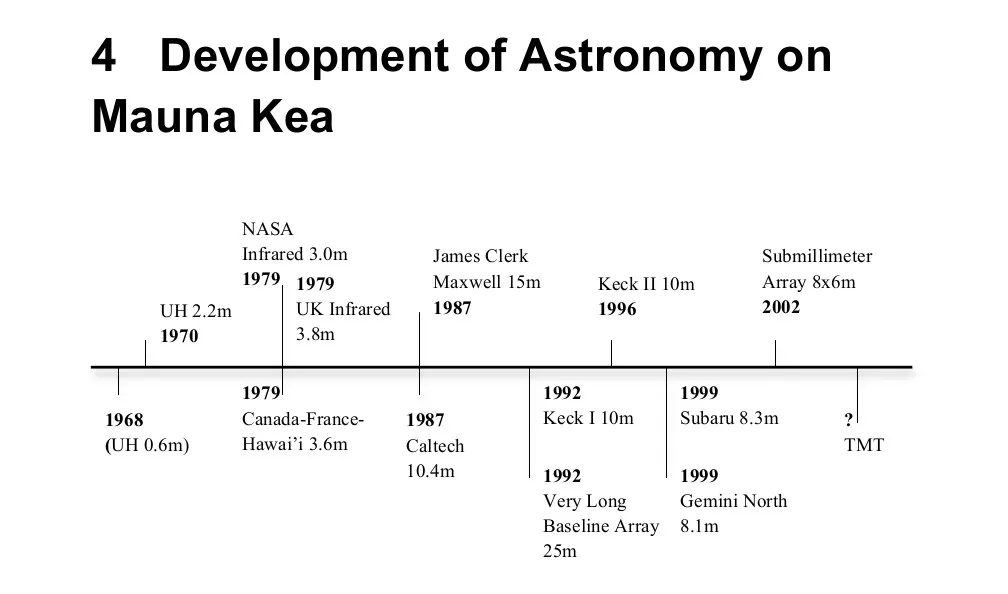
In 1968 the Board of Land and Natural Resources (BLNR) leased a portion of state lands to the University of Hawaii for 65 years, until 2033, and allowed the university the use of all lands on Mauna Kea above 12,000 feet (3600 meters).
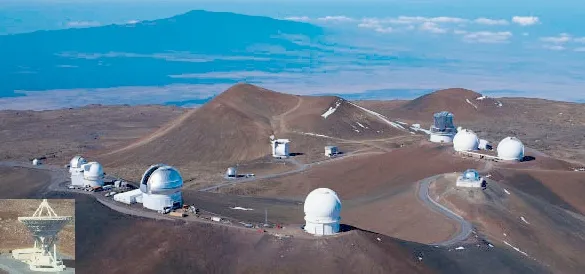
Since the late 1960s, telescopes began to be installed there. There are 13 telescopes currently, although some will have to close for the TMT to be built. It was not the only site considered, as other parts of the world were taken into account, such as the Canary Islands.
The TMT will be the first observatory to pay rent to be on the mountain: USD 1 million per year.
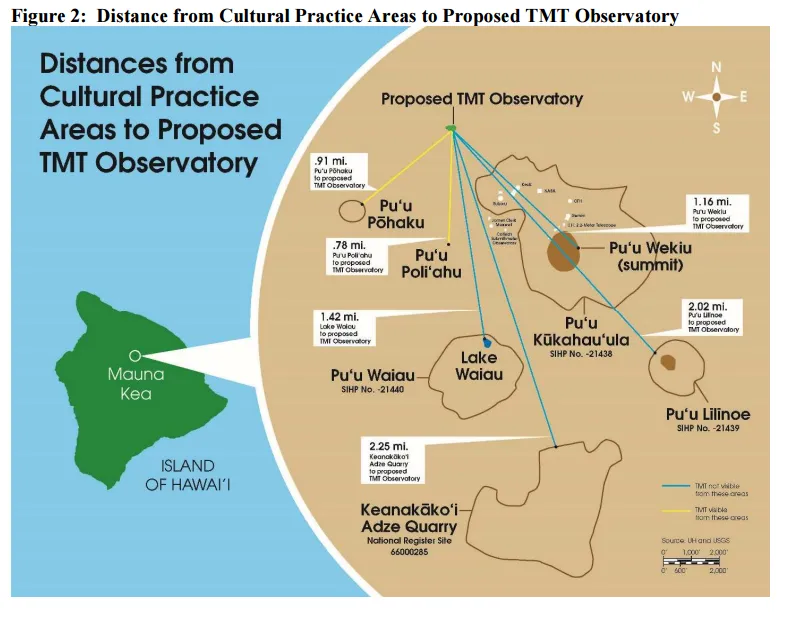
Opponents of the TMT construction have blocked roads for their claim and some have been jailed. They object not only to the violation of a site they consider sacred, but also to the alleged environmental impact, which the site managers dismiss. Regarding altars and other areas considered "sacred" by the local community, the managers say the construction will be done in an area away from those.
Open letter from the Observatories
In July of this year, the directors of the Telescopes on the mountain signed an open letter.
The signatories are:
Doug Simons, Canada-France-Hawaii Telescope; Pierre Martin, Hoku Kea Observatory; Jennifer Lotz, Gemini Observatory; Paul Ho, James Clerk Maxwell Telescope (East Asian Observatory); Director Robert McLaren, Institute for Astronomy; John Rayner, NASA Infrared Telescope Facility; Michitoshi Yoshida, Subaru Telescope; Klaus Hodapp, UKIRT; Hilton Lewis, W.M. Keck Observatory (Keck I and Keck II).
I provide a translation of the letter below:
Aloha to our scientific colleagues around the world.
On behalf of the more than 500 people employed by the Maunakea Observatories, we offer a perspective on the situation with the sincere hope that our words will foster greater understanding of the complex circumstances in which we find ourselves.Members of the staff of the Observatories, many of whom are born and raised in Hawaiʻi, feel a deep personal connection to the people and places of our home in the Hawaiian Islands. We work and live together in a community where our success is measured by the quality of our relationships, one of the supreme reasons why life here is enriching, rewarding, and inspiring. Even in conflict, our differences do not define us; our humble, reverent appreciation of our community does. The diverse mix of scientists, technicians, engineers, administrators, and students of the Maunakea Observatories continually seeks a path forward that strengthens the future of our island community. Our local staff, family, and friends have a wide range of views and strong feelings about the events surrounding us. We deeply respect all points of view, which come from our family and friends, and we believe in and defend their right to express them.
In our community we are resisting the pain of wounds in these carefully tended relationships that will take a long time and mutual respect to heal. We know that the challenges across our island home have gained attention from our peers in the international astronomical community. We understand their expressed concerns. We also ask for their appreciation of the nuances and complexity of the issues we face now.
The future of astronomy on Maunakea will be defined primarily by the diverse population of Hawaiʻi. The majority of residents support the Observatories, which have been part of this community for more than 50 years. The conflict over the TMT does not change the long-standing support our Observatories have earned, but it will undoubtedly influence their future. For the benefit of the people who work on the mountain, for those who practice their culture and religion on the mountain, we seek a future beyond coexistence because that still implies barriers. We look to a future where knowledge and worldviews combine to create a more beautiful and resilient reality than their progenitors.
This is already beginning, through A Hua He Inoa, the interstellar asteroid 'Oumuamua, the black hole Pōwehi and the unusual asteroids recently officially named Kamo‘oalewa and Ka‘epaoka‘awela by Hawaiian students. We seek a future for Maunakea where studies of the universe are driven by the wisdom of Hawaiian kupuna and founded on the cultural richness of Hawaii. We are nurturing this future now as devoted members of the Island and the international astronomical community. We ask for the informed understanding and support of the international community to defend this vision, which we believe will be an important part of everyone's future.
Mahalo, [List of signatories].
Language clarifications:
A Hua He Inoa: is a program to use the Hawaiian language (‘olelo Hawaii) to name astronomical objects.
Kupuna: wisdom of the elders.
Aloha: Hello.
Mahalo: Thank you.
CONCLUSION
It is evident that beyond the court rulings and protests, such as the roadblock to an observatory's access, there is a social tension between locals and those seen as "outsiders." The tension is also internal, since among the locals there are those who support modern astronomy and those who do not. At its core, it is the same old problem: land ownership. In any case, physical aggression against scientists or against protesters is unacceptable.
Scientific progress cannot be based on stepping on heads. Even if it takes time, we must seek Solomonic solutions.
The environmental impact has already been reduced through a smaller construction in size compared to other observatories of similar size; energy use was minimized using solar panels; water and waste management will be carried out.
And the social impact will be significant due to economic mobilization, local education, and scientific results. It is enough to think that the Hubble Space Telescope, with its 2.4 m diameter, will leave an impressive scientific and social legacy; how many wonders can be discovered with a 30-meter beast?
Sources and related links
- A Hua He Inoa
https://imiloahawaii.org/news/a-hua-he-inoa-8e3ax - A Hua He Inoa
https://www.hawaiitribune-herald.com/2019/03/14/community/a-hua-he-inoa/ - Astrobitos
Maunakea, Western astronomy and Hawai’i
https://astrobitos.org/2019/08/16/maunakea-la-astronomia-occidental-y-hawaii/ - Aloha to our scientific colleagues around the world
https://maunakeaobservatories.org/aloha-to-scientific-colleagues/ - State Supreme Court rules in favor of Thirty Meter Telescope’s construction
https://www.hawaiinewsnow.com/2018/10/30/state-supreme-court-rules-favor-thirty-meter-telescopes-construction/ - Understanding the Past, Navigating the Present, Embracing the Future
http://www.maunakeaandtmt.org/understanding-the-past-navigating-the-present-embracing-the-future/ - Astrobites: Mauna Kea and Modern Astronomy, Tarini Konchady
https://astrobites.org/2018/11/09/mauna-kea-and-modern-astronomy/ - Maunakea, Western Astronomy, and Hawai`i, by Ellis Avallone
https://astrobites.org/2019/08/02/maunakea-western-astronomy-and-hawaii/ - MAUNAKEA TIMELINE
http://www.maunakeaandtmt.org/wp-content/uploads/2019/07/TMT.Timeline.2019.pdf - Hawaiian Elders Protesting Telescope Construction Are Arrested
https://www.nytimes.com/2019/07/17/science/mauna-kea-protest.html - Hawai'i's Thirty Meter Telescope: Construction of the World's Largest Telescope on a Sacred Temple, by Herhold, Abby Starr
https://www.duo.uio.no/handle/10852/49032 - TMT
https://www.tmt.org/image/159
About the images
Initial image with photos by Caleb Jones/Associated Press/NYTimes; TMT.org; maunakeaandtmt.org.
Image 2: Size comparison: maunakeaandtmt.org.
Image 3: Observatories on Mauna Kea: Institute for Astronomy, University of Hawaii/Astrobites.org
Image 4: Herhold, Abby Starr.