New measurement of the proton radius published in Science.
In 2010, a group of physicists from Germany (Max Planck Institute) led by Randolf Pohl conducted an experiment that concluded the proton was smaller than previously thought, 4% smaller (0.84 femtometers). But what made noise in the scientific community was that the experiment was not done with a conventional hydrogen atom, those with a proton and an electron, but with an atom that had a muon orbiting the nucleus. Muons are particles like electrons, but much heavier. The additional conclusion was that perhaps protons shrink in the presence of muons. This was called "the proton size puzzle".
Now a new work has been published, carried out by physicists from York University in Toronto, which yields a similar result (0.833 femtometers, +/- 0.01), but was done in the traditional way, that is, with an electronic hydrogen atom, with an electron and not a muon.
The result is important because it would rule out the possibility of the proton changing size, although the mystery remains of why measurements up to 2010 gave values above that (0.88).
Unit of measurement
1 femtometer (fm) = 0.000 000 000 000 001 meter
1 fm = 10−15 m
The femtometer is also called a Fermi.
Measuring a proton
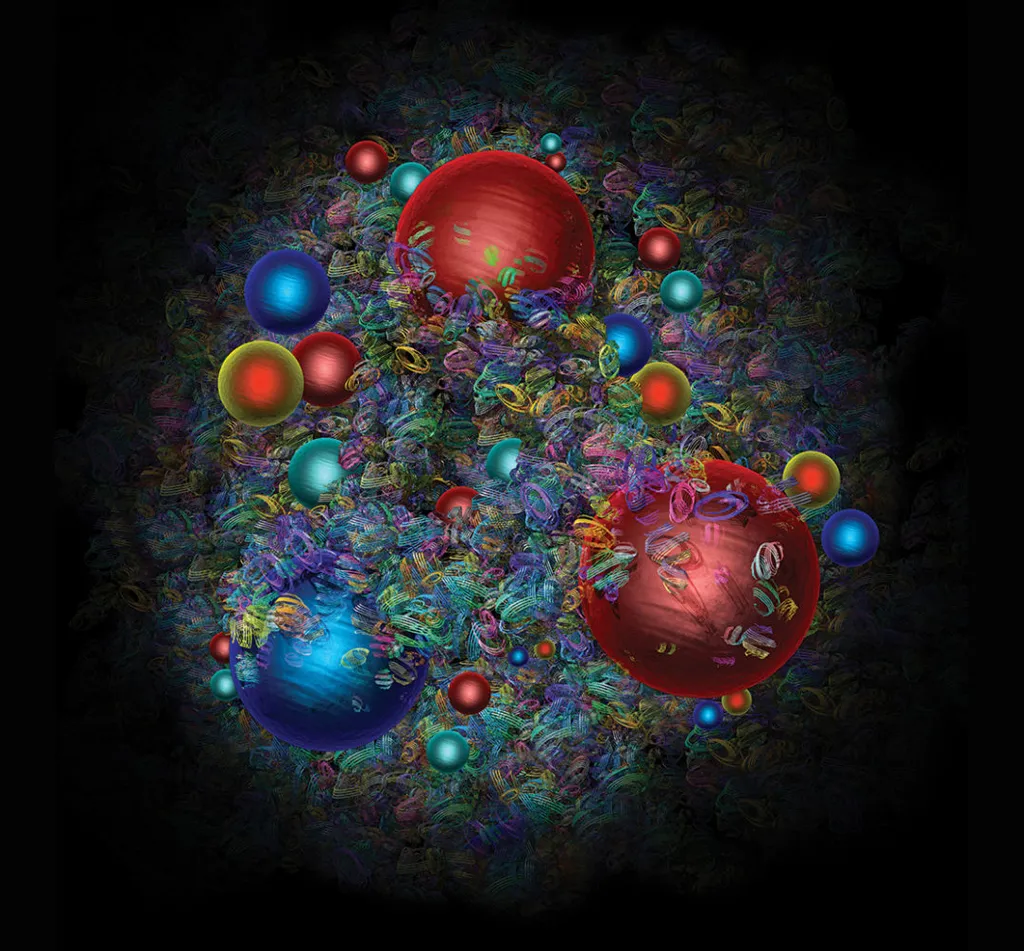
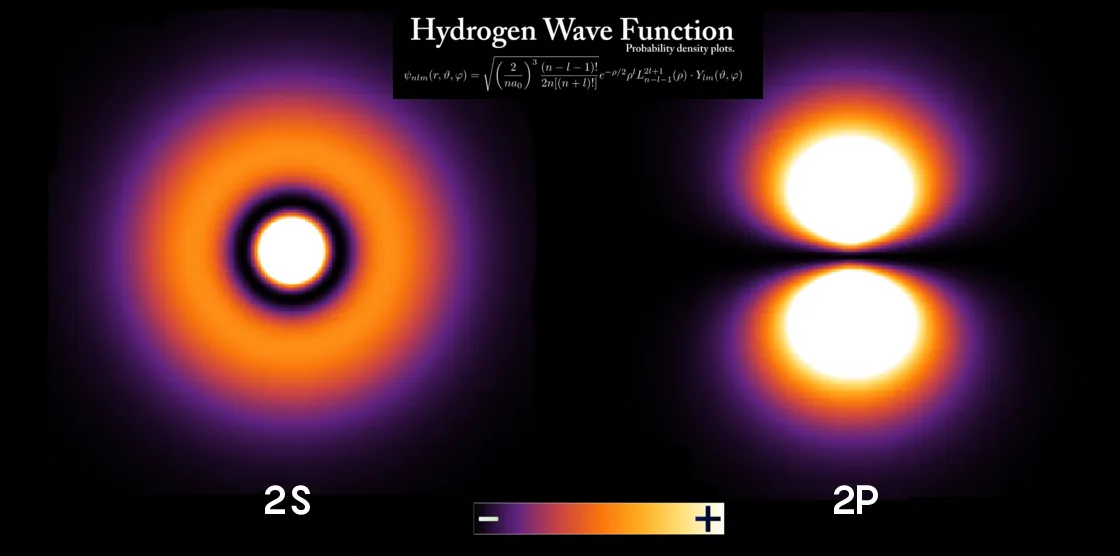
A proton is a particle composed of others, quarks and gluons, and is not like a little ping-pong ball. Measuring its size, through its radius, is not an easy task. The "Lamb Shift" is used, which is the difference between the hydrogen energy levels called 2S and 2P. This energy shift is named after physicist Willis Lamb, who attempted to measure it in 1947, and works like this:
When an electron orbits the proton in the 2S state, it spends part of its time inside the proton. At those moments, the proton's charge pulls on the electron in the opposite direction, partially canceling out. As a result, the amount of electrical attraction between the two decreases, reducing the energy that binds the atom. The larger the proton, the more time the electron will spend inside it, the weaker the electron's bond and the more easily it can escape to another state.
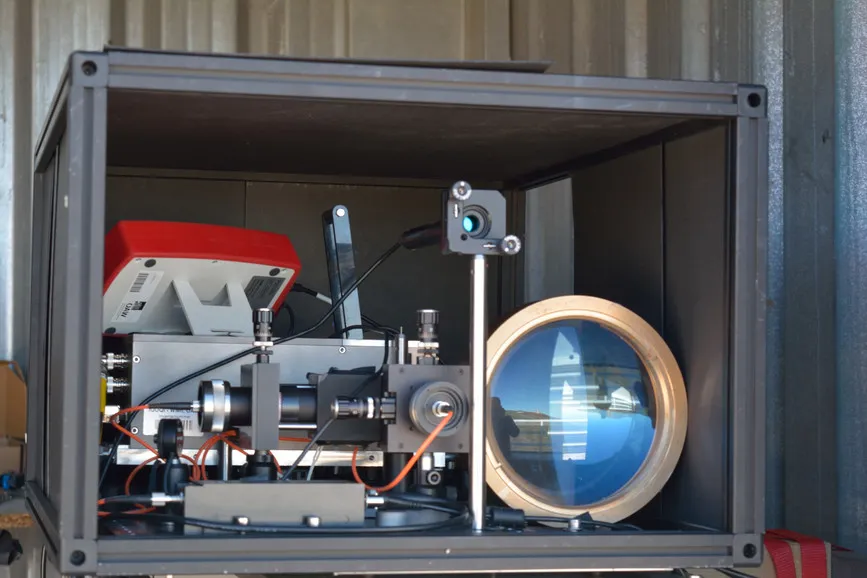
By firing a laser at a cloud of hydrogen gas, Eric Hessels and his colleagues caused electrons to jump from the 2S state to the 2P state, where the electron never overlaps with the proton. Deducing the energy required to make that jump reveals how weak the previous bond was, from partially residing in the proton. And that allows inferring the proton's radius.
In 2010, Pohl followed the same logic, but because muons are more massive, they crowd around protons more tightly in the 2S state than electrons do, so they spend more time overlapping, making the Lamb shift in muonic hydrogen millions of times more sensitive to the proton radius than in regular hydrogen.
In the June issue of the CERN magazine, Mark Rayner reported different results on the proton radius and announced that a new work by Eric Hessels was about to be published. In that report (which was part of a larger article), it was also noted that in 2017 Axel Beyer and colleagues from Max Planck had published a result of 0.8335 fm from observations of the 2S-4P transition in ordinary (non-muonic) hydrogen.
However, these results are obtained with spectroscopic analyses, while other experiments use the "scattering" technique. It is assumed that scattering experiments gave a larger result because they were not precise enough. Preliminary data from the Proton Radius Experiment (pRad), which uses scattering, in 2018 indicated a radius of 0.83fm. With more measurements along the same lines, the change in proton size would be ruled out, which leaves physicists with a bitter taste, as it was more than interesting to think that the proton modified its radius depending on the particle orbiting it.
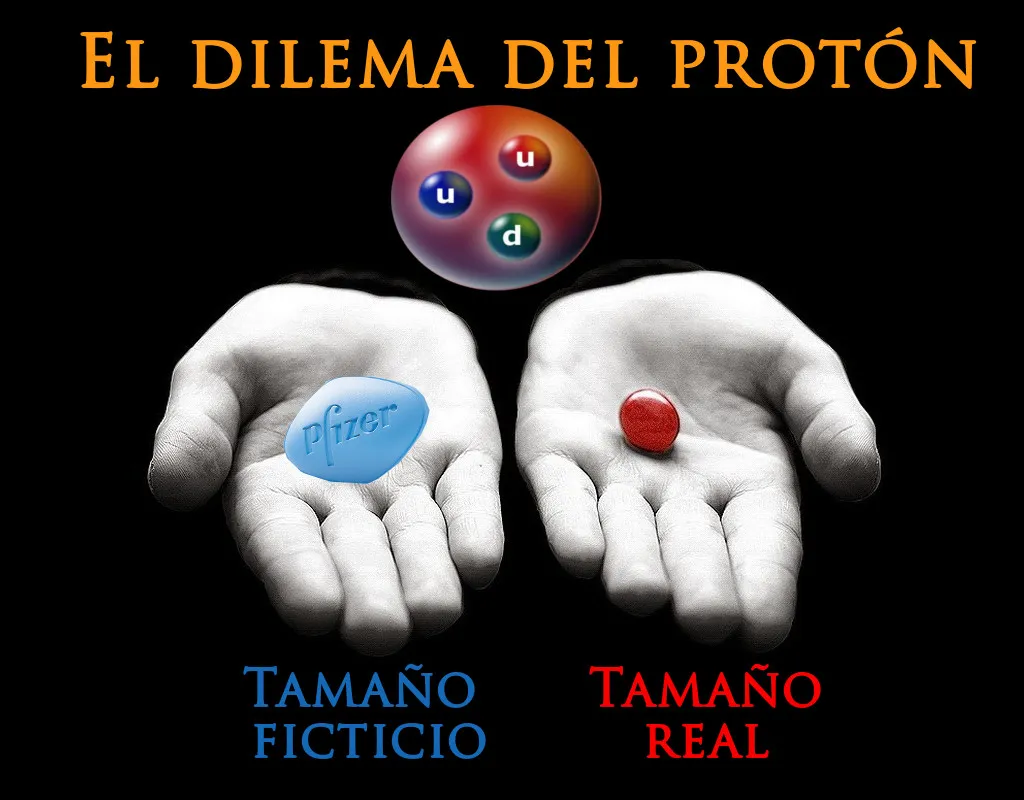
As it seems so far, the proton does not take the blue pill, but the red one.
Sources and related links
- Physicists Finally Nail the Proton’s Size, and Hope Dies, by Natalie Wolchover
https://www.quantamagazine.org/physicists-finally-nail-the-protons-size-and-hope-dies-20190911/ - The proton, a century on
https://alumni.cern/news/198304 - THE PROTON LAID BARE, Amanda Cooper-Sarkar, University of Oxford
Cern Courier, Volume 59, Number 3, May/June 2019, pp 38-43
https://cerncourier.com/p/magazine/ - A measurement of the atomic hydrogen Lamb shift and the proton charge radius
N. Bezginov1, T. Valdez1, M. Horbatsch1, A. Marsman1, A. C. Vutha2, E. A. Hessels1,*
Science 06 Sep 2019:
Vol. 365, Issue 6457, pp. 1007-1012
DOI: 10.1126/science.aau7807
About the images
Initial image. Credit: CERN.
Hydrogen graph: Wikimedia https://commons.wikimedia.org/wiki/File:Hydrogen_Density_Plots.png
Final image based on:
https://soyplastic.net/2015/11/el-dilema-de-l-pastilla-azul/