A tale of the absurdity of "disappearing" infinity and the logic of a number "as large as we need".
On March 24, 2576, in the Brasilentina Republic—which was once occupied by several countries—a de facto government was imposed by the force of arms.
The first decree of the new regime established the creation of the Office of the Last Number, officially called the Department of the Official Last Number (DUNO).
A technical official named Miguel Patato was appointed in charge of this department, whose mission was: "To sanitize the population of the subversive mania of supposing that numbers are infinite and, under strict technical control, bring order to the mathematical chaos and degeneration", as stated in the decree.
Thus, Patato had to establish what would be considered the largest number and no one could use a larger number, unless a formal request was made with the sky-blue form number 314159 and it was approved after proper technical review. All requests and decrees would be published in the Journal of the Mathematical Union, which had been taken over by the Government, and to which only the country's mathematicians had exclusive access.
Thus, the DUNO decreed, in July of that fateful year, that the maximum number should be 10^100 (read "ten to the one hundred"), to the delight of a technology company. The argument for stipulating such a number was that, according to a certain calculation, it is a quantity greater than the totality of particles that could exist in the universe and that, for this reason, there was no reason to use a larger number.
One day later, a petition to modify that number was submitted to the DUNO, signed under the pseudonym Jorge Cantante, which said:
"If in the universe there were only 3 balls of red, yellow, green colors, in how many ways could those balls be freely combined?
Combinations of one could be made, in which case it would only be 3. But they could be combined in pairs, considering that order does matter:
R-A; R-V; A-R; A-V; V-R; V-A, 6 permutations.
That is, to describe the number of permutations of a universe with only 3 particles, the total number of particles is insufficient. Therefore, the number of ways to combine all the particles of a universe with 10^100 "things" must be greater than 10^100. Consequently, a number greater than that is required."On the other hand, in the example used, the 3 balls can also be combined in groups of three, in which case the total number of combinations with order (permutations) is even greater:
RAV-RVA-ARV-AVR-VRA-VAR, another 6 combinations. In that case, the total number of combinations of 1, 2, and 3 is 15, five times larger than the number of particles."
Mr. Scissors—as the censor was called in the corridors of the Ministry of the Interior, where the DUNO was based—took 4 months to respond to this request, but finally agreed with the publication of a new decree that said: "The argument of the insufficient number contains an error in assuming that in Nature everything can be combined with everything. However, it is true that some things can be combined with others and that in such a case, the total number of particles would be insufficient to account for the total combinations. For this reason, and for purely pragmatic objectives, the new largest number will be 10^100^100 (ten to the one hundred to the one hundred). And since the difference between this new largest number and the previous one is a factor of 100 orders of magnitude, it should be more than sufficient."
Immediately, an objection was made in the form of a new request, under the pseudonym Hypatia Noether, with a simple example:
"3^3^3=(3^3)^3=27^3 and also 3^9 (since the exponents can be multiplied); while 3^(3^3)=3^27.
And it is evident that 3^9 is much less than 3^27."
Therefore, she requested the creation of a new last number that was indeed much, much larger: 10^(100^100).
Some months later, Mr. Scissors Hands finally agreed that the new last number would be 10^(100^100), "sufficient for all practical or theoretical purposes in any branch of knowledge", said the renewed decree.
A few days later, another petition was received from Mr. Euclídeo Sadosky, with the following argument:
"Suppose that at all times there existed a fixed number of particles in the universe, say n.
And suppose that at all times, on planet Earth there always exists the same quantity of "things", be they hats, mountains, people, cats, a number p of things.
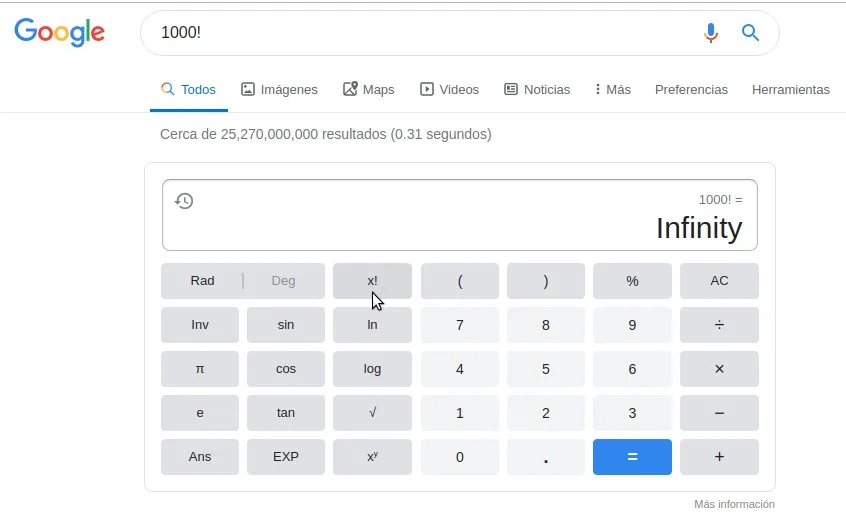
And that at all times it is possible to calculate the total number of combinations, which will be greater than n and that, since order is important, the total number of permutations (which we will call Comb) is n! (read factorial of n or n factorial). If n=10^(100^100), then, Comb=10^(100^100)! The factorial is the product of a number by its predecessors down to 1. Example: 5!=5x4x3x2x1=120.
This would be very coherent with the military policy of the current government, since the factorial is indicated with an exclamation mark, so it is as if the number were shouted. 5! (factorial of five) is like Fiiiiive!!"
The mathematical censor felt frustrated at not being able to find a "definitive solution" to the problem of the last number, but at the same time was pleased with the suggestion of using the mathematical shout. And he decreed that the new last number would be 10^(100^100)! A soldier sounded the bugle at dawn and shouted: "Teeeen, to the one hundred to the one hundreddddd!!"
Some time later, another request to modify the last numerical value was submitted, with its corresponding form, with this explanation signed under the pseudonym Heráclito de Banfield:
"The number of combinations is insufficient to calculate the total number of things or entities existing in historical form. Although from the point of view of energy it is held that it is conserved, we cannot say the same about matter. Let me explain: one can think of everything that exists in terms of a system that we can evaluate with a countable criterion like this: At moment 1 there is a tree that counts as 1, and it consumes nutrients that become part of the tree and we can consider them a loss (-1). In that case, the accounting balance of the system is 0. Later, the tree ceases to exist (-1) and there is a paper book (1) and the balance is maintained, as Lavoisier elaborated. But even that enlightened man had a mother. Is it possible to make an accounting balance of memory? Although physics, chemistry, and mathematics are very valuable sciences, we cannot diminish the importance of History. From this non-accounting point of view, we can record everything that ever existed, regardless of whether it no longer exists. In such a record, the quantity of things will always increase. It will not be a balance, but a summation."
And he added:
"That is to say, although the number Z, the last number, may seem sufficient, it will not be. If we were to take a complete census of everything that exists at every moment and that included everything that existed previously and everything that will arise with the passage of time, then, such a record will increase until it surpasses Z at some point. And although it may be a long time before that happens, right now it could be useful to calculate how many things and combinations could exist within a century or a millennium or 100^100! millennia. And we will not be able to make that calculation, so useful for social and economic planning, if we did not have the possibility of using 'a number as large as we need,' even if it does not coincide with the largest number set by that office. Keep in mind that there are two things that differentiate us from all inert objects and all living beings: emotions and calculation. Preventing us from doing the latter would be to resemble gorillas or slugs more."
He continued:
"As if this were not enough, we could count not only 'things,' like trees or tanks, but also words, silences, pauses, portable and porteño springs, wrinkles, lines on the hands, knocks on the ankles, and pockets. Is it conceivable that among all the combinations of all particles we are counting that too?
How many words have been published since antiquity? How many letters, how many question marks, how many periods and new paragraphs? How many pages have been published? Let's keep adding: How many minutes have passed since the beginning of time, how many milliseconds? How many goals were scored, how many tries, triples and checkered flags? How many steps has humanity walked since its origin? How many sleepless nights? How many measures since Pythagoras? How many quarter notes, half notes, whole notes, eighth notes? How many allegros ma non troppo? How many drum rolls have been made? How many more must we hear? How many silences have we screamed in all this period? How many grimaces and gestures? How many grains of sand and salt? How much dust has gathered and been swept under the rugs? How many times did I think all was lost? How many nightingales proved me wrong? How much ink and blood spilled? How much poetry is there in a dove? How many scars has Humanity left? How many sutures and ruptures and broken and unraveled futures? How many stars have gone out and how many are being born now without knowing it? How much brightness was in their eyes and how much cold in their wrists? How many deleted and rewritten emails? How many stamps and mailboxes did we buy? How many symphonies of barks and meows accompany us with their fleas? How many ingrown hairs, broken nails, poorly made hems, unfinished tasks? How many empires and revolutions? How many ruins? How much neglect and how much love? How many suns without extenuating circumstances or twilights? How many partial, total, and annular solar eclipses have feared and amazed the world? How many hopeful rocks calesite Saturn? How many rings celebrated weddings and sewers? How many corners orphaned of memories? How many balconies without plants or flowers? How many bees without honey? In how many tears and raindrops have we bathed? How many moments lost in time? How many attack ships on the shoulder of Orion? How many percentages did we invent to feel safe? How many times did I say never, always, everything, nothing, enough, come back?
It is clear that all these other 'things' increase over time. Ergo, the number n must be a variable in constant change."
Meanwhile, the censor received another petition, signed by a certain Juan Carlos Federico Guasso, from Córdoba, which said:
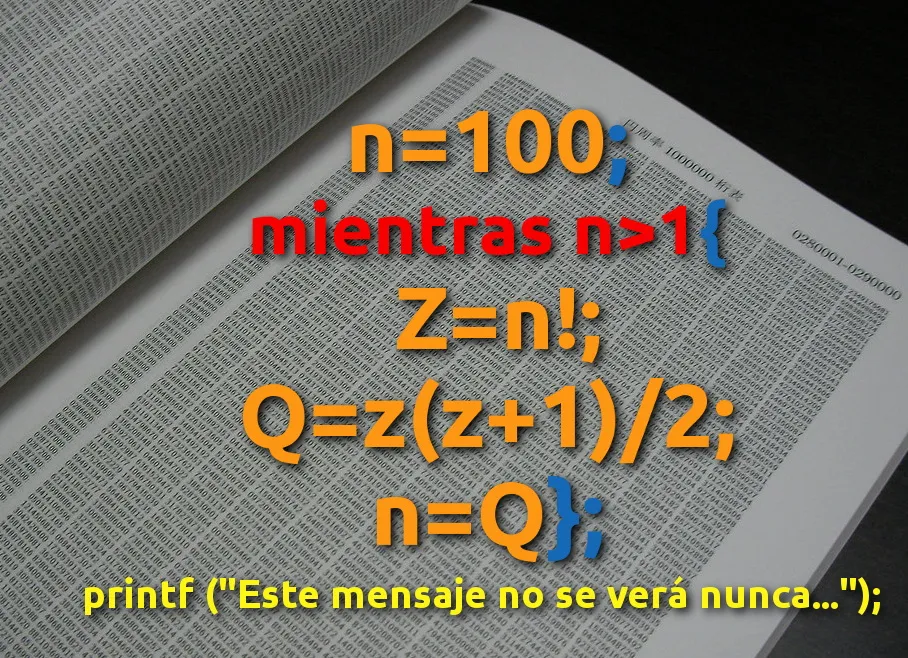
"Given a calculation for the last number, n, there will always be another number Q that is the sum of all positive numbers up to n and that can be calculated with the formula Q=n(n+1)/2. As an example, if n=100; the sum of all numbers up to 100 is Q=100(100+1)/2=5050. However, if by such calculation, the value of n becomes that of Q (n=Q), immediately there will be a new Q, that is, if now n=5050, then Q=12,753,775 and so on. For every number n there will always be an implicit larger number Q, as the sum of all previous numbers. One could argue that if n includes everything known, with the calculation of n! (called Zeta) it would be sufficient. However, for every n! there will be another number Q, which will be the sum of all preceding ones. I cannot assure that the sum of all combinations has any practical utility. But I can say that, if we stipulate a number n, it is mathematically possible to sum its predecessors (the number Q) or multiply them (Z). The latter implies that we can always keep exclaiming, for example, (n!)! Mathematics would make no sense if we could not add, and therefore, mathematics would be impracticable, despite it being proven its effective and efficient social utility and the invaluable differential value of possessing these cognitive skills that nebulae, chrysanthemums, and dolphins lack. It is thus concluded that n should be as large as we need."
Faced with this argument, Mr. Patato, gave in. He published a brief decree that said:
"Since it has been logically demonstrated—beyond the poetic—that things increase over time, any number that counts such things should also increase indefinitely. For this reason, the provisional Government decrees that infinity does not exist, but numbers have no end, that is, there is no number larger than all others, for human knowledge, but the Last Number is safeguarded by the wisdom of the Almighty who has no limit".
Finally, the dictatorship left, not without leaving an incalculable trail of disappeared people, among them, some mathematicians. Since then, in a very democratic manner and with quasi-religious or accounting fervor, the total number of people disappeared in that horrible era is discussed.
The unreasonableness of the dictatorship is as uncountable as Real, like the set R. The very idea of the disappeared is uncountable in that it cannot be counted, narrated. It is a truncated story. It is absurd then to try to shrink the number of irrationals in order to count it.
There are still fundamentalists of the scissors who are terrified of large numbers. Or ashamed.
∞∞∞∞∞∞∞∞∞∞∞∞∞∞∞∞∞∞∞∞∞∞∞∞∞∞∞∞∞∞∞∞∞∞∞∞∞∞∞∞∞∞∞∞∞∞∞∞∞∞∞
Sources and related links
- What Is The Largest Number?
https://zidbits.com/2011/01/what-is-the-largest-number/ - Miguel Paulino Tato censor during the dictatorship
https://www.youtube.com/watch?v=6OuSvHuEBqg - The number that computers will never be able to calculate. Eduardo Sáenz de Cabezón. U. de La Rioja
Expression of "a number as large as we need"
https://youtu.be/EtSN8GGBwsM?t=2638 - Max Cooper - Aleph 2 (Official Video by Martin Krzywinski)
https://www.youtube.com/watch?v=tNYfqklRehM
About the images
Image of pi book courtesy of Takashi Kiso on Flickr [Accessed June 2019].
https://www.flickr.com/photos/kisocci/3428360023/sizes/l/
Screenshot from Martin Krzywinski's video on Youtube.