Mars 2020, a mission with its own flight, the Hope orbiter from the UAE, and a Chinese mission, are launching to Mars.
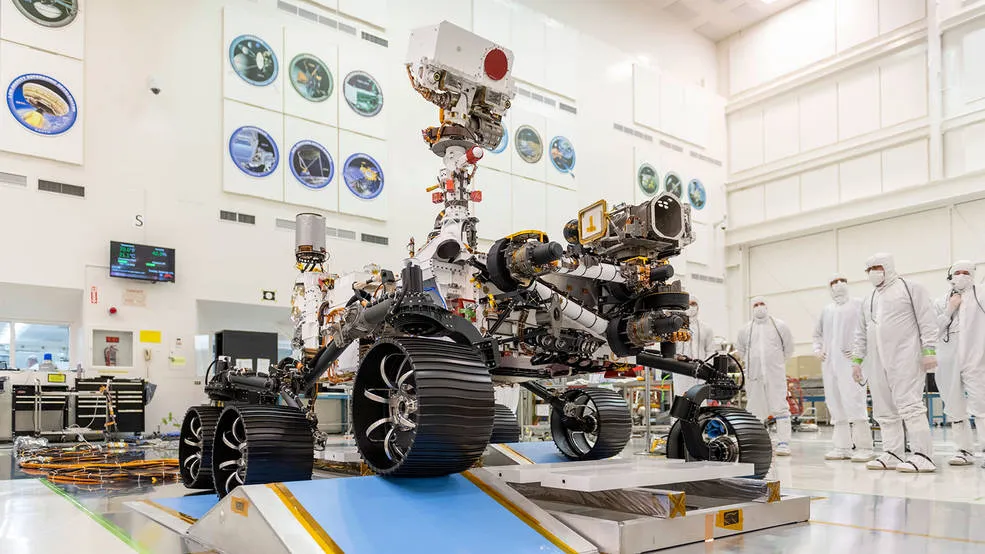
July 20 will mark an anniversary of the first moon landing, and a few days later the Perseverance rover will launch to Mars, the eighth from NASA to visit the Red Planet.
The goal is to search for signs of microscopic life in Mars's past, explore the geology of Jezero Crater, where it will land, and demonstrate key technologies for the future. But it stands out for an unprecedented objective: to be a first step in collecting samples to bring to Earth.
Due to the positions of Earth and Mars, launch opportunities occur every 26 months. If Perseverance fails to lift off in a few days, the project will have to wait until September 2022 for a new attempt. The launch window extends from July 30 to August 15.
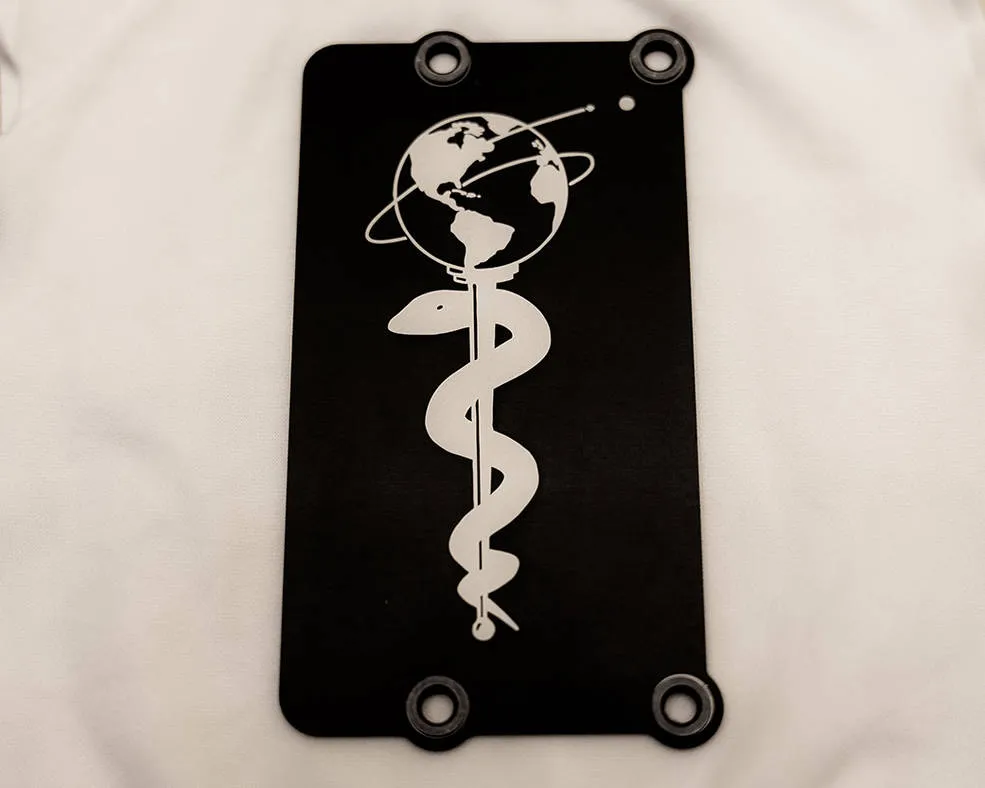
The Covid-19 pandemic did not stop NASA's plans, but it did require additional care for the personnel. As a form of gratitude to the medical community, an 8x13 cm aluminum graphic panel was installed showing Earth and the medical symbol along with a line illustrating the spacecraft's trajectory from Florida to Mars, represented as a small white circle.
The spacecraft will have to travel 505 million km and endure 7 minutes of terror to safely reach the fourth planet. If the launch is successful, the landing will be on February 18, 2021.
TWO KEY ASPECTS
The Mars 2020 mission has two outstanding characteristics:
1-It will be the first step in bringing Martian soil samples to Earth, in conjunction with ESA, the European agency.
2-It will perform an unprecedented technology demonstration: it will carry a helicopter, Ingenuity.
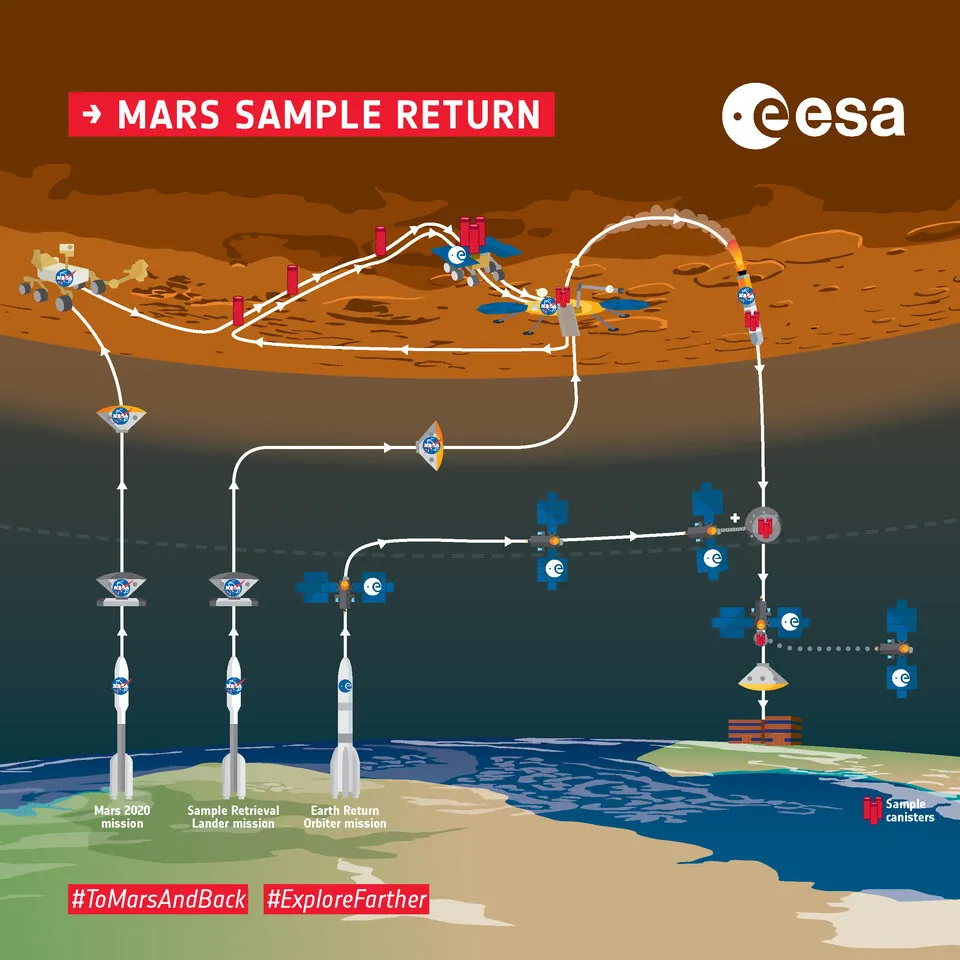
The Mars Sample Return campaign will begin with Perseverance, which will take soil samples with a drill and place them in tubes after photographing and sealing them. The tubes will be left until they are collected by another rover, ESA's Sample Fetch Rover (SFR), which will fly to Mars along with NASA's Sample Retrieval Lander (SRL) in 2026. By August 2028, the SRL will land near Perseverance, where the SFR will deploy to collect the samples and place them in a rocket known as the Mars Ascent Vehicle (MAV), which will launch in 2029 to a low Mars orbit. It will leave the samples in space, and then ESA's Earth Return Orbiter (ERO) spacecraft will collect the samples to bring them to Earth in 2032.
The flying ingenuity
Ingenuity has 4 blades on two rotors at 2400 rpm that must operate in the challenging Martian temperatures, between -130 and 90 degrees Celsius. It is lightweight (1.8 kg) to fly in an atmosphere that has only 1% of the density of Earth's atmosphere and with gravity that is one-third of ours.
Flight instructions will be sent to the flying robot in advance, due to the communication delay, and it must perform them autonomously. Engineering data from the flights will be communicated to Earth after the flight is completed. Ingenuity will communicate with the rover, which will then relay the data to an orbiter (MAVEN or MRO, also ESA's Trace Gas Orbiter), which in turn will transmit them to our planet.
Emirates Mars Mission and Tianwen-1
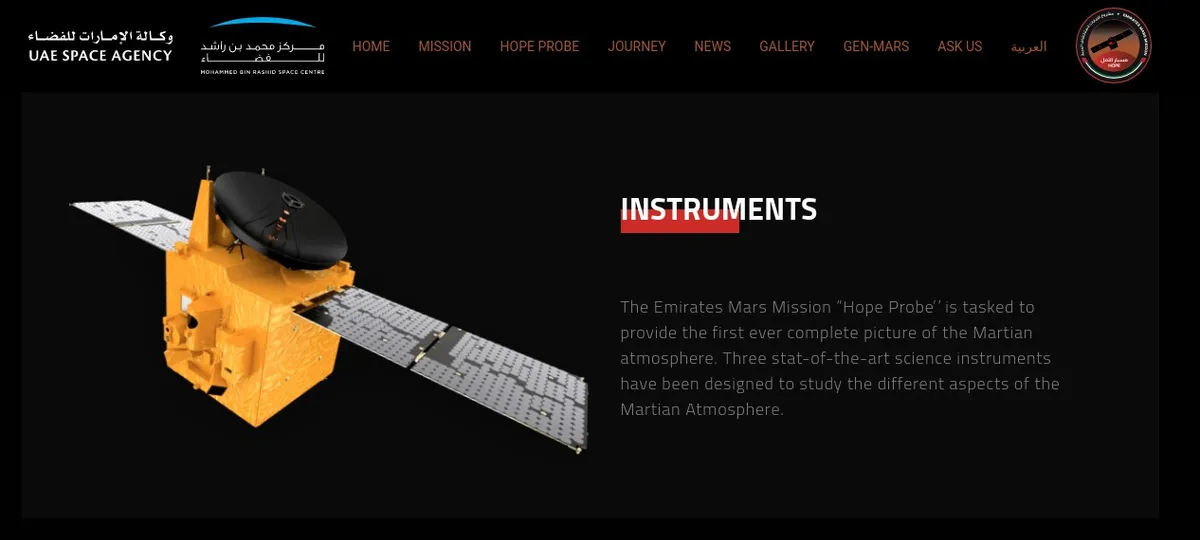
The United Arab Emirates mission is scheduled for July 15, with arrival at the planet in February 2021. Hope is the name of the orbiter that will conduct climate studies without touching the surface. It will launch from the Tanegashima base in Japan aboard a Mitsubishi Heavy Industries H2A202 rocket.
China planned a launch on July 23 for its Tianwen-1 spacecraft, which consists of an orbiter, a descent capsule, and a rover.
This means that next February, three missions will arrive at Mars. They will continue the task of learning more about the fourth planet, while the missions allow for greater technological development. "Vincit qui patitur," persevere and you will triumph, in Latin, is a phrase that summarizes part of the scientific work. It is evident that insistence or constancy is not enough, but also improvement. To persevere is to overcome adversity. These three missions will face adverse conditions and possible human and technical failures. Perseverance is not only a good name for a U.S.-European mission that plans to bring samples from Mars to Earth in a series of difficult steps, but also for China and the United Arab Emirates.
It is worth remembering that the United Arab Emirates united to end British rule in 1971. Next year marks 50 years. The contrast is strong between a monarchy, as an "ancient" institution, and the strong scientific-technical development capable of building satellites and now, a Mars orbiter.
Sources and related links
- Here’s How Perseverance’s Helicopter Sidekick Will Deploy on Mars
https://www.universetoday.com/146791/heres-how-perseverances-helicopter-sidekick-will-deploy-on-mars/ - How NASA’s Mars Helicopter Will Reach the Red Planet’s Surface
https://www.jpl.nasa.gov/news/news.php?feature=7684 - The Launch Is Approaching for NASA's Next Mars Rover, Perseverance
https://www.nasa.gov/feature/jpl/the-launch-is-approaching-for-nasas-next-mars-rover-perseverance - Mars sample return
https://www.esa.int/Science_Exploration/Human_and_Robotic_Exploration/Exploration/Mars_sample_return - Youtube: Mars sample return
https://www.youtube.com/watch?v=RNnJBKR9lqY - Youtube: NASA advances plans to bring samples back from Mars
https://www.youtube.com/watch?v=0PVjj0PEPMA - Mars 2020, following the footsteps of Apollo 12
https://www.noticiasdelcosmos.com/2019/11/mars-2020-tras-las-huellas-de-apollo-12.html - The Extraordinary Sample-Gathering System of NASA's Perseverance Mars Rover
https://www.jpl.nasa.gov/news/news.php?feature=7671 - It's the month of Mars! 3 Red Planet missions set to launch in July
https://www.space.com/three-mars-missions-launch-july-2020.html - How a small Arab nation built a Mars mission from scratch in six years
https://www.nature.com/immersive/d41586-020-01862-z/index.html - Emirates Mars Mission
https://www.emiratesmarsmission.ae/
About the images
Credit: NASA, ESA, EMM.