CHEOPS will be the first mission designed to study, rather than find, extraterrestrial worlds. The European Space Agency has planned other missions on one of the topics of greatest interest in current astronomy.
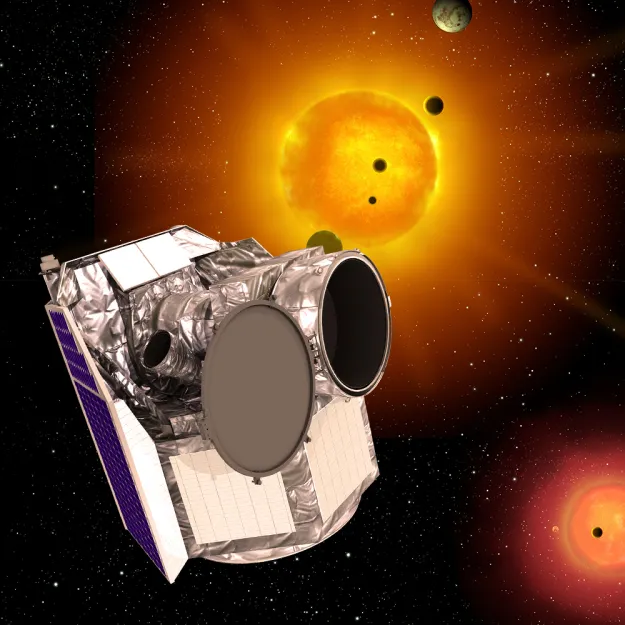
The European Space Agency (ESA) has scheduled the launch of a telescope to study exoplanets, called CHEOPS (Characterising Exoplanet Satellite).
After investing €50 million to build the 300 kg satellite, the launch from Kourou in French Guiana atop a Soyuz rocket is being prepared for December 17. Its orbit will be 700 km above Earth, with its main instrument constantly pointing toward the night side of the planet to have an uninterrupted view of space without sunlight.
"We are moving from the discovery [of exoplanets] toward characterization", said Kate Isaak, project scientist. "With CHEOPS we will be able to answer the question about how small planets form", she added.
Equipped with a single camera, the telescope will be used to observe stars in which planets are already known to exist in orbit. Through the transit method -the dip in brightness of starlight as the planet passes in front- astronomers will use CHEOPS to know the sizes of those worlds and study their atmospheres, providing crucial information about the formation and evolution of a variety of exoworlds. Over its 3.5-year scientific mission, which will begin in April 2020, the telescope will allow the study of between 300 and 500 planets.
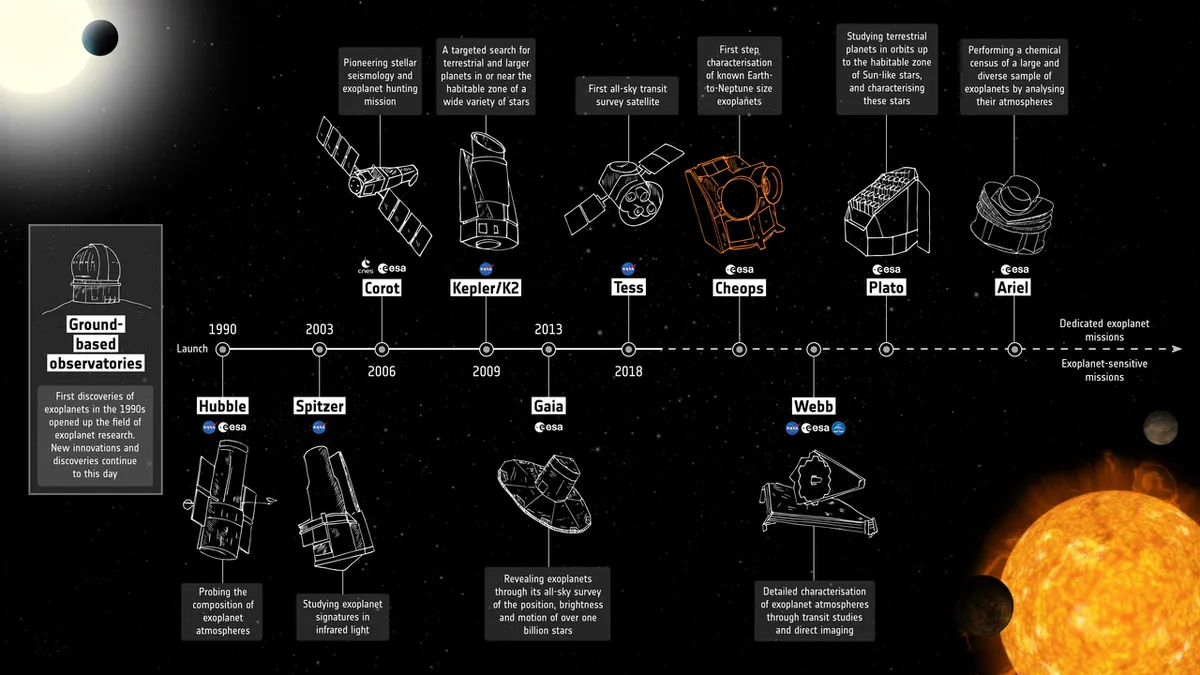
In 2028, ESA plans to launch the ARIEL (Atmospheric Remote-sensing Infrared Exoplanet Large-survey) satellite which will study the atmospheres of about 1000 exoplanets in infrared to learn their composition. Another planned mission is PLAnetary Transits and Oscillations of stars (PLATO), scheduled for 2026.
"Detecting exoplanets is now the norm", commented Matt Griffin, an astronomer at Cardiff University, part of the ARIEL team. "But we need to move toward a new era to begin to characterize and measure their detailed properties", he explained.
"Exoplanets have become in the last 25 years one of the hottest topics in astrophysics", says David Ehrenreich, CHEOPS scientist. "So there is a lot of excitement in the scientific community".
https://www.youtube.com/watch?v=xYIWjmUuZfU
Sources and related links
- NATURE: European space telescope to launch new era of exoplanet science
DOI: 10.1038/d41586-019-03800-0 - ESA CHEOPS
https://www.esa.int/Science_Exploration/Space_Science/Cheops - ESA PLATO
https://sci.esa.int/web/plato - ESA ARIEL
https://sci.esa.int/web/ariel
About the images
Credits: ESA/ATG medialab - ESA - C. Carreau