The half-truths of the "popular newspapers" about their lottery hits.
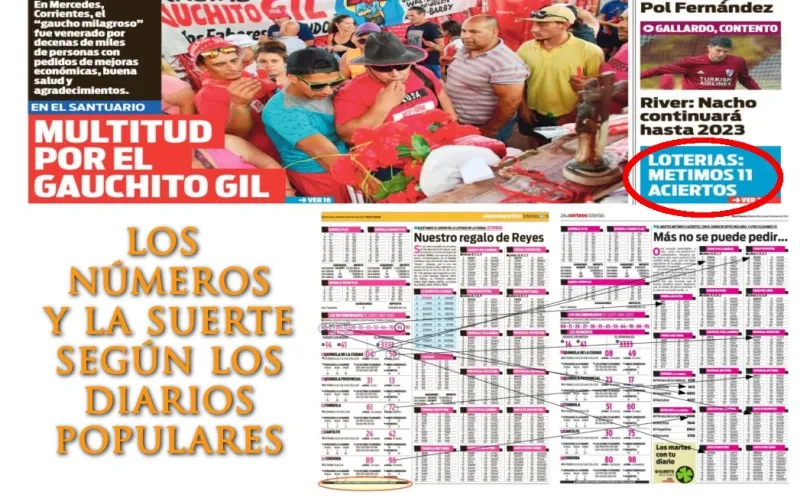
In the Federal Capital, there are two Buenos Aires newspapers categorized as "popular" that are generalists but emphasize police content, religious celebrations, sports, and lottery and turf information, in addition to publishing a photo of some woman with little clothing.
I will analyze here a practice used by these newspapers, based on a particular case, published on January 9.
Before analyzing what was published, it is necessary to provide some background data. The newspapers publish the results of different draws, whether lotteries or quinielas. In different jurisdictions, there are several draws per day, for example, First Morning, Matutina, Vespertina, Nocturna. In the case of quinielas, 20 four-digit numbers are drawn. The top prize is for the first position.
Bets can be:
-On different digits: meaning that, although each number has 4 digits, you can bet only on the last one, the last two, the last three, or all 4 digits. A higher prize will be paid when betting on numbers with more digits.
-On the head or the prizes: You can bet that a number will be first in the position ("a la cabeza") or that it will be included among the next 19.
The common bet is usually: on two digits, on the head, which pays 70 times the bet. That is, if you bet $1, and that number comes out in the first placement, you get a prize of $70, although the net gain will be the difference between the prize and the expense.
Now, let's see what the newspapers publish, with a specific example from this week.
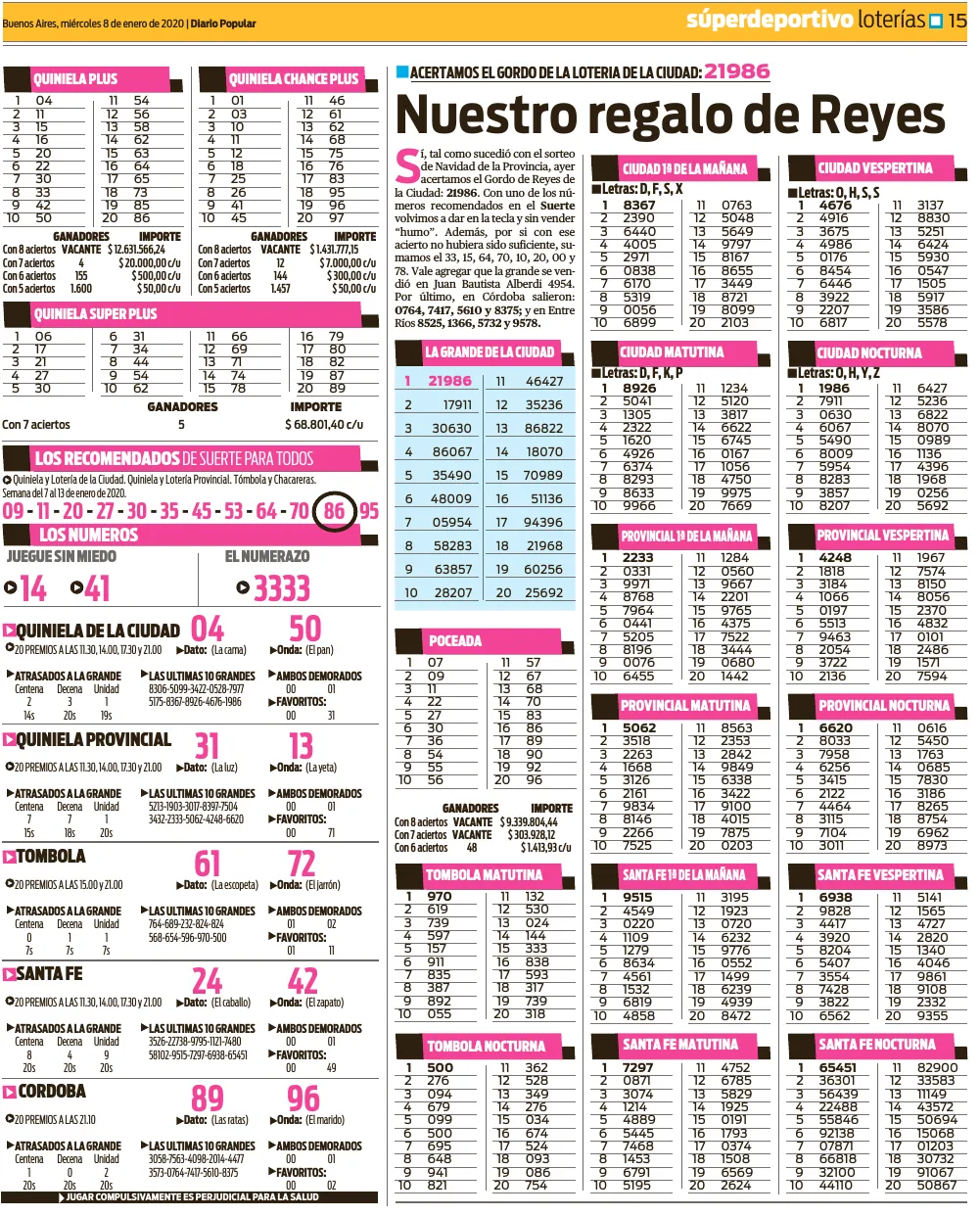
On January 8, a Popular Newspaper published the results of the previous day's draws and on the same page "recommended numbers".
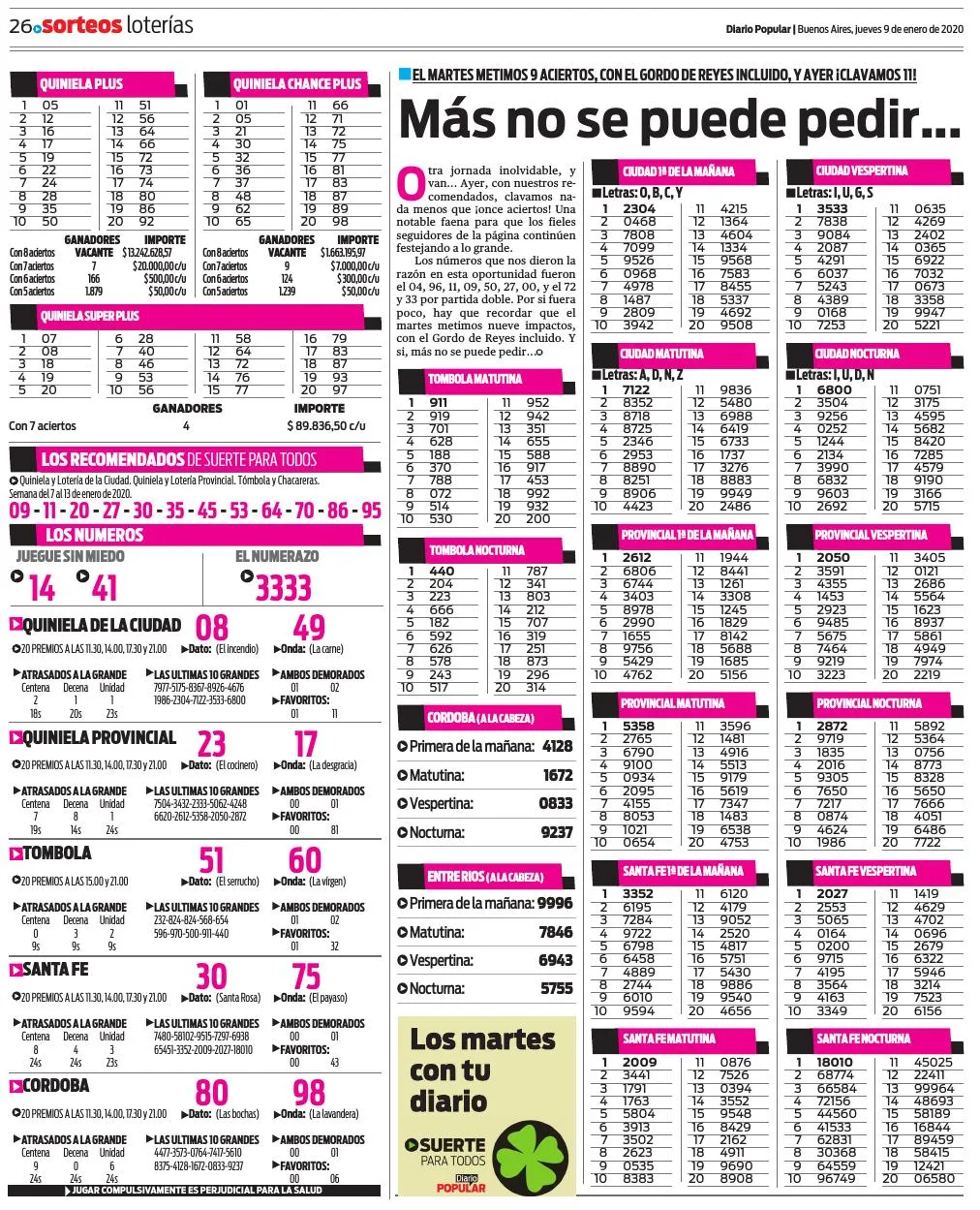
The next day, January 9, on the front page of the same newspaper, the headline reads "Loterías: metimos 11 aciertos". On page 26 of the newspaper, the numbers that came out the previous day in the draws are shown, and it is indicated that, of all the numbers that came out, the newspaper's recommended numbers from the day before came out on 11 occasions.
It literally says: "Another unforgettable day, and that makes... Yesterday, with our recommendations, we hit no less than eleven hits! A remarkable feat for the faithful followers of the page to continue celebrating big time. The numbers that proved us right this time were 04, 96, 11, 09, 50, 27, 00, and 72 and 33 twice".
First, let's see if this is true. For that, we look at the page from the previous day, to find out if those 11 numbers appeared as "recommended".
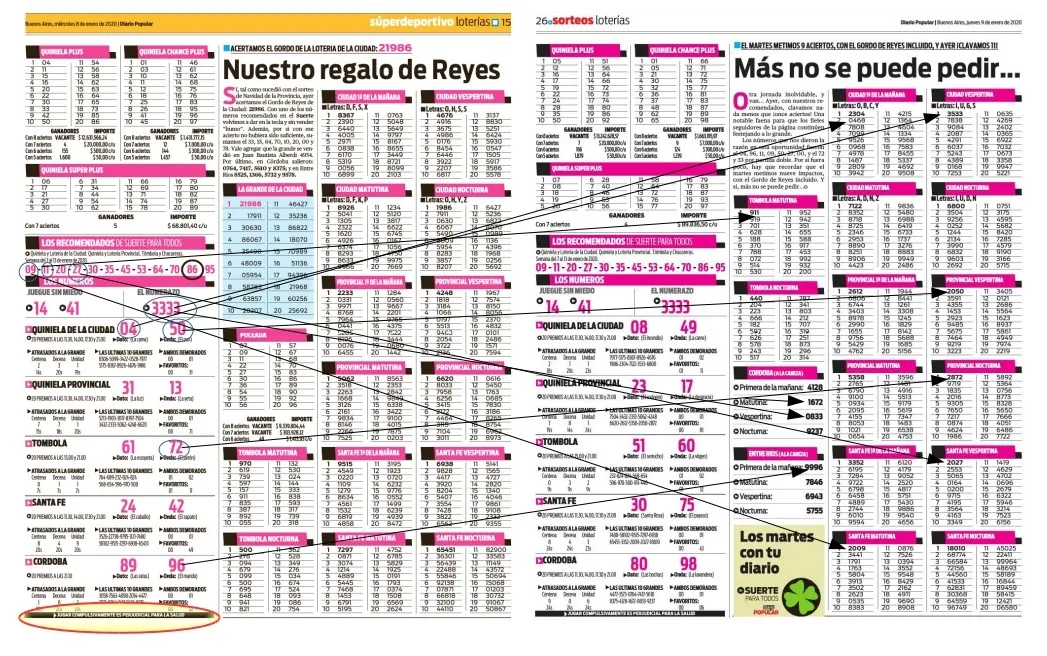
As shown in the following image, where the two pages from both days are shown, the recommendations from the 8th and the results from the 9th, there are coincidences.
Here we see the page from January 8, where the recommendations are shown, on our left, for the draws of that same day.
Here we see the page from January 9, where the results from the previous day are shown (and the recommendations for the draws of that day, the 9th).
And here we see the combination of both images, in which I show with arrows which of the numbers recommended on the 8th came out in the draws of that day, published the next day. There are 10 arrows, since I did not find the recommendation for the number 00 that according to the newspaper appears among its "hits".
However, let's think a little about what all this means.
First, it should be made clear not only how many hits the newspaper had, but also how many misses.
The total recommendations were 25, namely:
09 - 11 - 20 - 27 - 30 - 35 - 45 - 53 - 64 - 70 - 86 - 95 - 14 - 41 - 3333 - 04 - 50 - 31 - 13 - 61 - 72 - 24 - 42 - 89 - 96
That is, they got less than half right. And this is because I did not take into account other numbers indicated as "favorites" or as "delayed", which perhaps the public does consider "recommendations".
But now let's think about it another way. Suppose we read the newspaper and heed this encouragement to easily lose money, which are games of chance, often labeled as "Tax on statistical ignorance".
If we heed it, we could have different scenarios:
We bet on these two digits, all of them, 25 in total, $10, on each and every draw that takes place that day, in all shifts.
According to the report on the 9th, with the results, there were draws in CABA (4), Provincia (4), Santa Fe (4), Córdoba (4), Entre Ríos (4), Tómbola (2), Quiniela Plus (chance and super plus), that is, 25 draws.
If we bet $10 on each of the 25 "recommended" numbers, that's $250 and if we do this in 25 draws, it's an expense of $250x25=$6250.
How much would we collect in prizes?
On 11 occasions (although I found 10) we would have obtained a prize 70 times the bet, that is, 11 times 700 pesos=$7700.
The net gain would be $1450.
As is evident, in previous weeks, the number of hits was lower. That's why the eleven hits deserved the front page. Because it's not usual.
If the number of hits is 9, the prizes to be collected would be $700x9=$6,300, meaning the bettor would "break even", neither losing nor gaining. If the number of hits is less than 9, the bettor loses.
If the bettor, encouraged by this gain of $1450, heeds the newspaper again in the following weeks, it is obvious that, in the long run, they will lose more than they will gain.
On the other hand, this net gain of $1450 would only be obtained by having bet as I said, which implies having $6250 pesos for bets, which they could lose. That is, they should have that money to spare. In other words, the one who already has, wins (a little). And this happens once in a while. More frequently, however, the number of hits is less than 9, in which case the bettor loses.
ANOTHER MODALITY
The recommended numbers, in some cases, are specific to one draw, while others are "valid" for all, according to this newspaper.
If the bettor-reader heeded the newspaper and followed the specific advice, this would happen:
For the city lotteries, the numbers 04 and 50 were recommended for January 8. We bet $10 on each, in 4 draws, cost=$80.
Number 04 came up, prize of $700, we won $620.
For the provincial lotteries, the numbers 31 and 13 were recommended. We bet the same, with a cost of $80. Neither came up. We lost $80.
For the tombola, 61-72, they didn't come up. We lost another $40.
For Santa Fe, 24-42. They didn't come up. We lost another $80.
For Córdoba, 89-96. They didn't come up. Another $80.
ALEA IACTA EST AND THE CATEGORICAL IMPERATIVE
"Alea iacta est" is a Latin phrase translated as "the die is cast". The phrase is attributed to Gaius Julius Caesar upon crossing the Rubicon.
It may seem that, in this specific case, there was luck. But, in the long run, what you will have the least of is luck. Or, in any case, luck can be favorable or unfavorable. That it is favorable in this case does not imply it will also be so in the following weeks. On the contrary, it is most likely that luck will be missed.
But what is missed is the application of the Categorical Imperative, formulated by the philosopher Immanuel Kant in his Metaphysics of Morals:
"I ought never to act except in such a way that I could also will that my maxim should become a universal law". This is the same as what is called "exemplarity", acting by example.
Applied to this case, the writer of these notes in the newspaper should do what he says should be done, that is, bet on all those numbers. Will he do it? Or will he act like those who deal drugs but do not consume the product they sell?
I bet he won't, to the first question and I win...by a landslide.
Probabilistic details
The probability of hitting a two-digit number, in the first position, is 1 in 100. It is a fraction 1/100 which can be expressed as one hundredth and as a percentage, 1%.
If you bet on two two-digit numbers in the same draw, your probability doubles (2%), but the cost also multiplies.
If you bet $10 on all possible numbers, which are 100 -between 00 and 99- the cost will be higher than the prize ($1000 vs $700).
If you bet as I indicated at the beginning $10 on 25 numbers in the first position in 25 draws, the cost will be $6250 and you only recover it if you manage to hit in at least 9 different draws and you only win if you hit in at least 10 out of 25 draws.
There is a certain tendency among gamblers in games of chance called the "gambler's fallacy" which consists of thinking that reality, the universe, seeks balance and compensates. This is applied in this way: The gambler loses 10 times in a row and thinks that, to compensate, now the universe will make him win 10 times consecutively.
What happens in reality is a little similar, but very different. It is called "regression to the mean", which resembles "tendency towards equilibrium", but it is only an appearance.
To give an example that shows the similarity and the difference between both things I will say:
Let's imagine a couple composed of two people of short stature, say 1.65m. They have a first child who, upon growing up, reaches a height of 1.90m.
Some time later, they have another child, who barely reaches a height of 1.67m.
Then one might think that "the universe compensated". No, what happens is a return to the average, to the most frequent.
We realize the difference between both things if the couple has several more children, who -as expected- will be of short stature. There is no "compensation", what there is is a regression to the mean.
The average of hits for newspapers that have this type of publication is close to 4 hits. Therefore, although occasionally there are more than 9 hits and the balance is positive, all other times, the balance will be negative. You win a little once and lose many times.
The universe, reality, life, do not compensate. Those who go to ask and give thanks to San Cayetano and the Gauchito Gil are mostly poor. And they will continue to be so if the little they win, they squander on games of chance where the probability of winning a notable amount is very low.
Do you think great millionaires like Warren Buffett or George Soros made their money working, praying to the Gauchito Gil, or betting on the numbers from El Popular?
No more bets...
Sources and related links
- How much do I win if I bet on the Quiniela
https://www.quinielaresultados.com.ar/quiniela-cuanto-gano - Fundeu BBVA: echar en falta or echar de menos, not echar or encontrar a faltar
https://www.fundeu.es/recomendacion/echar-a-faltar/ - Wikipedia: Alea iacta est
https://es.wikipedia.org/wiki/Alea_iacta_est
About the images
Excerpts from Diario Popular.