Is the cosmos populated by intelligent civilizations? What would the density of cosmic intelligence be?
In these times of quarantine, population density has become a topic in the arguments for or against restrictions. The higher the population density, the greater the risk of contagion. Population density is the ratio between inhabitants and space.
For simplicity, density is usually calculated based on surface area and not volume, even though people also live in height, as in buildings.
Since we do not know the geometric shape of the Universe, to make some calculation we need to assume one. The simplest solid shape to calculate is the cube, since its volume is side cubed. Often calculations are made assuming the shape of the universe is spherical. The volume of a sphere is not difficult to find, but it has some slight complication, as it requires using a fraction and the number Pi.
Let's think about the intellectual density of the universe, as the ratio between volume of space and intelligent civilizations. We will say that such civilizations are those that possess space and radio technology. I will leave for another occasion the discussion of whether it is not preferable to define intelligence based on social development, instead of doing so only in a technical way.
It is quite possible that in the Cosmos there are multiple forms of life, from the simplest to the most complex. So we will not make such a calculation now, which would be the density of life in the Universe, but in a more specific way, the density of intelligent life.
For this we need two values: the size, to calculate the volume and the number of civilizations. We will use two values for the latter: the main idea is to think what would happen if there were a billion intelligent worlds in the Universe. For this purpose, we will also think what would happen if the number were 90 billion.
The diameter of the universe has been calculated at about 90 billion light-years. In scientific notation it is 9x10^10.
RUBIK'S UNIVERSE
So we will say that the Universe is a cube that has that measurement as its side. The volume is side cubed, a very large number. To make it easier for us to think about such huge numbers, it is worth doing the following:
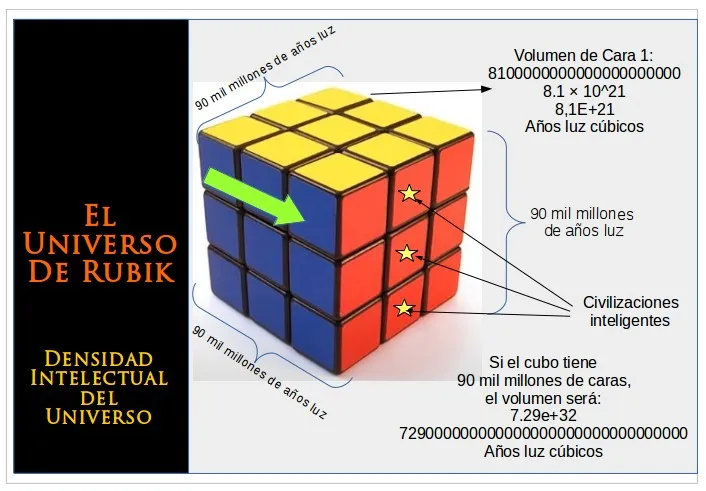
We will think that the volume of a cube is the number of small cubes that can fit inside the larger cube. For this we will use the Rubik's cube as an example, just to let our nerd side run free.
Let's say that in a Rubik's cube there are rows and columns. And that the rows we can move horizontally. By doing so, we move an entire face.
So if the Universe were such a cube, with 90 billion light-years per side, one face would have 90 billion squared as the number of small cubes. That is, on a single face of the cube, there would be 8.1x10^21 small cubes. To write it all out would be 8100000000000000000000 small cubes.
And that is just one face of the cube. Let's say that only one of those small cubes has intelligent life, illustrated as a star in the center of the face.
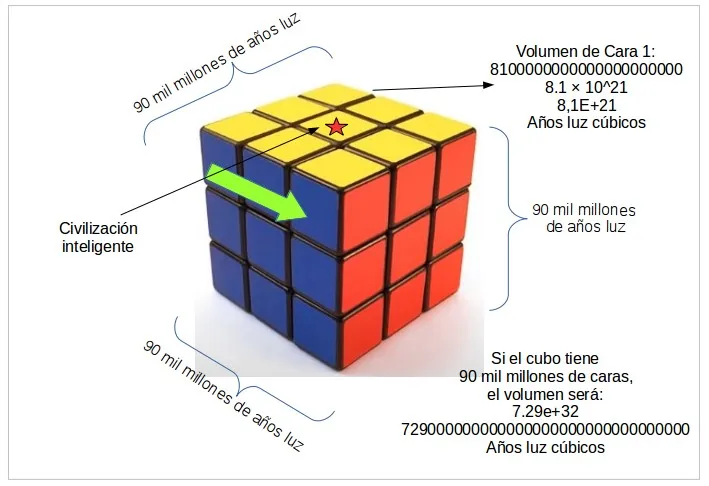
We still have all the remaining faces. The cube has 90 billion faces. To understand what it implies for there to be a billion intelligent civilizations, it is useful to first think about what it would be like to have one civilization per face.
To be clear, I will change the position of the star in the illustration, therefore, the location of the intelligent civilization. Now I will put it on a side, so that I can also illustrate the position of the remaining ones. If we put one on each face, since the cube has 90 billion faces, there would be 90 billion intelligent civilizations.
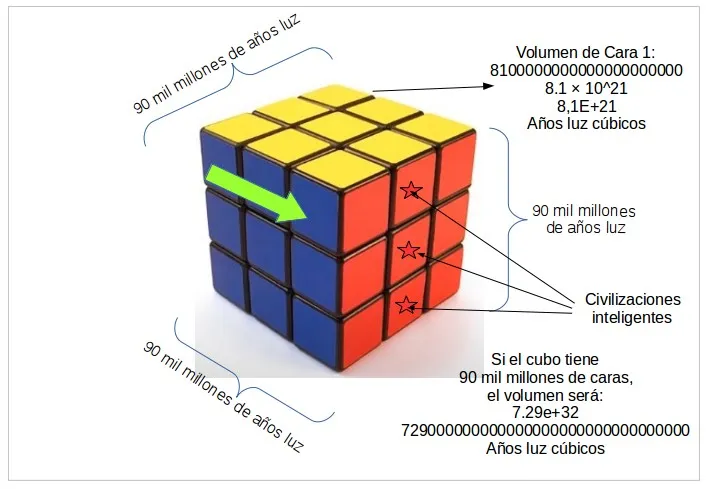
In such a scenario, the distance between intelligences could be as little as one light-year, if they were located as in the illustration. But the density would be 1 civilization every 8100000000000000000000 cubic light-years. 8.1 x 10^21. If one little star were in the first corner of a face, and another little star were in the last corner of the next face, between them there would be 90 billion light-years of difference.
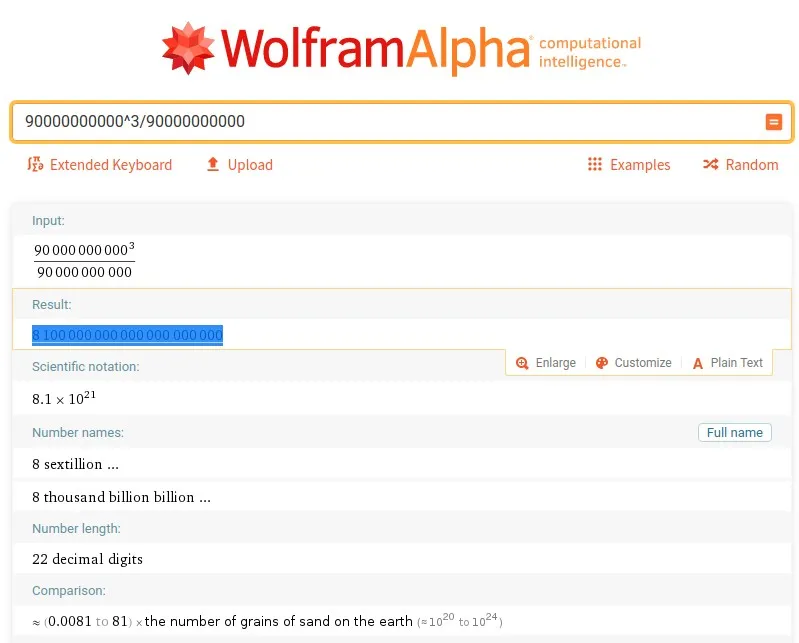
If instead of 90 billion there were only a billion intelligent civilizations, what would the intellectual density of the universe be like?
Well, if on the first face we place one little star, the next one we would have to place on face number 90. In that case, the minimum distance between civilizations would be 90 light-years.
The density calculation implies a homogeneous distribution, although it does not have to be that way. However, it is useful, since although in some cases such civilizations could be closer, in other cases they would be farther away, so we can think of such a distribution as an average.
Finally we can say that the volume of a cube with 90 billion light-years per side would be 7.29e+32, or 729000000000000000000000000000000 cubic light-years.
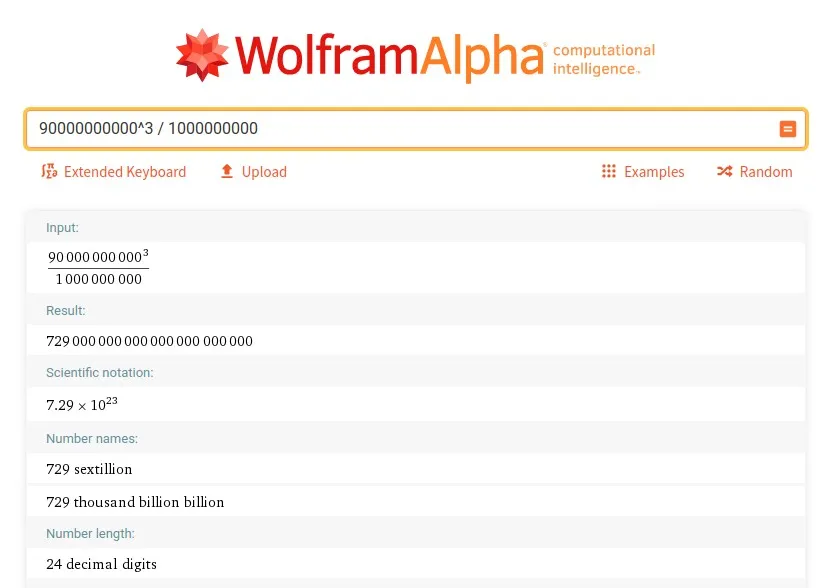
Density is the ratio between that volume and the quantity. If there were a billion intelligent civilizations, the ratio would be: 7.29 × 10^23, 729000000000000000000000 cubic light-years.
CONCLUSION
The Cosmos has an inherent physical distancing. Stars are very far apart from each other and galaxies are also far apart from each other. To make matters worse, the Universe is expanding, increasing the distance between galaxies, except for those that are close enough for gravity to attract them, as happens among the galaxies of the local cluster.
Since the size increases, the density decreases, assuming the number of civilizations remains constant. This assumption makes sense as long as civilizations arise and decline.
A billion civilizations sounds like a very large number. But even in such a scenario, the possibility of discovering intelligent life is as small as finding a needle in a haystack. Certainly, if we wanted to discover or be discovered, it is easier to send radio signals (which travel at the speed of light) than to use ships to travel at lower speeds through a universe that is enormous.
However, sending radio signals to communicate with civilizations 90 light-years away would imply that each message would take 90 years.
The probability of discovery is, therefore, different from the probability of existence. This probability of discovery, however, must be considered in terms of time. What is difficult to discover takes more time. It is unlikely that intelligent life will be discovered soon.
April marked 100 years since the Great Debate. A few years later, galaxies were discovered, almost a century ago. However, humans have been doing astronomy since the dawn of humanity. Why did it take us so long to find galaxies, which are enormous objects? Because they are very far away.
Does it make sense to search for something that is so hard to find? If we don't look for them, the probability of finding them will be zero. If we look for them, even if the probability is very low, it is possible...someday.
Recently, there have been talks circulating about the frequent visits of intelligent beings based on so-called UFOs. It would be wonderful to discover another type of intelligent life...if it were true. I don't know if it's true, but it's not realistic.
Some, however, express doubts about whether such a discovery would be desirable, on the grounds that it could be dangerous to find a much more advanced civilization. But we wouldn't have much to fear: the most likely scenario is that they are very far away, which implies it will be very difficult for them to get here in a short time. On the other hand, as already proposed in The War of the Worlds, the worst enemy of ETs is our viruses.
The threat is not extraterrestrial or technological.
It is natural and tiny.
It does not travel in spaceships.
It moves in foreign cells at the speed of a sneeze.
And it decreases the intellectual and labor density of our society.
The truth is out there: We must give more work to human intellect.☉
Also read:
Drake, Varsavsky and Intellectual Density https://www.noticiasdelcosmos.com/2020/08/drake-varsavsky-y-la-densidad.html