Like the "pop stars" of music, Population III stars are eagerly awaited.

The following text is a free translation of the one published by Daegene Koh, from KIPAC (Kavli Institute), in March 2018.
Astronomers divide stars into populations. Population III stars were the first to exist, but have never been seen. Population I stars, on the other hand, are third generation, like our Sun. Why this counter-intuitive way? Because the populations were named as they were discovered and observed. Population I (Pop I) stars were the first to be seen; then Pop II. Pop III stars are part of the early universe, still unobserved. But a lot can be known about these stars theoretically.
Astronomers call all elements heavier than helium "heavy elements" or "metals". The model of primordial nucleosynthesis explains how elements beyond hydrogen were formed. Thus it is known that during the first few hundred million years, the Universe contained only hydrogen, helium and a pinch of lithium (plus a tiny pinch of tritium and beryllium). This means that the abundance of metals found in stars decreases when looking back in time. In the early universe, there were almost no metals, therefore, Pop III stars lack them.
As they have not been observed so far, Pop III stars are studied theoretically and professionals rely on numerical, that is, computational, simulations. There is an advantage for the early universe: it was simpler.
The first stars were more massive than current ones, hundreds of times the solar mass. Therefore, they had short lives. Like "pop stars" they live fast and die young. The first elements were ejected into interstellar space by Pop III supernovae. From such events, black holes remained which would be the "seeds" of the supermassive black holes found in the centers of today's galaxies. Under the current paradigm of hierarchical structure formation of the Standard Cosmological Model (the Lambda-CDM model), objects formed small and through grouping the larger ones were created. That is why understanding the details of the formation of first-generation stars is vital to piecing together the formation of today's galaxies.
Magnetic fields in Pop III stars
One of the details in Pop III star models is the production and amplification of magnetic fields. These fields can vary in magnitude, from the magnetosphere that protects Earth from cosmic radiation to the absurdly powerful fields of magnetars (neutron stars). In the current universe they are inevitable. Most models of the early universe only allow for very weak magnetic fields. It is not clear how those weak fields were able to grow through stellar, galactic and galaxy cluster processes. Furthermore, these magnetic fields, once amplified, can also in turn influence the process of structure formation. Astrophysicists want to explore that symbiotic relationship by tracing the growth of magnetic fields, starting with the first objects.
By using the high-resolution computational simulation code Enzo, Daegene Koh studied the growth of magnetic fields through the life of a Pop III star, from birth to its explosive death and then during its aftermath. It includes the latest models to track chemical reactions, dark matter gravitational dynamics, gas thermodynamics, and the coupling of magnetic fields to gas dynamics. The code also uses a computational technique known as Adaptive Mesh Refinement that selectively increases resolution in regions of interest to gain degrees of precision with minimal computation time.
These simulations show a phenomenal growth of magnetic fields that can be associated with two distinct periods. The first is during the gravitational collapse of the gas prior to star formation. As the gas piles up due to gravitational pull, the field lines also bunch up and amplify. The second phase occurs shortly after the stars explode as supernovae, while the shock wave expands and begins to cool. This temperature difference between the cooled shock front and the hot shock wave itself results in the formation of turbulent motion that, again, begins to move and amplify the magnetic fields. The figure below shows images of the surrounding region before star formation, after supernova and the aftermath.
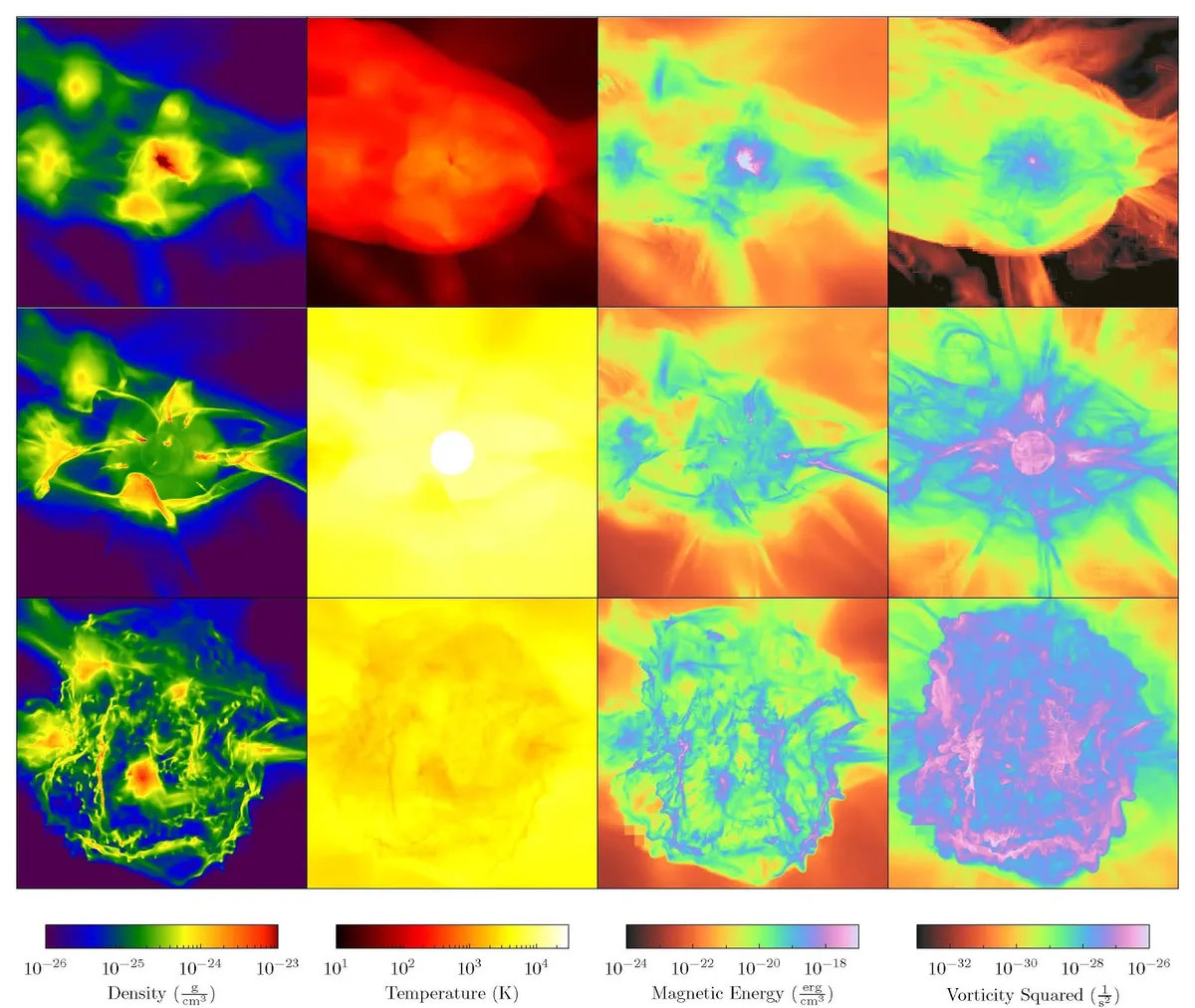
Over millions of years, the gas that was expelled by the radiation emitted from the star and the subsequent supernova will collapse again. However, some things will change. First, the heavier elements that formed and were released as a result of the supernova will have mixed into the gas. Second, the previously non-magnetized gas will be highly magnetic in the vicinity of the affected region. Future studies will attempt to explain how this effect impacts the next generation of star formation.
Pop III during reionization
Beyond the detailed model of these objects themselves, Pop III stars can be interesting in the context of reionization. Reionization is the transition from the neutral universe to the current fully ionized universe. This transition begins as a result of star formation and the ionizing radiation they emit. At first, these stars will simply form pockets of ionized gas around them which will then shrink as the atoms recombine. Finally, however, with the continuous formation of stars and radiation emitted by active galactic nuclei, the universe became ionized.
Daegene Koh studied the role of Pop III stars during this period using the semi-numerical simulation code 21cmFAST. Instead of doing a full numerical simulation, which would be computationally prohibitive for problems of such scale, this code combines analytical models to accelerate the calculations. In particular, Daegene Koh added the functionality for the models to be dependent on the mass of the galaxies, whereas previously it assumed a single value for the ionization capacity for all galaxies. Figure 3 shows a snapshot of the ionized fraction in the simulation box comparing a model with Pop III stars against a model with only canonical galaxies.
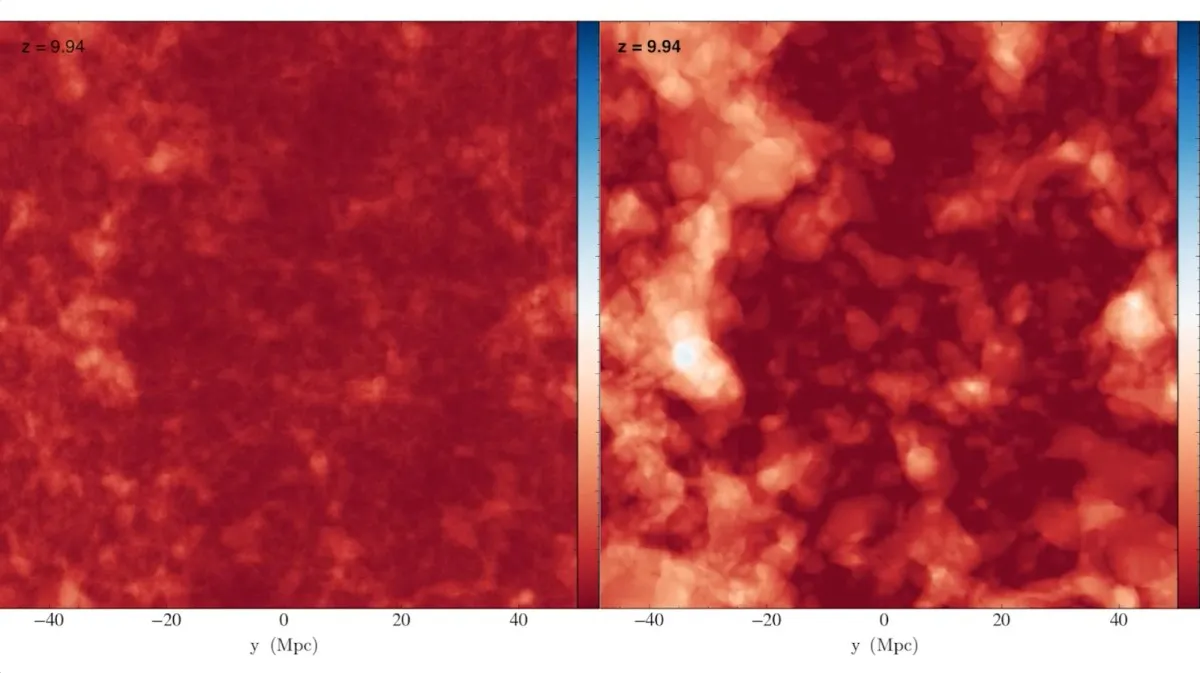
Observations of quasars, measurements of the cosmic microwave background radiation and other constraints, point toward a common endpoint for the "Epoch of Reionization", around z=6 (cosmological redshift), or when the universe was about a billion years old. All these models are adjusted to agree with these constraints. However, the main difference is in showing the importance of Pop III stars in dictating the beginning of the reionization process. They provide a significant fraction of ionizing radiation during the early universe and therefore are an important component in understanding this turbulent period in the history of the universe.
Observations in the near future
This is a particularly exciting period to search for Pop III stars and the first galaxies. Because these stars are short-lived, it would be difficult to expect any to have survived until today. Thus, the best chance of observing these objects is to look further back in the past. Until now, observational tools have lacked the technical capability to look far enough into the past to observe Pop III stars. However, the next generation of telescopes, like the James Webb Space Telescope should get ever closer to the realm of Pop III stars to further constrain our models. Giant arrays of radio telescopes to be built soon, like the Square Kilometer Array, will be able to peek through the Reionization Era into the dark ages and will surely provide more clues about the early universe. Also the new gravitational wave astronomy, opened by the Laser Interferometer Gravitational-Wave Observatory (LIGO), has found evidence of heavy black holes potentially connected to Pop III supernova remnants. Daegene Koh hopes to build increasingly sophisticated models to compare them with the observations we know are coming in the next decade.
And, perhaps in the end, someone with a powerful camera (on a telescope) will have a clear photograph of one of these loneliest pop stars.
Author profile

Daegene Koh earned his doctorate in physics from Georgia Institute of Technology (2017).
Among his publications are:
Koh, D., Wise, J. H. 2016, “Extending semi-numeric reionization models to the first stars and galaxies”, Monthly Notices of the Royal Astronomical Society, submitted (arXiv: http://arxiv.org/abs/1609.04400)
Koh, D., Wise, J. H. 2016, “Amplification of Magnetic Fields in a Primordial HII Region and Supernova”, Monthly Notices of the Royal Astronomical Society, 462, 81-91 (arXiv: http://arxiv.org/abs/1606.08477)
Sources and related links
- Population III stars: The Universe’s ultimate reclusive pop stars
https://kipac.stanford.edu/highlights/population-iii-stars-universes-ultimate-reclusive-pop-stars - What Telescope Will Be Needed to See the First Stars in the Universe? The Ultimately Large Telescope
https://www.universetoday.com/146888/what-telescope-will-be-needed-to-see-the-first-stars-in-the-universe-the-ultimately-large-telescope/ - Enzo
https://enzo-project.org/ - 21cmFAST: A Fast, Semi-Numerical Simulation of the High-Redshift 21-cm Signal
Andrei Mesinger, Steven Furlanetto, Renyue Cen
arXiv:1003.3878 [astro-ph.CO]
https://arxiv.org/abs/1003.3878 - Magnetic Fields in the First Galaxies and Stars
https://www.youtube.com/watch?v=-nS7h9Pni5k - Forming Ancient Stars
https://astrobites.org/2011/01/28/forming-ancient-stars/ - The First Stars in the Universe
https://www.scientificamerican.com/article/the-first-stars-in-the-un/ - Infrared Glow of First Stars Found
https://www.scientificamerican.com/article/infrared-glow-of-first-st/ - Scientists See Light that May Be from First Objects in Universe
http://www.spitzer.caltech.edu/news/222-ssc2005-22-Scientists-See-Light-that-May-Be-from-First-Objects-in-Universe
About the images
Figure 1
Visualization of the formation of one of the first stars.
Credits: Visualization: Ralf Kaehler. Simulation: Tom Abel.
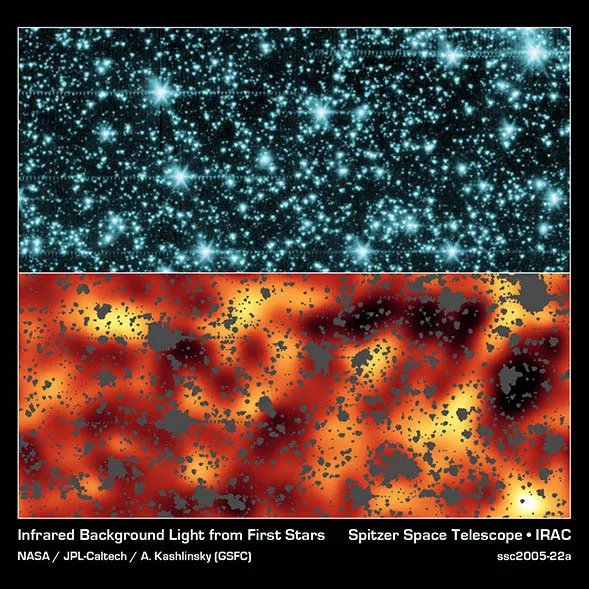
Figure 4:Credit: NASA/JPL-Caltech/A. Kashlinsky (GSFC)