Observations carried out with the ALMA array show that the most powerful bursts of star formation in the cosmos took place much earlier than thought.
The research is the most recent example of the discoveries made by the new international observatory ALMA, which today celebrates its inauguration.
It is believed that the most intense bursts of star formation took place in the early universe in massive, bright galaxies. These starburst galaxies convert vast reserves of cosmic gas and dust into new stars at a frenetic pace—many hundreds of times faster than in imposing spiral galaxies like our own galaxy, the Milky Way. By looking far into space, at galaxies so distant that their light has taken many billions of years to reach us, astronomers can observe that active period of the Universe's youth.
"The farther away the galaxy, the further back in time we look, so by measuring their distances we can build a timeline of how vigorous the Universe was at generating new stars at different stages of its 13,700 million-year history," says Joaquin Vieira (California Institute of Technology, USA), who led the team and is the lead author of the paper in the journal Nature.
The international team of researchers first discovered these distant and enigmatic starburst galaxies with the ten-meter SPT (South Pole Telescope) of the U.S. National Science Foundation and later used ALMA to get a closer look and explore the stellar 'baby boom' in the young universe. They were surprised to find that many of these dusty star-forming galaxies are even farther away than expected. This means that, proportionally, the bursts of star formation took place about twelve billion years ago, when the universe was less than two billion years old—a full million years earlier than thought.
Two of those galaxies are the most distant of their kind ever detected. So far away that their light began traveling toward us when the universe was one billion years old. Furthermore, in one of them molecules of water were found, which is another record.
The team used ALMA's unparalleled sensitivity to capture light from 26 of these galaxies at wavelengths around three millimeters. Light at certain wavelengths is produced by the gas molecules in these galaxies, and the wavelengths are shifted due to the expansion of the universe over the billions of years it takes for the light to reach us. By measuring the wavelength shift, astronomers can calculate how long the light has taken to travel and place each galaxy at the correct point in the history of the cosmos.
"ALMA's sensitivity and wide wavelength range allow us to make measurements in a few minutes per galaxy—about a hundred times faster than before," says Axel Weiss (Max-Planck-Institut für Radioastronomie, Bonn, Germany), who led the work to measure the distances to the galaxies. "Previously, a measurement like this would have been a laborious task of combining data from two types of telescopes, one in the visible-infrared range and another in radio waves."
In most cases, ALMA observations alone can pinpoint the distances, but for a few galaxies the team combined ALMA data with measurements from other telescopes (APEX, the VLT, the ATCA (Australia Telescope Compact Array) and the SMA (Submillimeter Array)).
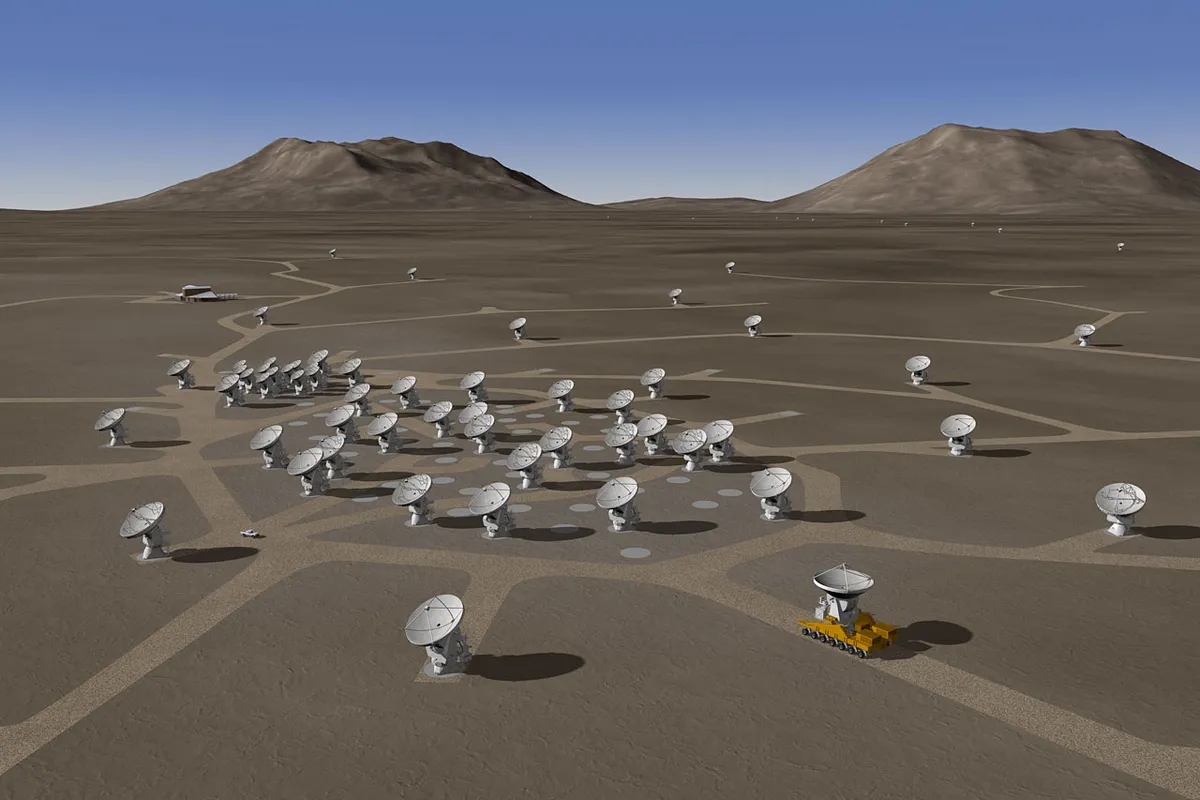
The astronomers were using only a portion of the antenna array, 16 of the total 66, as the observatory was still under construction, at an altitude of 5,000 meters in the remote Chajnantor Plateau in the Chilean Andes. Once completed, ALMA is even more sensitive, and will be able to detect even fainter galaxies. For now, the astronomers located the brightest ones. They also had help from nature: they were able to use the phenomenon of gravitational lensing, an effect predicted by Einstein's general theory of relativity in which light from a distant galaxy is distorted by the gravitational influence of a closer foreground galaxy, which acts as a lens and makes the distant source appear brighter.
To accurately understand to what extent this gravitational lens had magnified the brightness of the galaxies, the team took more precise images of them using ALMA at wavelengths of about 0.9 millimeters.
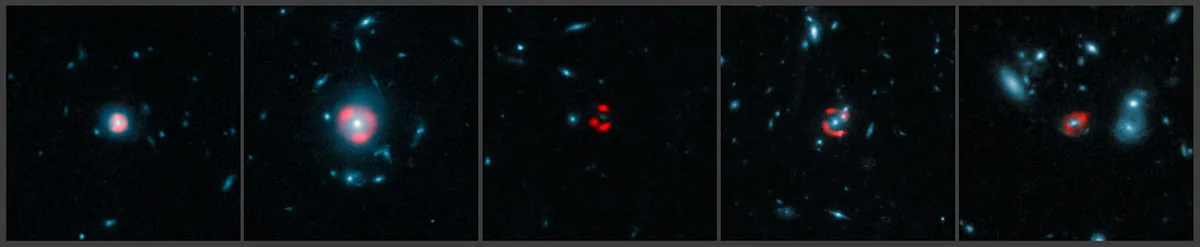
"These beautiful ALMA images show the background galaxies twisted into multiple arcs of light known as Einstein rings, surrounding the foreground galaxies," says Yashar Hezaveh (McGill University, Montreal, Canada), who led the study of the gravitational lenses. "We are using the enormous amount of dark matter surrounding galaxies halfway across the universe as cosmic telescopes to make galaxies even farther away appear larger and brighter."
Analysis of the distortion reveals that some of the star-forming galaxies shine as brightly as 40 million million Suns, and the gravitational lens has magnified them more than 22 times.
"Only a few galaxies observed with this gravitational lensing effect had been detected before at those submillimeter wavelengths, but now SPT and ALMA have discovered dozens of them," stated Carlos De Breuck (ESO), a team member. "This kind of science had been done before mainly at visible wavelengths with the Hubble Space Telescope, but our results show that ALMA is a new and powerful player in this field."
"This is a great example of collaboration among astronomers from all over the world, working together to make an impressive discovery with a state-of-the-art facility," said team member Daniel Marrone (University of Arizona, USA). "This is just the beginning for ALMA and for the study of these starburst galaxies. Our next step is to study these objects in detail and get a more exact idea of how and why stars form at such incredible production rates."
The ALMA of Radio Astronomy
ALMA is a large radio telescope composed of 66 antennas (of which 54 are 12 meters in diameter and 12 are 7 meters each) whose data are combined to achieve an image as detailed as a single much larger antenna would achieve. It's like having an antenna up to 15 km in diameter!
For this, the infrastructure is colossal. The antennas can be moved along tracks to achieve different configurations. The closer the antennas are, the greater the definition.
But that is only a small part of the intricate technological work. The signals received by each antenna must be synchronized with enormous precision, combined, digitized, and distributed via optical fiber. On the observatory's website there is more data about its operation.
It was decided that the final project would be cost-shared 37.5% / 37.5% / 25% between North America, Europe, and Japan, respectively. The cost is estimated at over one billion euros. Observing time, after a 10% share for Chile, would be shared accordingly.
The Atacama Large Millimeter/submillimeter Array (ALMA), an international astronomical facility, is a partnership between Europe, Japan, and North America in cooperation with the Republic of Chile. ALMA is funded in Europe by the European Organisation for Astronomical Research in the Southern Hemisphere (ESO), in Japan by the National Institutes of Natural Sciences (NINS) in cooperation with the Academia Sinica in Taiwan and in North America by the National Science Foundation (NSF) in cooperation with the National Research Council of Canada (NRC) and the National Science Council of Taiwan (NSC). The construction and operations of ALMA on behalf of Europe are led by ESO, on behalf of Japan by the National Astronomical Observatory of Japan (NAOJ), and on behalf of North America by the National Radio Astronomy Observatory (NRAO), operated by Associated Universities, Inc. (AUI).
Inauguration
Today, March 13, 2013, ALMA was inaugurated, thus celebrating the transition from a project under construction to a fully operational observatory.
A live broadcast (video streaming) of the inauguration was made available from the ALMA facilities located at an altitude of 2,900 meters in the Chilean Andes.
The broadcast of the ceremony on March 13 began at 14:30 UT (11:30 hours in Chile) and will extend until approximately 16:00 UT. The transmission is available at the following link http://www.almaobservatory.org/inauguration/.
Sources and related links
- "Dusty starburst galaxies in the early Universe as revealed by gravitational lensing", by J. Vieira et al., in the journal Nature. DOI :10.1038/nature12001
- "ALMA redshifts of millimeter-selected galaxies from the SPT survey: The redshift distribution of dusty star-forming galaxies", by A. Weiss et al., in the journal Astrophysical Journal.
- "ALMA observations of strongly lensed dusty star-forming galaxies", by Y. Hezaveh et al., also in the journal Astrophysical Journal.
- About ALMA at ESO
- ALMA Observatory
About the images
- This montage combines ALMA data with images from the NASA/ESA Hubble Space Telescope of five distant galaxies. The ALMA images, shown in red, show the distant background galaxies, distorted by the gravitational lensing effect produced by the foreground galaxies, indicated in blue in the Hubble data. The background galaxies appear distorted into ring-shaped arcs of light, the known Einstein rings, surrounding the foreground galaxies.
Credit: ALMA (ESO/NRAO/NAOJ), J. Vieira et al. - Illustration of ALMA. Credit: ALMA (ESO/NAOJ/NRAO)/H. Zodet (ESO)