Answer to a question about skepticism. My ten truths.
I receive an email from a reader who asks:
"You seem very sure that NASA reached the moon, despite all the supposed evidence being produced by the USA, but you deny that UFOs exist despite there being hundreds of thousands of testimonies and records from all over the world. Are you truly skeptical or do you choose to believe in the USA?"
First: Difference between Government, State, officials, and workers. To keep it short, it's enough to say that NASA, which is a state agency, has political officials, appointed by the government in power, but almost all the staff are career employees, meaning they were not appointed by the government in power and have worked for many years thanks to their specialization. This same thing happens, in other countries, with state organizations. (*see aside)
Second: I do not deny that "UFOs" exist, since the acronym means Unidentified Flying Objects. What I doubt is that such objects are extraterrestrial spacecraft. Some testimonies or records have been shown to be false, but I take it for granted that most are true. This does not imply that they are ships from other worlds, but that the public really saw something that seemed "strange" to them. The problem is the interpretation that those same people or others make of those testimonies. "A strange light" can be many things, not necessarily a ship from another civilization.
All testimonies and records are blurry and ambiguous. Some, however, can be explained by meteorological phenomena, human-made craft, celestial objects. And many others cannot be explained, simply because the data is insufficient. There is no clear evidence of any ET spacecraft.
Third: One thing is the probability that life exists outside Earth, another is the probability that intelligent life exists outside Earth, and another is the probability that such life forms can be discovered.
It is highly probable that there are worlds with different forms of "simple" life, like microorganisms. But intelligent life is more complex, requires more time to evolve, therefore, its probability of existence is much lower.
Even so, it is possible that there are billions of intelligent civilizations. I would love it if life outside Earth could be discovered, whether simple or intelligent. In the case of finding intelligent life, we could answer some very important questions, namely:
-Is biological evolution universal?
-What is the social, political, and economic organization of other civilizations like?
-Do they have religious beliefs?
-Do they possess the same mathematics as us?
The fact that I wish to find intelligent life must not interfere with the description of reality, because if it did, I would confuse reality with fiction. Human beings have the ability to find things that do not exist and give them the meaning we want, even if it is not true. If we want to find intelligent life, but also want to know the truth, we must evaluate the evidence objectively.
The probability of discovering life outside Earth is low, though not impossible, because with current technologies it is very difficult to detect life forms from a distance whose size can vary from a few centimeters to 100 meters. Reaching other worlds outside the Solar System with spacecraft is currently prohibitive given the resulting travel time. (See the note Rayuela on the search for life in the cosmos).
But discovering intelligent life must be more difficult, since it is less likely to exist than simple life. And the universe is too big. I addressed this in a note titled "Intellectual Density of the Universe".
Let's think about this: Is it more intelligent to go visit a person in Japan or to call them on the phone? They are two ways of "making contact." But in the first, it requires much more time and cost than in the second. Logically, the second is preferable. It is what someone "intelligent" would do.
Traveling with or without crew implies making spacecraft that will have mass and, therefore, cannot accelerate to the speed of light. But sending messages can be done at that speed. So it is incongruous to think of "visits" from "intelligent civilizations."
Fourth: It is true that all the evidence of the moon landings was produced by NASA. The supposed "oddities" in photos and videos are not such, as anyone who takes the time to review those records with knowledge knows. However, the fact that all the evidence was produced by NASA logically generates some distrust. Although one might ask how it could have been done otherwise. On the other hand, there are other data that strengthen this distrustful viewpoint, such as the loss of tapes, allegedly due to being mislabeled. At the same time, the space race was plagued with secrecy. That creates a breeding ground for conspiracy theories.
The claims that in 1969 the necessary technologies to reach the Moon did not exist are unfounded.
Fifth: Let's suppose, for a moment, that NASA had lied. Therefore, all the videos, photos, and audios should be a major fraud. The rockets too? Russia led the space race at the beginning.
It's worth remembering that the USSR landed on the moon without crew in 1966 with Luna 9 and Luna 13, and that the Luna 16 mission landed in the Sea of Fertility and returned to Earth with lunar soil samples in 1970. There don't seem to be many "skeptics" about these claims from the USSR.
However, there is no impediment for Russia, Japan, China, Europe to put spacecraft on the Moon and land in the same locations where NASA said it landed. In that case they could check whether NASA lied or not, since the agency said it left things on the Moon: astronaut footprints, rover, mirror, etc.
Does it make sense for NASA to lie knowing that Russia could have arrived right after and easily expose the fraud by not finding the remains of the Apollo missions?
What is left on the Moon does not go away. It is not covered by lunar dust or wind. Things break, at least due to the great temperature difference between day and night, but they remain. Any nation or private venture could prove that NASA is telling the truth or lied. And that is possible because NASA says it left things that do not go away. Does it make sense to claim that, which can be corroborated if it was all false?
Sixth: Despite the above, until now no country has reached the Moon. Why? On one hand, Japan flew over the Moon and China placed a mission on the "dark side" (the part of the Moon not visible from Earth). And, as I said before, Russia placed several spacecraft during the 1970s.
The thing is, a mission to the Moon costs money. How could Japan—which received two atomic bombs from the United States—explain that it would send a probe to the lunar surface where the Apollo 11 mission landed, just to check if NASA lied?
There are two possibilities: that Japan (or any other country) proves that the United States and all NASA workers lied (and the private contractors); or that they did not. In the first case, the country or company that proves it could be seen by the public as "truth heroes." But there is a 50% chance that, instead, they prove that NASA did indeed reach the Moon.
How do you explain to the citizens who pay taxes to carry out such a mission, that the objective was to prove that another country told the truth?
Seventh: Science is based on the reproducibility of experimental results. This implies that, if a group of researchers says that Substance A, under conditions X, transformed into Substance B, the conclusion is proven if the experiment is repeated by any other research group and the results are also repeated.
In contrast, if another group takes Substance A, under conditions X, and does not achieve Substance B, the discovery is called into question. If something is true, it cannot be true only for some.
NASA's claims can be corroborated. That is, they are demonstrable. Someone who wants to lie does not do that. The one who lies does not leave open the possibility of proving it.
In contrast, the claim that "strange lights" are extraterrestrial spacecraft is undemonstrable.
Eighth: Unfortunately, both one topic and the other are tinged with secrecy. In the name of "national defense," countries have secret activities. Some sightings could well be secret craft, prototypes, or tests. I am not in favor of such secrecy, but on the contrary, of the publication of all records that have so far been "classified."
This is because I am not afraid of the truth. If the evidence shows I am wrong, I will change my mind.
In the film Unacknowledged (on Netflix) it is claimed that there are thousands of pieces of evidence about UFOs, as extraterrestrial spacecraft. It is curious, however, that in such a documentary no evidence is shown. Unless one thinks that the multiple images like the following (online captures) are evidence:
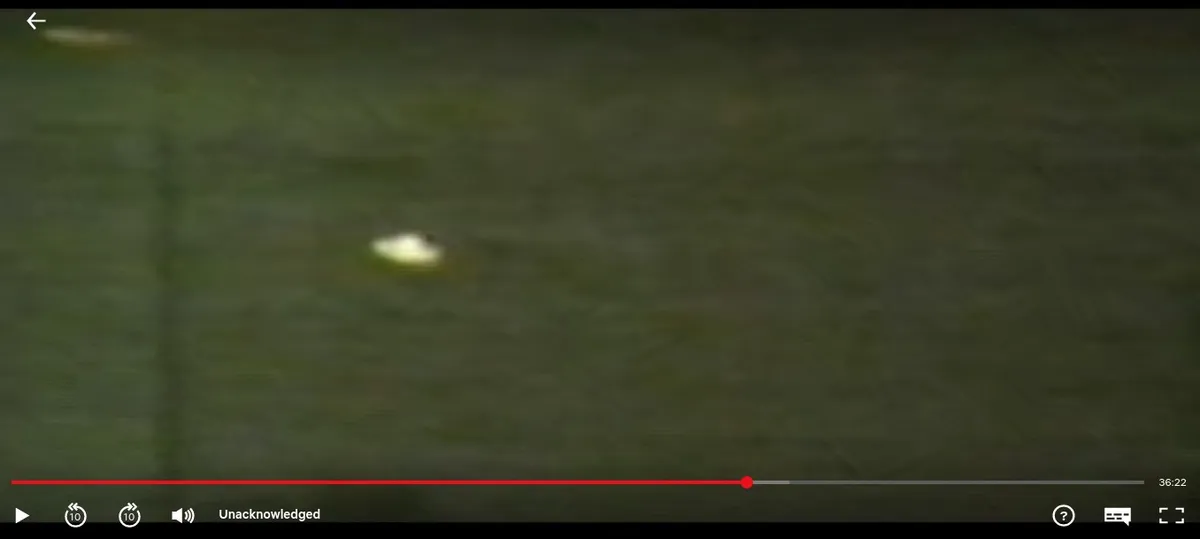

It is evident that these images are not evidence of any extraterrestrial spacecraft, but of lights or objects in the sky that are not known what they are. They could be many things.
At the end of that film, a rhetorical question is asked:
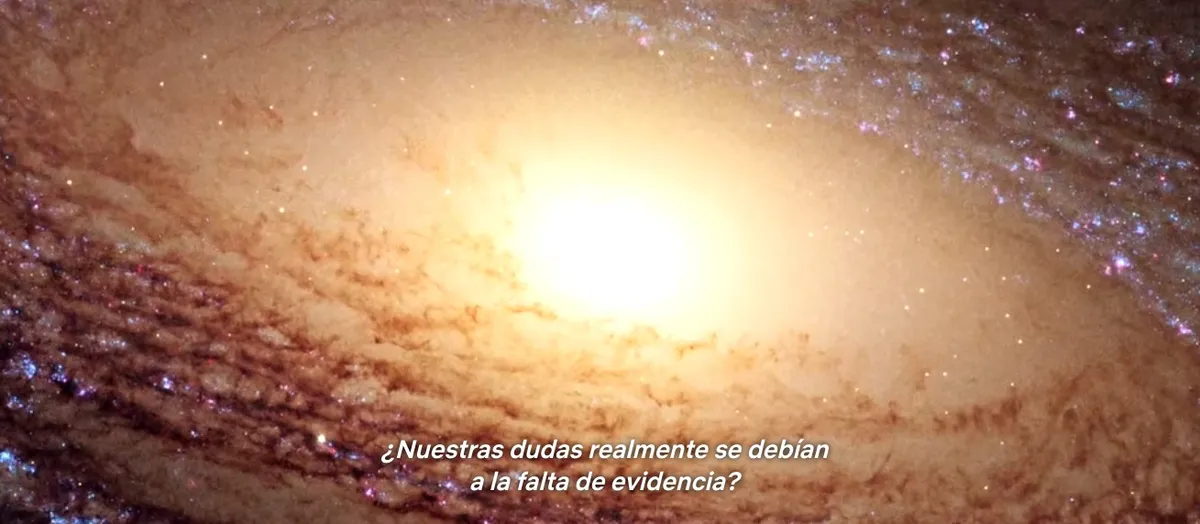
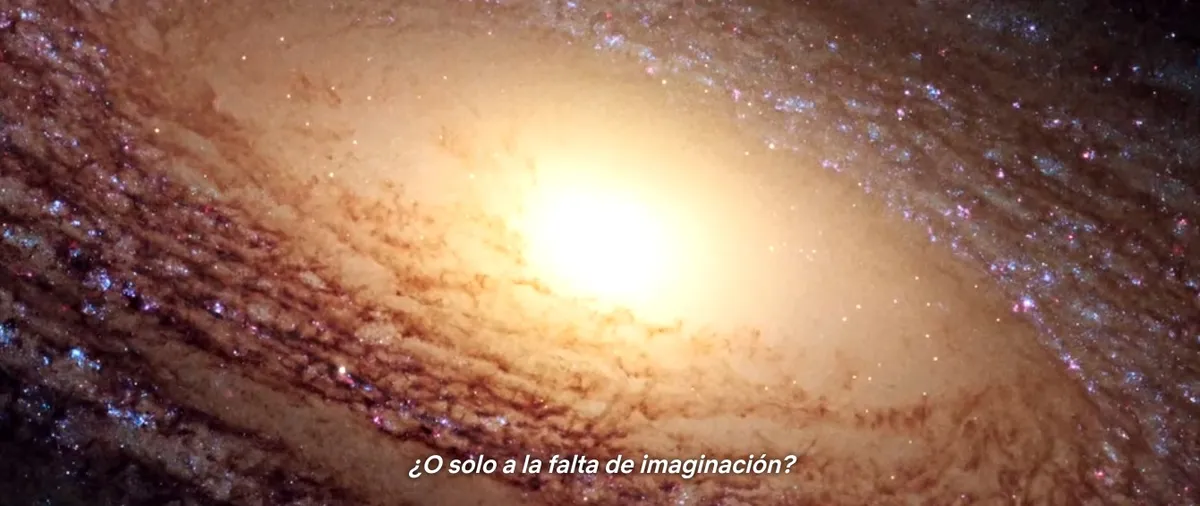
It is clear that to maintain that we have been visited by extraterrestrials for decades, blurry images and a lot of imagination are needed. The evidence is nowhere to be found.
In that film, it is argued that the U.S. possesses secret documents about alien technology that would change everything. People believe in ETs like those who believe in God. The solution to human problems does not come from the sky. Racism or unemployment are not solved with technology.
Ninth: It is striking that the Apollo program is questioned, but not all the other NASA missions since then (or before). Those who rely on conspiracy theories apply them to the Moon landings, but not to the successful landings of rovers on Mars (there are already 8), nor to the Voyager, Pioneer, Cassini, New Horizons spacecraft, and so many others. In all those cases, the evidence was also produced (almost) entirely by NASA. In some cases, NASA missions had collaborations from other countries, as is the case with the Hubble Space Telescope and the ISS.
Tenth: One cannot be critical if one does not first know the reality being criticized. It is illogical to deny the technological development of countries like the United States. Whether we like it or not. That does not prevent being critical of the policies of different U.S. governments, whether from an economic point of view or from political interference in other countries.
I am in favor of scientific-technological development in a peaceful manner with the goal of better understanding reality, for example, in astronomy.
The Apollo missions had more of a political than a scientific objective. I do not share the former: it is not proven that a country or political-economic system is better just by reaching the Moon first. It is proven by lifting workers out of poverty. Despite that, scientific-technical knowledge was produced that allows us to better know not only the Moon, but also to explore other worlds.
Being in favor of NASA missions (or those of any other agency from any country) does not imply being in favor of the governments in power in those countries.
Accepting the Moon landing by the United States does not imply endorsing everything the governments of that country do. It is a ridiculous reductionism. In the same way, accepting that the Holocaust existed is not the same as endorsing it.
Aside: State Scientists
In a Spanish documentary, titled "Escépticos: ¿Fuimos a la luna?" the host went to a high school and half the students in a class denied that we had reached the Moon. Then he went to a university class: they all denied it. One of the arguments used by a university science student is that scientists who work for the State could well keep a secret, since the Government pays them. Unfortunately, the host of the documentary did not ask that future scientist if she would be willing to lie if the State paid her. Or a private company, which for that matter is the same.
Another of the future scientists doubted the Moon landings under the assumption that the flag was waving, but immediately admitted not having seen the video. He also said he distrusted "the Yankees." I suppose he does trust the Spanish State (the one that had Franco in power), or the German one (Hitler) or Russia (Stalin) or China...
These responses from those who will later, for the most part, be part of the State are curious.
Sources and related links
Escepticos: Fuimos a la luna?
https://www.documaniatv.com/ciencia-y-tecnologia/escepticos-fuimos-a-la-luna-video_c49bbc303.html
Recommended reading: La conspiración lunar...vaya timo
Eugenio Fernández Aguilar, Ed. Laetoli.
Hopscotch of the search for life in the cosmos https://www.noticiasdelcosmos.com/2020/06/rayuela-de-la-busqueda-de-vida-en-el.html
Densidad intelectual del Universo https://www.noticiasdelcosmos.com/2020/06/densidad-intelectual-del-universo.html
About the images
Screenshots.