A few years ago, a group of astronomers predicted a red nova for the year 2022. Later, another team denied it. The story of an astronomical error.
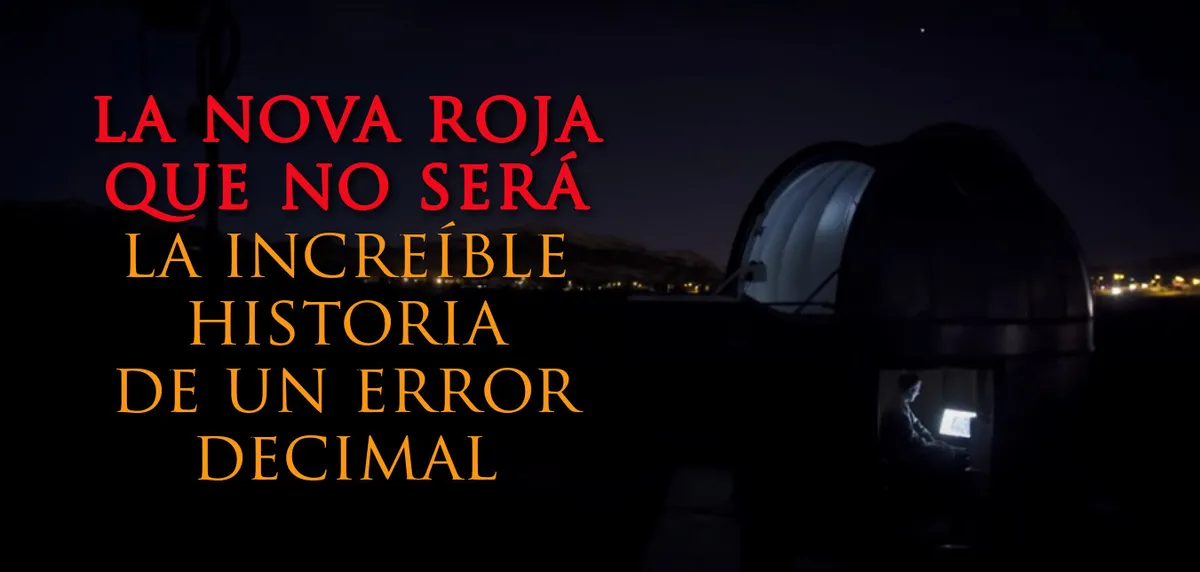
False positives in science could be considered harmful, as they are erroneous conclusions. But, in reality, they are the fruit of the virtuous cycle of the sciences: verification.
Unlike the failed prediction of a Betelgeuse supernova last year, an error driven more by desire than by objective data, this other earlier case is incredible, because ultimately, the error lay in a decimal place when converting a date format. In the study of celestial objects, even minor failures have astronomical size. Let's see how this story went.
INTRODUCTION: LUMINOUS RED NOVAE
For a few years now, astronomers have thought there is a phenomenon known as Luminous Red Novae, the result of the merger of two stars in a binary system. Due to the large amounts of dust and gas scattered by the outburst, the light reddens, since the peak luminosity occurs in the L band (3.5 micrometers), that is, in the infrared. An example may be V838 Monocerotis. The binary nature of the red progenitors was confirmed in Nova Sco 2008 thanks to archival data that revealed the precursor was the contact binary system V1309 Scorpii.
THE CASE OF KIC 9832227 AND THE PREDICTION
KIC 9832227 was originally classified as an RR Lyrae object, a type of variable star, but with data from the Kepler mission, in 2013, it was shown to be a contact binary system, that is, two stars orbiting around a common center of mass, so close that they share the outer layer of their atmospheres. A later investigation by Molnar and others in 2017 showed significant changes in the 11-hour period using eclipse timings from almost two decades earlier, with an exponential decay function of the same form as V1309 Scorpii.
That is, the stars are getting closer and closer and, when doing the calculations, they came to the conclusion that the merger would produce a red nova, reaching an apparent visual magnitude of almost 2 (visible to the naked eye) in 2022. Thus, KIC 9832227 could give astronomers the rare opportunity to study a red nova progenitor in detail before the outburst. This led other astronomers to become interested in the topic and finally discover that the prediction had an error as small as it was fatal.
THE DENIAL OF THE PREDICTION
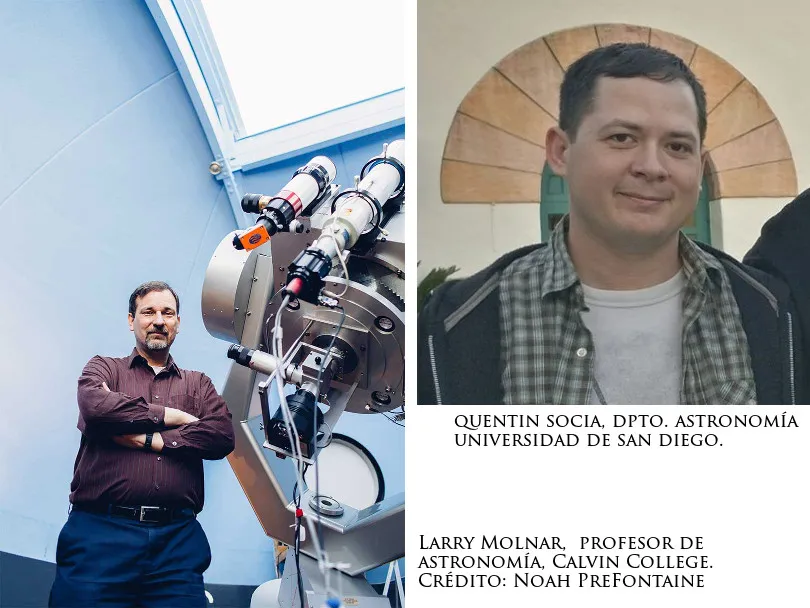
That new research was published in 2018 by Quentin Socia and others. For that work, they used data from the Vulcan photometer, with a 10 cm aperture, installed at Lick Observatory, designed to detect Jupiter-sized planets around stars like our Sun. It observed 20,000 stars brighter than magnitude 13 in a field of view of 49 square degrees for 90 days in the boreal summer of 2003. The Vulcan survey shares a substantial amount of data with the Kepler mission field, which makes it valuable.
Quentin Socia and his team de-archived and recalibrated the Vulcan observations of the object KIC 9832227. Eclipse timings (when one star passes in front of the other from the point of view of Earth observers) are crucial for the research, so to confirm the accuracy of the Vulcan timings, they measured the eclipse timings of another well-studied object and found they were good.
Then they searched for data on the object in question in the Northern Sky Variability Survey (NSVS) and found records from two camera fields which they combined into a light curve.
In summary, the idea is this: there are two very close stars, which eclipse each other every certain time (period). If they are finally going to merge, then that period should be getting smaller and smaller, meaning the time between eclipses should decrease over time (decay). To know if that is what is happening, observations made previously are sought. Such data can come from different surveys made with different instruments. This data must be calibrated. Particularly, certain time conversions are used, which I will refer to shortly. The NSVS survey was published by Woźniak and others in 2004. That data was also used in the previous research that arrived at the prediction of the red nova in 2022. This is vital to understanding the matter. All possible archival data was taken to find a possible trend. That is what Molnar's team found in 2016 and what Socia's other group reviewed in 2018. The oldest data used was that from NSVS, from 1999. In that chronological series of data, the NSVS data were the first.
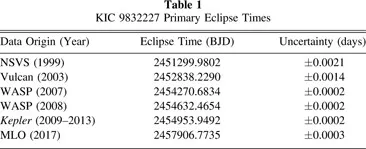
In addition, they added observations made by them in 2017 from the Mount Laguna Observatory (MLO). Finally, in their analysis, Quentin Socia and team say that to their surprise, the eclipse timing measurements in the Vulcan data do not agree with Molnar's prediction. Furthermore, their NSVS measurements differ by +1.01 hr from Molnar's eclipse timings. Based on the evidence from the Vulcan data, they speculate that the discrepancy with the NSVS timings could have been caused by a cycle count error and an MJD to BJD conversion error. And that?
DATES IN ASTRONOMY
MJD means Modified Julian Date, and is obtained by subtracting 2,400,000.5 days from the Julian date. Thus, MJD gives the number of days since midnight on November 17, 1858. That date corresponds to 2400000.5 days after day 0 of the Julian calendar. And that?
The Julian day is a way of counting days. Not months, nor weeks, nor years. This is particularly useful for counting the days that separate two astronomical events, like eclipses. The Julian day began to be counted from January 1 of the year 4713 before the common era, also called BC.
However, this way of counting must make clear when a new day begins to be counted. In the Julian day, that is at noon. By virtue of this, the hours must be taken into account. For this purpose, the Julian date is expressed using decimals. For example,
Saturday, January 1, 2000, at noon corresponds to the Julian date 2451545. That is, the number of days that have passed since January 1, 4713 BC.
However, Saturday, January 1, 2000 at midnight (twelve hours earlier) is the Julian date 2451544.5. And Saturday, January 2 at midnight would be 2451545.5. This small addition, a decimal place, is not so small if we understand that 0.5 days are 12 hours.
If instead of using JD (Julian Day) 2451545.5 we used MJD, it would be 51545, since instead of counting from the year 4713 BC, we would be counting the day difference from 1858. This variant is used to reduce the number. One can convert from one variant to the other.
However, ALERT! Unlike the Julian date, the MJD is calculated from midnight, meaning there is a half-day (12 hours) difference. This is what in English is called a "half day offset". It may seem trivial, but when evaluating eclipse times, this difference is significant.
Furthermore, in papers, BJD is also used: The Barycentric Julian Date is the Julian date corrected for differences in Earth's position relative to the barycenter of the Solar System.
ANALYSIS OF THE ERROR
Quentin Socia says in his paper that since the binary system's period is 10.99 hr, if the 0.5 day difference was omitted when converting MJD to JD, and the eclipses shifted by one cycle, there would be a difference in eclipse timing of 0.99 hr. The red X in the following figure is the hypothetical data point where both factors are included. The X agrees with the exponential decay curve. Moreover: Wozniak defines in his table 6 of the NSVS that MJD ≡ JD - 2400000; but in the draft version (on Arxiv) it appears differently, with the addition of the difference, as shown below:
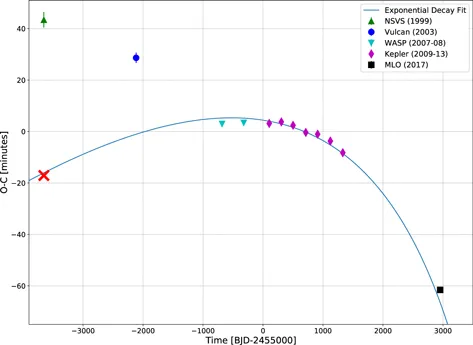
Figure 3 from Q. Socia's paper: this is an O-C diagram (observed minus calculated) for KIC 9832227 with a reference period of 0.4579515 days. The blue curve is a recreation of Molnar's (2017) exponential decay with the same period. The red X on the left is the NSVS data point with 1 cycle and the MJD +0.5 error.
Here we see Table 6 from the NSVS publication in the original paper (with the error) and in the draft on Arxiv.
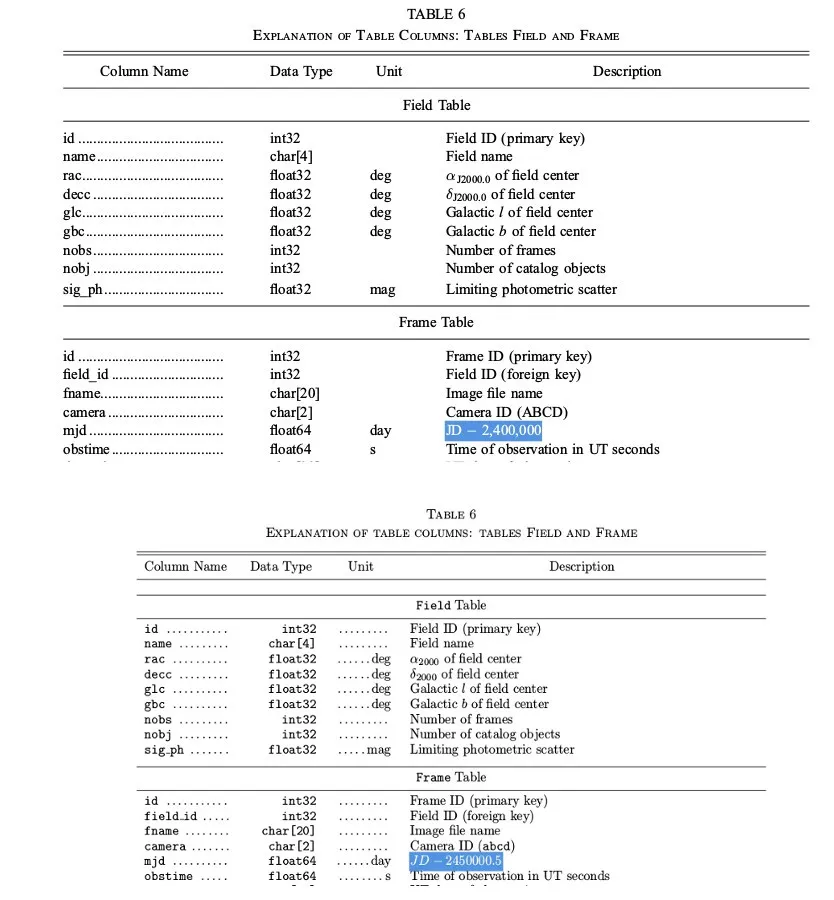
To seal the error hypothesis, in private communication between Socia and Molnar, the latter pointed out that from Los Alamos (where the NSVS was done), the KIC 9832227 system would not be above the horizon at the time reported by Wozniak in 2004, strengthening the idea of the MJD error.
The difference of one cycle means that if the eclipses of the object under study occur every 11 hours, as we said at the beginning, and there is a 12-hour difference in the initial data, one cycle (plus one hour) was omitted. The period is usually indicated in days, instead of hours, but 0.45 days is 11 hours.
THE THIRD PARTY IN DISCORD
In both works, Molnar's and Socia's, it is postulated that in the system in question there is a third star with a mass less than 0.8 Solar Masses.
In the following graph, the O-C diagram is reviewed with all the times, and the data for three potential stars of different mass are shown in dotted lines. In this correction, T0 = 2454953.48885.
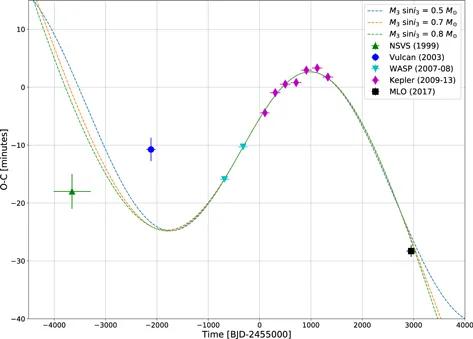
In any case, the O-C diagrams show real changes in period. But the authors point out that this is common and does not necessarily indicate a decay curve, meaning the stars are about to merge soon. Different processes can explain the period difference: mass transfer or magnetic cycles are plausible causes. Systems like AB Andromedae, AH Virginis and V566 Ophiuchi vary in their eclipse times by up to 2 hr. Thus they concluded that KIC 9832227 does not exhibit the decay period similar to V1309 Scorpii, so it is unlikely to merge in 2022.
O-C DIAGRAMS
It can be difficult to interpret these diagrams, but we can understand them this way: they plot the Observed minus the Calculated. So if I have observations of reality and theoretical calculations and my theory equals reality, then O-C=0, meaning they cancel because they are equal quantities. But if my theory is not correct, there will be a difference that will remain. Those differences can be due to the need to correct the theory or that something about reality remains undiscovered. In a stellar system, the difference could imply the existence of another object not yet discovered. However, it is vital that what is observed is real, otherwise false conclusions will be reached.
So when reading an O-C diagram we will look at the Y-axis, where O-C is usually placed, and we will note that there is a value 0. Everything that appears there implies agreement between O and C (that's why it's zero when subtracted). What is below or above is the difference.
MOVIE-LIKE CONCLUSION
Larry Molnar and his team did things right. Their work is based on data. They used the Calvin Observatory between 2013 and 2016, as well as archival data between 2007 and 2013. To complete the eclipse times, they used the NSVS survey from 1999. The latter was published with an error in the MJD to JD conversion. Incredibly, such a typo does not appear in the draft version of the work in the well-known digital repository Arxiv. The error in one decimal implied a difference of 12 hours. And the object's period is 11 hours, meaning a difference of one cycle plus one hour. When reviewing that primordial data point (the oldest data), Socia's team realized the prediction had to change.
In a statement from Calvin University, Quentin Socia expressed: "This is possibly the most important part of the scientific process. Knowledge advances most when bold predictions are made, and people question and test those predictions". And he added: "Often, the most exciting discoveries occur when our expectations are not met. This is a good example of how scientists from different parts of the world can work together to better understand how our universe works, bringing new pieces to the puzzle".
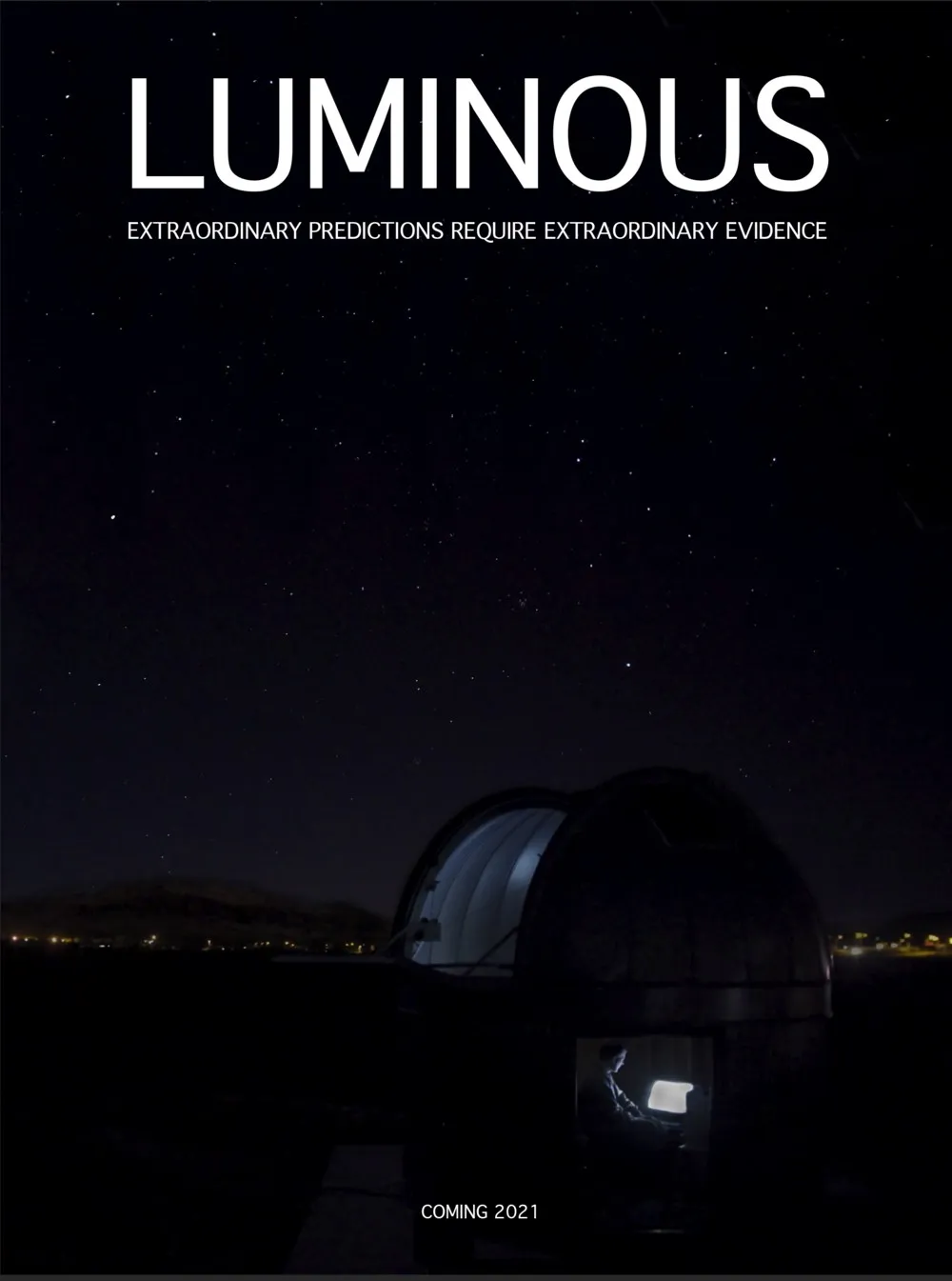
The publication of the prediction, in 2016, was accompanied by a trailer for a film that was planned to be made about the alleged discovery. The project dates from 2014 and the idea was to document the entire process until the end of 2022 or when the "new star" occurred. A website about the film was created and is still online. Director Sam Smartt seems not to have abandoned the project, titled "Luminous".
In an email communication, director Smartt confirmed to me that he is in the post-production process of the film and plans to finish it for the Northern Hemisphere fall-summer. He already has screenings scheduled in various places in the U.S. He offered me the possibility of screening the film in Argentina as well, if it is of interest to amateurs. The documentary includes an interview with Socia, whom the director visited in San Diego, meaning it tells the whole story, despite the failed prediction.
On the film's poster, the phrase is added: "Extraordinary predictions require extraordinary evidence".
What is truly extra-ordinary is that a simple decimal error has such an impact. Not even in comets is the comma so important. Mathematics has no feelings.☉
Sources and related links
- TEAM OF RESEARCHERS CHALLENGE BOLD ASTRONOMICAL PREDICTION
https://calvin.edu/news/archive/team-of-researchers-challenge-bold-astronomical-prediction - KIC 9832227: Using Vulcan Data to Negate the 2022 Red Nova Merger Prediction
Quentin J Socia et al 2018 ApJL 864 L32
https://iopscience.iop.org/article/10.3847/2041-8213/aadc0d - Northern Sky Variability Survey (NSVS): Public data release
https://arxiv.org/abs/astro-ph/0401217 - Northern Sky Variability Survey: Public Data Release*
P. R. Woźniak et al 2004 AJ 127 2436
https://iopscience.iop.org/article/10.1086/382719 - Modified Julian Date
https://scienceworld.wolfram.com/astronomy/ModifiedJulianDate.html - The Red Nova Prediction
https://calvin.edu/publication/spark/2016/03/15/the-red-nova-prediction - The Typo That Ruined a Prediction
https://www.investigacionyciencia.es/noticias/la-errata-que-arruin-una-prediccin-16756 - LUMINOUS Trailer
https://www.youtube.com/watch?v=8yYZGOk-oaw&feature=emb_logo&ab_channel=SamSmartt - Luminous film
https://www.luminous-film.com/about
About the images
Credit for the graphics: Q.Socia et al (2018); Wozniak et al (2004).
Initial image: Sam Smartt trailer.
Luminous poster: Sam Smartt.