They are satellites of M31. When is its birthday?
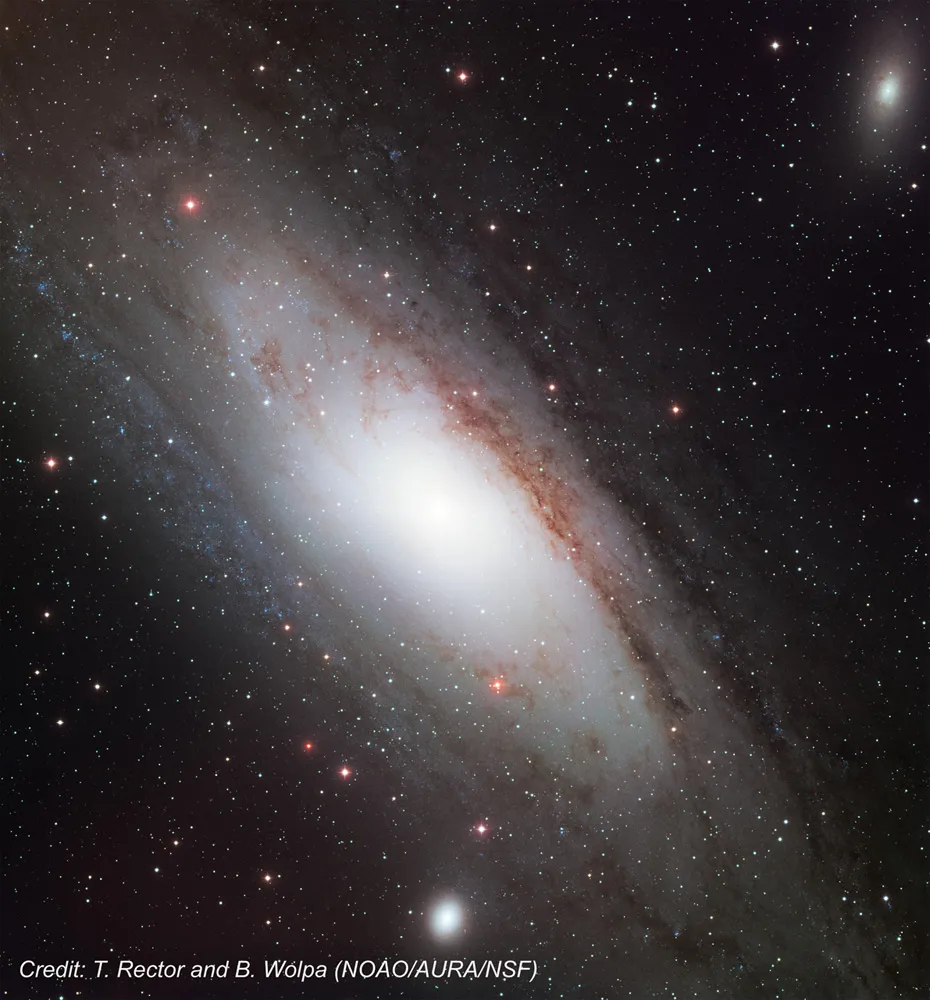
Andromeda, the great spiral galaxy with entry 31 in the Messier catalog and number 224 in the New General Catalog (NGC) is surely the second best-known galaxy, after the Milky Way, by the general population. That does not make it the closest, as there are many others at shorter distances.
Probably one reason for its fame comes from its large size, more than double that of our galactic home. Together with M33, the Triangulum Galaxy, they stand out as the great spirals of the Local Group.
Some records indicate that the first observation corresponds to a Persian astronomer, Abd Al-Rahman Al Sufi (also known as Azophi), between the years 960-965.
Charles Messier included this "spiral nebula" in his catalog on August 3, 1764. It indicates Simon Marius, a German astronomer, as the discoverer. This is how it appears in the original from 1771 (published in 1774) in the Memoirs of the French Academy of Sciences. The annotation for this entry said:

SUPERNOVA 1885
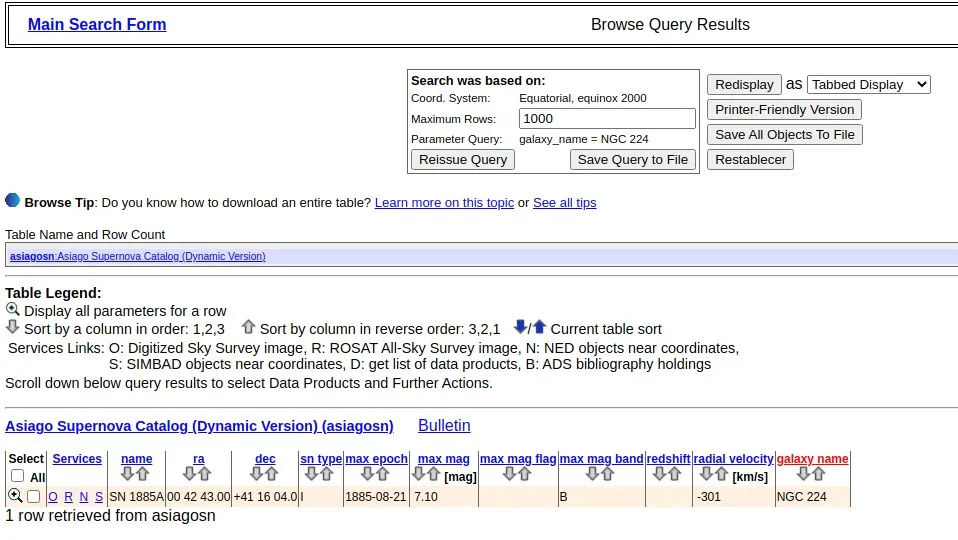
As strange as it may sound, there is only one record of supernova observation in M31, made by Ernst Hartwig at the Dorpat Observatory in Estonia. It was on August 20, 1885 and reached magnitude 6. It is known as S Andromedae or SN 1885A.
If seeing a Milky Way supernova with the naked eye is like scoring a goal from midfield, then seeing an Andromeda supernova with the naked eye is like scoring a goal from a kilometer away!
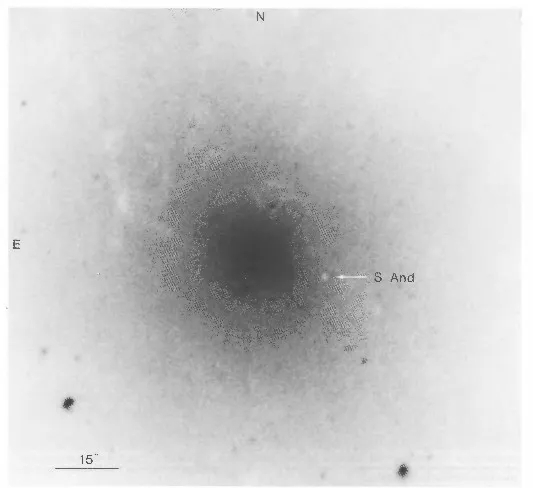
More than a century later, in 1989, a group of astronomers recorded the remnant of that supernova:
In 2002 Kong and others published a research paper on two years of observations of M31 in X-rays. There they detail the discovery of two supernova remnants in Andromeda.
In the Asiago Supernova Catalog, only SN 1885A is listed as an event in NGC 224.
CEPHEID V1: THE REVOLUTIONARY STAR
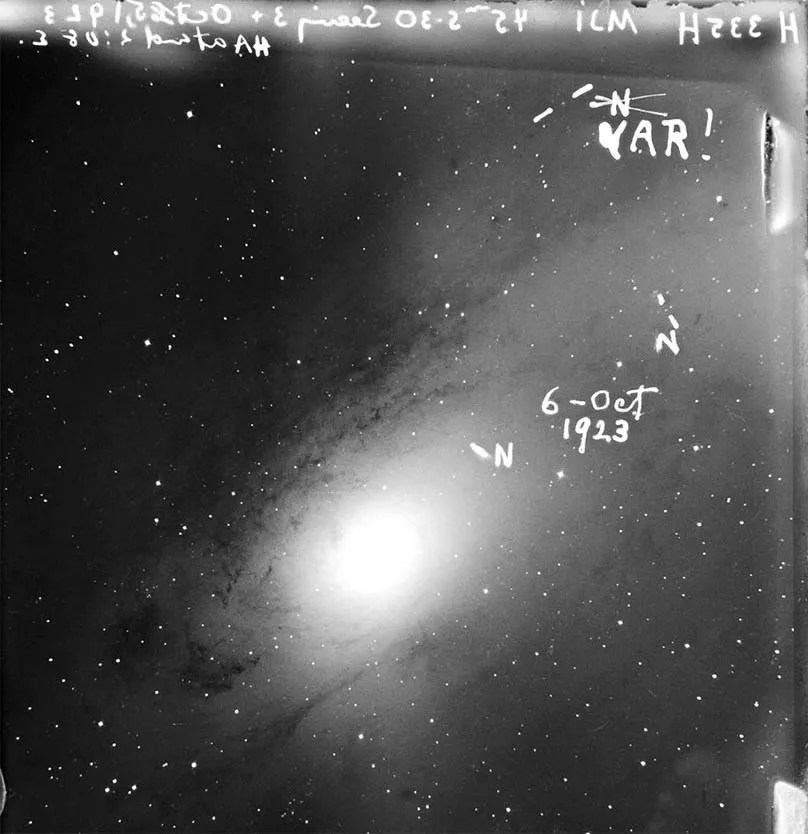
Another strong reason why this galaxy is one of the most famous is the discovery of Cepheids by Hubble, which ended "The Great Debate" and since then spiral nebulae have been considered galaxies. On the night of October 5-6, 1923, Edwin P. Hubble took a plate of Andromeda with the 100-inch Hooker telescope at Mount Wilson Observatory. That plate, with the identification H335H ("Hooker plate 335 by Hubble") is famous for the discovery of the first Cepheid, the star that would revolutionize our idea of the size of the universe.
THE OTHER ANDROMEDAS
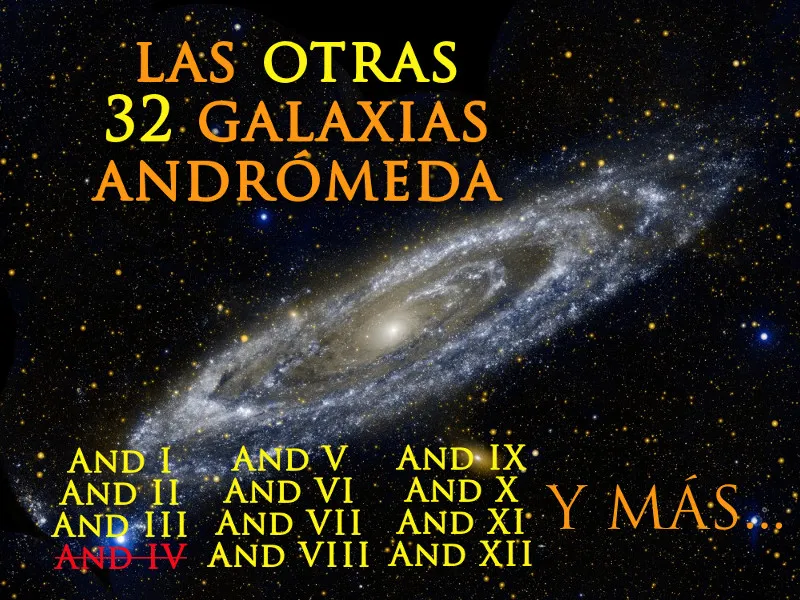
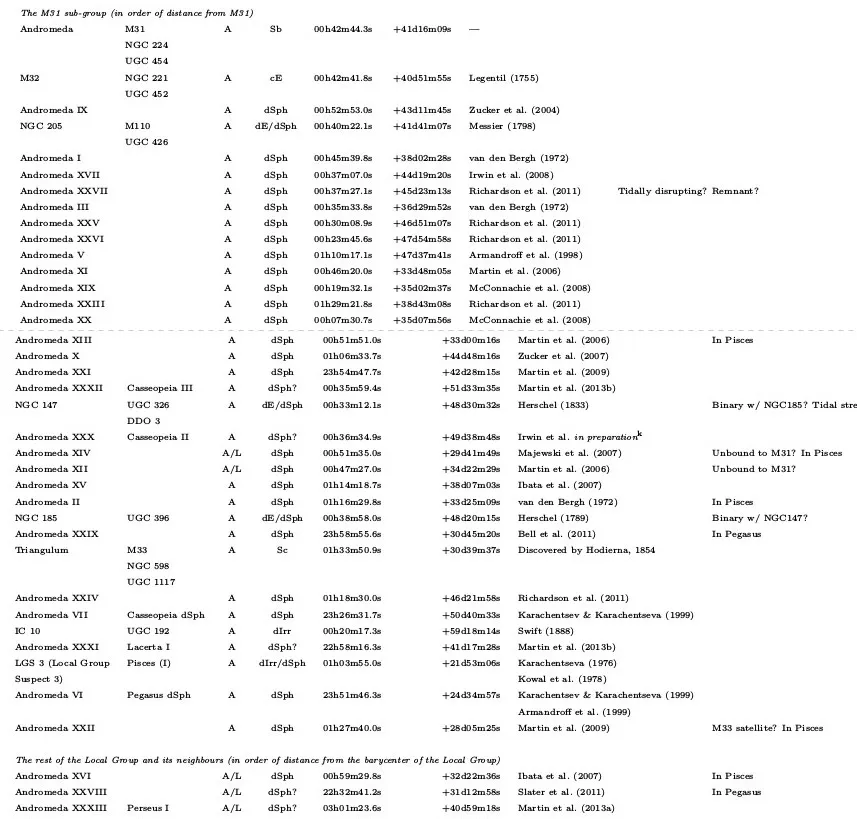
Like other large galaxies, M31 has satellites, galaxies that orbit it. According to Wikipedia, it has at least 13 dwarf galaxies, the brightest and largest of which is M110, followed by M32. Some of these satellite dwarfs are also called Andromeda, plus a number. Andromeda I is a spheroidal dwarf (dSph), as are almost all the other satellites, known as Andromeda II, Andromeda III, Andromeda V... up to Andromeda XXXIII, discovered in 2013.
What happened to Andromeda IV?
It was discovered in 1972, but more modern research indicates it is an irregular dwarf at 22-24 million light-years, an isolated galaxy that has no gravitational relationship with M31.
There is no consensus on whether M33 is a satellite galaxy of Andromeda or not.
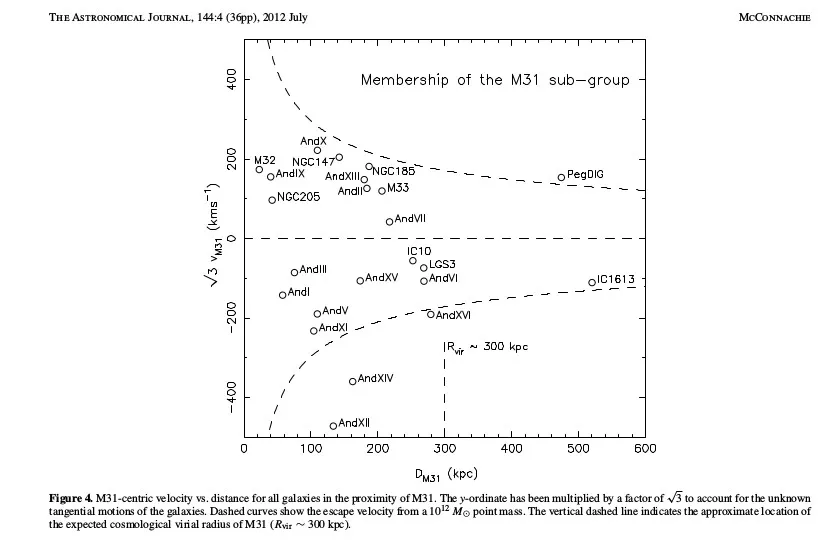
A paper by astronomer McConnachie published in 2012 details the observed properties of dwarf galaxies in and around the Local Group.
From there I extract a map of the M31 subgroup and a combined table here (it's from several pages) with the details of many of the satellites.
BIRTHDAY
It is not common for galaxies or stars to have a birthday date. But since records with day and month indicate it was included in the Messier Catalog on August 3, 1764, that date could well be used, which in reality would not be its "birth" date, but its registration in a first catalog (even though it was discovered earlier).
The date of October 5-6, 1923 could also be used, for the discovery of the first Cepheid variable in M31, a milestone in the history of astronomy.
In any case, it's not a good idea to throw a party. The cake would need about 10 billion candles. And it would be accompanied by its 32 neighbors out of gravitational solidarity. Or perhaps stellar sorority.☉
Sources and related links
- Charles Messier's Original Catalog of 1771
https://www.messier.seds.org/xtra/history/m-cat71.html - The Great Debate of Cosmology Turned One Hundred
https://www.noticiasdelcosmos.com/2020/05/el-gran-debate-de-la-cosmologia-cumplio.html - La variable más ignorada
https://www.noticiasdelcosmos.com/2011/05/la-variable-mas-ignorada.html - Hubble's Famous M31 VAR! plate
https://obs.carnegiescience.edu/PAST/m31var - Andromeda IV turns out to be a solitary gas-rich dwarf galaxy
https://phys.org/news/2015-12-andromeda-iv-solitary-gas-rich-dwarf.html - THE OBSERVED PROPERTIES OF DWARF GALAXIES IN AND AROUND THE LOCAL GROUP
Alan W. McConnachie, 2012 AJ 144 4
https://iopscience.iop.org/article/10.1088/0004-6256/144/1/4
https://www.cadc-ccda.hia-iha.nrc-cnrc.gc.ca/en/community/nearby/ - ASIAGOSN - Asiago Supernova Catalog (Dynamic Version)
https://heasarc.gsfc.nasa.gov/W3Browse/all/asiagosn.html - The Local Group supernova rate.
https://ui.adsabs.harvard.edu/abs/1983PASP...95..388V/abstract - Two Years of the X-ray Sky in M31
A.K.H. Kong, M.R. Garcia, F.A. Primini, R. Di Stefano, S.S. Murray (CfA)
https://arxiv.org/abs/astro-ph/0202065 - Discovery of the Remnant of S Andromedae (SN 1885) in M31
Robert A. Fesen, Andrew J. S. Hamilton, Jon M. Saken
https://ui.adsabs.harvard.edu/abs/1989ApJ...341L..55F/abstract - S Andromedae: Supernova 1885 in M31
https://www.messier.seds.org/more/m031_sAnd.html - HST Images and Spectra of the Remnant of SN 1885 in M31
Robert A. Fesen et al
https://arxiv.org/abs/astro-ph/9810002
About the images
SNR And: Credit Fesen, Hamilton, Saken (1989)
The Cepheid variable star V1 M31 marked (var!) on the original plate by E. Hubble.
GROUND-BASED IMAGE OF ANDROMEDA GALAXY, M31 https://hubblesite.org/contents/media/images/2012/04/2962-Image.html
T. Rector and B. Wolpa (NOAO/AURA/NSF)
ANDROMEDA GALAXY HALO DETAILS https://hubblesite.org/contents/media/images/2003/15/1343-Image.html
NASA, ESA and T.M. Brown (STScI)
The Galaxy Next Door https://www.nasa.gov/mission_pages/galex/pia15416.html
NASA/JPL-Caltech