Astrophysicists are rewriting the textbooks.
The logonaut of the Kosmopista travels the universe looking for stories to tell, aboard his ship, the Tortuga de Luz. But sometimes, this probe escapes and leaves the navigator on foot, so he is forced to "hitchhike" or take the C bus. After waiting a while at the stop, the cosmosbus arrived and the logonaut got on. The trip is not paid with money, but with gray hairs. While looking out the window, marveling at the space landscape, a street vendor appeared.
-"I sell, I sell, cosmic trinkets, I selllll," he shouted.
-"Can I offer you some astronomical scoop, sir?" inquired the vendor to the traveler.
-"Do you have little whales?" asked the blogger.
-"The what? No, I don't know what that is," he replied and added: "I sell breaking news, do you want some?"
-Too bad you don't have little whales. They're for shirts...anyway. Do you have something new for my log?
-Of course: supernovas.
-Supernovas? They're not exactly news...
-Ahh, but these are. They're new. They don't appear in the classifications in the textbooks, they were never seen before, they are reserved for the most massive stars, probably the primordial ones and also for some very well-known ones, in the future, like Eta Carinae. And they leave no remnant.
-I'm interested. How much is the news?
-Twenty gray hairs...green ones.
The Logonaut paid with effort, got off at the next stop and began to write the story. This is the result.
If the public looks for bibliography on the subject, they will find supernova classification criteria, which are very similar to algorithms, and which divide these processes according to the chemical composition of the stars. In a broader framework, if we think about how the life of stars ends, we will have to add mass, which determines whether the end will be one way or another. In that sense, the supernova end is reserved for the most massive stars, but within that category there are divisions.
We will soon review those classifications, typical of textbooks. But in the research of recent years, astrophysicists have proposed other types of supernovas, which do not appear in traditional schemes. The books are being re-written, adding "new" supernovas.
REVIEW: TRADITIONAL SUPERNOVA CLASSIFICATION
Synoptic charts are a very suitable visual synthesis for understanding how astronomers classify supernovas.
Here I show one such scheme:
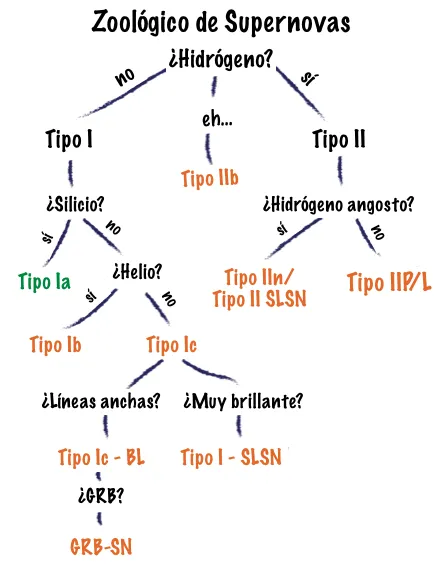
Fig. 1: A supernova algorithm.
As we see, at the beginning, it asks if the star has hydrogen. If it does not, it will be a Type I supernova, whereas if it does, it will be Type II. If we follow the first branch for the NO, then:
If the star (which must be more massive than a certain amount), does not possess hydrogen, it will have a Type I supernova end. But if it has silicon, it will be Type Ia and if it does not, we must consider if it possesses helium. If it does, it will be Type Ib and if it does not, it will be Type Ic.
To know if stars possess certain elements or not, astronomers use spectroscopy, which is dividing the radiation that arrives from the stars by passing it through a prism to evaluate the emission/absorption lines in comparison with the lines generated in a laboratory. Chemical elements generate certain lines in the spectra of stars at different wavelengths, measured in λ Armstrong or nm (nanometers). Light curves are also used to establish the classifications.
In other schemes, the mechanism is also indicated, divided between thermonuclear explosions or gravitational collapses.
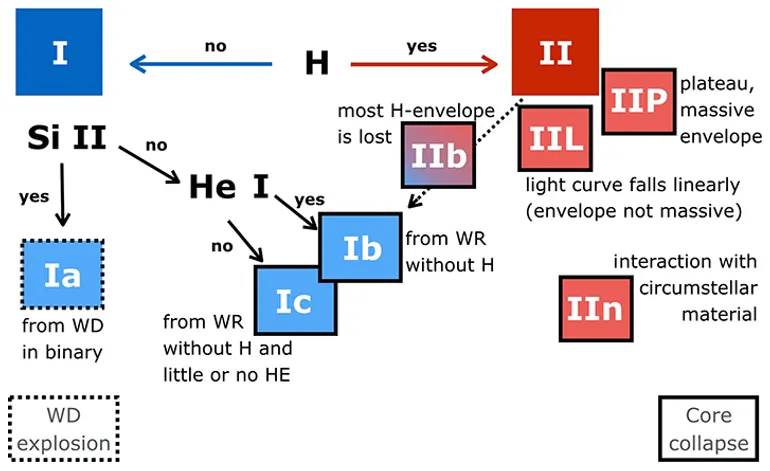
Fig. 2: Another supernova classification scheme.
The most famous are Type Ia, as they are used as "standard candles" to measure distances. They are associated with white dwarfs that extract mass from other stars, which ultimately produces a thermonuclear explosion.
The rest are produced by gravitational collapse, being very massive. Astronomers, thanks to the study of spectra, know that as stars evolve, they fuse different elements forming "onion layers". In some periods, stars expel the outer layers of their atmospheres. Thus, Type Ib supernovas no longer have the hydrogen layer, but they do have the helium layer. Type Ic lack both layers. Type II do possess the hydrogen layer, but Type IIb possess little.
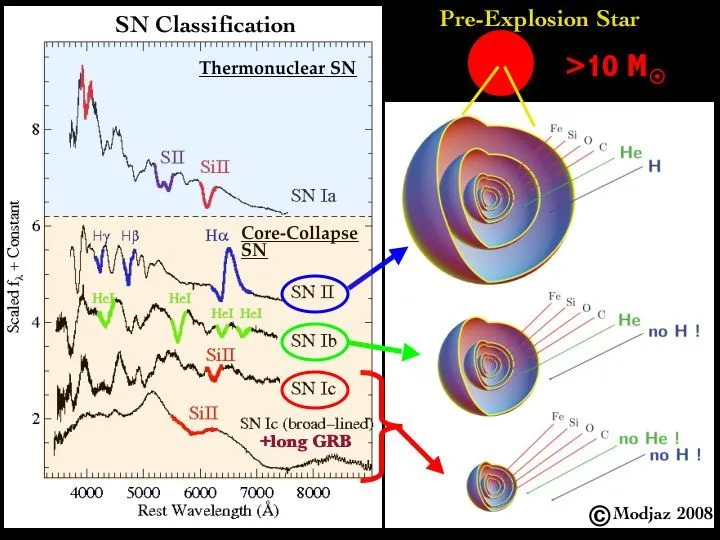
Fig. 3: SN classification illustrating the "onion layers" of stars.
A LITTLE BIT OF HISTORY
Records of supernovas are found in different cultures around the world. The Chinese recorded the supernova of 1054. The Danish astronomer Tycho Brahe recorded a "new star" in 1572. Towards the end of the 19th century, William Huggins made the first observations of nova spectra noting the hydrogen lines. In 1885, Ernst Hartwig recorded what would be the first extra-galactic detection, in M31 (Andromeda). In 1938, Walter Baade identified a nebula as a supernova remnant.
The classification of supernovas dates from 1941 when Rudolph Minkowski recognized two types according to the possession or not of hydrogen lines.
Later, Fritz Zwicky proposed other classes. That is why the Brazilian astronomer Luiz Augusto L. da Silva called this classification scheme Minkowski-Zwicky (MZ) in a 1993 paper.
In 1987, supernova research received a notable boost with the recording of SN1987A in the Large Magellanic Cloud. Even though the Hubble Space Telescope had not yet been launched, pre-event images allowed it to be linked to a blue supergiant progenitor star, similar to Rigel (the brightest in Orion, although it is called Beta Orionis).
THE NEW SUPERNOVAS
For some years now, there has been talk of pair-instability supernovas. Perhaps the origin is the discovery of SN 2006gy in 2006 which was considered the most luminous at that time and remains one of the brightest recorded. The supernova lies in a distant galaxy (NGC 1260) some 238 million light-years away. It was classified as Type II because it showed hydrogen lines in the spectrum. The radiated energy has been calculated at 10^51 ergs, hundreds of times more powerful (two orders of magnitude) than a typical supernova, which suggests that the progenitor star must be very massive. It was suggested that it could have originated through pair-instability ejections. We'll see what that is. But first, let me amaze you.
ETA CARINAE, A KEY PIECE
This star in the constellation Carina is a hypergiant located 7,500 light-years away in the Milky Way. As it lies 32,000 times closer than SN 2006gy, its light will be a billion times brighter when its end comes. If it exploded as a supernova in our lifetime, we could see it with the naked eye, even during the day. We could read at night thanks to its light. The apparent magnitude of SN 2006gy was 15, but a similar event in Eta Carinae would be -7.5.
So, if the progenitor of SN 2006gy was a star like Eta Carinae and the supernova was not as indicated by traditional classification diagrams, then we cannot help but be enormously curious about this "new" class of supernova.
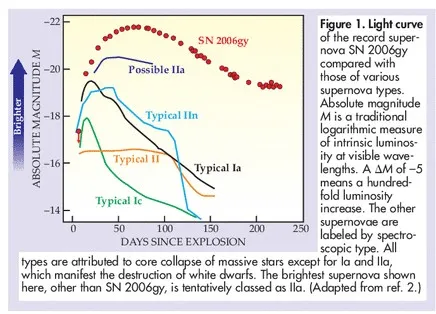
Fig. 4: Comparison of the absolute magnitude of SN 2006gy relative to typical SNe, as a function of time since the explosion (Physics Today 60, 7, 17, 2007).
PAIR-INSTABILITY SUPERNOVAE
Theory has allowed thinking about this type of supernova, abbreviated as PISN, for decades, for very massive stars. There is literature dating from the late 1960s. What does the theory say?
Photons produced by a body in thermal equilibrium have a blackbody spectrum with an energy density proportional to the fourth power of the temperature, as described by the Stefan-Boltzmann law. Wien's Law states that the wavelength of the peak emission of a blackbody is inversely proportional to its temperature. To put it in Spanish: there are certain relationships between temperature, energy, frequency, and wavelength. And when one thing changes, it alters the rest, like in a game of dominoes.
In very hot and large stars, with temperatures above 3x10⁸ K, the photons produced in the stellar core are mainly gamma rays, with a high energy level. The pressure of that radiation helps support the upper layers of the star against gravity. It's like an arm-wrestling match where gravity pulls "inward" and radiative pressure "outward." As long as these opposing forces are equivalent, the star maintains an equilibrium. But nothing lasts forever. If the level of gamma rays (energy density) is abruptly reduced, then the outer layers of the star collapse because gravity no longer has a rival in radiative pressure.
If the gamma radiation is sufficiently energetic, it can interact with nuclei and electrons and form particle pairs like electron-positron pairs that can meet and annihilate to create gamma rays again. In stellar cores with high density, pair production and annihilation can occur very rapidly. An avalanche of electron-positron pairs reduces the pressure. The star contracts, compressing and heating the core, and increasing energy production, which generates more gamma rays that generate more pairs and so on until the supernova occurs, since at each step the star contracted more. Gravity wins.
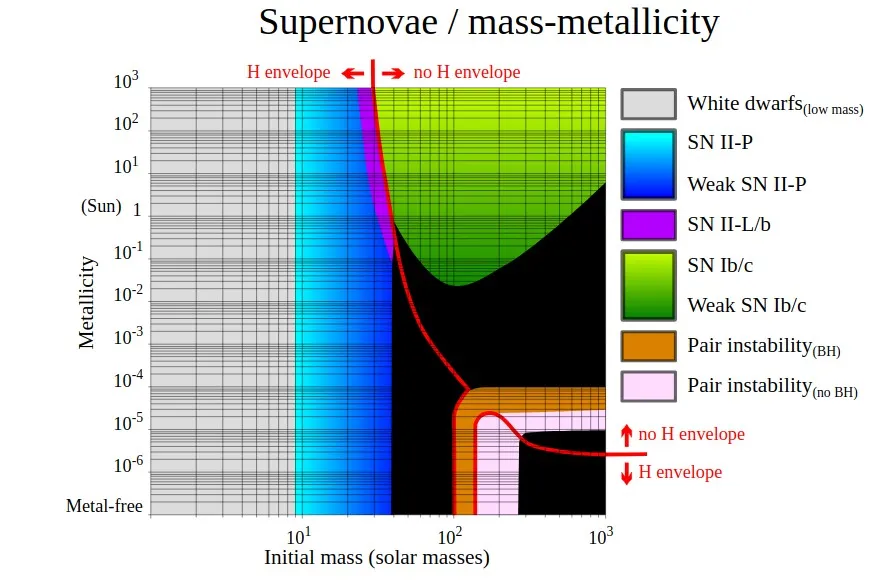
Fig. 5: Classification of SNe by metallicity.
What can prevent this process is rotation and metallicity. It is difficult to find objects in the universe that do not rotate. The lack of rotation is actually low-speed rotation. And metallicity is a term used in astronomy to denote the generation of elements heavier than helium.
This is why it is thought that pair-instability supernovae (PISN) must have been typical of primordial stars, those that had no metallicity, meaning they were composed of hydrogen and helium without other heavier elements. As we told here recently, these stars are known as Population III and have never been observed until now. It's that, being very massive, their lives are short, which implies they ceased to exist in the very distant past. With new instruments, with better resolution, it may be possible to detect fainter (i.e., more distant) objects.
However, in the local universe, stars hardly lack metallicity. In a 2007 paper, it is established that PISN or PCSNe (Pair creation supernovae) can occur with metallicities up to Z☉/3, meaning one-third of the heavy elements our Sun has. And they conclude that in the local universe there may be one PISN every 1000 supernovae and one every 100 at cosmological redshift z=5, which means very distant. According to the open supernova catalog, the most distant recorded to date is SN 1000+0216 with z=3.8.
PULSATING PAIR INSTABILITY OR FALSE PISN
Depending on the mass, some stars can have several contraction periods, making their variability "pulsating," but then the pair generation mechanism ceases and the star ends as a supernova of the already known classes. It is thought that Eta Carinae had such a period in 1843. These PPSIN (pulsating PSIN) would have masses between 100 to 140 solar masses, while the "true" PSIN would have masses between 140 to 250 M☉.
THE REMNANTS OF SUPERNOVAE
To add more mystery to PSIN, astronomers think this type of supernova leaves no trace. One of the astronomers who has been researching the topic and publishing a lot is named Alexander Heger. Here we see a graph from one of his 2002 papers:
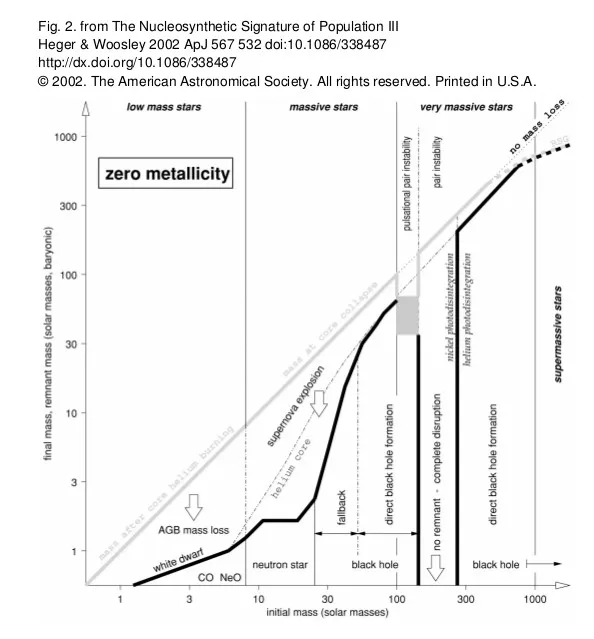
Fig. 6: Classification of SNe by remnant.
As can be seen, in some cases it indicates that the result of the supernovae will be neutron stars, in others a black hole will be generated, but in the particular case of PSIN, there would be no remnant, meaning the explosion destroys the star.
But there's more: for some years, astronomers believed they identified supernovae that could be good candidates for PISN. One example was SN 2007bi. But with more studies, it seems that it is actually a superluminous supernova (SLSN), which is not an exclusive classification regarding other types, but complementary based on luminosity. It is thought that stars with a mass greater than 40 M☉ can be SLSN at the end of their lives, like SN 2006gy. SLSN are associated with GRBs, gamma-ray bursts, and Wolf-Rayet stars.
THE SUPERNOVA PUZZLE
There is a phenomenon in astronomy that becomes evident with time and data collection: classifications are insufficient. The paradigmatic case was the redefinition of "planet" in 2006. What happens is this: astronomers are like hardware store clerks who store objects or phenomena in little boxes as they make discoveries, analogous to hardware stores that keep screws in one box, nuts in another, and so on. But with greater data collection, nuts and screws different from those previously known appear and they don't fit into any previous box, which forces a redefinition.
Here I show an animation of the discovery rate of supernovae over time. Over the years, astronomers have better instruments and techniques, and discover more supernovae. With that greater data collection, "rare cases" inevitably appear in relation to previous knowledge.
Fig. 7: Animation showing the positions of SNe discovered since 1885. The increase in the discovery rate in recent years is remarkable.
The historical reconstruction made here is somewhat simplistic, but sufficient to note that supernova classifications have used different criteria: mass, chemical composition by spectra, mechanism, and luminosity.
The theory of PISNe has existed for decades, but until recently it was just a mere potential curiosity, until supernovae that didn't fit into the rest of the "boxes" began to be detected. The importance of these phenomena is evident: stars are factories of heavy elements and supernovae contribute to the production and distribution of that matter in interstellar space. The enriched material later forms new stars (with planetary systems) and that is also why they are key to understanding galactic evolution and star formation rates.
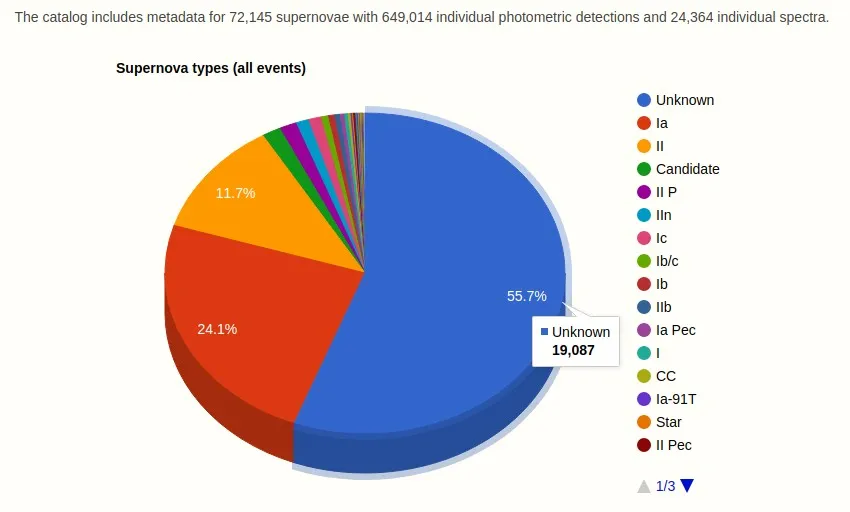
Fig. 8: Chart of the type of discovered supernovae recorded in the Supernova Open Catalog. In more than half, the type of SN is unknown.
THE COSMIC PLATYPUS AND THE STELLAR BLACK SWAN
A possible conclusion from this story is that the universe is weirder than we thought. We knew ducks and beavers, until one day platypuses were discovered and we didn't know what to do with those strange creatures.
Just as in the case of black swans, which were thought not to exist because none had been seen in Europe until the 18th century, since they are native to Australia, PISNe are a strange creature in the supernova zoo.
And as in other cases, the first is discovered last. It is somewhat paradoxical that PISNe may have been the preferential mechanism of primordial stars, and therefore, they would be the first supernovae, but the last to be discovered. So I don't know if I was scammed when they sold me this story as a scoop, but the truth is I didn't know it. The only thing I regret is that that space street vendor didn't have little whales...☉
Sources and related links
SN 2007bi: Without a Trace https://astrobites.org/2020/12/04/sn-2007bi-without-a-trace/
Supernovae from Blue Supergiants https://astrobites.org/2011/03/27/supernovae-from-blue-supergiants/
Pair-Instability Supernovae: What might they look like?
https://astrobites.org/2014/10/28/pair-instability-supernovae-what-might-they-look-like/
Super-luminous supernovae: 56Ni power versus magnetar radiation arXiv:1208.1214 [astro-ph.SR]
https://arxiv.org/abs/1208.1214
The Classification of Supernovae da Silva, L. A. L.
Astrophysics and Space Science, Volume 202, Issue 2, pp.215-236
April 1993
1993Ap&SS.202..215D
Spectra of Supernovae
Minkowski, R.
Publications of the Astronomical Society of the Pacific, Vol. 53, No. 314, p.224
Pub Date: August 1941 DOI: 10.1086/125315 Bibcode: 1941PASP...53..224M
Supernovae Explosions Induced by Pair-Production Instability
Fraley, Gary S.
Publication:
Astrophysics and Space Science, Volume 2, Issue 1, pp.96-114
Pub Date: August 1968 DOI: 10.1007/BF00651498 Bibcode: 1968Ap&SS...2...96F
Instabilities in Highly Evolved Stellar Models
Rakavy, G.; Shaviv, G.
Publication:
Astrophysical Journal, vol. 148, p.803
Pub Date: June 1967 DOI: 10.1086/149204 Bibcode: 1967ApJ...148..803R
https://en.wikipedia.org/wiki/Pair-instability_supernova
Pair-instability supernova
Searching for Signatures of Pair-Instability Supernovae https://astrobites.org/2012/07/23/searching-for-signatures-of-pair-instability-supernovae/
Long-Lived Stellar Blast Kindles Hope of a Supernova We’ve Never Seen Before https://www.quantamagazine.org/long-lived-stellar-blast-kindles-hope-of-a-pair-instability-supernova-20190912/
New Type of Supernova Totally Annihilates Its Parent Star http://www.sci-news.com/astronomy/sn-2016iet-pair-instability-supernova-07519.html
Open Supernova Catalog https://sne.space/sne/SN1000+0216/
Pair creation supernovae at low and high redshift
N. Langer, C. A. Norman, A. de Koter, J. S. Vink, M. Cantiello and S.-C. Yoon
A&A, 475 2 (2007) L19-L23
DOI: https://doi.org/10.1051/0004-6361:20078482
About the images
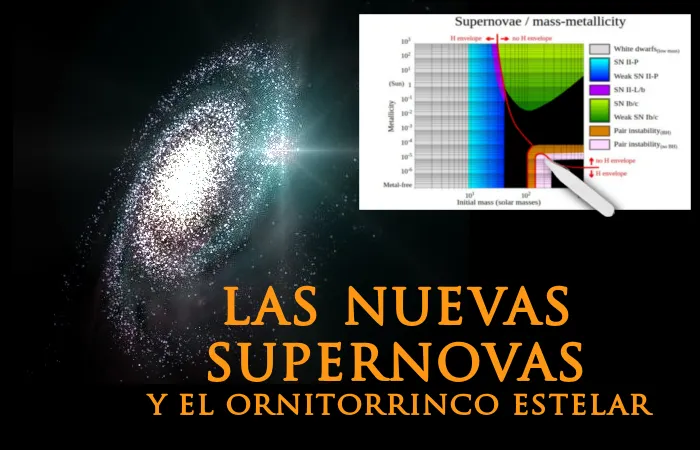
Supernova galaxy illustration: Wikimedia: By No machine-readable author provided. Xenoforme~commonswiki assumed (based on copyright claims)
Fig. 1: Classifying Supernovae, by Ashley Villar https://astrobitos.org/2016/12/08/clasificando-supernovas/
Fig. 2: SN 2007bi: Without a Trace, Astrobites: from Lamers & Levesque, 2017.
Fig. 3: Supernova classification chart https://www.ptf.caltech.edu/image/ptf140101
Fig. 4: Most luminous supernova ever seen may be manifesting a new eruption mechanism https://physicstoday.scitation.org/doi/abs/10.1063/1.2761787?journalCode=pto
Fig. 5: metallicity: By Fulvio314 - Own work based on A. Heger, C. L. Fryer, S. E. Woosley, N. Langer, D. H. Hartmann: How massive single stars end their life. The Astrophysical Journal, 591:288–300, 2003 July 1, CC BY-SA 3.0, https://commons.wikimedia.org/w/index.php?curid=29901117
Fig. 6: The Nucleosynthetic Signature of Population III
A. Heger, S. E. Woosley (UCSC)
Astrophys.J. 567 (2002) 532-543 https://arxiv.org/abs/astro-ph/0107037
Fig. 7: SNe discovered since 1885
By Raviryan84 - Own work: source code, GFDL, https://en.wikipedia.org/w/index.php?curid=61204526
Fig. 8: Open Supernova Catalog: statistics https://sne.space/