An upgrade to the Super-Kamiokande experiment will give astronomers an alert of a probable supernova.
Two ideas:
1-The Weather Forecast is correct, even when it is wrong.
2-The Supernova Forecast is very bad.
Let me overcome your skepticism about the first statement, with an example.
Let's say that in an office there are 3 people, one of whom is named Juan. His coworkers know that Juan, every day, at 11:00, gets up, leaves and returns 15 minutes later with an alfajor. In Argentina we eat alfajores. One day they invite me to the office. At the appointed time, Juan leaves. So I ask his coworkers where Juan is going. What would you answer me? Understand that your answer is a forecast. His coworkers tell me that Juan went to the kiosk. When I ask them how they reached that conclusion, they tell me that's what Juan does every day. Logical, right? But Juan returns in 5 minutes. When asked, Juan explains that the day before, as the merchant had no change, he decided to buy two alfajores, so today he didn't need to go to the kiosk; and that he got up to go to the bathroom. What was predicted was not what happened. But the forecast was correct. It was correct for two reasons: I-The conclusion was logical based on the data his coworkers had. II-If we repeated the experiment every day, most of the time, they would be right.
2-Just at the start of the pandemic, public discourse began to speculate that the famous star Betelgeuse was "about" to explode as a supernova. The same had happened in 2011, with the same star. We are waiting. It is evident that in those cases, the method was not appropriate. That a VARIABLE star drops a lot in brightness (or increases it) is not sufficient and necessary for it to explode as a supernova.
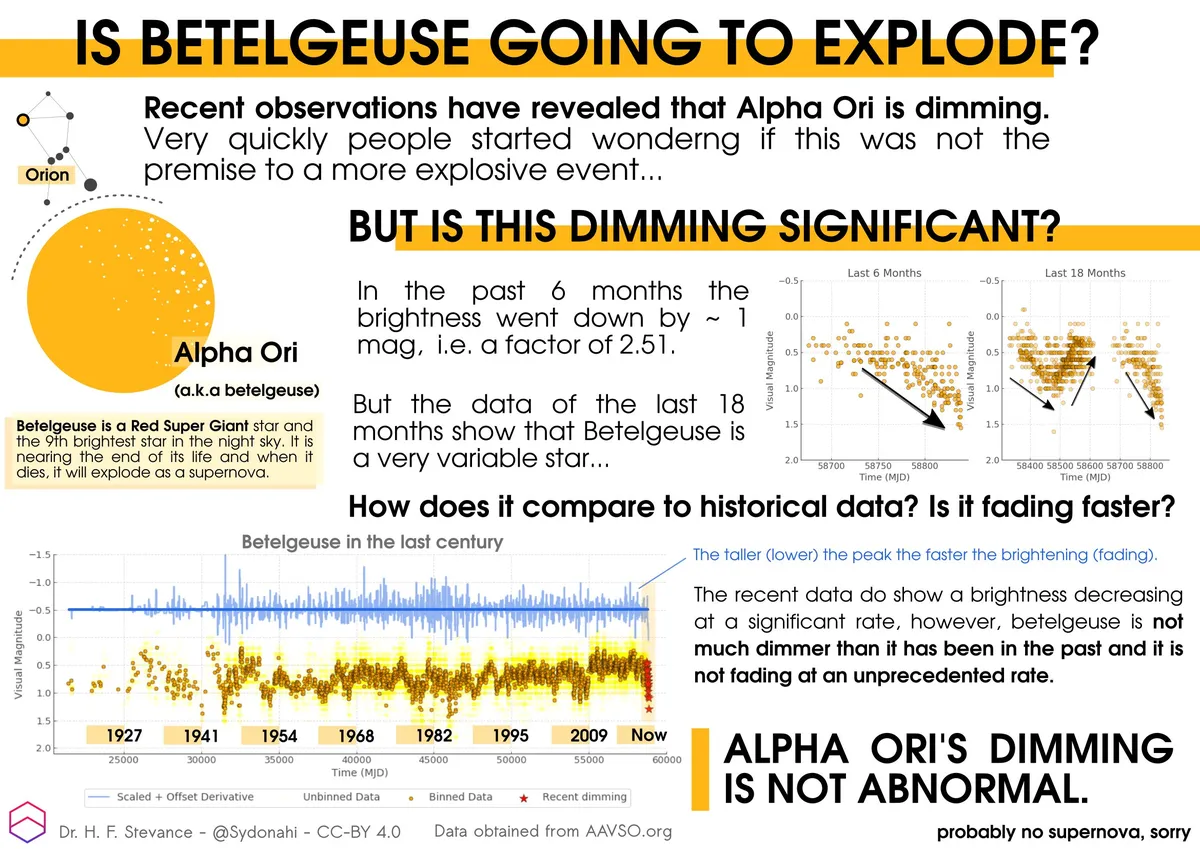
Image from a tweet by Dr. Heloise Stevance (@Sydonahi) from 12-23-2019.
In mid-2021 I said in a post that it would be better to monitor neutrinos. I didn't say it for no reason.

Gosh! And now who can help us?: Neutrinos
Telescopes are increasingly sensitive, better at detecting diffuse objects which are generally more distant. That poses a problem when observing nearby supernovae, which are very bright. The last nearby supernova was discovered on February 24, 1987 in Chile, that's why it is known as SN 1987A, in the Large Magellanic Cloud, a dwarf galaxy 170 thousand light-years from Earth. When they are nearby, supernovae can be seen with the naked eye, which is quite a spectacle, rare because it's infrequent. The previous time that happened was in 1604.
As I pointed out in a previous post, the frequency of the unrepeatable, in astronomy, is not 1. There are eclipses every year, conjunctions, oppositions, transits, meteor showers, comet passages, etc. Everything repeats. But nearby supernovae, visible to the naked eye, repeat with very low frequency. It is an event that, perhaps, we can see once in a lifetime. Or none.
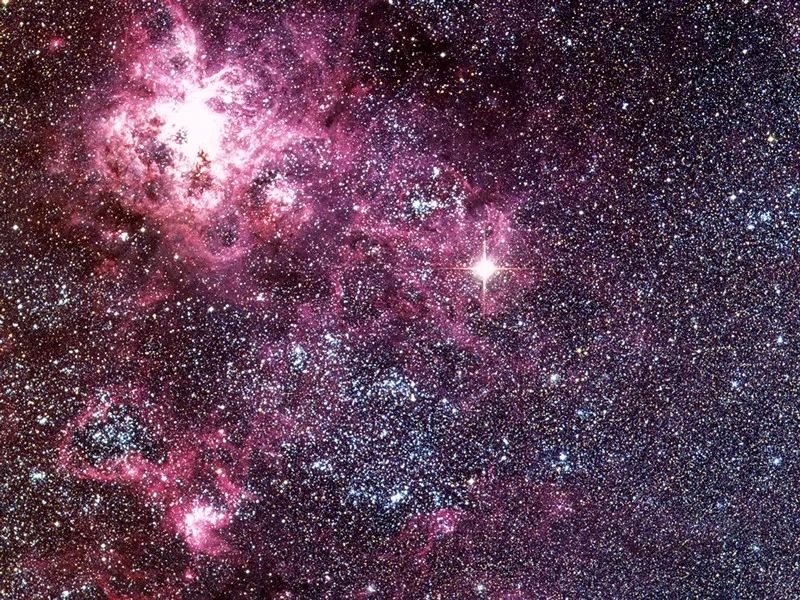
Supernova 1987A appears as a bright point near the center of this image of the Tarantula Nebula, taken by ESO.
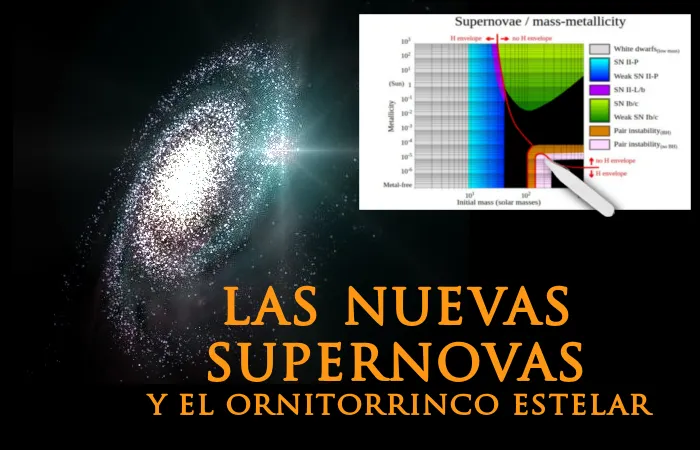
There are different types of supernovae. The most common are the product of stars more than 8 times the mass of the Sun. When they cannot continue their thermonuclear fusion process, they leave a core of iron and nickel and the outer layers collapse. The process compresses protons and electrons and neutrons are formed, increasing the density of the core by several orders of magnitude. The formation of neutrons releases neutrinos. When the outer material of the star reaches the core, a shock wave is produced that propagates, disintegrating the star and leaving the core bare as a remnant, a compact and dense object.
A large amount of energy from the collapsed star is given by the release of neutrinos. The shock wave can take hours, but neutrinos are released earlier. That is very good for anticipating supernovae. But...Neutrinos interact little and there is more than one type or "flavor" of neutrino.
GADZOOKS!: HOLY GADOLINIUM TO THE RESCUE
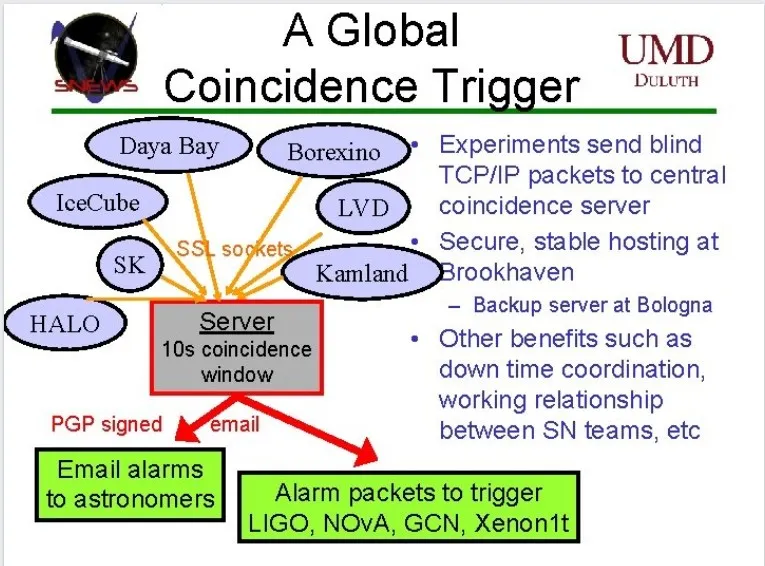
The Super-Kamiokande experiment was updated to add the SNWatch system programmed to alert astronomers worldwide upon the arrival of a certain quantity and type of neutrinos. There is another alert network called the Supernova Early Warning System (SNEWS). This network combines data from different detectors and if it receives several signals in a small time window (in seconds), it sends alert notifications. The direction of arrival of the signals can be calculated by triangulating with the angular resolution data of each signal.
Super-K lies a thousand meters under a mountain near Hida in Japan. Inside there are 50 thousand tons of purified water, to which a rare metal -gadolinium- was recently added, which allows better distinction between different types of neutrinos, by Cherenkov radiation.
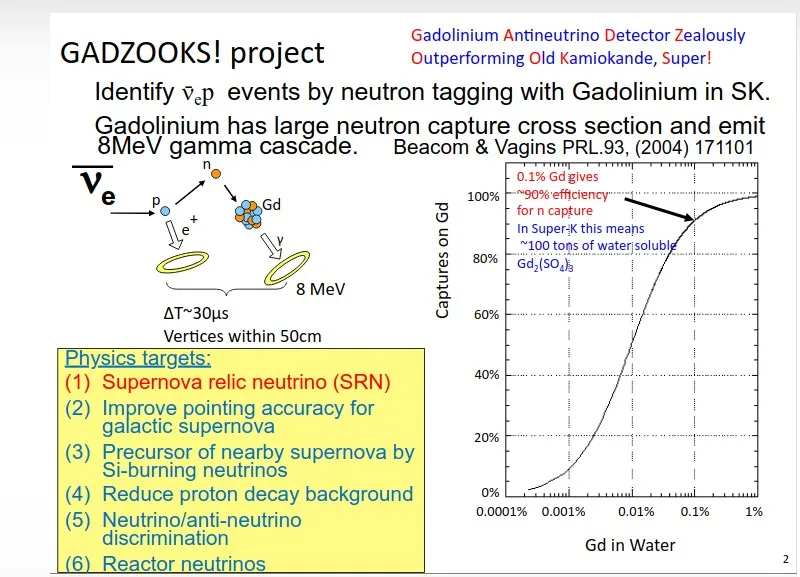
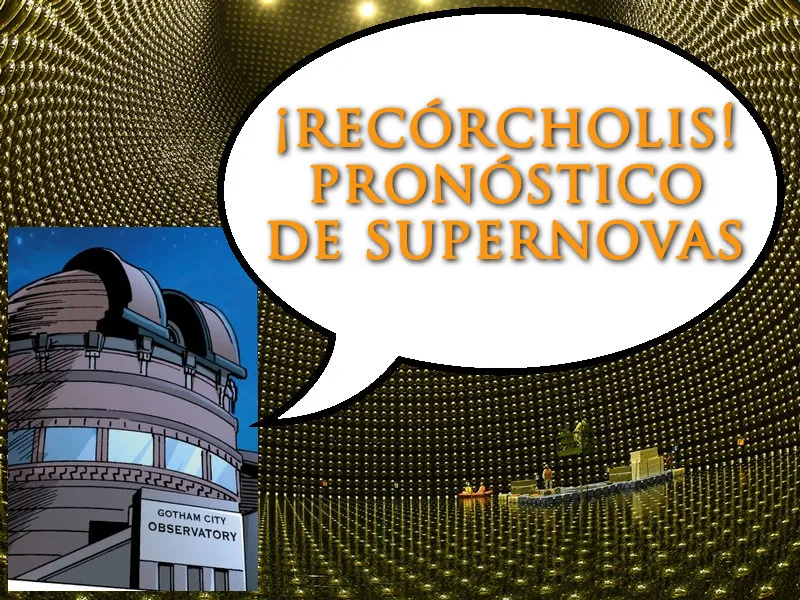
The idea is from the early 2000s when John Beacom and Mark Vagins proposed a system humorously called GADZOOKS! (Gadolinium Antineutrino Detector Zealously Outperforming Old Kamiokande, Super!). The word "Gadzooks" has been used in Anglo-Saxon comics as a superhero interjection, with a meaning similar to "WoW", implying surprise. An example in Spanish would be "¡Recórcholis!"
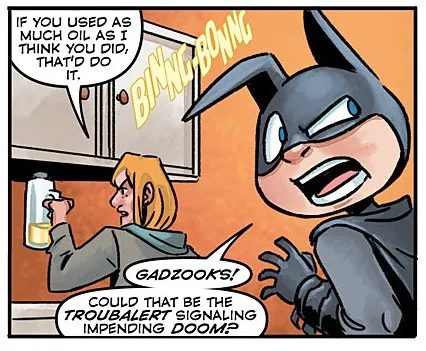
Example of the use of the interjection Gadzooks! in a superhero comic.
Many solar neutrinos are revealed when they collide with an electron in the water molecules. By Cherenkov radiation a bluish glow is generated, as if Smurfs were swimming in the water. Others, in particular anti-neutrinos (which are the same as neutrinos, but wear a mask), interact with a proton in the atomic nucleus. The collision releases a neutron and a positron. The positron is difficult to distinguish, but the neutron releases gamma rays when captured by another nucleus. This implies that, with the GADZOOKS! upgrade in Super-K, two signals microseconds apart can be obtained. Bang!
Alerts are important, but if they are correct, it is necessary to measure the brightness and with very sensitive telescopes it is a problem. An army of amateurs is ready to be part of the solution and very quickly: the AAVSO, American Association of Variable Star Observers brings together amateur astronomers from all over the world.
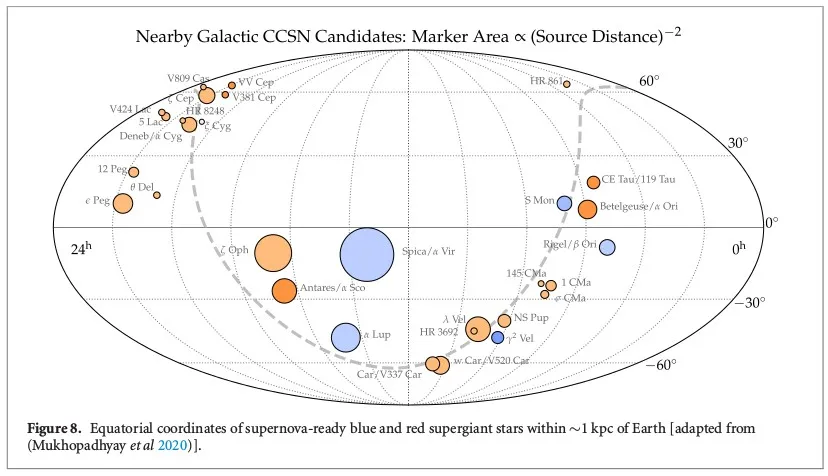
Candidates for nearby supernovae in equatorial coordinates.
CONCLUSION
These systems will allow obtaining better information on supernova events to improve knowledge of these astrophysical processes. But the probability of observing supernovas with the naked eye does not change. In our galaxy, there are a few explosions per century and some are not observed due to interstellar dust. There are several relatively nearby stars in the final stages of their stellar cycle. However, stellar cycles can last hundreds of thousands or millions of years.
On the other hand, despite better alert methods, it is always possible that there are false positives. Supernovas are not the only sources of neutrinos.
For the bat-men, those who inhabit the night and seek bat-signals of explosions in the sky, the opportunities are few. But now they have a better tool to face the Riddle of the supernovas. Bazinga!☉
Sources and related links
- Why are so few supernovas seen with the naked eye?
https://www.noticiasdelcosmos.com/2021/06/por-que-se-ven-tan-pocas-supernovas.html - A supernova could light up the Milky Way at any time. Astronomers will be watching
Davide Castelvecchi
https://www.nature.com/articles/d41586-022-00425-8 - Gigantic Japanese detector prepares to catch neutrinos from supernovae
https://www.nature.com/articles/d41586-019-00598-9 - SNEWS 2.0: a next-generation supernova early warning system for multi-messenger astronomy
S Al Kharusi et al 2021 New J. Phys. 23 031201
https://iopscience.iop.org/article/10.1088/1367-2630/abde33 - GADZOOKS! Anti-neutrino spectroscopy with large water Cherenkov detectors
John F. Beacom(Fermilab), Mark R. Vagins(UC, Irvine)
https://inspirehep.net/literature/629172 - GADZOOKS! project
https://slideplayer.com/slide/8478631/ - GADZOOKS!
https://studylib.net/doc/15483017/mark-vagins
About the images
Credits: ESO; Kamioka Observatory/Institute for Cosmic Ray Research/The University of Tokyo.
Graphic: S Al Kharusi et al.
Gotham City Observatory https://youngjustice.fandom.com/wiki/Gotham_City_Observatory
EL BLOG DE BATMAN http://www.elblogdebatman.com/2015/09/preview-bat-mite-4.html