What if cosmological phenomena could be explained without dark matter? MOND theories make their bet.

Dark matter hypotheses arose from discrepancies between the observation of galaxies and clusters relative to Newton's theory.
However, another way to explain these differences is to change the prevailing theory. The acronym MOND stands for Modified Newtonian Dynamics, although it also refers to Milgromian Dynamics, a nonlinear theory of gravity proposed by Mordehai (Moti) Milgrom in the 1980s.
The different MOND theories were not taken very seriously, until now, as they did not seem sufficient to explain observations on different scales.
Recently in Astrobites, a new work on galaxy rotation curves was publicized that is in tune with previous works and seems to explain some of the observational differences through MOND theories.
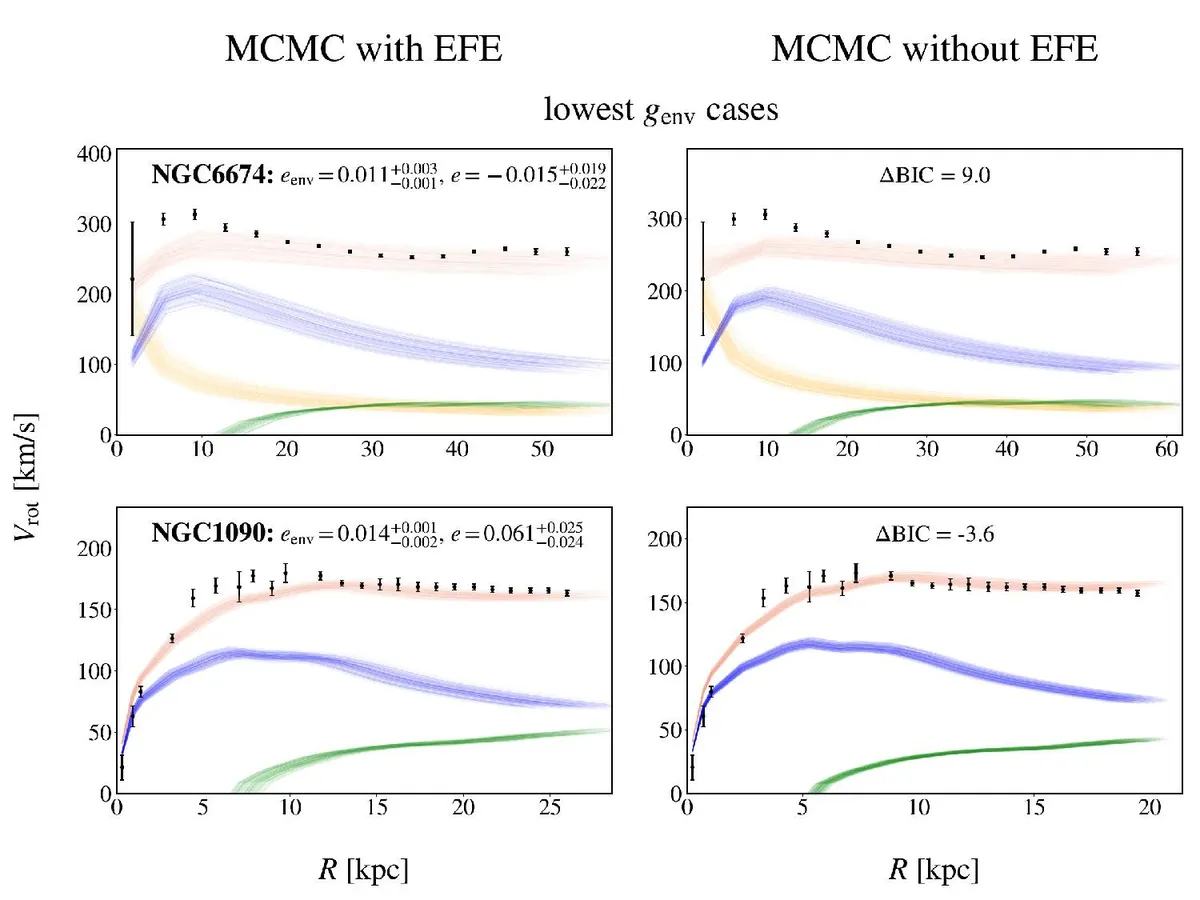
This study shows that galaxies experiencing a stronger external field have weaker self-gravity (rotate more slowly) than similar galaxies in weaker external field environments. Since the external field is relatively more important farther from the galaxy, the shape of the rotation curve is also different: it decreases in the outskirts with a strong external field (Figure 1), but remains flat with a weak external field (Figure 2). The observation of this represents a robust and statistically significant detection of the external field effect on the internal dynamics of rotating disk galaxies. The results of the new study are more complete and robust than any previous attempt.
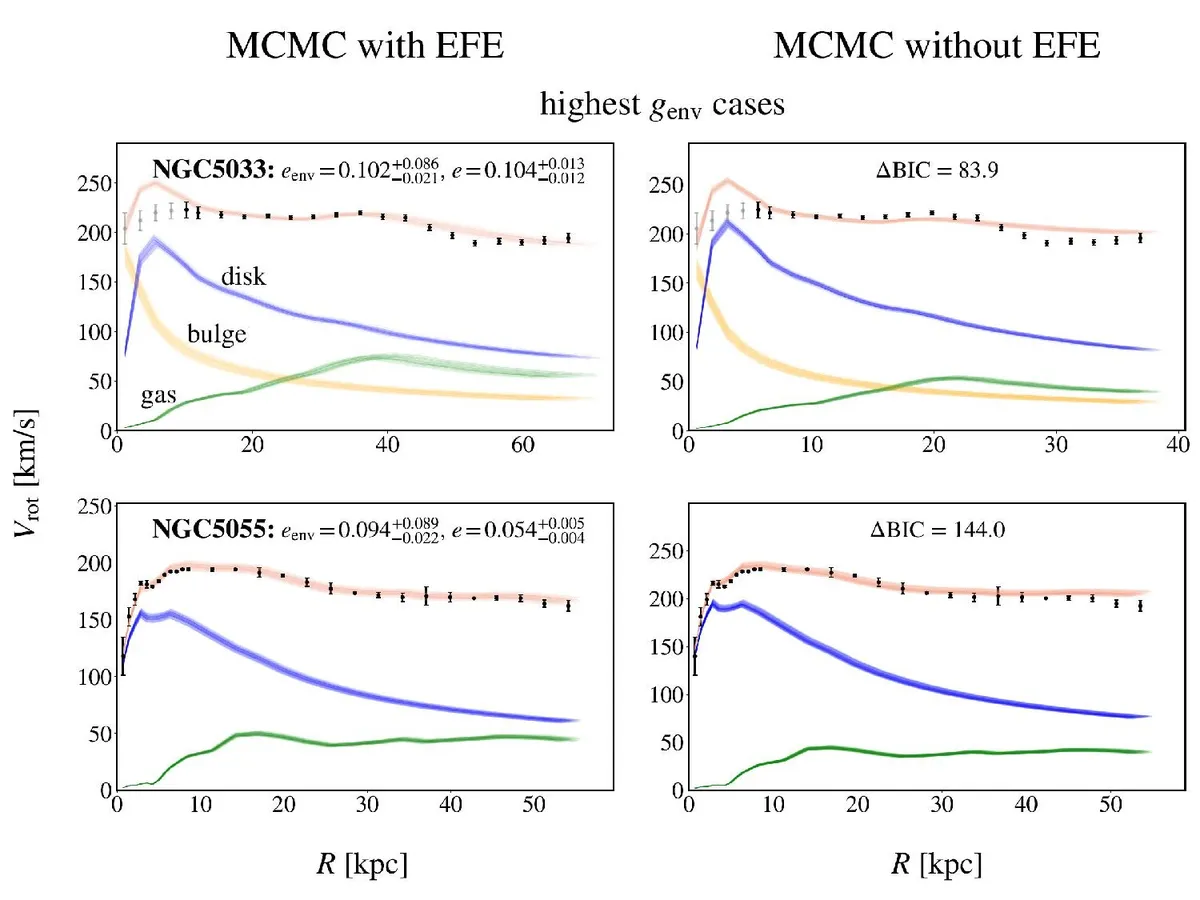
The result indicates that General Relativity and Newton's gravity "break" when gravity g is weaker than a0, a new fundamental acceleration constant of nature. Thus, galaxy rotation curves could be explained only with the visible mass. If gN (Newtonian gravity) is much weaker than a0, then g=√(a0*gN). The square root causes the rotation curve of an isolated galaxy to be flat at large distance. And as a consequence, it implies that gravity is not linear in the mass distribution.
In Newtonian mechanics, the acceleration of an object can be considered as the vector sum of the acceleration due to each individual acting force. This means that a subsystem can be decoupled from a larger system to which it belongs; in other words, the influence of the larger system is irrelevant to the internal dynamics of the subsystem. Since Milgrom's law is nonlinear in acceleration, subsystems cannot be decoupled from their environment in that way. This is known as the "External field effect (EFE)", which is an external field effect.
On the other hand, it may seem that MOND theories always try to explain phenomena by excluding all kinds of "dark matter". However, G.W. Angus proposed a cosmological MOND theory with dark matter composed of sterile neutrinos, a model some call νHDM.
This model has been used to try to resolve the Hubble tension, that is, the nearly 10% difference between the measurements of H0, the Hubble constant.
In a 2012 paper, Famaey & McGaugh say (my translation):
The main motivation for studying MOND is, therefore, completely empirical, as it is driven by the observed phenomenology on galaxy scales, and not by an aesthetic desire to get rid of dark matter (DM).
The corollary is that a priori it is not a problem for a theory designed to reproduce the astonishing successes of MOND phenomenology to replace CDM with "dark fields" or more exotic forms of DM, different from simple collisionless DM. Contrary to the common belief that this would go against the spirit of the MOND paradigm (although it is true that it would be more elegant to avoid too many additional degrees of freedom). Perhaps more importantly, if MOND is correct in the sense that the acceleration a0 is a truly fundamental quantity, the strong equivalence principle can no longer hold, and local Lorentz invariance might perhaps be spontaneously violated as well.
THE APPARENT SCALES
I think it is appropriate to bring an example from mathematics for reflection. Until now, Newton's laws seem unbeatable, although at large scales General Relativity must be added. But something seeming a certain way does not mean it is.
In mathematics, amicable numbers are known, such that the sum of the proper divisors of one is equal to the other number and vice versa.
If a number is amicable with itself, then it is a perfect number.
The smallest pair of amicable numbers is 220, 284, since:
the proper divisors of 220 are 1, 2, 4, 5, 10, 11, 20, 22, 44, 55 and 110, which sum to 284; the proper divisors of 284 are 1, 2, 4, 71 and 142, which sum to 220.
Mathematicians discovered several pairs of these numbers and looked for some regularity. Mathematician James Grime, on his Youtube channel Singingbanana, explains it visually:
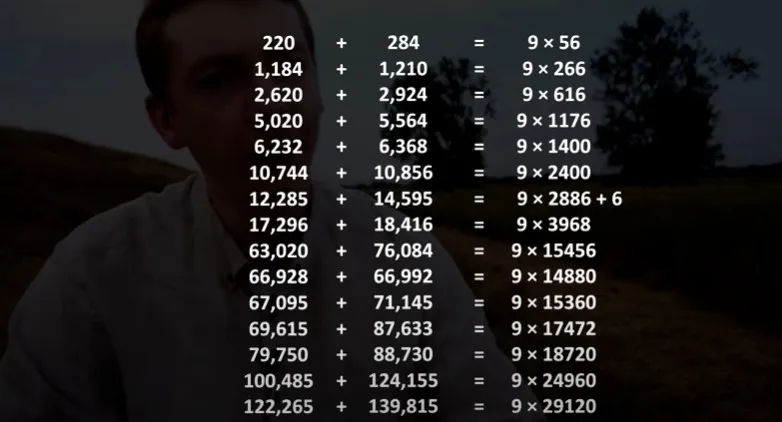
Here we see pairs of amicable numbers, which seem to be almost all even, except some ending in 5. The sum of these numbers, including those, is even. Furthermore, all seem to be multiples of 9, except the sum of those that are odd.
So we can postulate a conjecture: the sum of two even amicable numbers is a number multiple of 9. It is difficult to prove a conjecture, so it is easier to look for a counterexample. And one exists:
666,030,256 and 696,630,544 are amicable numbers, they are even, but the sum is not a multiple of 9.
So, up to a certain critical value, the conjecture is correct and then it ceases to be. Perhaps the same happens with Newton's gravity.
PARADIGMS AND HABITS
If LCDM cosmology were wrong, how would we know? Astrophysicist Stacy McGaugh, jokingly, made this algorithm of current thought:
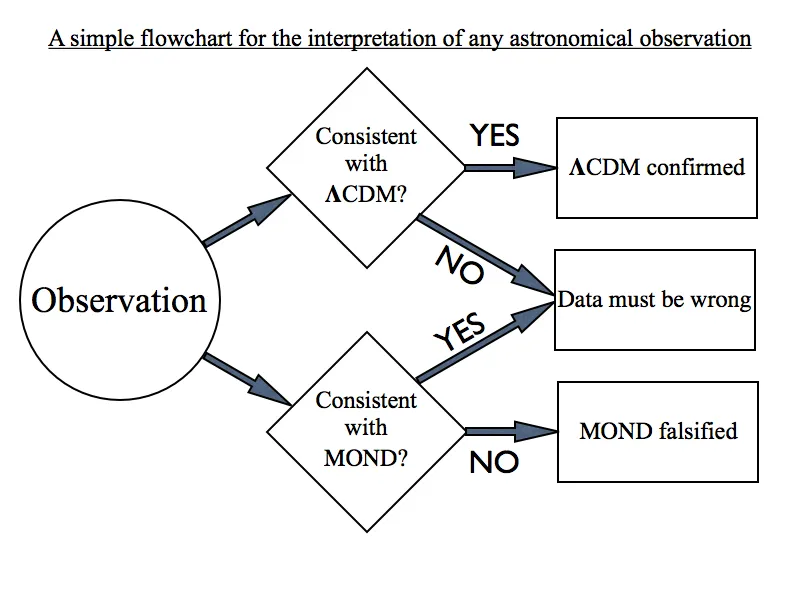
When a postulate is not investigated, but blindly accepted or denied, then it becomes a myth.
Until now, the LCDM model had two lemons in the cosmology slot machine, but the third lemon does not come.
MOND theory, on the other hand, only had one lemon, in its successes at galactic scale, but it was not a relativistic theory at cosmological scale.
And it does not seem that achieving the second lemon is going to change anything. Unless MOND manages to shout Eureka! or Jackpot! it will not prevail. It makes no sense to change something that doesn't work for something else that doesn't work either.
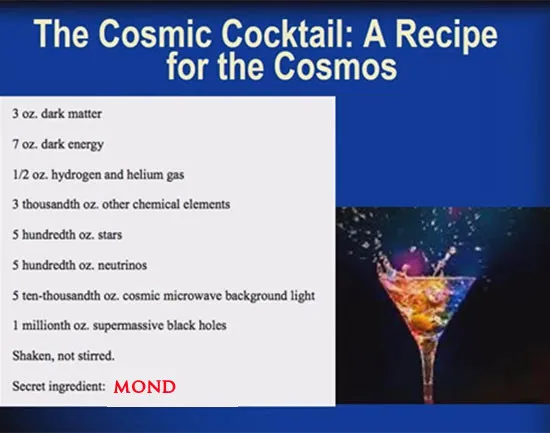
Perhaps, in the end, we need to mix things up a bit. Shaken, not stirred!, a double astronomical espionage agent would say, while sipping his cosmic cocktail.☉
Sources and related links
- Galaxies In More Crowded Environments Rotate Slower: Implications For Gravity
https://astrobites.org/2021/03/25/galaxies-in-more-crowded-environments-rotate-slower-implications-for-gravity/ - Big Trouble in a Deep Void
https://tritonstation.com/2020/10/23/big-trouble-in-a-deep-void/ - Welcome to the MOND pages
http://astroweb.case.edu/ssm/mond/ - A modification of the Newtonian dynamics as a possible alternative to the hidden mass hypothesis.
Milgrom, M.
1983ApJ...270..365M
https://ui.adsabs.harvard.edu/abs/1983ApJ...270..365M/abstract - Modified Newtonian Dynamics (MOND): Observational Phenomenology and Relativistic Extensions
Famaey, Benoît; McGaugh, Stacy S.
2012LRR....15...10F
arXiv:1112.3960
https://arxiv.org/abs/1112.3960 - Declining rotation curves of galaxies as a test of gravitational theory
Hosein Haghi, Amir E. Bazkiaei, Akram Hasani Zonoozi, Pavel Kroupa
Monthly Notices of the Royal Astronomical Society, Volume 458, Issue 4, 01 June 2016, Pages 4172–4187
https://doi.org/10.1093/mnras/stw573
Testing the Strong Equivalence Principle: Detection of the External Field Effect in Rotationally Supported Galaxies
Kyu-Hyun Chae, Federico Lelli, Harry Desmond, Stacy S. McGaugh, Pengfei Li, James M. Schombert https://arxiv.org/abs/2009.11525
MOND laws of galactic dynamics https://arxiv.org/abs/1212.2568
The MOND paradigm of modified dynamics http://dx.doi.org/10.4249/scholarpedia.31410
Mordehai (Moti) Milgrom https://www.weizmann.ac.il/particle/milgrom/
Is an 11 eV sterile neutrino consistent with clusters, the cosmic microwave background and modified Newtonian dynamics?
G. W. Angus
Monthly Notices of the Royal Astronomical Society, Volume 394, Issue 1, March 2009, Pages 527–532, https://doi.org/10.1111/j.1365-2966.2008.14341.x
On Divisibility By Nine of the Sums of Even Amicable Pairs
By Elvin Lee https://www.ams.org/journals/mcom/1969-23-107/S0025-5718-1969-0248074-6/S0025-5718-1969-0248074-6.pdf
MegaFavNumbers - The Even Amicable Numbers Conjecture https://www.youtube.com/watch?v=R2eQVqdUQLI
Maybe Milgromian gravity solves the Hubble tension!?
https://www.youtube.com/watch?v=LMhjenB7V8g&ab_channel=CosmologyTalks
About the images
The Cosmic Cocktail: Three Parts Dark Matter https://press.princeton.edu/books/paperback/9780691169187/the-cosmic-cocktail
The Cosmic Cocktail Recipe (Source: Katherine Freese, at April APS Meeting in Denver), modified for the purposes of this post.
https://www.palmiaobservatory.com/2019/04/first-sessions-of-april-aps-meeting.html