A roadmap for high-energy physics, cosmology and astroparticle physics in the region.
Researchers in high-energy physics, cosmology and astroparticle physics (High Energy, Cosmology and AstroParticle Physics, HECAP), gathered at the Latin American Strategy Forum for Research Infrastructures (LASF4RI), after years of debates and proposals, have developed a roadmap.
The team represented 10 countries in the region: Argentina, Bolivia, Brazil, Chile, Colombia, Ecuador, Mexico, Peru, Paraguay and Venezuela, as well as Japan, Europe (represented by CERN) and the United States.
It is a document titled Latin American Strategy for HECAP that includes 10 recommendations, namely:
1-Support the development and operation of current and future projects in astronomy, cosmology and astroparticle physics located in Latin America.
2-Continue the establishment of the international flagship laboratory, ANDES, which will enable the region to become a global center for underground physics and other sciences.
3-Support existing efforts in international neutrino physics projects in Latin America.
4-Support small-scale experiments.
5-Strengthen collaboration between theoretical groups.
6-Develop training and education programs.
7-Foster R&D capabilities in key technologies across HECAP, enabling connections with industry and with a potential broader social impact.
8-Improve high-performance computing infrastructure and Internet connectivity in the region.
9-Develop formal and stable mechanisms for coordination and funding.
10-Promote the dissemination of knowledge, outreach and the active participation of the general public in scientific research, fostering Social Engagement.
The document is the result of the efforts of scientists in the region to promote research in these areas through the development of infrastructures, i.e., observatories, experiments, laboratories, which can only be carried out with sufficient funding. But it is also necessary to know where one wants to go. That is, to establish the cutting-edge research topics, what needs to be known.
One element to highlight is the SAGO project: South American Gravitational-Wave Observatory, a South American gravitational-wave observatory, projected for a decade from now.
It is somewhat paradoxical that this document by physicists from Latin America has been published only in English. It is understood that scientists use English as an academic language, but point 10 of this roadmap will be difficult to achieve only in that language, given that the public in the region speaks other languages.
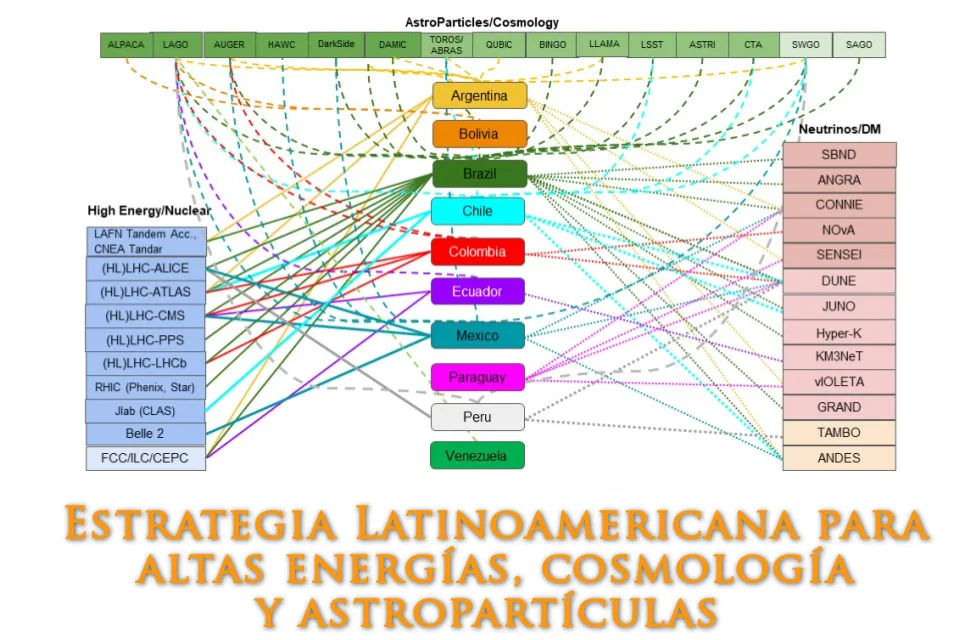
The following graphic shows, in different colors, experiments in different areas: green, astroparticles/cosmology; blue for high energy; pink for neutrinos/dark matter; and their relationship with the participating countries.
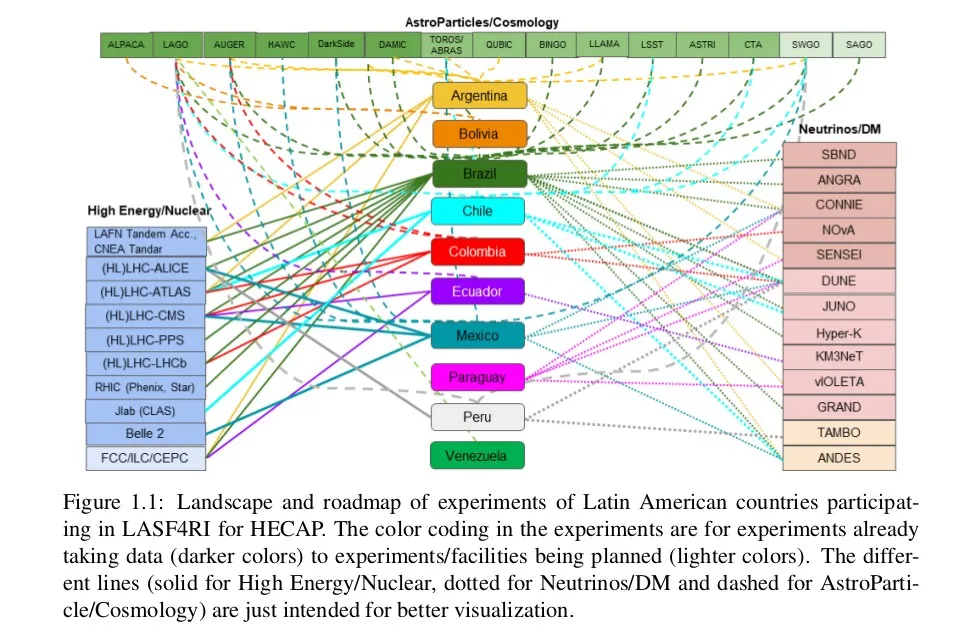
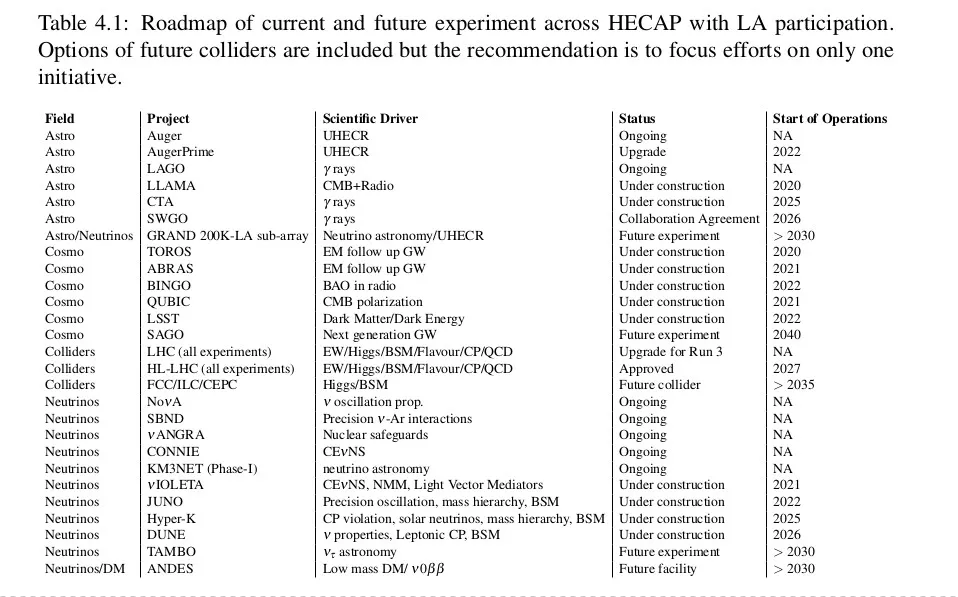
This table lists current and future experiments and their status: ongoing, under construction, future experiment, approved and upgrade, with estimated operation dates.
Sources and related links
- New strategy for Latin American physics
https://www.symmetrymagazine.org/article/new-strategy-for-latin-american-physics?language=es - LASF4RI
https://lasf4ri.org/ - Latin American Strategy for HECAP
https://drive.google.com/file/d/1muqdLMMQaZ-yBxFdYLPuCpOQgeSfsvtV/view - SAGO:South American Gravitational-Wave Observatory
https://www.ictp-saifr.org/wp-content/uploads/2020/07/09-Odylio-D.-Aguiar.pdf
About the images
Screenshots from the document.