About an autonomous positioning system for spacecraft.
If I told you that someone proposed an autonomous navigation system for...flying cars, what would you say? To me it would seem useless, unless flying cars are made.
In the series Seinfeld, Season 9, episode 11, titled "The Dealership", from 1998, Jerry wants to buy a car and George accompanies him. At the beginning of the episode, they talk and say that there should already be flying cars. And 23 years have passed since then. It would be ridiculous to think of an autonomous positioning system for flying cars, as long as there is no significant advance in the creation of cars that fly.
Recently, the work of an astronomer who proposed an autonomous positioning system for spacecraft on interstellar voyages became known.
Interstellar travel is far from becoming a reality. The spacecraft created so far achieve accelerations well below 1% of the speed of light. Thus, traveling to other stars would take thousands of years. Analogous to flying cars, an autonomous navigation system for spacecraft that are far from existing we might think is...useless. However, let me tell you what it is about and then we'll see how useless it is or seems to be.

Jerry and George thought cars should already fly in 1998.
Until now, with spacecraft traveling the solar system, spacecraft navigation is done from Earth, sending and receiving radio signals, through antennas. Between the sending and receiving of signals there is a delay, since the signals travel at the speed of light, but space is big. If the distance between the planet and the spacecraft is 20 light-hours, there will be a 20-hour delay between sending and receiving instructions.
The problem becomes exponentially greater with increasing distances. If the spacecraft were traveling to interstellar space and were, for example, 1 light-year away, the delay between sending and receiving signals would be 1 year. If the spacecraft sends its position, the information would arrive a year later, during which time the spacecraft would have continued its journey, so its position upon receiving the information will be different. If an attempt is made to change course, instructions would have to be sent that would take another year to reach the spacecraft.
This justifies the need to think of an autonomous system by which the spacecraft, through computing, is capable of correcting its course if necessary. Astronomer Coryn Bailer-Jones proposed such a system in a publication hosted on the ArXiv repository. Although it is a technical work, it is enough to understand the basics of an astronomical positioning system: angular position.
If we put our index finger a few centimeters from our face, at nose level, and look at the finger with one eye, alternately, that is, first with one eye and then with the other, we will notice a difference in the apparent position of the finger. Having binocular vision, because we have two eyes located at a certain distance, what we observe in one case and the other is slightly different. This depends on two variables: the distance between the eyes and the distance to the finger.
If we now extend our arm and repeat the procedure, we will notice that the difference in apparent position is smaller. This then implies an inversely proportional relationship: the greater the distance, the smaller the difference in apparent position. If we know that proportion, then by knowing the difference in apparent position, we can calculate the distance. This is how trigonometric parallax works.
Angular position requires thinking in angles that can be measured in degrees, minutes, seconds. The Hipparcos mission, which mapped the sky, had an accuracy of one thousandth of an arcsecond. More recently, the GAIA mission achieved an accuracy of one millionth of an arcsecond.
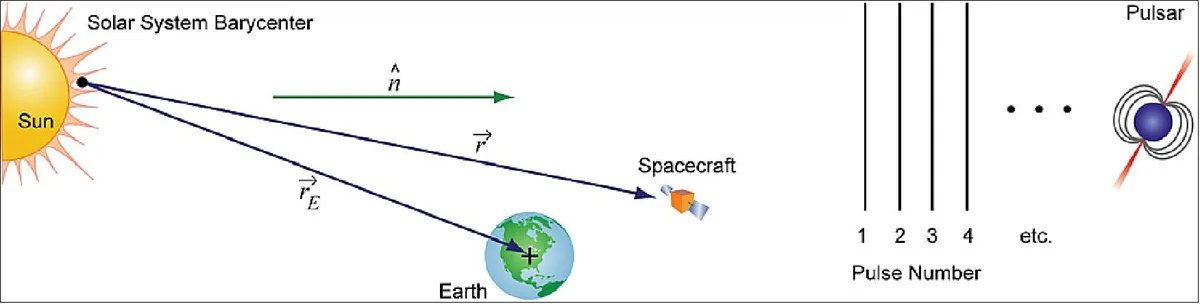
Geometry of an XNAV observation
What Bailer-Jones proposes is to take the data from the GAIA catalog and have the spacecraft, through devices like sextants, measure the distance between stars and compare them with those in the catalog. There would have to be a difference similar to that observed when looking at the finger from different positions.
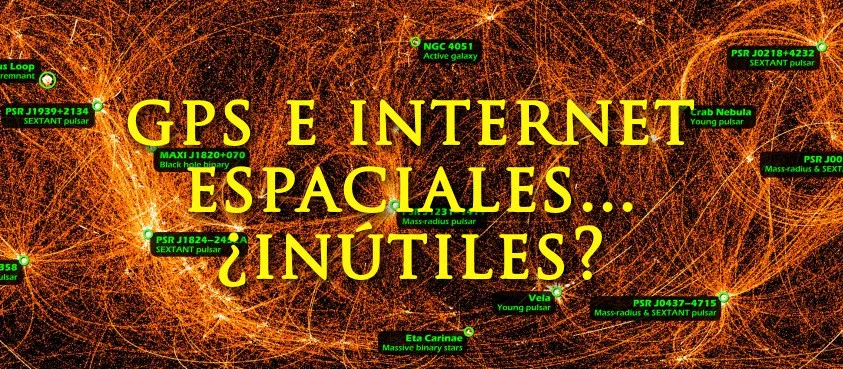
As early as 2012, an autonomous space navigation system had been proposed, but with a difference: using pulsars through X-ray telescopes, a system known as XNAV. NASA has a specific project on this called Station Explorer for X-Ray Timing and Navigation (SEXTANT).
This does not prevent spacecraft from still needing antennas to send the collected information. But...
SPACE INTERNET
Italian astronomer Claudio Maccone proposed a few years ago a system to receive signals from very distant spacecraft using the Sun as a gravitational lens. For this purpose, FOCAL-type spacecraft (Fast Outgoing Cyclopean Astronomical Lens) would be used, which would be spacecraft with an antenna to use the Sun as a lens. The minimum distance to do this would be 550 AU (Astronomical Units). For comparison, the Voyager spacecraft are at less than 200 AU. On the other hand, this spacecraft could only be used in this way to observe objects that are right behind the Sun. Additionally, the result would be distorted, as happens with gravitational lenses.
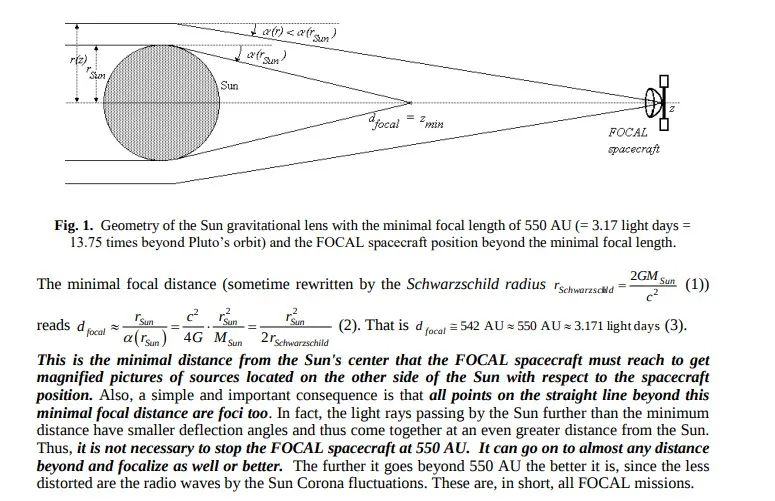
It is interesting, however, that a good number of these spacecraft, around several stars, could generate a cosmic "internet".
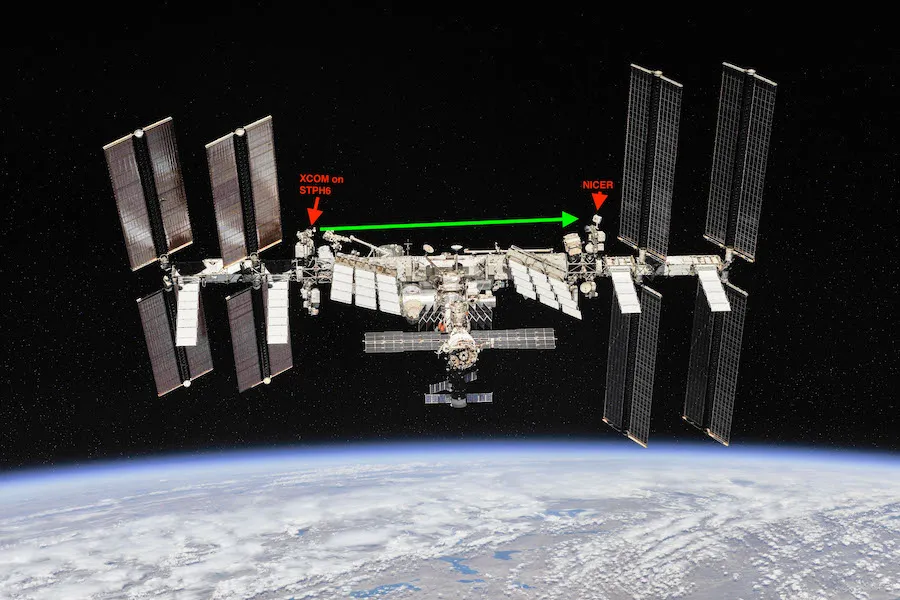
The International Space Station and two experiments on board: XCOM and NICER.
NASA is also developing a space broadband, again using X-rays. They call this technology XCOM and an experiment was designed and tested on the ISS.
THE ENGINE OF THE SCIENCES
In both proposals, what drives them is curiosity. In the first case, an autonomous positional information system is proposed, and in the second, a long-distance data transmission system. However, what is really needed in both cases are better engines.
Both ideas could be compared to something already known: autonomous transport for cars. Prototypes of cars already exist to which a destination is indicated and they calculate when to turn and how to get to the location. However, that positional information system for the car would be useless if the car had no engine.
Bailer-Jones's proposal says nothing about any propulsion method. Nor does Maccone know how to place a spacecraft at 550 AU in humanly possible times.
Both ideas have technical difficulties to overcome and the publication of the initiatives promotes collaboration to achieve that goal. On the other hand, Bailer-Jones's proposal could have some application on a smaller scale, within the Solar System.
In fact, the XNAV and SEXTANT technology was successfully tested by NASA on the International Space Station in 2018, although the possibility of using it on spacecraft requires more work. In this sense, although its application is not immediate, there are sufficient reasons to think that these autonomous navigation systems will be incorporated into spacecraft in the coming decades. Although it would be much more important on interstellar flights, this technology can also be used within the solar neighborhood, as a support system.
Additionally, both ideas can be very fruitful within science fiction. In any case, what seems useless today is nothing other than building the future. No more, no less.☉
Sources and related links
- Measuring distances to stars via parallax
http://spiff.rit.edu/classes/phys301/lectures/parallax/parallax.html - Lost in space? Relativistic interstellar navigation using an astrometric star catalogue
Coryn A.L. Bailer-Jones (Max Planck Institute for Astronomy, Heidelberg)
https://arxiv.org/abs/2103.10389 - An Astronomer Has Just Designed a Navigation System for Interstellar Space Travel
https://www.infobae.com/america/ciencia-america/2021/03/23/un-astronomo-acaba-de-disenar-un-sistema-de-navegacion-para-viajes-espaciales-interestelares/ - Coryn Bailer-Jones
https://www2.mpia-hd.mpg.de/homes/calj/ - Gravitational Lenses Could Allow a Galaxy-Wide Internet
https://www.universetoday.com/150671/gravitational-lenses-could-allow-a-galaxy-wide-internet/ - Galactic internet made possible by star gravitational lensing
Claudio Maccone
https://arxiv.org/abs/2103.11483 - Dr. Claudio MACCONE, Ph. D.
http://www.maccone.com/ - NASA Will Soon Use GPS Technology to Navigate in Space
https://www.everythingrf.com/News/details/8498-NASA-Will-Soon-Use-GPS-Technology-to-Navigate-in-Space - Deep Space GPS from Pulsars
https://www.discovermagazine.com/the-sciences/deep-space-gps-from-pulsars - Timing X-ray Pulsars with Application to Spacecraft Navigation
Mike Georg Bernhardt, Tobias Prinz, Werner Becker, Ulrich Walter
https://arxiv.org/abs/1011.5095 - Johns Hopkins Applied Physics Laboratory to Apply Space Research Expertise to Develop Deep Space Navigation Network
https://www.jhuapl.edu/PressRelease/051024 - Station Explorer for X-Ray Timing and Navigation (SEXTANT)
https://gameon.nasa.gov/projects/deep-space-x-ray-navigation-and-communication/ - NASA Team First to Demonstrate X-ray Navigation in Space
https://gameon.nasa.gov/2018/01/12/nasa-team-first-to-demonstrate-x-ray-navigation-in-space/ - Media Material Relevant for Pulsar Navigation
https://www.mpe.mpg.de/~wbecker/psrnav/index.html
ISS Utilization: NICER/SEXTANT (Neutron-star Interior Composition ExploreR / Station Explorer for X-ray Timing and Navigation Technology)
https://directory.eoportal.org/web/eoportal/satellite-missions/content/-/article/iss-utilization-nicer-sexta-1
NASA Set to Demonstrate X-ray Communications in Space https://gameon.nasa.gov/2019/02/20/nasa-set-to-demonstrate-x-ray-communications-in-space/
About the images
Image of cluster 0024+1654
GRAVITATIONAL LENS CAPTURES IMAGE OF PRIMEVAL GALAXY https://hubblesite.org/contents/media/images/1996/10/403-Image.html
Credit: W.N. Colley and E. Turner (Princeton University), J.A. Tyson (Bell Labs, Lucent Technologies) and NASA
Geometry of an XNAV observation: NASA, NICER/SEXTANT Team.
FOCAL lens scheme: Claudio Maccone.
Initial image: NICER's Night Moves https://svs.gsfc.nasa.gov/13214
Credits: NASA/NICER