There are two very similar, but distinct concepts used in astronomy: stellar aberration and parallax. They are two important ideas, not only because they are used for calculations and observations, but because they were and are foundations of the heliocentric theory.
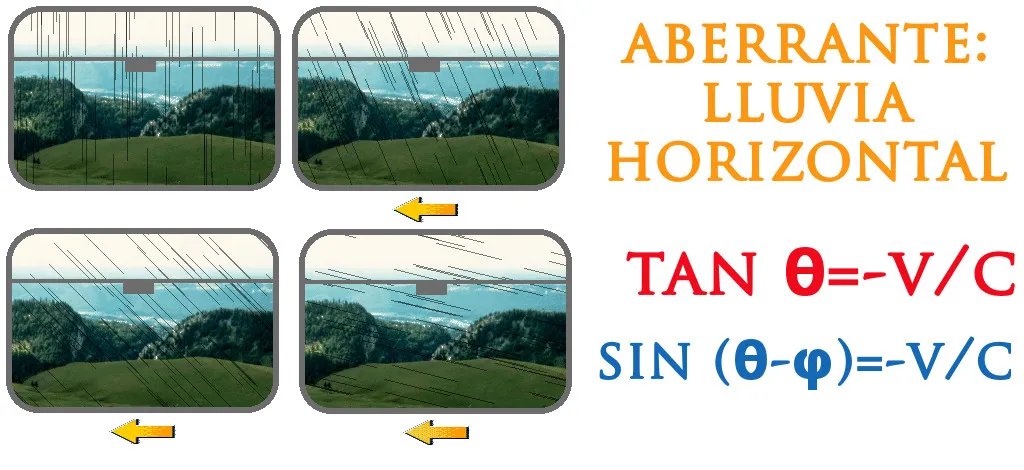
In both cases it is about a difference between the real position of a star and its apparent position. But parallax depends on the distance to the star, the farther away, the smaller the angle. While aberration depends on the observer's speed. And since from Kepler we know that the Earth's orbit is elliptical, then the speed varies according to the position in the orbit, but it is the same for every star regardless of its distance.
It is very common to compare stellar aberration with rain. If we are standing (at rest) and the rain falls vertically (90º), without taking wind into account, the water will fall on our head. If we wanted to collect the rain in a tube, we would have to keep it vertical. But if we move, we would have to tilt the tube at an angle (θ). If the speed of the rain is constant, then that angle will vary according to our speed.
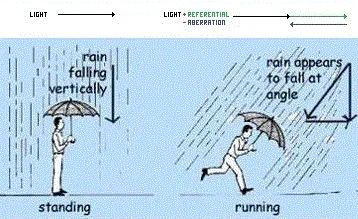
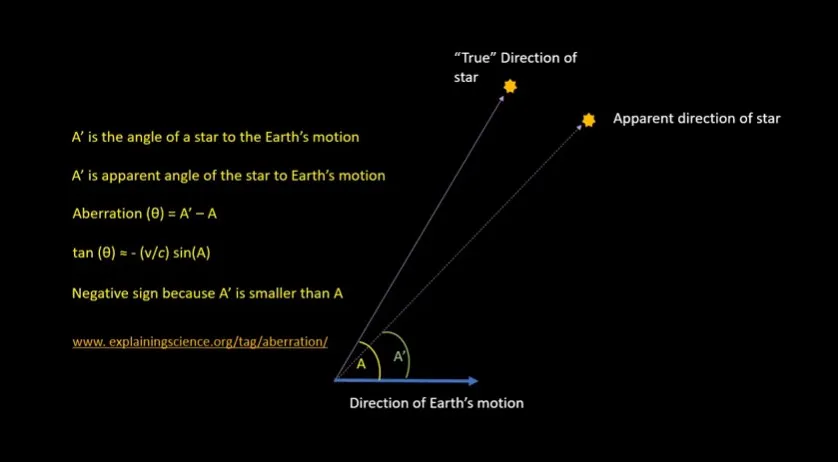
The "aberration of rain" will be the difference between the apparent angle at which the rain falls (A') and the true angle (A) and since the first is smaller than the second, that difference is indicated as negative.
The angle is calculated with the formula: tan θ= -v/c * sin (A).
If the rain falls at 90º, since sin (90º)=1, then tan θ=-v/c.
This means that if we run very fast, the apparent angle gets smaller. But... would it be possible to run so fast that the rain becomes horizontal?
It turns out that if c is the speed of the rain and we ran at the same speed, then v/c=1 and if the tangent of an angle is 1, the angle is 45º.
And if we think the same but assume the speed of the rain is equal to the speed of light?
DIGRESSION: THE HISTORICAL IMPORTANCE OF THE ABERRANT DISCOVERY
Aberration was measured almost by chance, in the 18th century when an Englishman, James Bradley, was actually trying to measure the parallax of a star. Since parallax depends on distance inversely proportionally, the farther away the star, the smaller the apparent angle, it is very difficult to measure.
The absence of parallax was used by geocentrists to give strength to their theory. Ultimately, if the Earth moves, as heliocentrism postulates, then there should be a stellar parallax. Since it could not be measured, geocentrists considered it evidence for their theory. The Copernicans, on the other hand, claimed that the lack of measurement was because the stars are very far away.
Although Bradley did not manage to measure parallax, he did notice an apparent angle in the star Etamin or Eltanin, Gamma Draconis, and thus managed to discover stellar aberration, which cannot be explained if the Earth is at rest.
But the finding had another consequence: if we go back to the equation, we will see that if we solve for it, we could know the value of c, the speed of light in a vacuum. Bradley's calculations gave a value very similar to the one accepted today. And, of course, it is also possible to solve for v and know the Earth's orbital speed.
In fact, knowing the aberration constant, 20.5 arcseconds, is important for calculating stellar parallaxes.
THE RELATIVISTIC ABERRATION OF RAIN
John Walker, author of the website fourmilab.ch, made a specific page on the topic and, logically, compared stellar aberration with "rain aberration". But, to complete it, he tells us about relativistic aberration. In classical physics, stellar aberration can be compared to rain aberration, but for higher speeds, relativistic effects must be taken into account. When the Lorentz transformation is applied, we discover that the aberration measured by an observer traveling at speed v, of light from a distant source in the direction θ is:
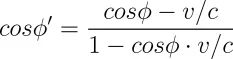
In that case, as the v/c ratio increases and approaches 1, relativistic stellar aberration continues to increase, so the apparent angle becomes smaller.
Here we see the same thing, summarized in another way, according to Wikipedia:

If we managed to equal our speed to that of light, then v/c=1.
If the sine of an angle is 1, the angle can be found using the reciprocal function, cosecant. On calculators it appears as sin^-1. The result is 1.5707, expressed in radians. Converting to degrees we multiply by 57.26=89.94. Which means that if the aberration is so large, the apparent angle is the difference with the real angle, that is, almost zero.
Here we see a table with the results of varying v/c making it closer and closer to 1, with the classical and relativistic formula:
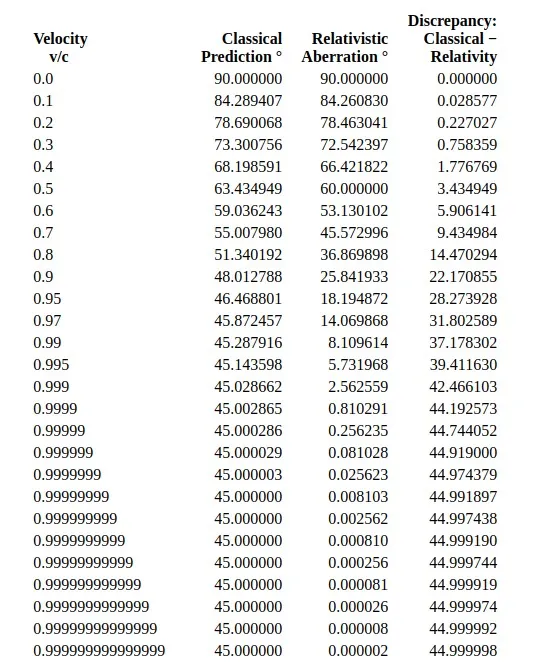
So if the rain fell at the speed of light and we moved at the same speed, we would have a true aberration: horizontal rain.
Of course, according to Murphy's Laws, in that case, the wind would be vertical...☉
Sources and related links
- Stellar aberration
https://explainingscience.org/2019/05/28/stellar-aberration/ - https://www.youtube.com/watch?v=3JaFVH36WHQ
- C-ship: The Aberration of Light
https://www.fourmilab.ch/cship/aberration.html - Aberration of light
https://es.wikipedia.org/wiki/Aberraci%C3%B3n_de_la_luz - Bradley's Discovery of Stellar Aberration (Proves That The Earth Moves)
http://cseligman.com/text/history/bradley.htm
About the images
YouTube video capture from Explaining Science.
Graphics by J. Walker Fourmilab.ch; cseligman.com.