A five-year search to map the universe and unravel the mysteries of dark energy officially began on May 17 at Kitt Peak National Observatory near Tucson, Arizona. To complete its task, astronomers from DESI (Dark Energy Spectroscopic Instrument) will capture the light from tens of millions of galaxies.
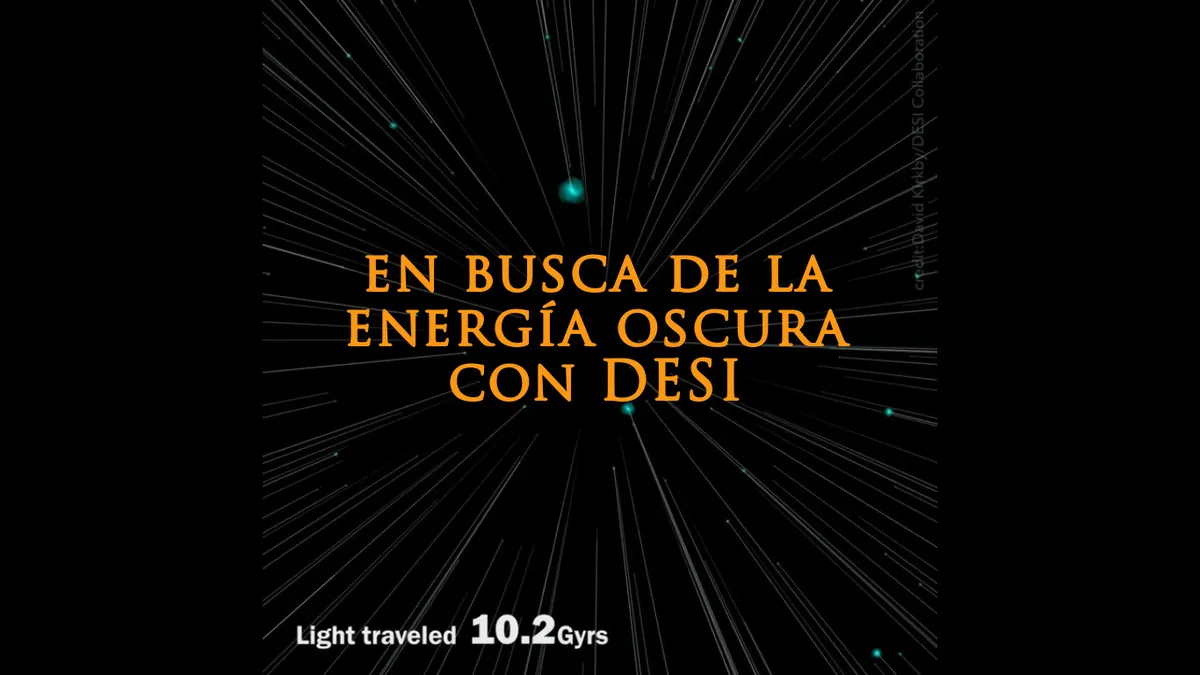
By capturing the light from about 30 million galaxies, astronomers plan to make a highly detailed map of the universe to understand the repulsive force colloquially called "dark energy."
"DESI will allow us to see about ten times more galaxies than previous surveys and study the evolution of the universe from 11 billion years ago to the present," explains Héctor Gil Marín, a researcher at the Institute of Cosmos Sciences of the University of Barcelona (ICCUB) and the Institut d’Estudis Espacials de Catalunya (IEEC), who co-leads the first analysis of the galaxy maps.
The DESI telescope collects light, or spectra, from galaxies and quasars, which allows us to measure their recession velocity. "We know that the farther away an object is from us, the greater its recession velocity, which allows us to build a 3D map of the universe," points out Gil Marín.
DESI is installed on the renovated 4-meter Nicholas U. Mayall telescope at Kitt Peak National Observatory, which belongs to the U.S. National Science Foundation and is managed by NOIRLab. It includes novel optics, which increase its field of view, and 5,000 robotically controlled optical fibers, capable of simultaneously measuring the spectroscopic data of as many astronomical objects.
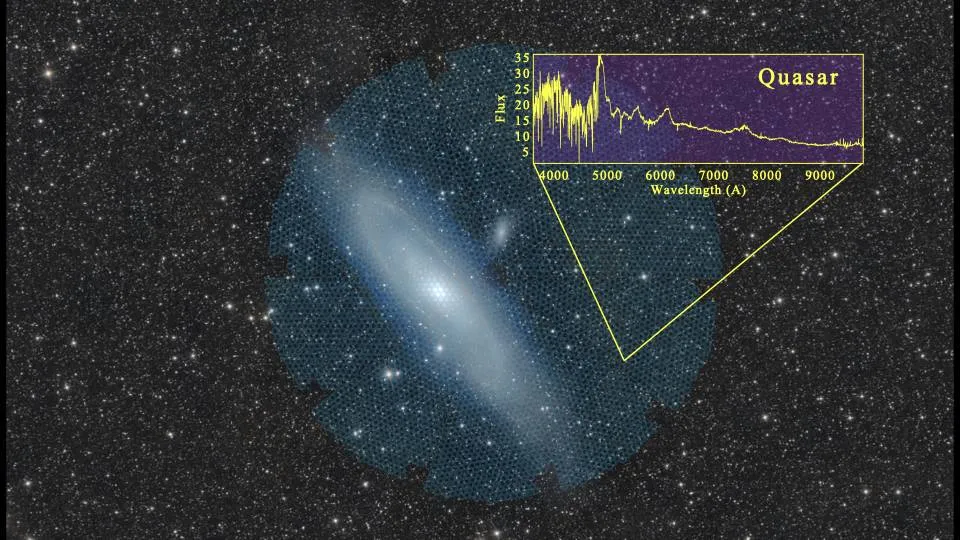
The DESI instrument, represented by the circular surface in pale green superimposed on the image of the Andromeda galaxy (M31), covering a portion of more than 3 degrees of sky. The small circles, within DESI's circular surface, represent the regions of sky accessible by each of the 5,000 robotic fiber positioners. In this sample, the 5,000 spectra collected by DESI simultaneously include, in addition to stars belonging to the Andromeda galaxy, distant galaxies and quasars. The spectrum represented in the image corresponds to a distant quasar with an age of 11 billion years. / DESI Collaboration and Legacy Imaging Surveys)
As the telescope moves, the optical fibers align to collect the light from galaxies reflected in the telescope's mirror. From there, the light is conducted to a bank of spectrographs and CCD cameras for further processing and study. On a good night, DESI can record spectra of about 150,000 objects.
"Unraveling the properties of the mysterious dark energy is the main goal of DESI," said Licia Verde, a professor at ICCUB. "We know that currently 70% of the energy content of the universe is composed of dark energy, but we know very little about its properties."
Dark energy determines the expansion rate of the universe, explains Verde. As the DESI instrument looks into space and time, she says, "we can simultaneously observe the universe in different epochs and, by comparing them, discover how the energy content evolves as the universe ages."
Journey back in time following a beam of light through 11 billion years computationally simulated from DESI observations. Bright, nearby galaxies appear in yellow, luminous red galaxies in red, emission-line galaxies in green, and quasars in blue. Quasars illuminate faint regions of the intergalactic medium (represented by white lines). The volume of the universe shown in this simulation fits in the palm of your hand with your arm extended toward the sky and shows 30 thousand galaxies measured by DESI in 5 hours. DESI will map almost a thousand times more volume over the next five years. (credit: David Kirkby and DESI collaboration).
DESI is an international collaboration led by Berkeley Lab, but with significant Spanish participation: From Spain, the following participate in DESI: the Centro de Investigaciones Energéticas, Medioambientales y Tecnológicas (CIEMAT), the Instituto de Ciencias del Espacio (ICE, CSIC), the Institut d'Estudis Espacials de Catalunya (IEEC), the Institut de Física d'Altes Energies (IFAE), the Instituto de Física Teórica (IFT) of the Universidad Autónoma de Madrid (UAM) and CSIC, the Instituto de Astrofísica de Andalucía (IAA), the Instituto de Astrofísica de Canarias (IAC) and the Instituto de Ciencias del Cosmos of the University of Barcelona (ICCUB).☉
Sources and related links
- Successful Start of Dark Energy Spectroscopic Instrument (DESI) Follows Record-Setting Trial Run
https://newscenter.lbl.gov/2021/05/17/start-of-dark-energy-survey/ - DESI
https://www.desi.lbl.gov/ - A 3D Journey Through 11 Billion Years
https://www.youtube.com/watch?v=gFGteRdBBvg&t=14s&ab_channel=BerkeleyLab - Data collection begins for the Dark Energy Spectroscopic Instrument (DESI)
https://www.ciemat.es/portal.do?IDM=61&NM=2&identificador=2228
About the images
Credit: DESI Collaboration.