The long-awaited results of the Muon g-2 experiment show that muons behave differently than predicted by theory. Or do they?
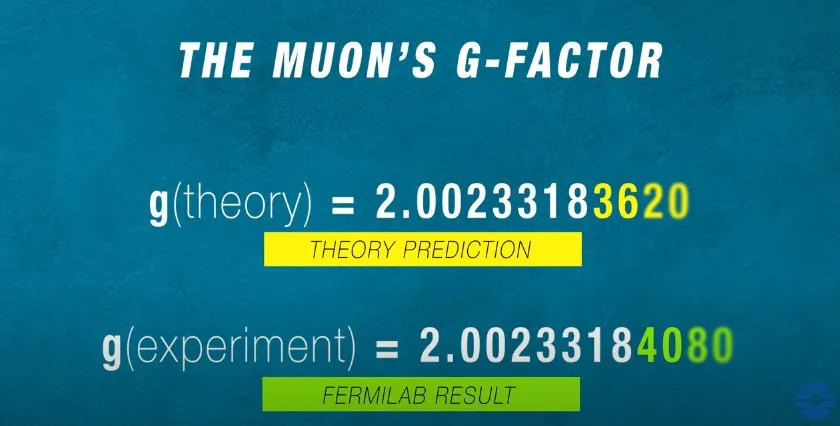
Muons are like electrons, but 200 times more massive. Muons are created naturally when cosmic rays hit the atmosphere and can be produced in laboratories. Like electrons, muons act as if they have a small magnet inside. In a strong magnetic field, the direction of that magnet precesses, meaning it "wobbles" like the axis of a top or a gyroscope. The strength of that magnet determines the rate of that muon motion and is described by a number that physicists call the "g-factor".
In the Muon g-2 experiment at Fermilab, muons circulate in a large magnet and interact with a fog of subatomic particles. Such interactions affect the value of the g-factor. The Standard Model predicts that anomalous magnetic moment with great precision.
"That measured quantity reflects the muon's interactions with everything else in the universe. But when theorists calculate the same quantity, using all the forces and particles of the Standard Model, we don't get the same answer", said Renee Fatemi, a physicist at the University of Kentucky. "This is strong evidence that the muon is sensitive to something that is not in our best theory", she added.
IT'S NOT THE FIRST TIME
The previous experiment, at Brookhaven Laboratory, which concluded in 2001, offered hints of this anomalous behavior.
Fermilab reuses the main component of the previous experiment: a superconducting magnetic storage ring that was transported to the Chicago laboratory in 2013. In the following years, researchers built the experiment and calibrated it to be four times more precise.
The Muon g-2 experiment sends a beam of muons into the ring, where they circulate thousands of times. The detectors allow determining how fast the muons precess.
In its first year of operation, in 2018, Fermilab collected more data than all previous experiments combined. With over 200 scientists from 35 institutions in 7 countries, the collaboration has now finished analyzing the motion of more than 8 billion muons from the first run of the experiment.
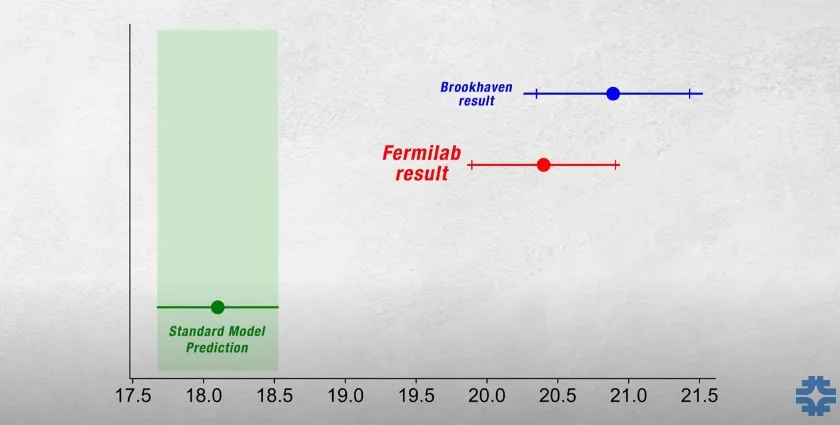
Other data collection runs have already been carried out and are being analyzed, and a fifth run is planned. Combining all the results will give scientists a more precise measurement. So far, they have analyzed less than 6% of the data the experiment will ultimately collect.
BUT...
The g-factor was calculated by a group of 132 physicists known as the Muon g-2 Theory Initiative (TI for short). This is the value that does not perfectly match the experiments.
However, a few days ago, another group of theorists known as BMW (for the European city names they belong to), performed another calculation and say the expected value is the one reflected by the experiments. If this is correct, perhaps physicists have been chasing ghosts for the last 20 years. "Surprisingly, our result [values] removes the need to invoke new physics to explain the gµ-2 measurements", they say.
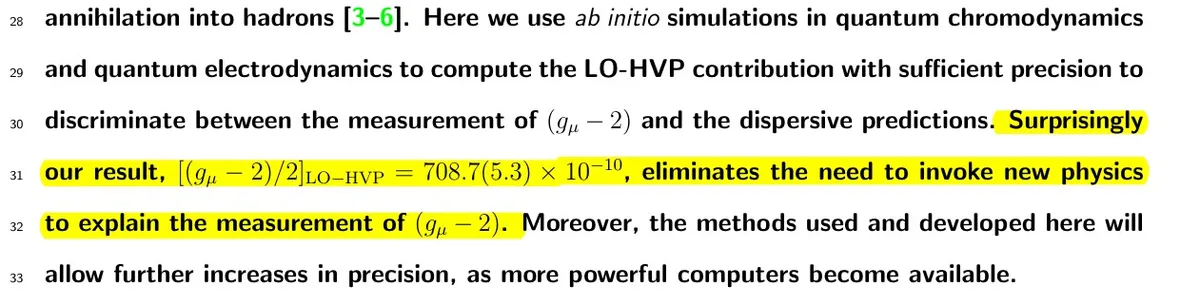
So now there is a discrepancy between observational data and calculations, but also another difference between calculations.
To us, sad mortals, there is nothing left but to wait for the numbers to be reviewed and for the analyses of the other experiment runs to be done. Perhaps this story of forking paths will finally converge on some conclusion.
For now, about this micro problem, we can't say mu.☉
Sources and related links
- Muon g-2 experiment finds strong evidence for new physics
https://www.youtube.com/watch?v=ZjnK5exNhZ0&ab_channel=Fermilab - First results from Fermilab’s Muon g-2 experiment strengthen evidence of new physics
https://news.fnal.gov/2021/04/first-results-from-fermilabs-muon-g-2-experiment-strengthen-evidence-of-new-physics/ - ‘Last Hope’ Experiment Finds Evidence for Unknown Particles
https://www.quantamagazine.org/muon-g-2-experiment-at-fermilab-finds-hint-of-new-particles-20210407/ - Muon g-2 Theory Initiative
https://muon-gm2-theory.illinois.edu/white-paper/ - Borsanyi, S., Fodor, Z., Guenther, J.N. et al.
Leading hadronic contribution to the muon magnetic moment from lattice QCD.
Nature (2021). https://doi.org/10.1038/s41586-021-03418-1
https://arxiv.org/abs/2002.12347
About the images
Credit: Fermilab.