Gravity passed a test: New experiment demonstrates that the inverse square law works at 50 micrometers.
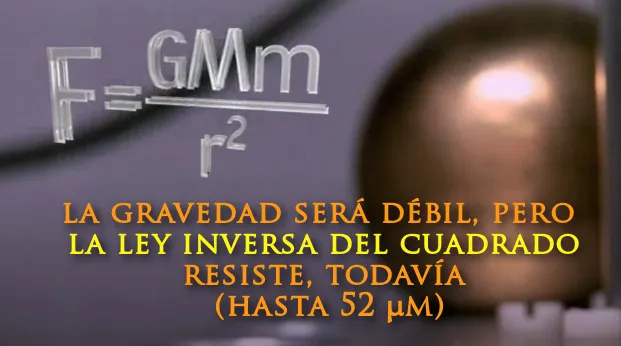
A new experiment, reported in a paper published in Physical Review Letters, found that gravity continues to work, as known, at a small scale, 52 μm.
Physicists design experiments to find gravity at very small scales, since if the result were different from expected, it could be the mark of New Physics®.
Gravity, it is known, decreases with the square of the distance. That is, at double the distance, the "force" of gravity is one fourth (half, squared). If this known Inverse Square Law (ISL) were not detected at small scales, it could be an indication of the existence of other dimensions. However, detecting gravity at very small scales is challenging, since gravity is very weak.
The Eöt-Wash group at the University of Washington, led by E. G. Adelberger, has been working in this field for several years, conducting experiments with torsion pendulums.
These are devices with different configurations, but which are basically comprised of a pendulum ring with 10 holes hanging from a tungsten fiber over a rotating disk with another 10 holes. The disk acts as the driving mass that provides a gravitational pull on the pendulum that oscillates 10 times for each revolution of the disk. The pendulum's oscillation is measured by a laser reflected in a mirror mounted on the ring. The induced oscillation (torque) in the pendulum at different distances is then compared with a Newtonian calculation of the system. They also take into account a possible Yukawa interaction as a signal of extra dimensions. The theories they test are those of Arkani-Hamed and others who propose that gravity is not so weak (in relation to the other "forces"), but rather it appears that way by "leaking" into extra dimensions.
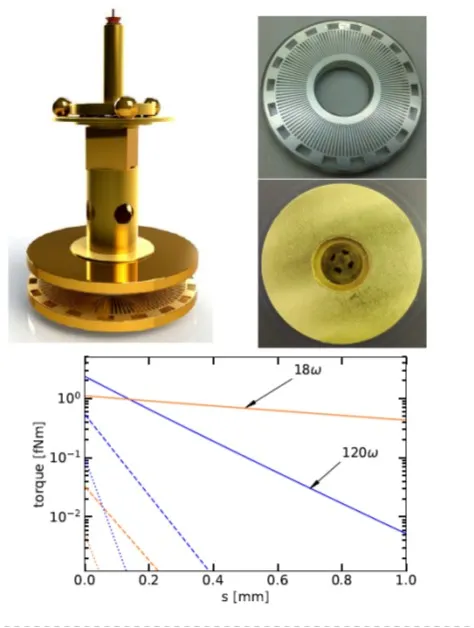
In some configurations, two disks are used, instead of one. The idea is that both disks have holes and that the second has its holes located halfway between those of the upper disk. If the ISL is correct, the lower holes are designed to produce a twist that cancels the oscillation produced by the upper disk. However, if gravity changes strength at short distances, as some theories propose, the twist induced by the lower disk, which is farther from the ring, will not cancel and a clear signal would be detected.
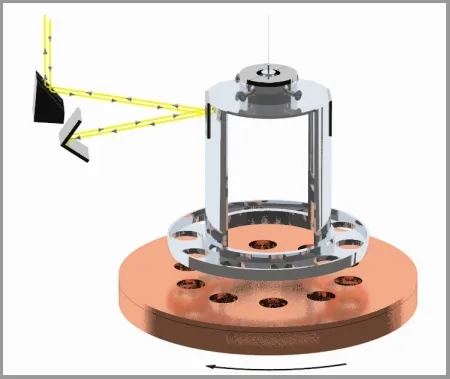
To avoid electromagnetic interference, thin copper sheets with ground connection are used between the ring and the disk and the device is placed in Faraday cages. The elements also have a gold coating to minimize electrical effects.
The experimenters report that to refine the results they must prevent environmental vibrations and that they are working on that. Meanwhile, Newton can rest easy.
Videos
Adelberger explained his experiments in two programs: one from the Discovery Channel, with Morgan Freeman (whose episode can be seen on YouTube), and another on the online learning platform Physics for the 21st Century, in the chapter on gravity. Links to both videos are below.
Sources and related links
- Experiment finds that gravity still works down to 50 micrometers
https://arstechnica.com/science/2020/04/gravitys-inverse-square-law-tested-at-scale-of-a-human-hair-and-passes/ - Physical Review Letters, 2020, DOI : 10.1103/PhysRevLett.124.101101
- New Test of the Gravitational 1/r2 Law at Separations down to 52 μm
J.G. Lee, E.G. Adelberger, T.S. Cook, S.M. Fleischer, B.R. Heckel
arXiv:2002.11761 [hep-ex]
https://arxiv.org/abs/2002.11761 - The Eöt-Wash Group
https://www.npl.washington.edu/eotwash/inverse-square-law - GRANDES MISTERIOS DEL UNIVERSO CON MORGAN FREEMAN ( hay mas de 3 dimensiones ? )
https://www.youtube.com/watch?v=5_7l1rug2VQ - Physics for the 21st Century
https://www.learner.org/series/physics-for-the-21st-century/gravity/gravity-video/
About the images
Images from J.G.Lee et al., The Eöt-Wash Group.
Video screenshot from Harvard-Smithsonian Center for Astrophysics Science Media Group in association with the Harvard University Department of Physics.