Together with Marc Kamionkowski and Uroš Seljak, for their contributions to the study of the CMB.
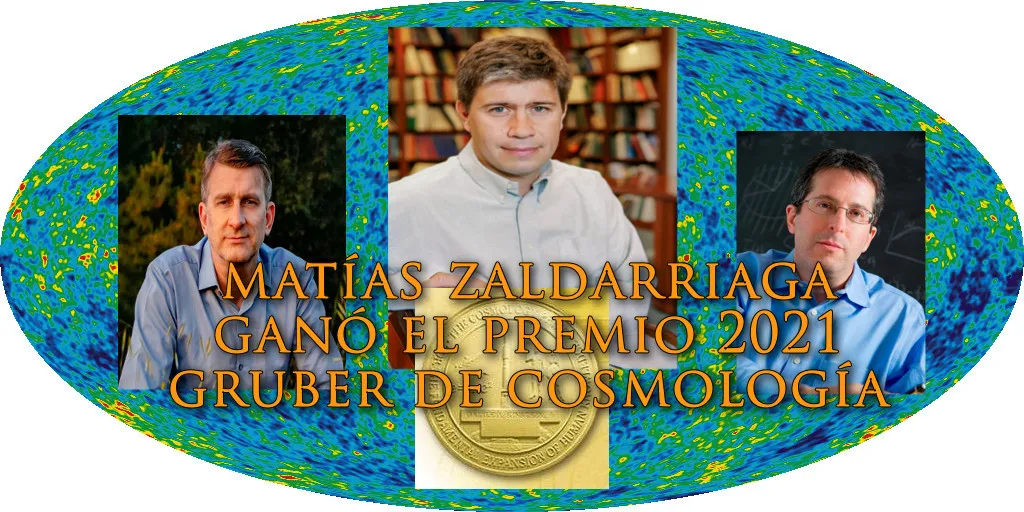
The Gruber Prize in Cosmology, which is sponsored by the IAU, recognizes scientists whose contributions have generated fundamental advances in the understanding of the Universe. This year the prize was awarded to Marc Kamionkowski, Uroš Seljak and Matías Zaldarriaga for the development of techniques to investigate the Cosmic Microwave Background radiation (CMB).
The three researchers will share the USD 500,000 prize and each will receive a gold medal at a ceremony to be held in August at the 24th International Conference on Particle Physics and Cosmology (COSMO'21) at the University of Illinois and online.
The CMB provides an image of the universe when it was about 380 thousand years old, but it represents an observational limit, since measurements before that time are not possible. However, Kamionkowski and, independently but simultaneously, Seljak and Zaldarriaga, developed a mathematical technique to use the CMB radiation to infer what the universe was like before that limit. The method uses the property of polarization, that is, the degree of oscillation of a wave relative to a perpendicular orientation. In 1997 the work of these astrophysicists was published in two papers in Physical Review Letters. There, they identified a signature in the CMB that, if found in reality, would prove the existence of primordial gravitational waves, predicted by inflationary theory.
Beyond that specific contribution, the prize recognizes the careers of the three theoretical physicists. Before publishing the 1997 paper, Seljak and Zaldarriaga created a code that allowed the study of some aspects of the CMB much faster, called CMBFAST. Since the code was made public, it dominated the research to come. It still remains a foundational code for analyzing CMB polarization. Other programs are currently used, such as CAMB in Fortran, but they are based on CMBFAST.
Marc Kamionkowski is from Johns Hopkins University; Uroš Seljak is from the University of California; and Matías Zaldarriaga belongs to the Institute for Advanced Study (Princeton).
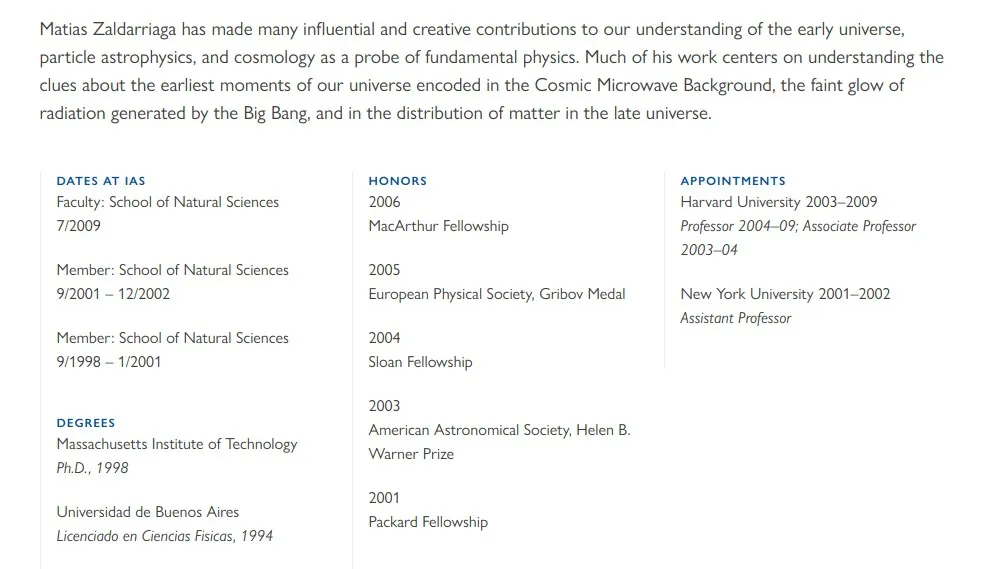
Zaldarriaga studied physics at the UBA and obtained his undergraduate degree in 1994. Later, he earned his doctorate at MIT (1998). His work had already been recognized with other awards, such as the Barret in 1996 and the Helen Warner in 2003.☉
Sources and related links
- Signature of Gravity Waves in Polarization of the Microwave Background
Uros Seljak (CfA), Matias Zaldarriaga (MIT)
https://arxiv.org/abs/astro-ph/9609169
https://journals.aps.org/prl/abstract/10.1103/PhysRevLett.78.2054 - An All-Sky Analysis of Polarization in the Microwave Background
Matias Zaldarriaga (MIT), Uros Seljak (CfA)
https://arxiv.org/abs/astro-ph/9609170
https://journals.aps.org/prd/abstract/10.1103/PhysRevD.55.1830 - A Line of Sight Approach to Cosmic Microwave Background Anisotropies
Uros Seljak (Harvard Smithsonian Center for Astrophysics), Matias Zaldarriaga (MIT Physics Department)
https://arxiv.org/abs/astro-ph/9603033 - Matías Zaldarriaga at IAS
https://www.ias.edu/sns/matiasz - 2021 Gruber Cosmology Prize
https://gruber.yale.edu/2021-gruber-cosmology-prize - Recipients of 2021 Gruber Cosmology Prize Announced
https://www.iau.org/news/pressreleases/detail/iau2103/
About the images
Credits: NASA / WMAP Science Team.
Photos: IAU/Andrea Kane, Institute for Advanced Study.