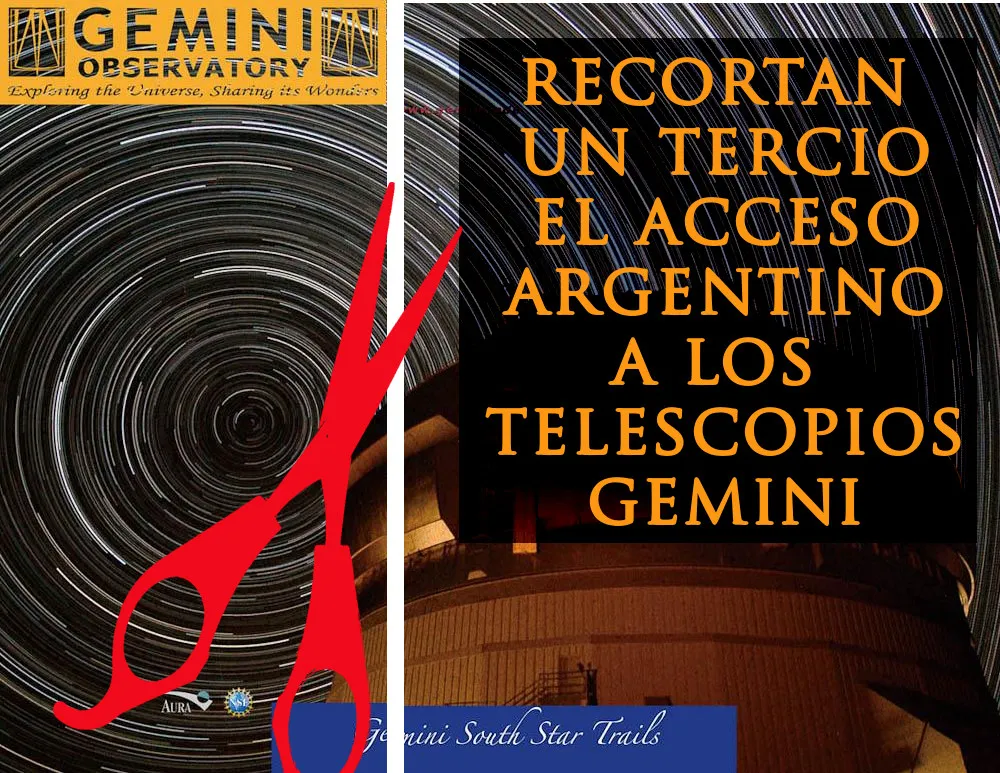
In the Year of Argentine Astronomy, they apply the short blanket and there will be annoyance when blowing out the 150 little candles.
On October 24, 1871, the National Observatory, today the Astronomical Observatory of Córdoba (OAC), was inaugurated. The modern Argentina of Sarmiento boosted local astronomy through Benjamin Gould, which gave rise to Uranometría Argentina. For this reason, every October 24 is celebrated as Argentine Astronomy Day. In 2021, 150 years will have passed since that foundational stone, which is why this is considered the Year of Argentine Astronomy.
But the birthday party has no good gifts. We have gone from the knowledge-hungry astronomy of the late 19th century to the overstuffed astronomy.
Situation of Current Argentine Astronomy
There are many ways to describe the status quo, in a quantitative manner: number of professionals, institutes, publications, students. Another is infrastructure. In that sense, a comparison is worthwhile, which we will immediately nuance.
Almost a century ago, Edwin Hubble used the Hooker Telescope, on Mount Wilson, to make his famous discoveries. His hunger for knowledge led him to discover the famous Galaxy Fork, which fed so many researchers of galaxy morphology and evolution. He performed the feat with an apparatus whose aperture (the diameter of the primary mirror) was 100 inches, 254 cm.
Even today, Argentina does not possess -on national territory- an optical instrument of that size. The best national telescope, installed at CASLEO, is the Jorge Sahade Telescope (TJS), with a 215 cm mirror.
However, infrastructure in astronomy does not begin and end there: there are radio telescopes, like those at IAR, which has a 30-meter antenna, as well as some projects under construction: LLAMA (12 m antenna) and CART (40 m antenna) in collaboration with Brazil and China, in Salta and San Juan, respectively.
But these other instruments are sensitive to different wavelengths, which is very good because it is necessary for astrophysics research to study phenomena at different energies.
In the optical range, the "visible" part of the spectrum, the TJS is the best, although small compared to global astronomy. Science can be done with that equipment, anyway, but technological advancement now allows the construction of 30 and even 40-meter telescopes.
Argentina can access that type of cutting-edge technology thanks to membership in the Gemini Consortium, which owns two twin telescopes, with 8.1-meter mirrors, in Chile and Hawai'i. Argentina's participation requires the payment of an annual fee, close to one million dollars, to obtain in return 3.1% of observing time.
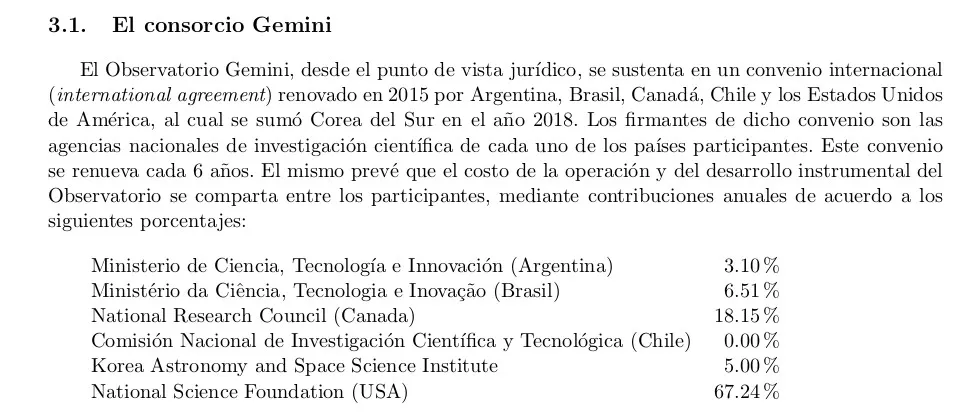
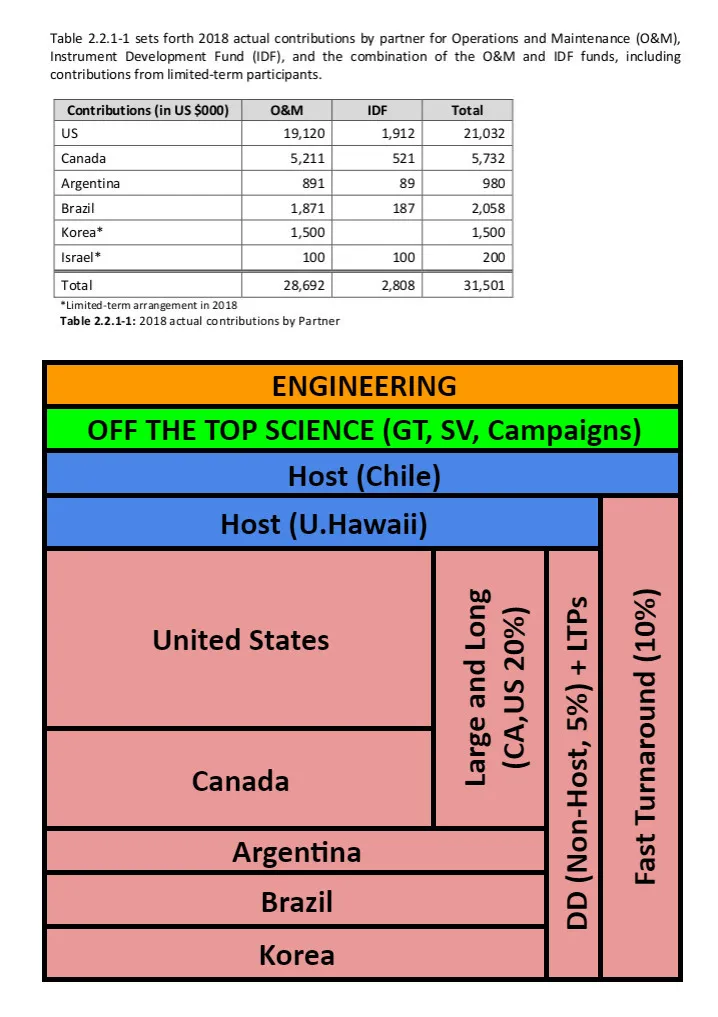
It may seem like a lot is put in to get little, but this comparison is worthwhile:
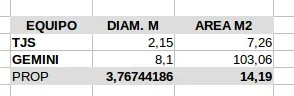
An 8-meter mirror is 4 times larger than a 2-meter one. But the light-gathering area is 14 times greater. It's not just the optics, but also the instruments these devices have, which are top-level. The science that can be done is notably different.
However, starting next year, Argentine astronomers will have 2% of observing time on those telescopes, after a 35% cut (one third), which also implies a lower payment, supposedly to be channeled to the construction projects, delayed during the previous administration due to lack of funding.
HISTORY OF THE CUT
The authorities of the Ministry of Science have not made this cut public. Upon inquiries made by me to the authorities, there was no response.
The information I was able to gather is this:
In 2019, a commission was created at AAdA to prepare a Decadal Report 2021-2030. It was an initiative similar to those carried out in other countries, like the U.S., with the aim of evaluating research opportunities in relation to available resources. That commission was deactivated and the report was not completed, given that at that time the Federal Council of Astronomy (CFA) was created, an organization that includes all those responsible for the country's astronomical institutions, namely: observatories, faculties, and institutes.
Later, in December 2020, another organization called the National System of Astronomy and Space Sciences (SiNACU) was created, as an advisory body to MinCyT on astronomy resources.
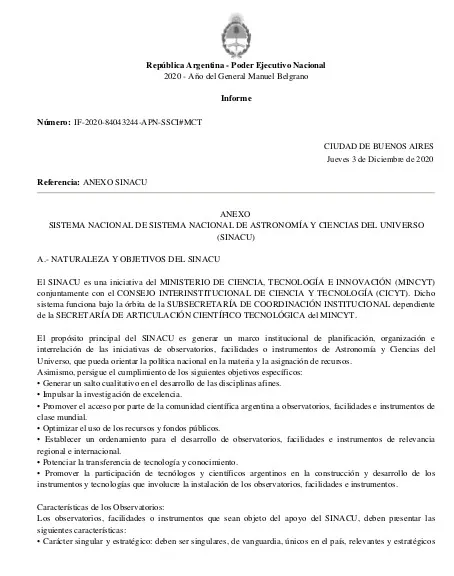
(See documents in links, below)
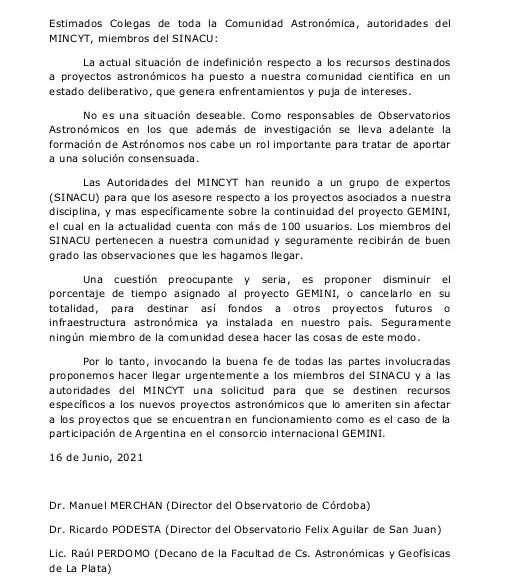
A simple web search for the term "Sinacu" yields, among the results, a note posted on the page of the Faculty of Astronomy of the University of La Plata (FCAGLP). The note says (bold is mine):
The current situation of uncertainty regarding resources allocated to astronomical projects has placed our scientific community in a deliberative state, which generates confrontations and a clash of interests.
The Authorities of MINCYT have brought together a group of experts (SINACU) to advise them on projects associated with our discipline, and more specifically on the continuity of the GEMINI project, which currently has more than 100 users. The members of SINACU belong to our community and will surely welcome the observations we send them.
A concerning and serious issue is to propose decreasing the percentage of time allocated to the GEMINI project, or canceling it entirely, in order to allocate funds to other future projects or astronomical infrastructure already installed in our country. Surely no member of the community wishes to do things this way.
Therefore, invoking the good faith of all parties involved, we propose urgently sending to the members of SINACU and the authorities of MINCYT a request that specific resources be allocated to new astronomical projects that merit them without affecting projects that are in operation, as is the case of Argentina's participation in the international GEMINI consortium.
June 16, 2021
Dr. Manuel MERCHAN (Director of the Córdoba Observatory)
Dr. Ricardo PODESTA (Director of the Felix Aguilar Observatory of San Juan)
Lic. Raúl PERDOMO (Dean of the Faculty of Astronomical and Geophysical Sciences of La Plata)
The FCAGLP has online minutes of the Board of Directors. Minutes 415 of the virtual session of May 28 and 416 of June 25 address the issue.

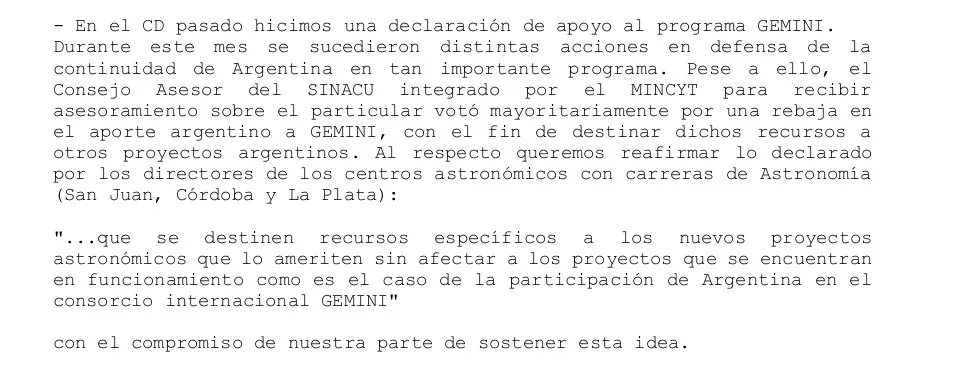
In the latter it says:
In the last CD we made a statement of support for the GEMINI program. During this month, various actions took place in defense of Argentina's continuity in such an important program. Despite this, the Advisory Council of SINACU, integrated by MINCYT to receive advice on the matter, voted in majority for a reduction in the Argentine contribution to GEMINI, in order to allocate those resources to other Argentine projects. In this regard, we wish to reaffirm what was declared by the directors of the astronomical centers with Astronomy degree programs (San Juan, Córdoba and La Plata):
"...that specific resources be allocated to new astronomical projects that merit it without affecting projects that are in operation, as is the case of Argentina's participation in the international GEMINI consortium" with the commitment on our part to uphold this idea.
According to what some sources tell me, since SiNACU was created, suspicions arose because for making proposals to finance local infrastructure, nothing better than the CFA. Hence, it was suspected that the MinCyT's incursion had the purpose of cutting. Other voices tell me that creating a national astronomy system makes perfect sense, as it allows sharing and planning resources more efficiently.
In summary, the cut is 35% of the observing time on the Gemini Telescopes, which would lead to using 2% instead of 3.1%, with a reduction in financial contributions, with the goal of using the difference for the construction projects delayed by the lack of funds during the previous government. As a consequence, there will be research that cannot be done and doctoral theses that will be delayed.
Apparently, the authorities' idea is that allocating USD 1 million is more than enough. As a consequence, since almost all of those funds must be allocated for Gemini Argentina alone, a cut had to be made to finance the other projects. Evidently, not all Argentine astronomers agree that the cut was necessary and timely.
The situation generated a crisis in the AAdA due to a discrepancy between its president and the Executive Committee, since the former voted in favor of the cut, despite the fact that the CD had decided otherwise.
COUNTERPROPOSAL
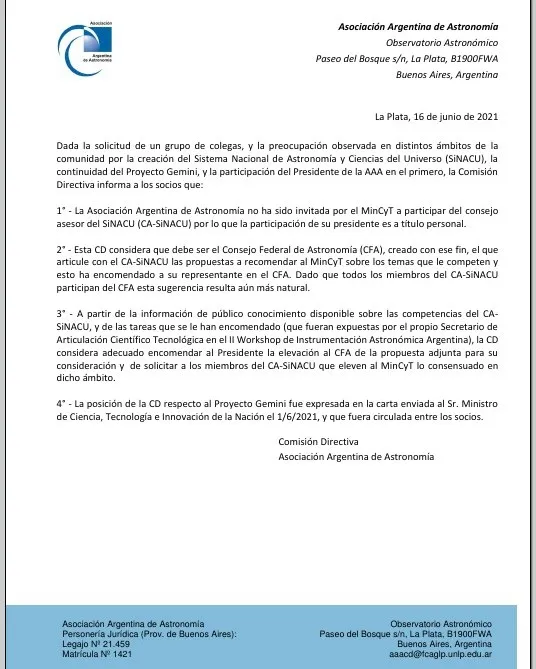
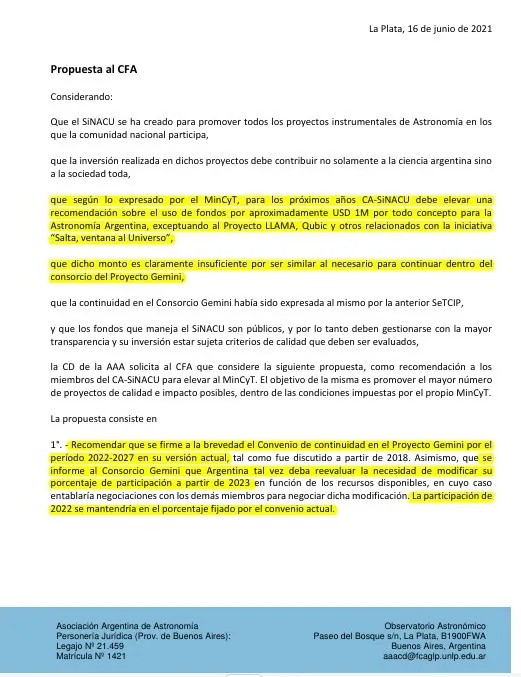
The Executive Committee of the Association (AAdA) made a suggestion: maintain the current percentages, making it clear that, perhaps, they should be reviewed in 2023, but maintain them in 2022. At the same time, consider a budget increase for SiNACU by virtue of the Financing Law. And evaluate other sources of income (provinces, universities, etc). The proposal was made to the CFA so that they raise it to SiNACU. Here I show screenshots of the document dated June 16, 2021.
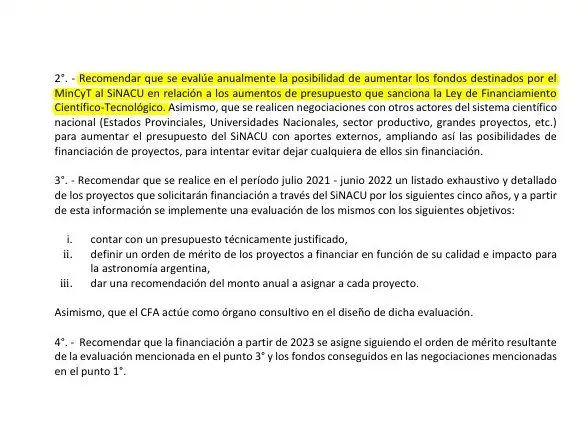
Cut announced
On June 25, the cut was officially announced and the members of the AAdA were informed:
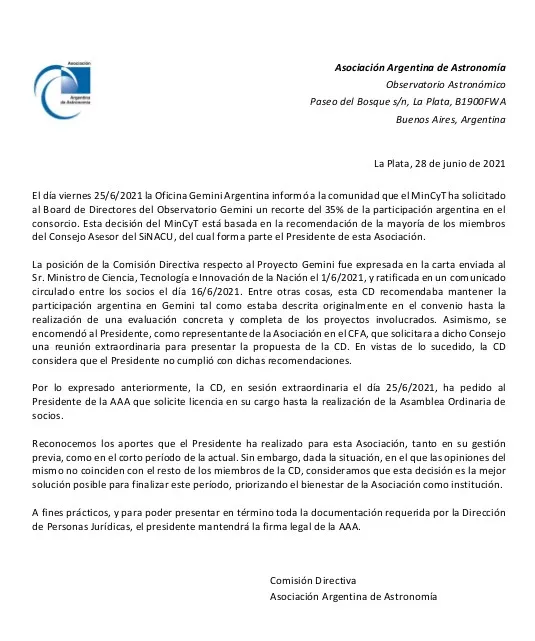
CONTEXTS
1-The importance of Gemini
In a work by Sergio Cellone and others in the AAdA Bulletin 56, from 2013 (1), the importance of using these instruments is highlighted. At the end it states:
It is therefore crucial in the immediate future to take the actions that allow strengthening and expanding Argentine participation in Gemini, with a view to favorably positioning our country in the face of the challenge posed by telescopes of more than 30 m in diameter that would operate in the coming decades.
Currently, there is an overdemand for the use of Gemini by Argentine researchers, by a factor of 3 and growing (see fig.2, below). That is, the available time had to be increased. It was not always like this: training was needed to know how to use these instruments. When that was achieved, the demand curve skyrocketed.
In a report from the Technical Secretariat of the Argentine Gemini Office (OGA), with data up to 2020, it is stated:
The statistics show that the Argentine astronomical community has acquired the necessary capabilities to efficiently use the Gemini telescopes, achieving high scientific productivity in relation to the investment made by the State. The number of astronomers who use or have used the Gemini Observatory for their research work, as well as the number of doctoral theses produced or in development using data from said Observatory, show that it has become established as one of the most relevant facilities for our community. Together with CASLEO, they constitute the main sources of observational data in the optical and infrared bands.
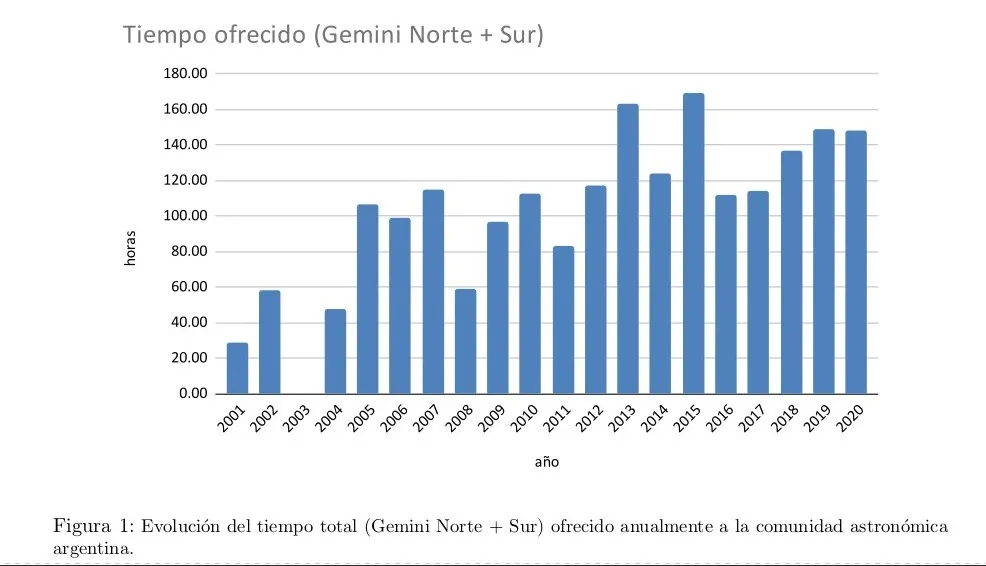
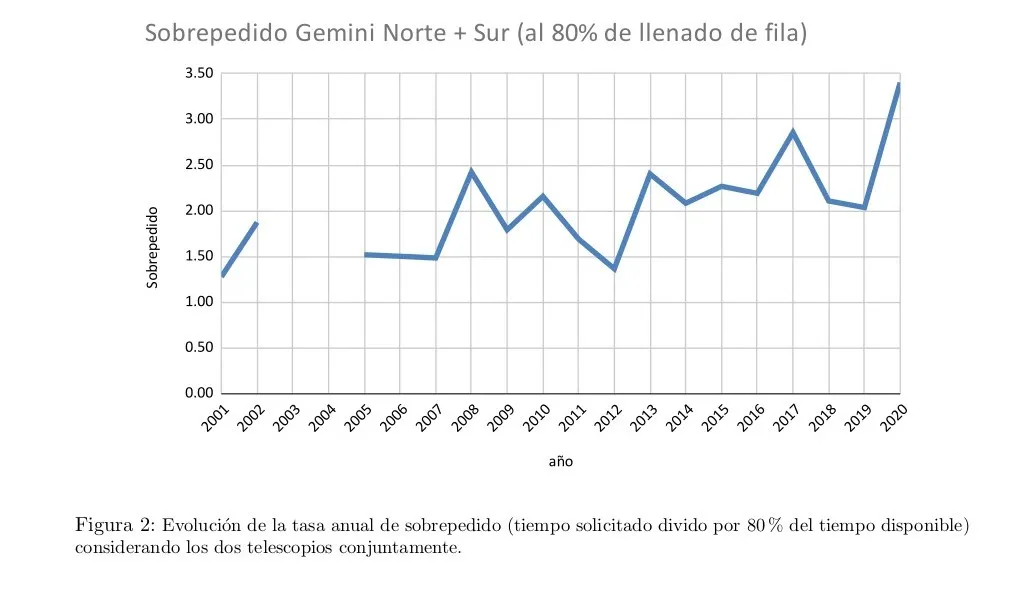
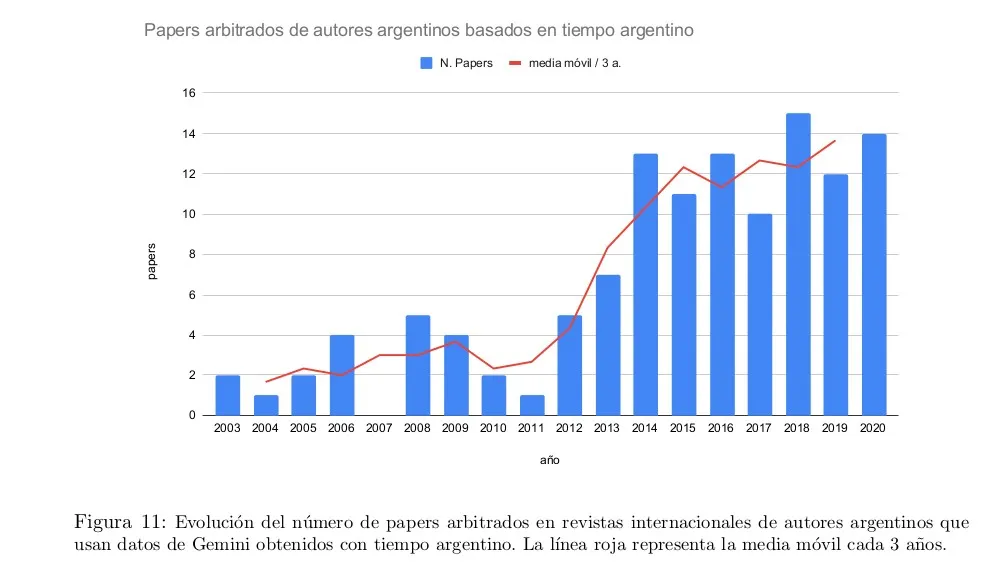
It is worth mentioning that the high-resolution spectrograph BHROS, decommissioned at Gemini South in 2009, was brought into the country in 2014 through an agreement between the Ministry of Science and ICATE, CONICET (2).
It is not as simple as "a lot of dollars go out, nothing comes in": data comes in, with which research is done; training in cutting-edge science comes in; and sometimes also decommissioned equipment, very useful for use in local telescopes and of great economic cost.
2-Adjustment with the short blanket
One could say that the current policy is NOT an economic cut (although it is in terms of access time), if we consider that the same amount of money as before is used: USD 1 million, only distributed differently. Until now all the money was used for Gemini, now less is used for those telescopes, to finance the delayed projects, due to the lack of funding from the previous Government. This implies that it is not a new adjustment, but rather the previous one is maintained, only distributed differently. However: what are those other projects? Is there a plan or is it an isolated measure?
3-Momentary restrictions or shift in scientific policy
It is reasonable to think that it is not the time to increase the budget allocated to astronomy, since there are other priorities arising from the pandemic. For this reason, it was decided to redistribute what was available. But there is a possibility that it is a shift in scientific policy: the current leadership of MinCyT does not like paying a fee in dollars without keeping the hardware, so the idea is to keep shrinking the Gemini quota.
4-The stellar Tupac Amaru
If the astronomical community in the country is about ~400 professionals (number of members of the AAdA) and 80 use or plan to use Gemini and 320 do not, but 95% of the astronomy budget ends up with the former, it is logical to expect the latter to have complaints. It must be remembered that there is an oversubscription, which means that if the amount of available time were increased, there would be a greater number of users. If the oversubscription is almost 4, the proportions are reversed: 80*4=320. Furthermore, the AAdA members agreed to recommend that time on Gemini not be cut.
The possible solutions are not infinite: either the short blanket is used: taken from some to give to others; or income is increased. The latter can be the result of an increase in the national budget or through other sources of funding. Some projects, like those in Salta, have their own funding.
Regardless of whether the decision taken is correct or not, it is clear that there is an issue there, which deserves serious and transparent treatment, which does not seem to be the case.
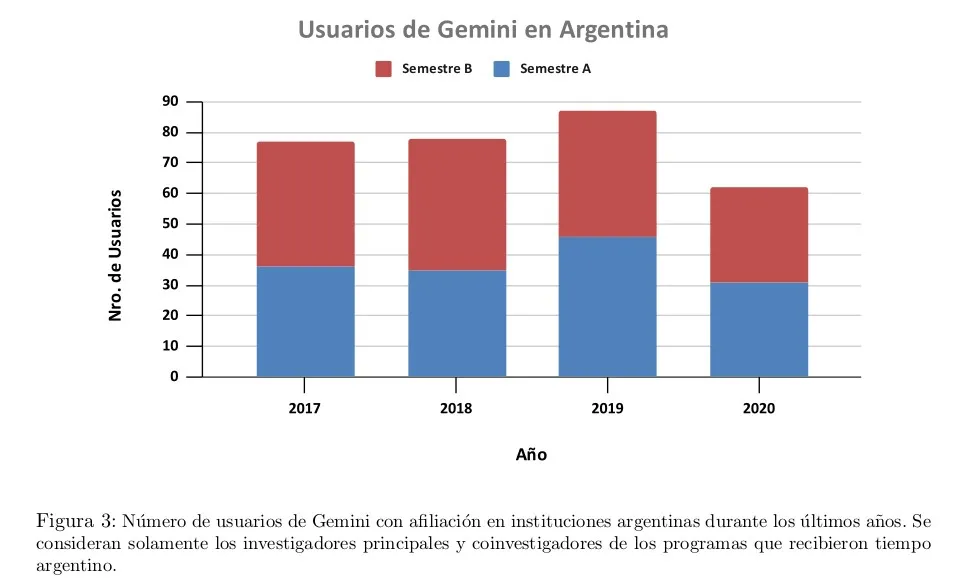
PERSONAL COMMENTS
1-In times of fake news, it does not seem like good policy to fall silent in the face of rumors that spread at the speed of light. The attitude falls under the scientific corporatism of not "airing dirty laundry in public," which is an old custom.
2-It is logical that in the current economic context the astronomy budget cannot be increased, but it is not clear what the funding needs are: how much money to do what things. If it is a shift in scientific policy, contrary to the use of Gemini, it merits a broader and more serious debate.
The search for greater scientific sovereignty touches a special chord in all of us, but cutting access to Gemini to 2% while Brazil has 6.5% may not be in the right direction. The search for additional sources of funding makes sense, on the other hand.
3-As I said at the beginning, we went from a hunger for knowledge to an overindulgence. It is understood that Argentine astronomy must have a scale appropriate to the country's economic development. It is understood that due to the pandemic and the necessary restrictions that led to a shrinking of the economy, the economic situation is delicate. It is known, because no one lives in a mayonnaise jar, that the Gemini Office was organized in 2007 and that during the 2015-2019 government administration science was defunded. But, were there no other alternatives? The AAdA's Board of Directors made coherent suggestions, which were ignored.
4-I believe, finally, that beyond the displeasure this decision generates in the country's astronomical community, one should swallow one's saliva, count to ten, and look to the future. The professionals of local astronomy are intelligent and creative enough to seek solutions, even with this cut already made. I mean looking for ways to mitigate the impact and possible additional sources of funding. If each sector pulls in its own direction, local astronomy will have the fate of Tupac Amaru and will be dismembered into a constellation of island universes.
In short, although Argentine astronomers live in the Milky Way, it would not be good for them to only cry over spilled milk while blowing out the 150 little candles.☉
Sources and related links
- (1) Argentine participation in the Gemini Observatory
http://www.astronomiaargentina.org.ar/b56/2013baaa...56...429C.pdf - (2) Progress in the commissioning of the BHROS spectrograph
http://www.astronomiaargentina.org.ar/b59/2017baaa...59...64D.pdf - OGA
https://www.argentina.gob.ar/ciencia/sact/convocatorias-gemini
Updated information about Argentina's participation in the Gemini Observatory
Statistical data as of the end of 2020
Technical Secretariat of the Argentine Gemini Office (OGA)
Gemini: 2018 Annual Progress Report https://www.gemini.edu/files/governance/annual_reports/2018%20Annual%20Report_final.pdf
Gemini: Participating Country Shares https://www.gemini.edu/about/participant-shares
Actas FCAGLP https://intranet.fcaglp.unlp.edu.ar/intra.php?p=6
Resolución Sinacu https://drive.google.com/file/d/1YtGaTpSaL9tTaD2vvCDN2cUK6x_pYZyI/view?usp=sharing
Anexo Sinacu 1 https://drive.google.com/file/d/1bisp0LggrELhn5z16waf0li5n4UhjqMY/view?usp=sharing
Anexo Sinacu 2 https://drive.google.com/file/d/1lm6DLuc6K727oMHgCLOQC_PhnL9qxHsa/view?usp=sharing
About the images
Initial image credit: Gemini-AURA.