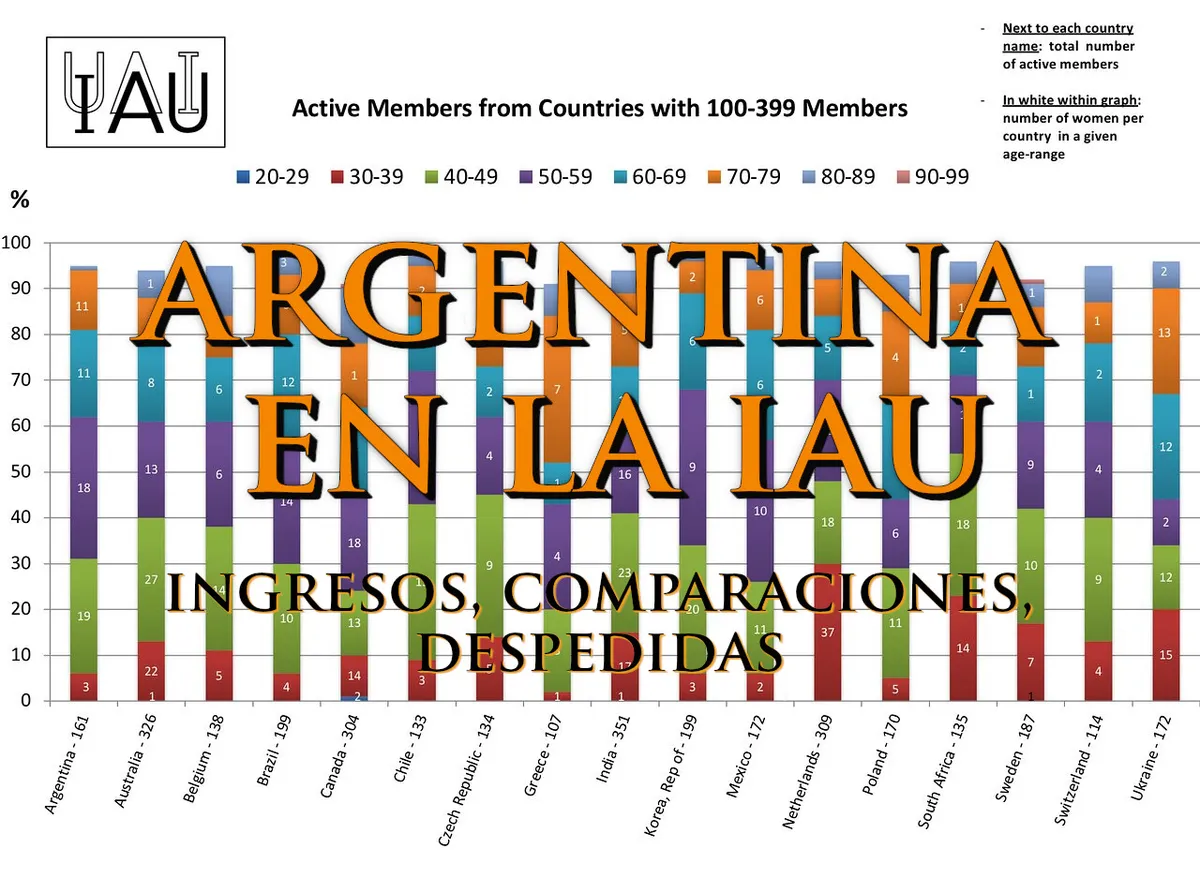
On a study of remuneration for university graduates.
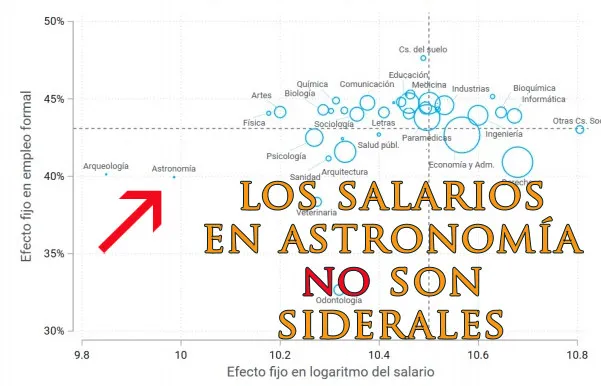
CEP XXI - Centro de Estudios para la Producción, published Working Document No. 7: University credentials and salary differentials in the Argentine productive structure, signed by Martin Trombetta, Gisella Pascuariello, Nicolás Sidicaro, Pablo Sonzogni and Gisel Trebotic.
The introduction indicates the data sources:
This work combines two sources of information. The first is the Araucano system database, used by the Secretaría de Políticas Universitarias of the Ministerio de Educación (SPU), which records students and graduates from all public universities in the country, as well as most private universities. The second is the database of the Sistema Integrado Previsional Argentino (SIPA) from November 2019, which contains information on all registered salaried jobs in that month.
Let's look at some graphs:
In Graph 5. Fixed effects on salaries and formal employment, by discipline:
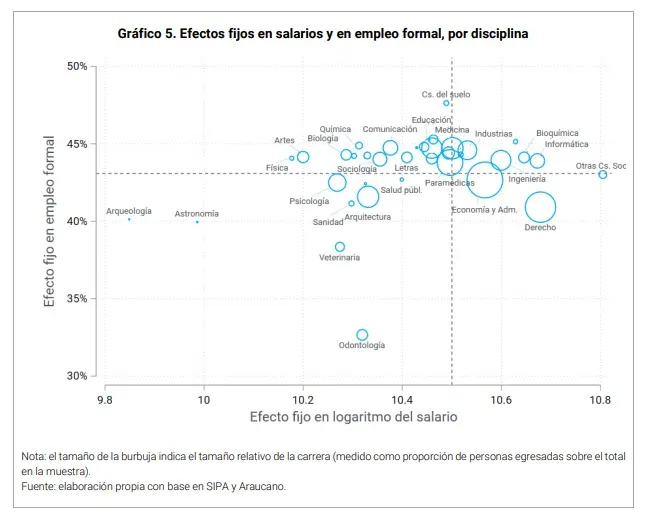
There we see that Astronomy has low labor market insertion and low salaries (compared to the average).
Graph 7. Salary premiums and gender gaps, by discipline:
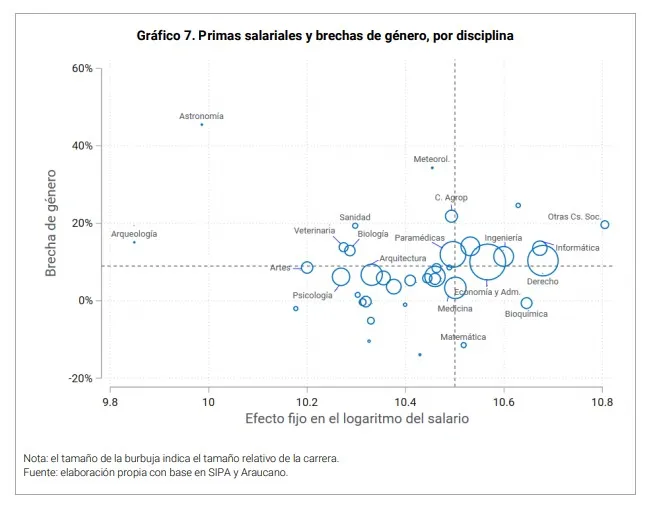
Quadrant 2 (top-left) contains sectors with high gender gaps and low salary premiums: archaeology, astronomy, biology, agricultural sciences, meteorology, paramedicine, health, and veterinary medicine.
Graph 8. Feminization and gender gap, by discipline:
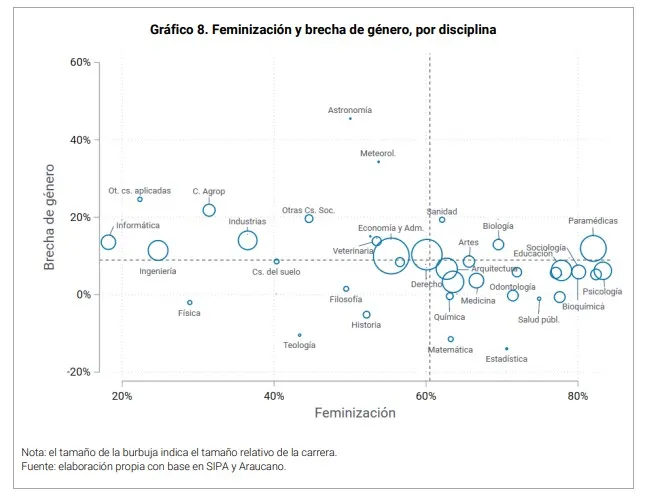
This graph shows that, in line with previous findings, this association has a negative sign. The most feminized careers (psychology, literature and languages, sociology, education, biochemistry and pharmacy) exhibit gender gaps lower than the general average (although paramedicine is an exception).
Similarly, careers with particularly high gender gaps exhibit a lower relative presence of women (as is the case with other applied sciences, agricultural sciences, meteorology, and astronomy).
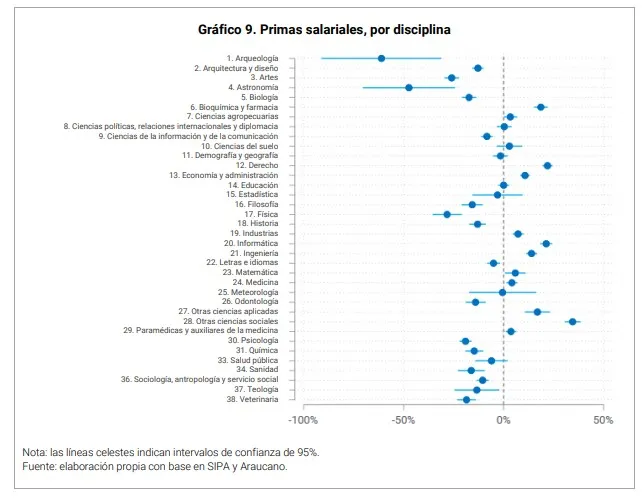
Graph 9. Salary premiums, by discipline:
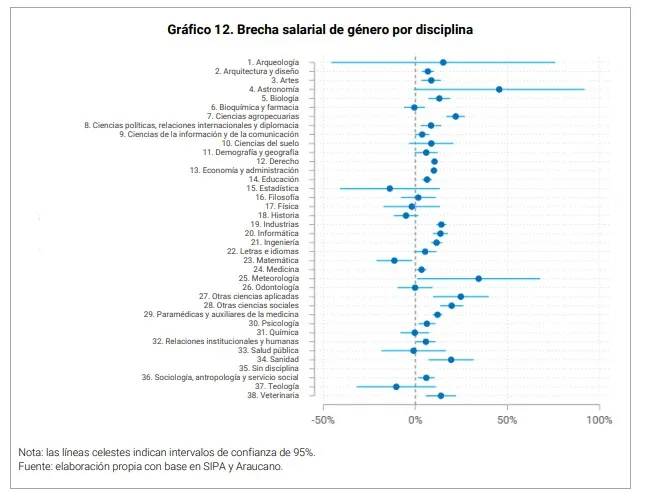
Graph 12. Gender salary gap by discipline:
CONCLUSIONS OF THE WORK
I extract only some paragraphs:
Graduates obtain different results in the labor market depending on the branch, discipline, and area of study they choose when enrolling in a university. Even more interesting is that this variability is even greater when results are separated between jobs belonging to different productive sectors.
A possible interpretation for these findings is one that identifies the relative values of the different university credentials as prices that reflect the relative scarcity of each professional profile in the Argentine productive structure taken as a whole, or in that of each particular sector. Thus, the significant premiums associated, for example, with engineering careers, would reflect the scarcity of graduates in those areas, which in turn can be attributed to the intrinsic difficulty in obtaining those credentials, or to heterogeneous preferences among agents.
It is worth noting that an educational credential can be acquired for reasons that go beyond its labor return, since it does not seem strange to assume that individuals obtain satisfaction from their university studies. Therefore, it cannot be ruled out that the careers with the lowest remuneration in salary terms provide, instead, satisfaction differentials that compensate for their lower monetary returns. From this perspective, the best-paid careers could simply be the least preferred or those that suffer certain structural disadvantages that must be compensated in economic terms.
A PERSONAL REFLECTION
It is clear that those who study and work as astronomers do not do it for the love of money. Nor for "stardom," since most astronomy graduates in Argentina are not known to the general public. Curiously, with similar knowledge, mathematicians or computer scientists can have higher incomes, as there is greater demand.
To make matters worse, dedicating oneself to research in astronomy requires finishing a doctorate, which is certainly difficult and adds about 4 years to the bachelor's degree, which is not easy either. Not counting post-docs, a decade of complex studies. Let's add that in the national territory there are not a large number of Observatories and the existing ones leave much to be desired, compared to other parts of the world. The latter can be nuanced by the Gemini Collaboration and the construction of some telescopes underway.
Under such circumstances, why study and research astronomy in Argentina?
The floor belongs to the professionals. The women and men who have dedicated and dedicate themselves to astronomy in our country probably do so because they love discovering how the universe works, be it planets, asteroids, the interstellar medium, galaxies, AGN, pulsars, etc. And because, despite the limitations, with ingenuity and collaboration, it is possible to make a significant contribution.
Although female astronomers and astrophysicists are not like firefighters, they are -in some way- anonymous heroes of Argentine science. When there is enough empirical evidence of dark matter, perhaps a compatriot will achieve a Nobel Prize.
Until then, the best prize they can have is that the State's efforts to finance the construction of new observatories and maintain the Gemini collaboration, which implies the possibility of using cutting-edge instruments, do not stop. That is, the prize is the work. And the work (the fruit of much study) should be better paid. Universally.
Sources and related links
Trombetta, M.; Pascuariello, G.; Sidicaro, N.; Sonzogni, P.; and Trebotic, G.
University credentials and salary differentials in the Argentine productive structure.
Working Documents of CEP XXI No. 7, June 2021, Centro de Estudios para la Producción
XXI - Ministerio de Desarrollo Productivo de la Nación.
https://www.argentina.gob.ar/produccion/cep/investigaciones-productivas
Ranking of best and worst paid careers https://www.pagina12.com.ar/349670-ranking-de-carreras-mejor-y-peor-pagas
Gemini: Participant Subscription http://www.gemini.edu/about/participant-shares
About the images
Charts by Trombetta and others (2021).