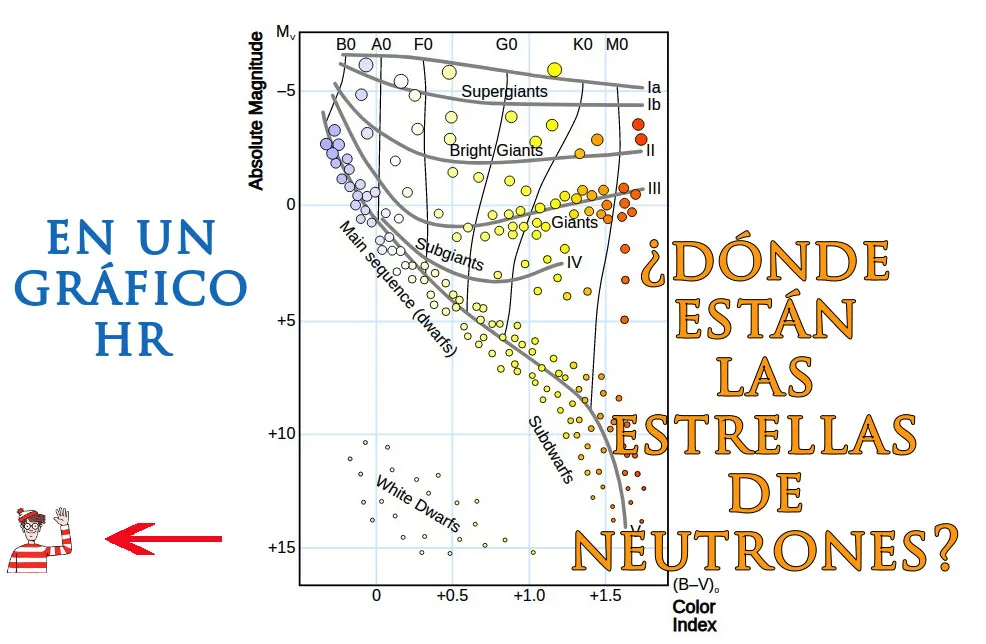
Like in Where's Waldo, but in HR diagrams.
It's hard to separate the meanings of discovering and inventing. But we could accept that inventing is creating something new, even if it's an idea; while discovering is learning about something that existed previously.
Ejnar Hertzsprung and Henry Norris Russell had a similar idea at the beginning of the 20th century. Their combination is known as the H-R Diagram or color-magnitude diagram. It is one of the most fruitful inventions of modern astronomy, even though they didn't win a Nobel Prize for it, since it wasn't a discovery.
These diagrams are the best synthesis of stellar astrophysics. Until the 19th century, astronomy was positional, meaning it was about studying the motion of objects. With the development of spectroscopy and nuclear physics, it became possible to begin to understand how stars form. That led to stellar classification, thanks to contributions like those of Joseph von Fraunhofer and Annie Jump Cannon.
The story is told in the second season of the new Cosmos series, available now on an online video platform and also on some other website.
HR diagrams are not all the same, but they usually have these elements:
On the abscissa axis (the horizontal one) the temperature is placed, in degrees Kelvin. It is usual to also use the same axis, but on the top part, to indicate the spectral type, from O stars -the hottest- to M stars. There is a famous mnemonic rule for this: "Oh, Be A Fine Girl, Kiss Me" (OBAFGKM).
In many cases the color index (B-V) is also indicated, which assigns a number according to the color: negative if it's blue, zero if it's white, positive if it's yellow, orange, or red.
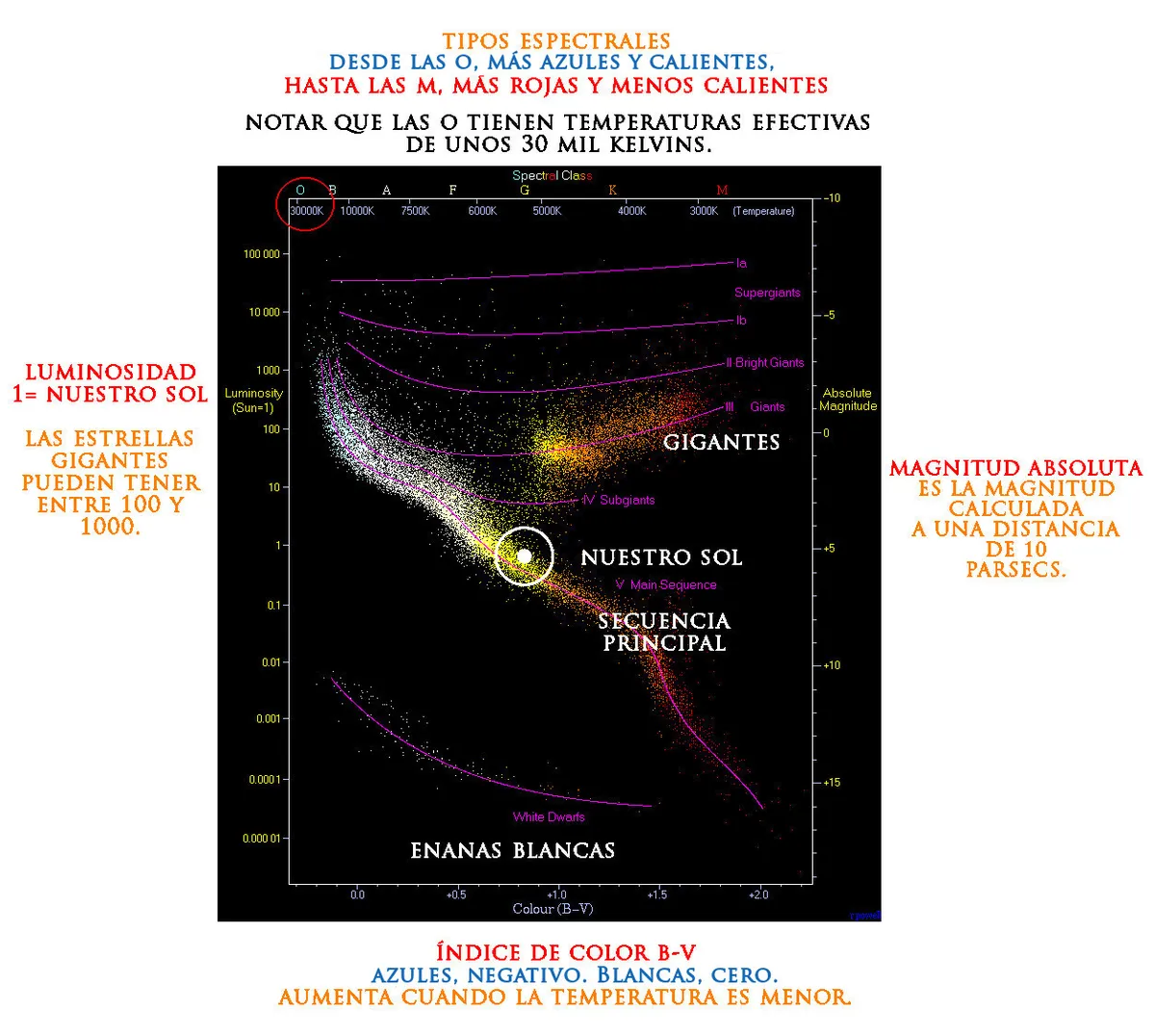
The spectral type or classification of stars depends on the interior physical processes by which they create elements heavier than helium. As a consequence of those physical-chemical processes, they have different effective temperatures. The current classification comes from an earlier one, which is why the letters of the alphabet are out of order. The hottest stars, the O stars, are a small percentage of the total, so often, in HR Diagrams, they are omitted to start with B stars.
On the ordinate axis, the vertical one, the luminosity is indicated, with our Sun as the unit of measurement (which is a G star) and the absolute magnitude is also indicated. Luminosity and magnitude depend on mass. And the greater the mass, the greater the size, except for compact objects, which are very dense.
In this way we have something that resembles a map, but it is not spatial, meaning it does not have spatial coordinates, but color-magnitude coordinates.
Among a set of stars, for example in a globular cluster, or a galaxy, we will have this conceptual map that allows us to place the stars in this way:
The smallest ones will be at the bottom since they are not very luminous. The largest and brightest ones, at the top. The hottest ones, on the left, since they are blue, and the less hot ones, red, on the other side.
We will see that among a group of celestial bodies, a kind of path forms, the main sequence: they are the stars in equilibrium. Outside that path are the post-stellar objects: white dwarfs. But neutron stars are also post-stellar objects. Where are they? Why don't they usually appear in HR diagrams?
Note: brown dwarfs are sub-stellar objects, that's why they don't appear.
AND WHERE ARE THE NEUTRON STARS?
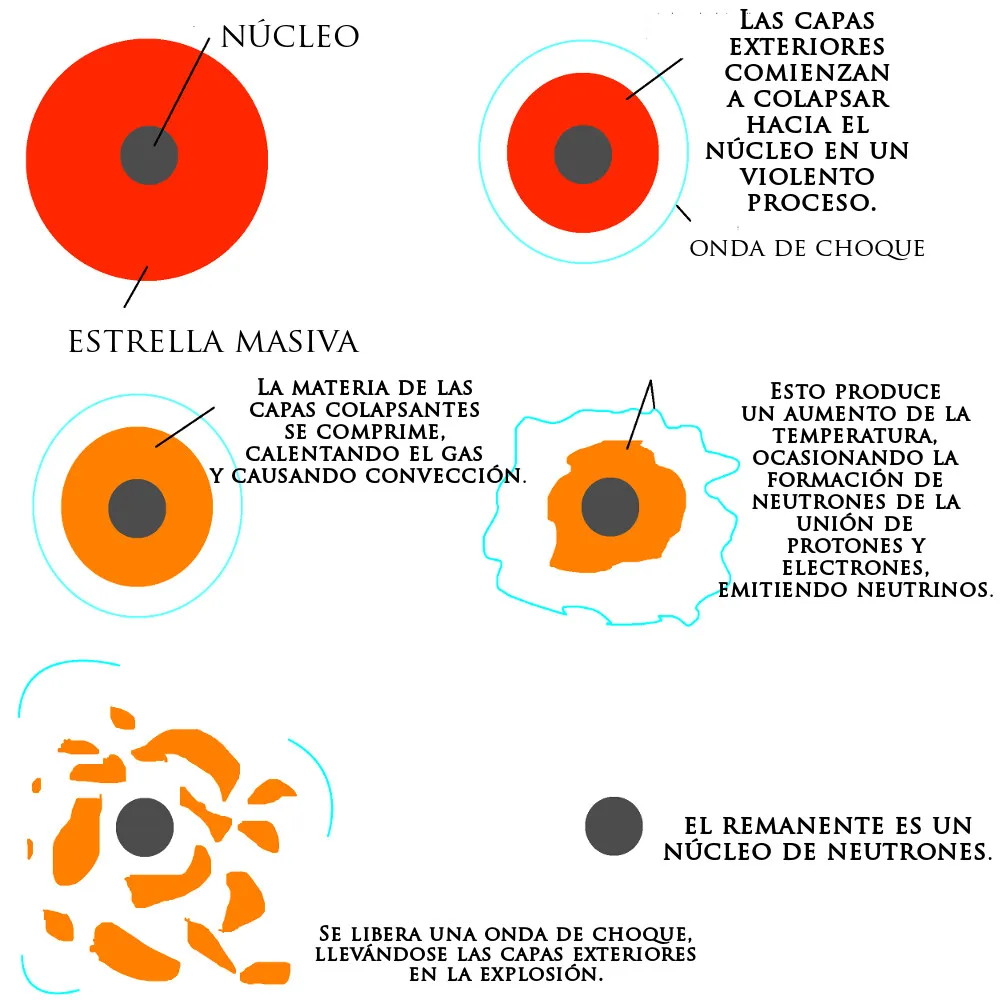
Neutron stars are remnants of stars larger than our Sun. For a neutron star to be produced, the progenitor must have at least 8 solar masses (M☉). The compact remnant objects up to 1.4 Solar Masses (M☉) are white dwarfs and end up in the lower left corner of HR diagrams, since they are small and hot.
If the remnant is more than 5 M☉ they end up as black holes. There is a gap between 2.1 and 5 M☉. It has been theorized that quark stars, not observed, would be there.
Neutron stars are remnants of between 1.4 and 2.1 stellar masses, even though the progenitor star may have been 8 M☉ or higher. That's because in the process, a large part of the matter is expelled to leave a very compact core exposed.
The temperature of a neutron star depends on its age. The youngest ones can reach temperatures of up to 10^12 kelvins, but neutrino emission cools them down to 10⁶ (one million) kelvins.
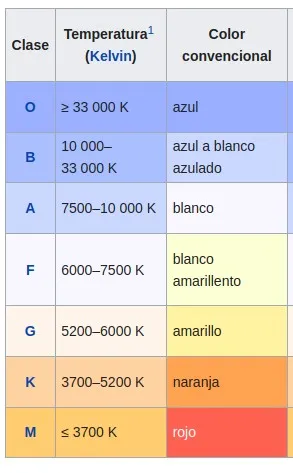
However, the stellar classification generally used (Morgan-Keenan System) starts with O stars, which have maximum temperatures of 30 thousand kelvins, although exceptionally they could reach double that in some cases.
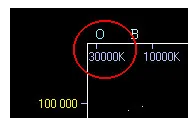
That's why neutron stars are not usually included in HR diagrams. The oldest ones could be next to the white dwarfs, since they will be small and hot, but not as much as the youngest ones, whose temperatures would place them far off the chart. You have to change the scale to make them fit!
It could happen that a neutron star merges with a white dwarf, which would form a Thorne–Żytkow object, or fall into what is called the Asymptotic Giant Branch (AGB). A possible example of this is the object HV 2112.
Like in Where's Waldo games, neutron stars are hidden...in the temperature scale.
Now you know: Neutron stars are (in HR diagrams), at the bottom left.☉
Sources and related links
HV 2112 https://en.wikipedia.org/wiki/HV_2112
About the images
By User:Spacepotato - Modified version of Image:HR-diag-no-text.svg, written by Rursus and modified by Bhutajata, CC BY-SA 3.0, https://commons.wikimedia.org/w/index.php?curid=2093830
By Richard Powell - The Hertzsprung Russell Diagram, CC BY-SA 2.5, https://commons.wikimedia.org/w/index.php?curid=1736396