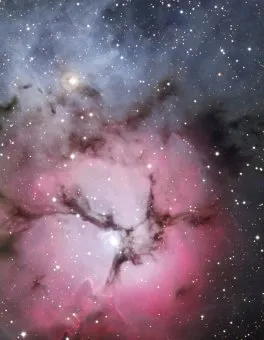
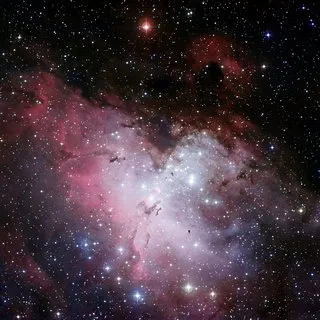
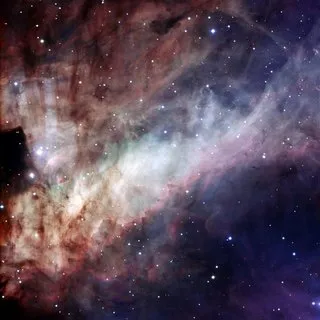
We live in a state of uncertainty. And also in the Local Interstellar Cloud, a nebula among the 15 of the Local Bubble.
According to the RAE dictionary on the web, the word nebuloso/sa admits 8 meanings. The first 6 are adjectives. The last ones are feminine nouns. The seventh is the general astronomical definition. The sixth and eighth meanings are Latin idioms (Argentina, Cuba, Mexico, Uruguay). The origin of the word refers to clouds and fogs. Something covered with clouds is dark, clouds darken the sky, they block the sun. The dark is gloomy, somber. Since light was associated with knowledge, the lack of light is also a lack of lucidity and clarity. It is something difficult to understand.
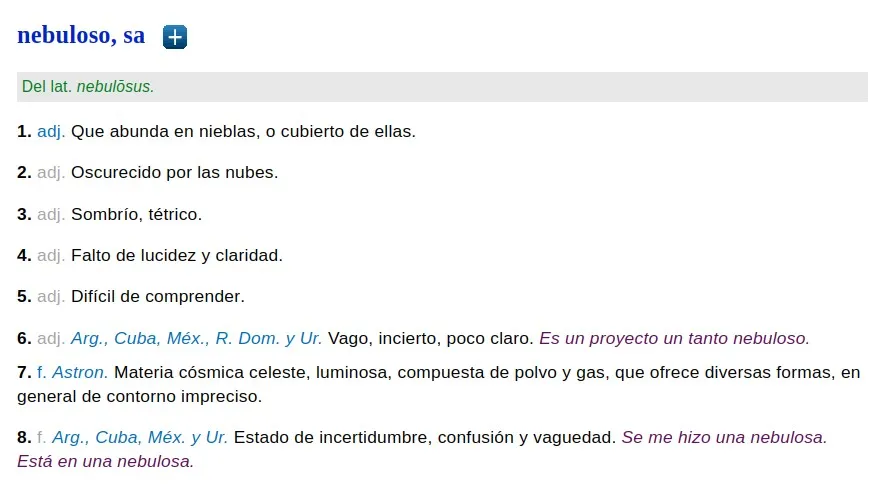
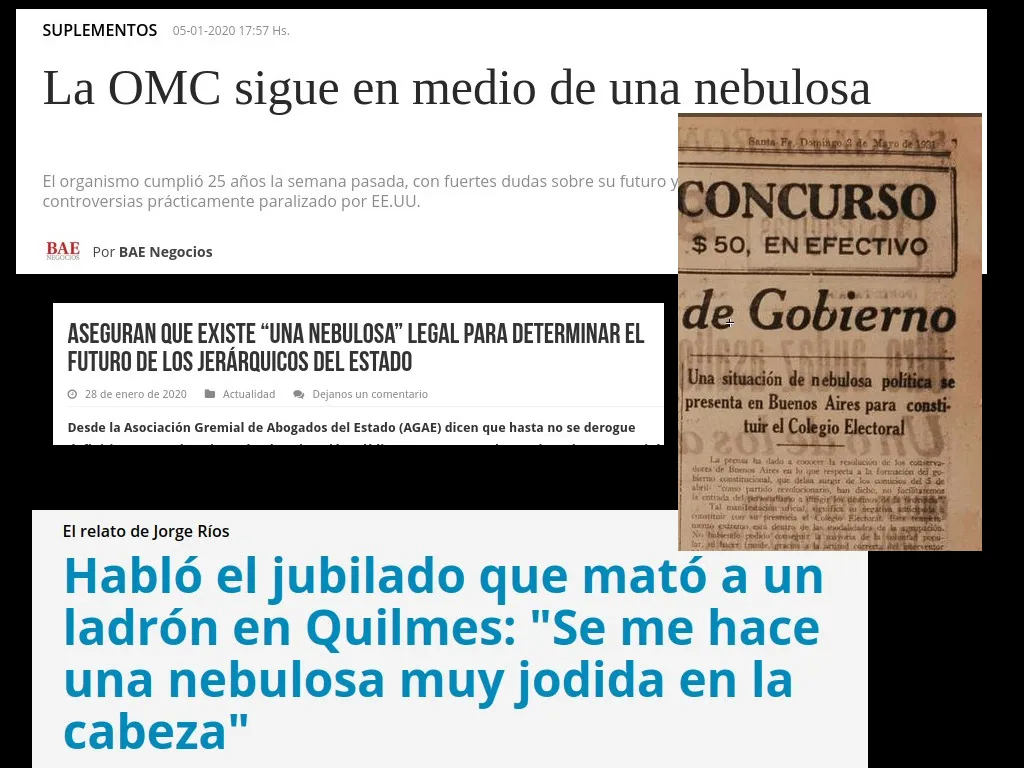
As a consequence of these nuances of synonymy, in some countries of the region, something nebulous is vague, uncertain, unclear. It is also a state of uncertainty, confusion and vagueness. Journalistic media often use the adjective "nebuloso/sa" to refer to political, economic, social situations in general. Here are some screenshots of online news that used the adjective recently in Argentine media, plus a clipping from 1931.
ASTRONOMICAL "IMPRECISION"
According to the DRAE, "nebulosa" is: Astron. Celestial cosmic matter, luminous, composed of dust and gas, which offers various forms, generally with an imprecise outline.
What we now call spiral galaxies were called "spiral nebulae." Any amateur will know that when observing the Magellanic Clouds or, much farther away, the Andromeda Galaxy with a medium-sized telescope, what is observed with the eye in the eyepiece is not very different from some diffuse little clouds. There are different classes of nebulae: emission nebulae, absorption nebulae, reflection nebulae. Also, planetary nebulae, a stage our Sun will go through.
Beyond the social metaphor, do we live in a nebula? If so, would we realize it?
A nebula is a very extensive and very diffuse region, with low matter density. A possible analogy is with smog. Do you notice that we live in large cities covered in smog? Probably the inhabitants of cities like Los Angeles know it, since they have taken photographs from a distance, panoramas that make clear, a situation... diffuse, difficult to discern from the inside.
But the answer is yes, to both questions. We live in a nebula. Literally.
It is called the Local Interstellar Cloud (LIC) and extends about 30 light-years. Wait, there's more. The LIC is an interior region of a more extensive nebula: the Local Bubble. These concentrations of gas and dust make up the interstellar medium.
That the LIC is of very low density is demonstrated with numbers: it has less than one atom per cubic centimeter. Here on Earth, there are about 10^19 molecules for the same volume.
How did astronomers manage to realize it, if it is so diffuse? Because the Sun (and the entire Solar System) moves through these nebulae. And also other nearby stars. And because they created probes that were launched into space to study the interstellar medium. For example, the IBEX (Interstellar Boundary Explorer) satellite placed in orbit in 2008. The results released in 2012 with measurements of the speed of interstellar atoms allowed determining the location of the Sun in relation to the surrounding gas and dust.
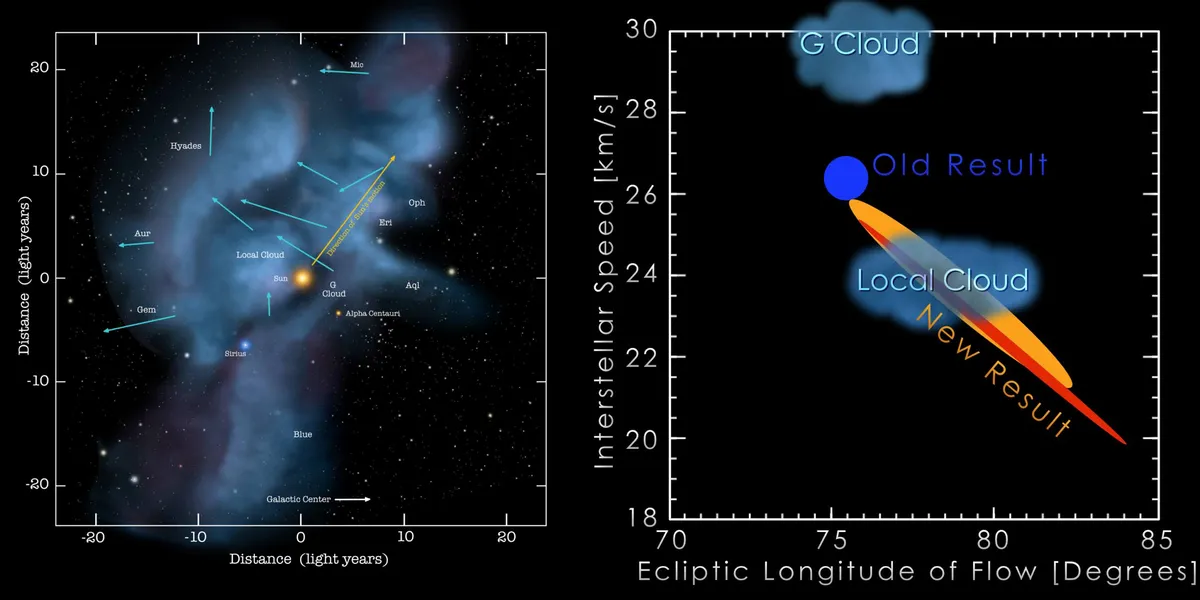
Fig. 1: In these graphs, on the left, the distribution of gas and dust around the Sun is observed and the direction of movement of several gas clouds is indicated with arrows. The closest clouds are the Local Cloud and the G Cloud. On the right, the 2012 results from IBEX resolved a discrepancy and are in agreement with measurements of the Local Cloud made by observing nearby stars. Thus it is known that the Sun is surrounded by the Local Cloud, while it is very close to its edge (and in the direction of the G Cloud). Credit: NASA/Goddard/Adler/U. Chicago/Wesleyan
THE LOCAL CHIMNEY
In 2003 a group of American and French astronomers investigated the Sun's neighborhood. They found that the region is an irregular cavity of low-density gas that has branched tunnels through a dense wall of surrounding gas. The suspicion was that such cavities, analogous to the holes in a sponge, were created by supernovae. "When we started mapping the gas in the galaxy, we found a deficit of neutral gas within 500 light-years, suggesting we are in a bubble-shaped cavity, perhaps filled with hot ionized gas. But the Local Bubble is more tube-shaped and should be called the Local Chimney", astronomer Barry Welsh indicated at the time.
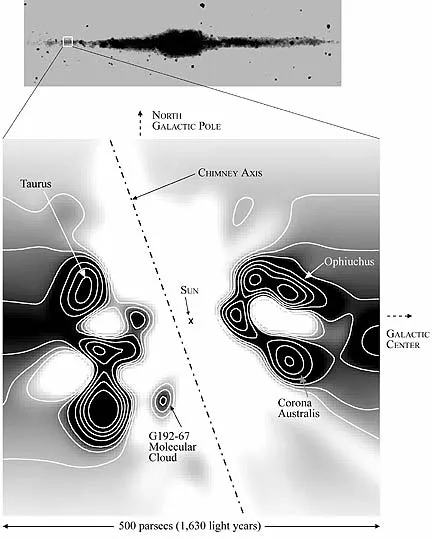
Fig. 2 The Local Chimney Credit: UC Berkeley.
A CONVULSIVE HISTORY
A portion of the wall of the Local Bubble appears to have collided with another huge bubble of hot gas called Loop I. Located above the galactic plane, about 500 light-years from the Local Bubble, the brightest element of Loop I is the North Polar Spur, which is thought to have been created by supernovae and stellar winds from the massive stars of the Scorpius-Centaurus OB Association. Furthermore, astronomers detected two other nearby bubbles, Loop II and III. The Sun has been moving through the Local Bubble, with low gas density, for the last 5 to 10 million years. Thus, Earth and its life forms have evaded dangerous flows of cosmic radiation. But the LIC is a subregion within the Bubble that has higher density and is moving toward the Solar System. In some literature, the LIC is also called "Local Fluff." Stellar winds from a star-forming region in the Scor-Cent Association, near the Aquila Rift (a dense molecular cloud) push the Local Interstellar Cloud toward the Sun.
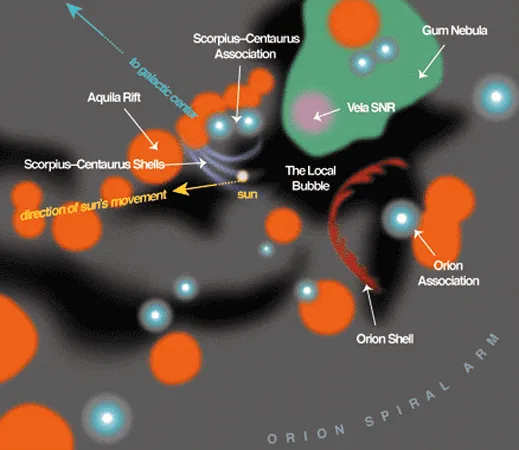
Fig. 3: Astronomy Picture of the Day for February 17, 2002. Illustration Credit & Copyright: Linda Huff (American Scientist), Priscilla Frisch (U. Chicago)
Currently, the Sun is passing through a Local Interstellar Cloud, moving away from the Scorpius-Centaurus Association of young stars. The LIC resides in a low-density cavity in the interstellar medium called the Local Bubble, shown in the illustration in black. Nearby, high-density molecular clouds include the Aquila Rift, in orange. The Gum Nebula, in green, is a region of ionized hydrogen. Inside lies the Vela supernova remnant, in pink, which expands creating fragments of material like the LIC.
CLOUDS ALL OVER THE ASTRONOMICAL SKY
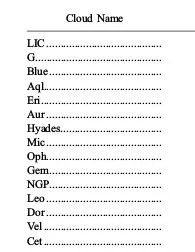
In a 2008 publication, Seth Redfield and Jeffery Linsky include maps of the different clouds and their interactions. It's not just two, like the ones named so far, that is, the LIC and the Local Bubble, but 15, as listed in the table I show below.
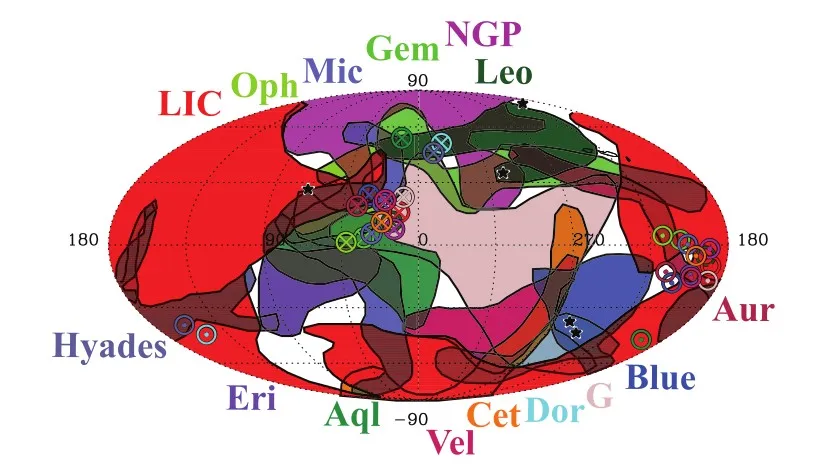
Fig. 4: Map and table of local nebulae. Credit: Seth Redfield and Jeffery Linsky
As can be seen at a glance, most have names linked to constellations. One might wonder why one of them is called "Blue", another is called "G". The NGP cloud stands for North Galactic Pole.
THE G CLOUD
If something still motivates me to do this blog, it's that when writing about a topic I must delve into what has been published and learn in the process. I also try to put myself in the reader's place. Perhaps you wonder why the G Cloud gets that name. According to Redfield and Linsky (2008), the term was coined in a 1992 paper by Lallement & Bertin which showed that the flow of interstellar gas in the direction opposite to the Galactic center is consistent with a vector that differs from the gas in the direction of the Galactic center.
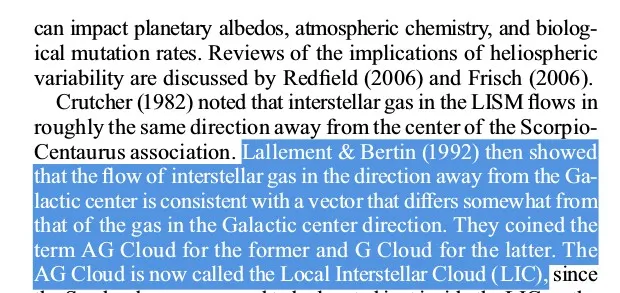
They used the term AG Cloud for the former and G Cloud for the latter. The AG Cloud is now called LIC, from the English Local Interstellar Cloud. To verify this, I searched for that 1992 paper and found it. So the G Cloud is named for Galactic.

THE BLUE CLOUD
In the professional literature, the term CLIC is used: cluster of local interstellar cloudlets. In a paper by Priscilla C. Frisch, Jonathan D. Slavin (2006) they explain that highly ionized gas was observed toward Epsilon Canis Majoris (Adhara), but not toward Sirius (Alpha CMa). It was speculated that the Silicon abundance forms in an outer layer of the LIC behind Sirius. That other cloud is blueshifted relative to the LIC (∼ −7 km s−1), hence it is named the Blue Cloud.

CONCLUSION
We live not in one, but among several nebulae, astronomically speaking. Anyone who has seen photographs of the Orion Nebula (M42) might wish to live in a nebula like that, as it is aesthetically beautiful.
However, what is seen in those photographs is not perceived with the naked eye, as they are made using filters at different wavelengths, such as infrared. The shapes of nebulae are due to gas and dust clumping together by gravity, but radiation from massive stars digs into that material creating cavities and filaments. This process is very energetic and turbulent, with large flows of charged particles.
Although it may seem desirable to live in the nebulae photographed using telescopes, astronomically it is not. At the same time, we don't like living in the "mental nebula," the state of permanent uncertainty.
We'd better get used to it. Much of the Universe is like that, diffuse. Despite that, astronomers manage to detect the boundaries and movements of those "astronomical uncertainties" that are the regions of interstellar gas and dust. Paradox: knowledge about nebulae is, increasingly, less nebulous.☉
Sources and Related Links
- Are we actually in a Nebula?
https://www.youtube.com/watch?v=9BV8X76iLF8 - NASA IBEX
https://www.nasa.gov/mission_pages/ibex/multimedia/013112-briefing-materials.html - APOD February 17, 2002
https://apod.nasa.gov/apod/ap020217.html - Local Chimney and Superbubbles
http://www.solstation.com/x-objects/chimney.htm - 3-D map of local interstellar space shows sun lies in middle of hole piercing galactic plane
https://www.berkeley.edu/news/media/releases/2003/05/29_space.shtml - Northern-hemisphere observations of nearby interstellar gas : possible detection of the local cloud.
Lallement, R.; Bertin, P.
Astronomy and Astrophysics, Vol. 266, p. 479-485 (1992)
https://ui.adsabs.harvard.edu/abs/1992A%26A...266..479L/abstract - THE STRUCTURE OF THE LOCAL INTERSTELLAR MEDIUM. IV. DYNAMICS, MORPHOLOGY,
PHYSICAL PROPERTIES, AND IMPLICATIONS OF CLOUD-CLOUD INTERACTIONS
Seth Redfield and Jeffrey L. Linsky
arXiv:0709.4480 [astro-ph]
https://arxiv.org/abs/0709.4480
https://iopscience.iop.org/article/10.1086/524002 - Short-term Variations in the Galactic Environment of the Sun
Priscilla C. Frisch, Jonathan D. Slavin
arXiv:astro-ph/0601359
https://arxiv.org/abs/astro-ph/0601359