16 reflections on astronomy as a business in the age of nonsense.
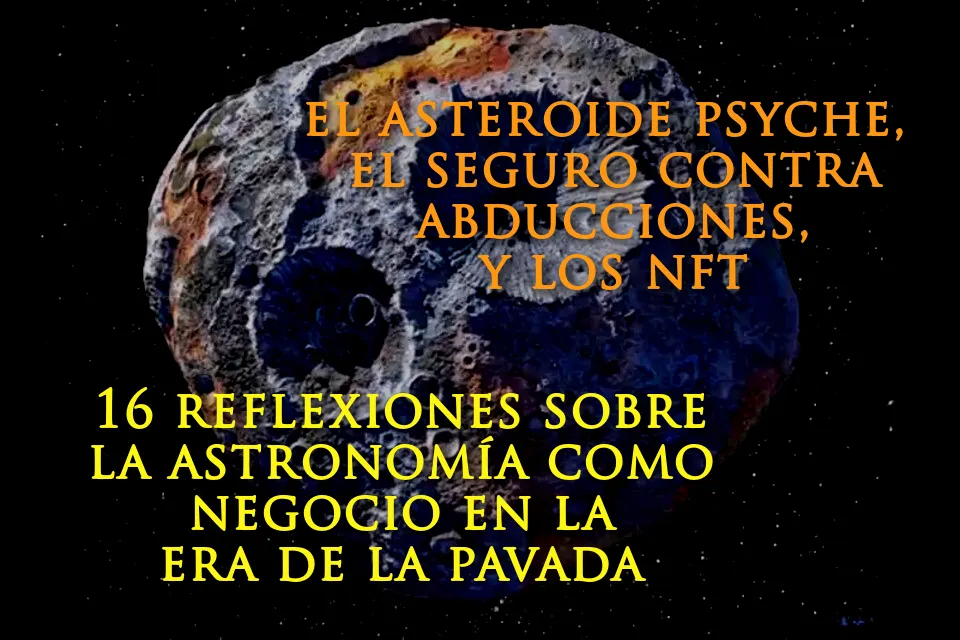
Several media outlets echoed a press release confirming the composition of asteroid (16) Psyche, almost all iron and nickel. Consequently, given its size of about 200 kilometers, its economic value is estimated at several trillion dollars. The asteroid belt object would be the core of some ancient rocky planet. NASA plans to launch a mission next year, named after the object itself, which would reach the metallic body in 2026.
Some reflections on this "news".
1-The name Psyche comes from Greek mythology and has been used to refer to the soul or psyche, that is, something immaterial. In other cases it has been narrated as something slightly material, a breath of life, a "cold wind". Paradoxically, the M-type asteroid designated with this name is not slightly material (like a collection of gases would be), but a metallic body. But although it has a certain mass, it has no weight: it is in weightlessness.
2-Until now, astronomy is one of the least profitable natural sciences. It is difficult to turn current knowledge about black holes or dark matter into large sums of money. In geology and geophysics, on the other hand, the discovery of gas and oil reserves can generate economic income. If what has been said about (16) Psyche is true, then perhaps astronomy will become a big "business".
3-Value is not the same as price. Value is the cost of production, the effort or energy needed to produce a good. Let's say I make an effort to create 100 wicker baskets. Since it is difficult to measure the energy spent, we can use a proxy: time. Let's say it took me 50 hours. So 1 basket = 0.5 hours of work. If I now give an economic value to each hour, I will have the cost. Let's say each hour is worth $100, then each basket is worth $50. Then we will see the price. However, if I have those baskets piled up in a room unsold because no one wants to buy them, then the baskets are worth $0. That is, value exists only if there is an exchange for something else or money, as exchange goods and not use goods.
For the reasons stated, the metal on Psyche is worth $0 until someone goes to the asteroid, removes the iron and nickel (Armageddon-style) and brings it to the planet and sells it.
4-There are those who question the economic value indicated in various publications in relation to the supply and demand curve that is usually associated with price. If today nickel is worth a certain amount of money, given the current supply-demand, and demand remains, then by increasing the supply, the price should drop, therefore, the price used to make the calculation is wrong.
5.1-However, there are several reasons to suppose that the latter is not quite so. First we must think that in a standardized production system, goods are produced in large quantities that are considered identical copies. This characteristic of reproducing identical goods is easy to understand with a simple example: if we go to a hardware store to buy nails and they show us 100 nails (of the same size and material), the price of each one will be the same and it will be impossible for us to differentiate one nail from another. In this case there is no "original nail" and copies. They are all copies.
5.2-But this same thing does not always happen. An exception is artisanal work, among which is art. Let's think about the famous work Las Meninas, by Diego Velázquez. We can take a photo of it and print it on glossy paper and then frame it. And we can do this very easily and at low cost. Then we compare the original with the "reproductions" and we will certainly notice the difference. It is not like in the case of the nails.
5.3 But if the "original work" is already a digital photograph, and I make a copy (which is certainly easy), such a copy will be identical and indistinguishable from the original. There is no longer an "original". One can resort to an artist to paint another Meninas that is a copy of the original, and if the artist is good it could be a good forgery, but it is very difficult to do something like that. On the other hand, making an exact copy of a .jpg is as easy as Copy and Paste.

6.The supply and demand curve explains some aspects of the price of a good. For example, it is known that some patrons buy artistic works that at that time do not have great demand, and pay a low price for them, to later sell them when the artist dies and they come to have great demand, but a supply that is unique, since the work of art is "original".
7-The latter generally happens with collecting: be it a Maradona sock, a card game, an old video game or device, etc., if it is in good condition and there are few in such a state, it can have a very high price. However, that does not mean that such goods have a very high demand. Since such goods are considered unique or "incunabula", little demand is enough for it to be greater than the supply.
8-Let's go back to the example of the nails and think about the asteroid Psyche. A little piece of the minor body contains nickel and iron. If we compare a piece of asteroid with another extracted from a mine on Earth, of the same size, it will be difficult to discern which is which. That is, the metal contained in Psyche would be EQUAL to any other quantity of the same material. However, if the little piece of rock says "Asteroid", then it is no longer EQUAL. One comes from Earth, it is common. The other comes from "outer space", which gives it an "aura", to say it with Walter Benjamin.
9-A little piece of Psyche could be worth millions of dollars, just because someone is willing to pay for it to have something "unique", even if its utility is nil. It is the value of display.
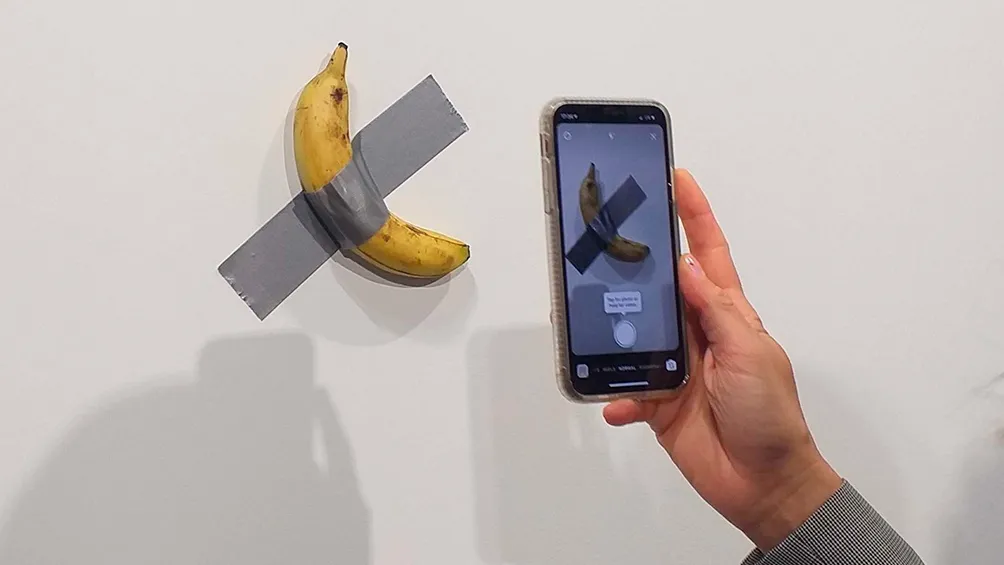
10-If what I say seems strange to you, think about it: recently someone thought of sticking a banana on a wall with adhesive tape and considering it "a work of art", which was later sold for USD 120,000.
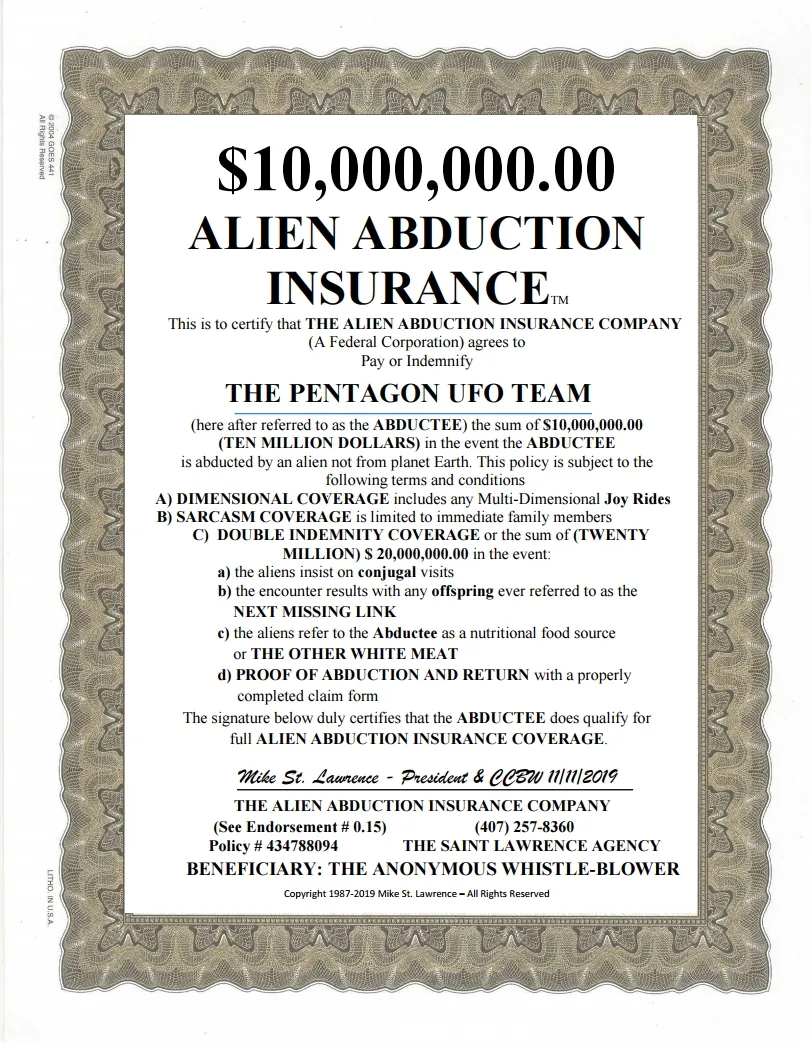
11-There is even an "Alien Abduction Insurance" on a website that promotes itself with the slogan: "The perfect gift for the person who has everything".
12-Now we have the NFT trend. Messi is offering NFT "products." They are digital works, like photographs. Getting those images could be very easy. Why would NFT technology generate something different? The answer is difficult. On one hand, this technology based on blockchains ensures that the transaction was completed. It's like a "certificate" of purchase. But what "value" could a "certificate" of the jpg Bliss, typical in Windows XP, have, which anyone can get, for free, just by browsing the web?

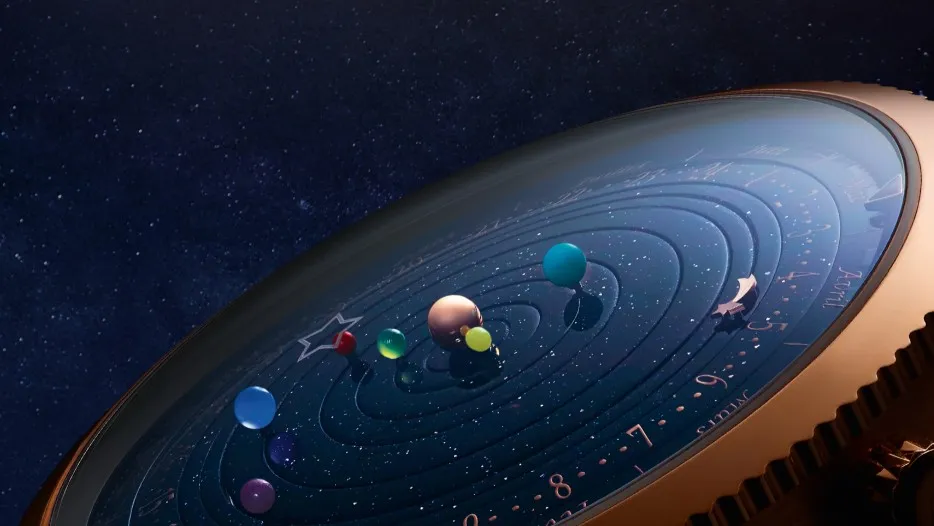
13-There are wealthy people who buy watches that cost fortunes, like the Midnight Planétarium by Van Cleef & Arpels whose price is over USD 200 thousand. It's likely those people don't use such watches daily, but keep them stored in safes, without using or seeing them, for fear of being robbed. Why pay so much money for something that later won't be used, that is, will be useless? Obscenity? Money laundering?
14-Therefore, in the days we live in, a photo of (16) Psyche could be worth more than its metal content. In principle because to sell its content you would first have to go to the object, extract the metal, and bring it to Earth, which will not only have an enormous cost, but will be very difficult. Whereas a photo taken with telescopes is much simpler. Astronomers...to the NFTs!
15-Transforming astronomy into a "good business" might seem like a bad thing. But if with the money raised better telescopes were built, astronomy would have a new form of funding.
16-If we continue like this, at any moment, some mega-millionaire will buy 200 grams of antimatter. We already know how long it's going to last for them.☉
Sources and related links
- They confirm that asteroid Psyche 16 is worth more than the entire world economy
https://www.pagina12.com.ar/360662-confirman-que-el-asteroide-psyche-16-vale-mas-que-toda-la-ec - (16) Psyche
https://es.wikipedia.org/wiki/(16)_Psyche - The Work of Art in the Age of Mechanical Reproduction
https://es.wikipedia.org/wiki/La_obra_de_arte_en_la_%C3%A9poca_de_su_reproductibilidad_t%C3%A9cnica - The Guggenheim will exhibit the controversial banana stuck to a wall by artist Maurizio Cattelan
https://www.telam.com.ar/notas/202009/516297-el-guggenheim-exhibira-la-polemica-banana-pegada-a-una-pared-del-artista-maurizio-cattelan.html - Should You Buy Alien Abduction Insurance?
https://www.entrepreneur.com/article/376354 - ALIEN ABDUCTION INSURANCE
https://ufo2001.com/ - Messi started playing in the unusual NFT market
https://www.pagina12.com.ar/360496-messi-empezo-a-jugar-en-el-insolito-mercado-de-nft - THE INCREDIBLE ASTRONOMICAL WATCH THAT TELLS US THE ORBIT OF THE PLANETS
https://www.sopitas.com/geek/increible-reloj-astronomico-orbita-planetas-lujos-dinero/
About the images
Credits: NASA, Microsoft, Van Cleef & Arpels, Télam.