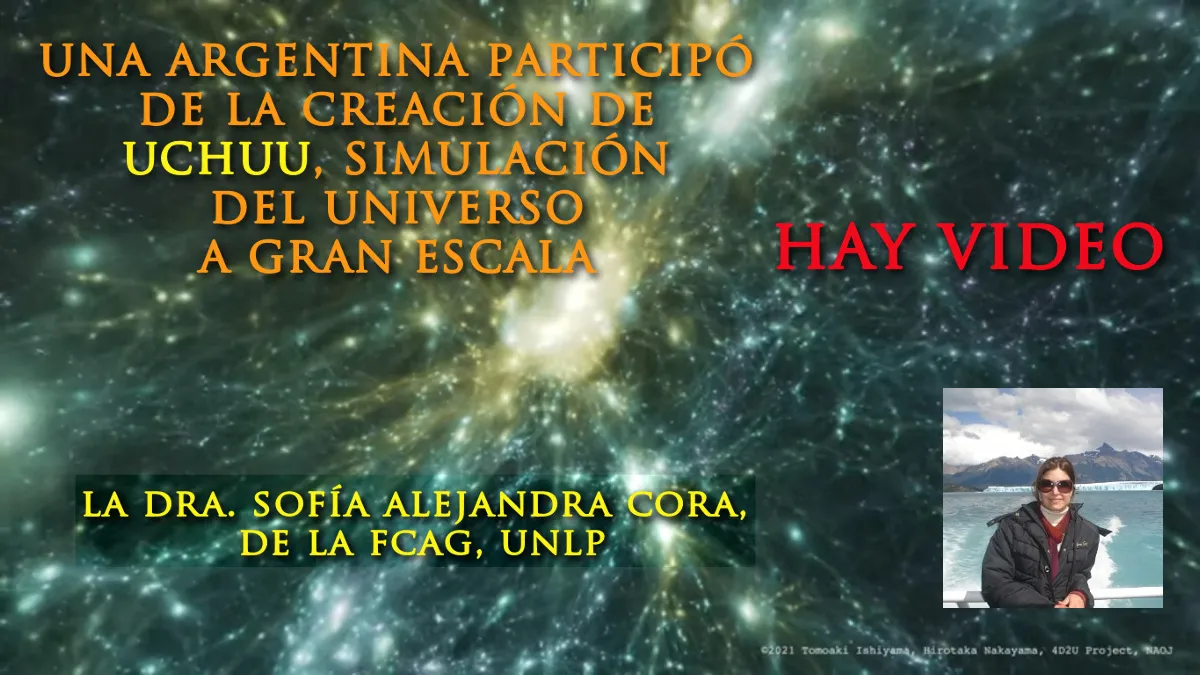
In the creation of Uchuu, which means "universe," a Cordoban astronomer from the UNLP participated.
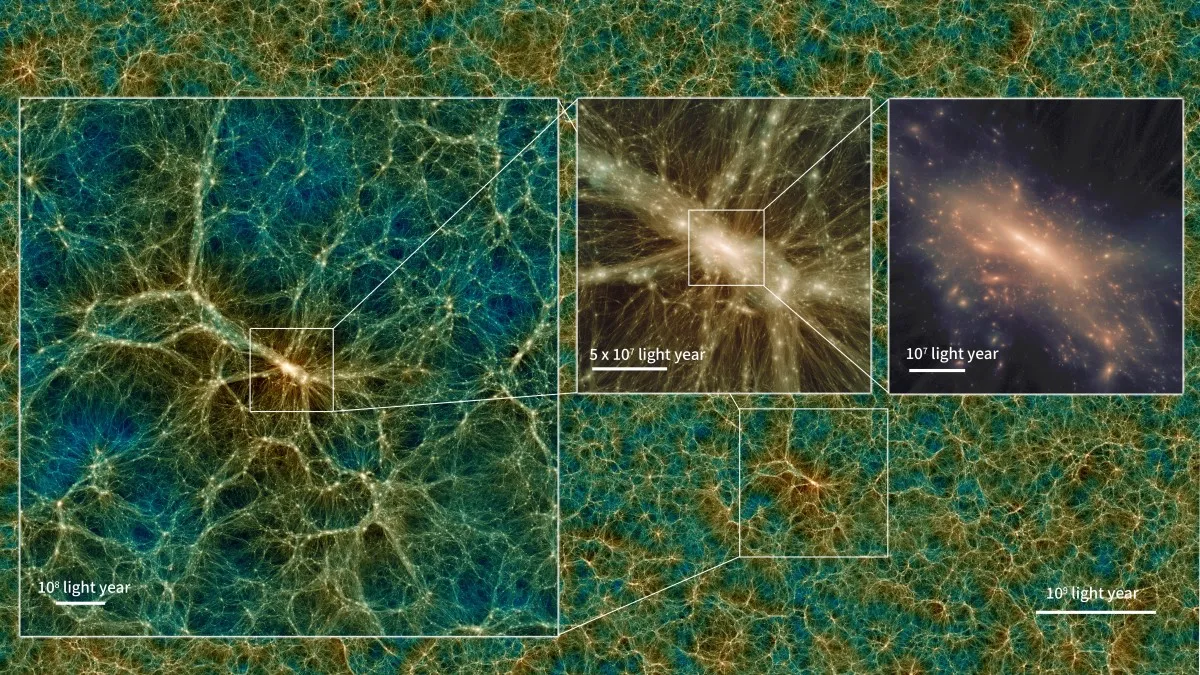
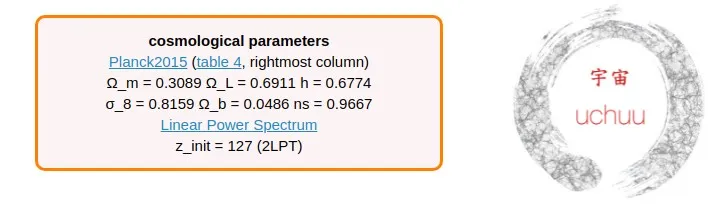
The Uchuu simulation consists of 2.1 trillion particles in a cube 9.63 billion light-years on a side. The work focuses on large-scale structures: dark matter halos that control the formation of galaxies and their evolution. The scale of these structures ranges from the largest galaxy clusters to the smallest galaxies, but does not include stars or planets. In terms of time, Uchuu simulates the evolution of matter for almost all of history: 13.8 billion years.
Julia F. Ereza, a student at the Instituto de Astrofísica de Andalucía (IAA-CSIC), explained in a statement the importance of the new virtual universe: "Uchuu is like a time machine: we can go forward, backward and stop in time, we can zoom in on a single galaxy or zoom out to visualize a complete cluster, we can see what is really happening at every instant and in every place of the Universe from its earliest days to the present".
An international team of researchers from Japan, Spain, USA, Argentina, Australia, Chile, France and Italy created Uchuu, using ATERUI II, the most powerful supercomputer dedicated to astronomy. It took a year to produce the simulation. Tomoaki Ishiyama, a professor at Chiba University, who developed the code, explains: "To produce Uchuu we used all 40,200 processors available exclusively for 48 hours each month. 20 million supercomputer hours were consumed and 3 Petabytes of data were generated, the equivalent of 900 million photos from a 12-megapixel cell phone".
The results were published in Monthly Notices of the Royal Astronomical Society and the data are available online for other researchers to use.
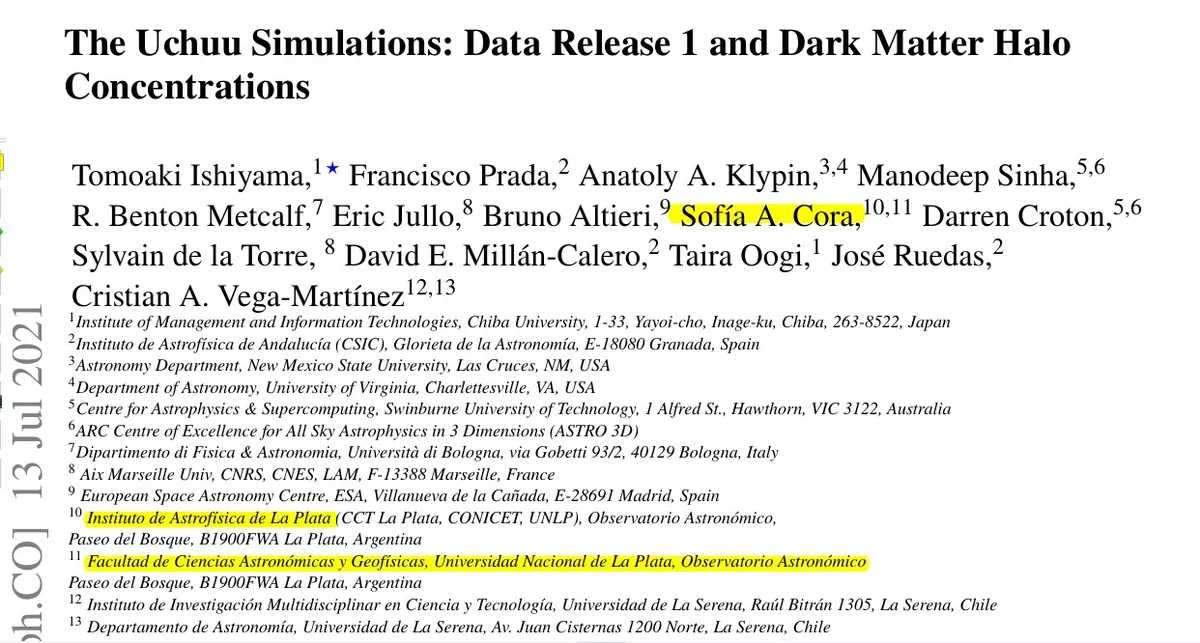
The Argentine participation is due to the work of Sofía Alejandra Cora, from the Instituto de Astrofísica de La Plata and the UNLP. Dr. Sofía A. Cora obtained her doctorate at the FCAyG of the UNLP in 1999, under the direction of Dr. J. C. Muzzio. She was born in Villa María, Córdoba.
It is worth adding that these days another contribution by an Argentine also became known, which gained attention for the use of images taken with Hubble to investigate white dwarf stars, Dr. Leandro Althaus.
In the Year of Argentine Astronomy, for the 150th anniversary of the Córdoba Observatory, this is a good way to celebrate. Like Messi, scoring goals.☉
Sources and related links
- The Uchuu Simulations: Data Release 1 and Dark Matter Halo Concentrations
Monthly Notices of the Royal Astronomical Society, Volume 506, Issue 3, September 2021, Pages 4210–4231,
https://doi.org/10.1093/mnras/stab1755
https://arxiv.org/abs/2007.14720 - CFCA: Largest Virtual Universe Free for Anyone to Explore
https://www.cfca.nao.ac.jp/en/pr/20210910 - NAOJ: Largest Virtual Universe Free for Anyone to Explore
https://www.nao.ac.jp/en/news/science/2021/20210910-cfca.html - Uchuu Simulations
http://skiesanduniverses.org/Simulations/Uchuu/ - The board moved in the universe of white dwarfs
https://investiga.unlp.edu.ar/cienciaenaccion/se-movio-el-tablero-en-el-universo-de-las-enanas-blancas-20652 - Video Uchuu
https://youtu.be/R7nV6JEMGAo
About the images
Credit: Tomoaki Ishiyama