If in the Milky Way most stars are red dwarfs (type M). Why does known life lie around a G2 dwarf, like our Sun?
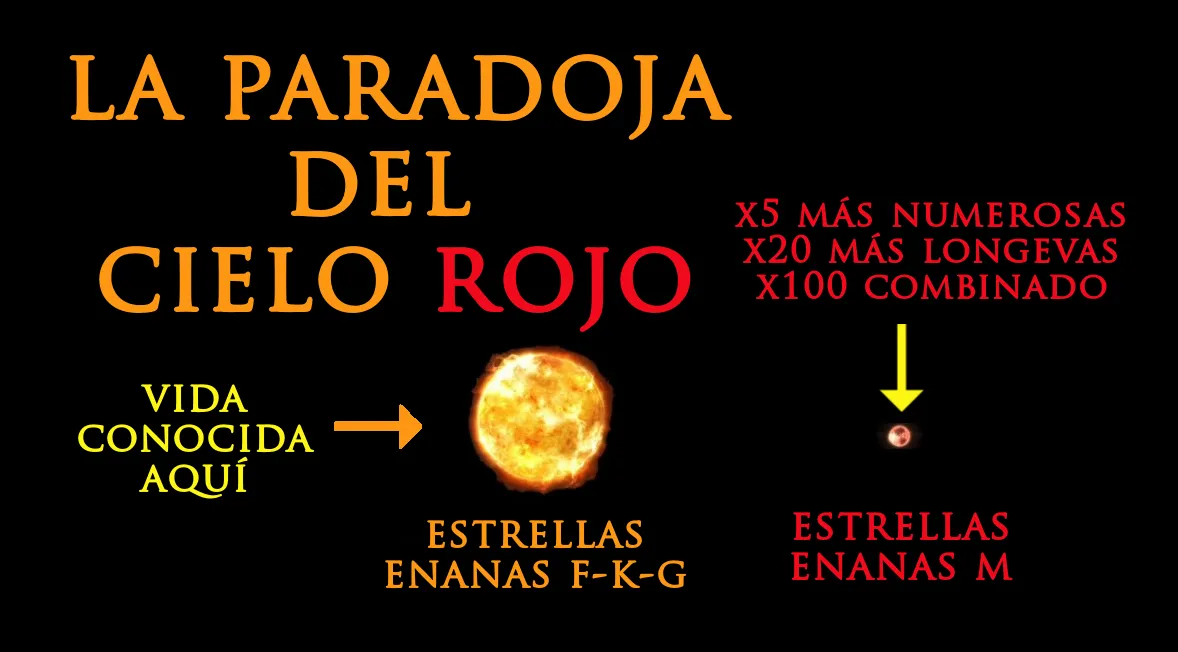
A recent study analyzes what astronomer David Kipping called the "Red Sky Paradox". The professional has a YouTube channel where he explained his own analysis. Here I will only take the initial idea to then raise another, associated topic.
What the astronomer says is that we, the only known form of life so far, live on a G-type star. The Sun is a dwarf star, if we divide stars between giants and dwarfs. And it has an "average" temperature, since the O, B, A classes are hotter and bluer.
Other stellar classes are in the same middle range, the F and K ones. F-G-K are more yellow, but the red ones, of class M, make up the vast enormous majority of stars. From this arises an apparent paradox: Why did life arise in our world, if red dwarfs are much more common? To answer this question, the astronomer performed a Bayesian analysis.
From a probability point of view, it is important to establish whether the emergence of life around this type of star, red dwarfs, is equiprobable with respect to other classes. That is, whether we can think that the chances of life are the same, or not. If the answer is affirmative, then we can analyze it like tossing a coin in the air, where the two sides are equiprobable. In that case, it would be much more likely for life to arise on red dwarfs than on F-G-K stars, because the former are many more in number. It should be added that red dwarfs have longer "lives".
But is it so? Is habitability on planets around red dwarfs the same as on other stellar classes? Short answer: it is not known, although there are already some ideas, but they require further research.
Until some time ago, red dwarfs, M-class stars, were ruled out from the potential for life, just as giant O, B, and A stars were excluded.
Blue giant stars have short lives. Their equilibrium period lasts millions of years, which would be insufficient for natural evolution to act. But even if it were possible, upon exhausting their nuclear fuel, their gravitational collapse occurs and they explode as supernovae, destroying any form of life in their vicinity.
With M dwarfs it was considered that they could not host planets with life, since by emitting little radiation, the "habitable zone" would place a potential planet very close to the star, so it would have synchronous rotation (tidal locking) with one side always facing the star and the other in permanent darkness.
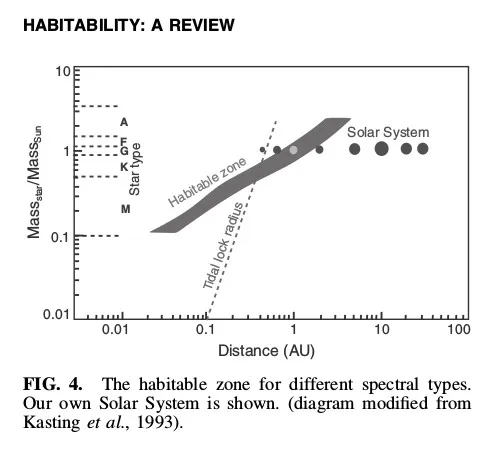
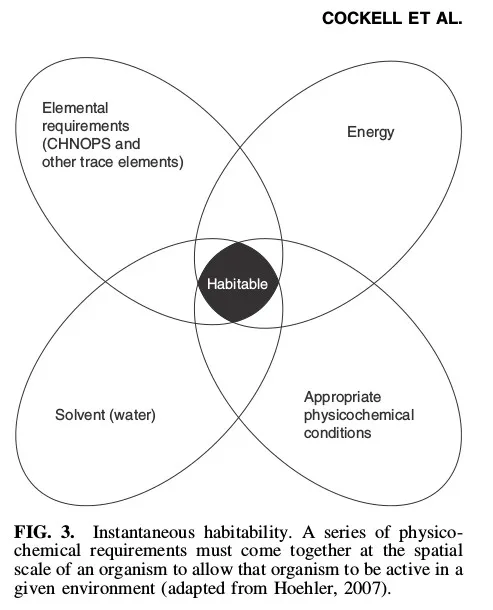
It is worth remembering that the concept of "habitable zone" was used by Stephen Dole in his book Habitable Planets for Man, in 1964. In a 2016 paper, Cockell and others reviewed the concept of habitability. There they use this graphic that associates the habitable zone with stars according to their spectral class.
A first issue is that red dwarfs have sizes that vary greatly, from a little smaller than our Sun, to stars with 10% of the radius of the white-yellow star we orbit. Therefore, astronomers, in addition to using letters for stellar classes, also use numbers.
In a 1999 paper, Martin Heath illustrates this range of sizes compared to a star like our Sun (Class G2). We see here that M0 red dwarfs can have a size of 60% of the solar radius, while M8 ones have sizes of 12% compared to a star like the Sun.
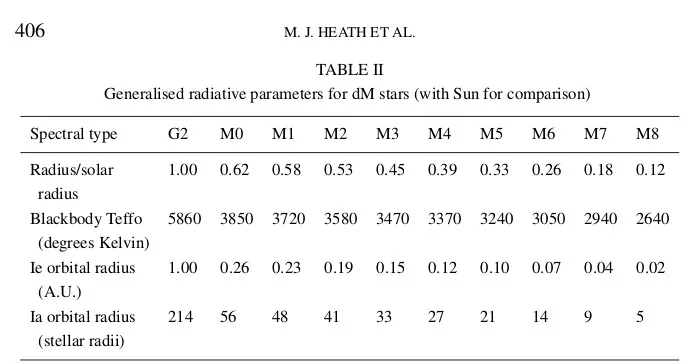
From here, the topic of potential habitability around red dwarfs will be addressed with information from a 2016 paper by Aomawa L. Shields and others.
WHAT RED DWARFS ARE LIKE
If blue giants are not a good place to find life, since they lose equilibrium "very quickly" compared to natural evolution, with red dwarfs the opposite occurs: every M dwarf that exists is still on the main sequence and will remain there much longer, since their equilibrium lasts trillions of years. In the Milky Way, they make up 70% of the stars.
A first issue is the detection of this type of star, which is not very luminous, as well as the detection of exoplanets around them. Contrary to what one might think, the transit method would make it "easier" to discover exoplanets around M dwarfs than around stars like our Sun. The radial velocity method, on the other hand, would not be as useful since magnetic activity would generate changes similar to the existence of a planet.
It is known that around M dwarfs it is more feasible to find small planets, between 0.5 and 4 Earth Radii, than around F-G-K stars. Some studies show that on terrestrial exoplanets in eccentric orbits that take them to habitable zones around low-mass stars, tidal heating in their interiors can occur enough to generate a greenhouse effect scenario, like Venus. That would lead to the desiccation of the planet and is likely to occur on bodies orbiting stars whose masses are less than 0.3 MS (Solar Masses). This implies that the concept of "habitable zone" is more complex in low-mass stars.
It is tempting to use a simple formula to calculate the habitable zone in relation to a star's radiation according to its mass, but other factors can influence whether that potential habitability is really possible or not.
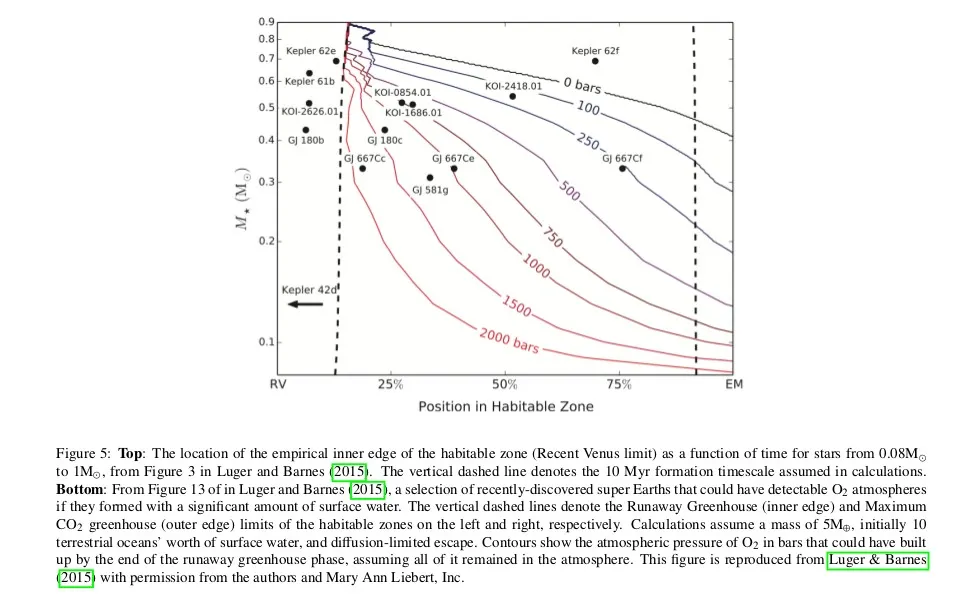
Figure 5 from A. Shields (2016): from Figure 13 of Luger and Barnes (2015), a selection of recently discovered super-Earths that could have detectable Oxygen atmospheres if they formed with sufficient water.
The extreme UV (XUV) radiation in the pre-main-sequence phase - the period of time before settling on the Main Sequence to begin hydrogen fusion in their cores - can be high, as that phase is longer in M dwarfs. If life can begin after 0.5-1 billion years, on red dwarfs, planets receive too much XUV to dry up oceans. However, one study indicates that water retention on exoplanets around cool stars would be possible, particularly the case of TRAPPIST-1d.
EXTREMOPHILE LIFE
Life as we know it on Earth requires three things: liquid water; a suitable environment for the formation of organic molecules from essential elements (phosphorus, oxygen, nitrogen, carbon, hydrogen, sulfur); and a source of energy, whether stellar or chemical.
Given the possibilities of extreme temperatures in the day and night zones of a planet with synchronous rotation around an M dwarf, the high stellar activity over long periods, and low water concentrations, it is possible that such bodies possess life forms similar to what on Earth are called "extremophiles".
PHOTOSYNTHESIS
The range of the spectrum where photosynthesis occurs on Earth is restricted to 400-700 nm, a range called "Photosynthetically Active Radiation" (PAR in English, RFA in Spanish).
In a world receiving a large portion of stellar radiation in the near IR from a small star, the low availability of PAR photons has cast doubt on the likelihood of photosynthesis on M dwarfs. However, there are bacteria that perform photosynthesis that contain pigments that absorb at IR wavelengths.
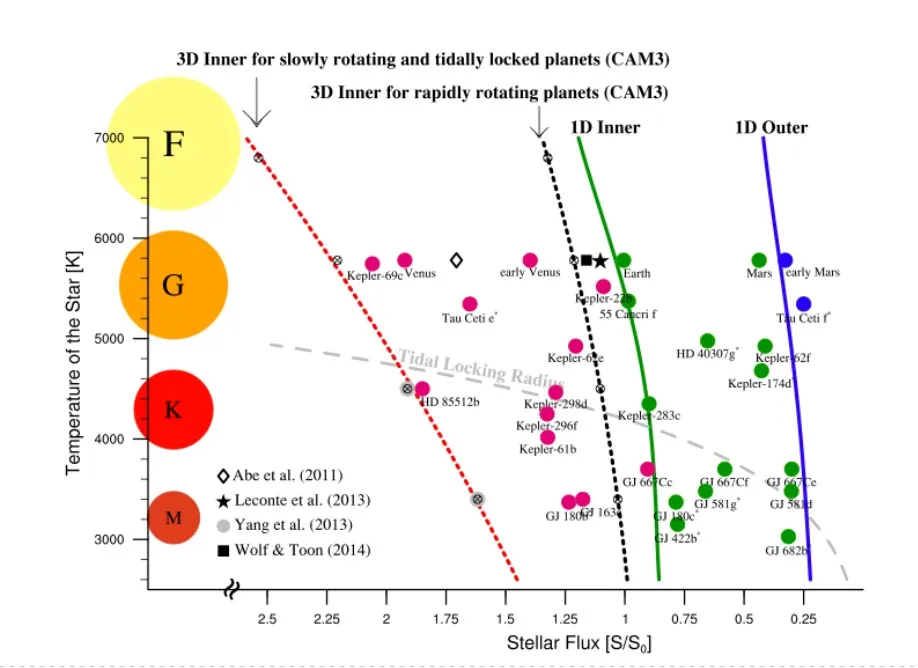
Figure 9 from A. Shields (2017): Habitable zone limits as a function of stellar type and planetary rotation using a CAM3 model from Yang et al (2014).
CONCLUSIONS
As missions like Kepler or TESS are launched, astronomers obtain more data on exoplanets around red dwarfs. With the James Webb Space Telescope, this very important data acquisition process will continue. Since the 1990s when exoplanets began to be detected, the possibility of life around M dwarfs has been questioned. In recent years, based on new data and simulations, it has not been so clear that life cannot form on these faint stars. In the M7 and M8 types, of lower mass, the possibilities seem lower than in the M0-M6 range. However, with current data, it does not seem very likely that the potential life that could exist on exoplanets around M dwarfs could evolve into more complex forms than extremophiles, although the timescale of this type of star could facilitate a slower and longer evolution.
On the other hand, the apparent red sky paradox also depends on how many planets M systems could have compared to F-G-K stars. It is logical to assume that if stars form from molecular clouds of a certain mass, the larger they are, the larger the stars and the greater the number of planets they could have around them, but that is not entirely clear either.
What I do believe is quite true is that the emergence of life has requirements, meaning it does not arise in any environment, so there will not be life on all planets. And that on M dwarfs, although they are a majority in our galaxy, only a fraction will have planets with some form of life. All those worlds could be an enormous number, even if it is a smaller percentage, since the total number of stars is high. But of all those planets with life, only some -perhaps- will manage to have some form of evolved or "intellectual" life.
Thus, the idea that the Intellectual Density of the Universe is low is reinforced. Another piece of data that agrees with that is reading the newspapers...:)
THE PARADOX OF PROGRESS
The extremophiles that may exist on exoplanets around red dwarfs will not have the problems that we do have here.
In the series Seinfeld, there is an episode titled "The Dinner Party" (Episode 13, Season 5). Jerry presents what could be called "The Paradox of Progress":
We should never have taken a man to the moon. It's a mistake. Now everything is compared to that single achievement. Now we say: "I can't believe they can take a man to the moon and Taste my coffee!".
I think we all would have been much happier if we hadn't taken a man to the moon. We would say: "Can't they make a bottle cap open easily? I'm not surprised they couldn't take man to the moon. Things make perfect sense to me now". Neil Armstrong should have said: "That's one small step for man, one giant leap for every whine and complaint from every damn person on the face of the Earth".☉
Sources and related links
- Shouldn’t we be orbiting a red dwarf?
https://astrobites.org/2021/08/24/red-sky-paradox/ - Habitable Planets for Man by Stephen H. Dole
https://www.rand.org/pubs/commercial_books/CB179-1.html - Habitability: A Review
C.S. Cockell et al January 2016 Astrobiology 16(1):89-117
DOI:10.1089/ast.2015.1295
https://www.researchgate.net/publication/289528782_Habitability_A_Review - Heath, M.J., Doyle, L.R., Joshi, M.M. et al. Habitability of Planets Around Red Dwarf Stars. Orig Life Evol Biosph 29, 405–424 (1999).
https://doi.org/10.1023/A:1006596718708 - The Habitability of Planets Orbiting M-dwarf Stars
Aomawa L. Shields, Sarah Ballard, John Asher Johnson
https://arxiv.org/abs/1610.05765 - Planetary habitability
https://www.cs.mcgill.ca/~rwest/wikispeedia/wpcd/wp/p/Planetary_habitability.htm - R. Luger, R. Barnes, E. Lopez, J. Fortney, B. Jackson, and V. Meadows.
Habitable Evaporated Cores: Transforming Mini-Neptunes into Super-Earths in the Habitable Zones of M Dwarfs
Astrobiology.Jan 2015.57-88.
http://doi.org/10.1089/ast.2014.1215 - Jun Yang et al 2014 ApJL 787 L2
STRONG DEPENDENCE OF THE INNER EDGE OF THE HABITABLE ZONE ON PLANETARY ROTATION RATE
https://iopscience.iop.org/article/10.1088/2041-8205/787/1/L2 - Seinfeld - Landing the Man on the Moon
https://www.youtube.com/watch?v=ZHngY3iJBCo
About the images
Credits: David Kipping; Yang et al (2014); Luger et al (2015); A.Shields (2017).