Design and uses of monolithic telescopes for cubesats.
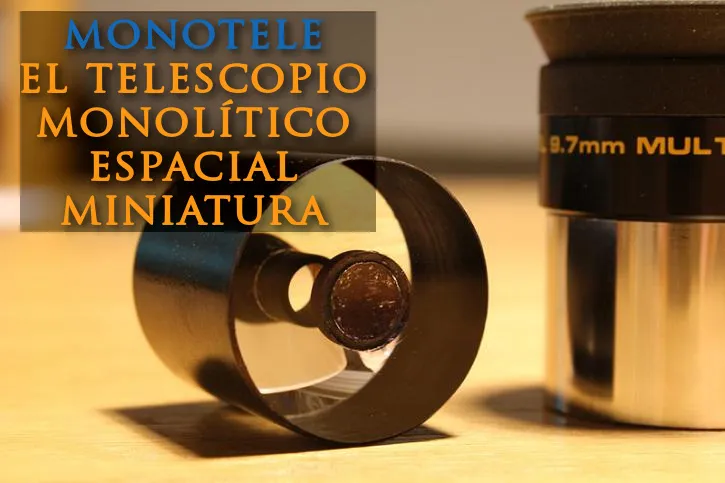
Lawrence Livermore National Laboratory (LLNL) announced an agreement last year with the company Tyvak, to develop telescopes for nano-satellites.
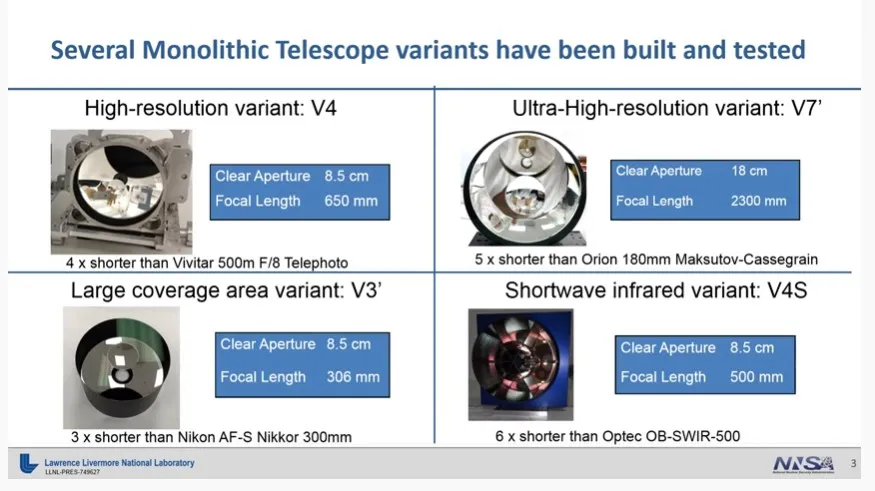
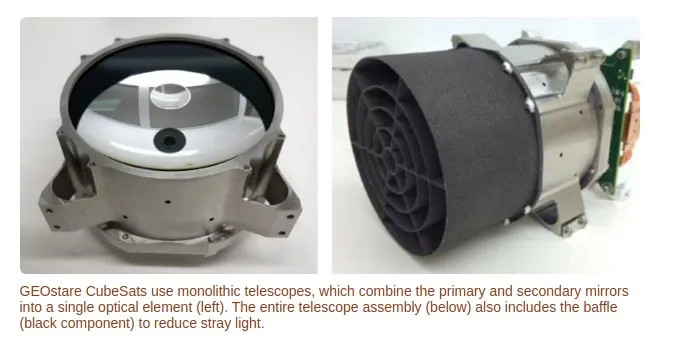
The telescope in question is called MonoTele, made from a single piece of silica, making it ideal for operating in space conditions. These miniature telescopes can have sizes from 1 to 14 inches.
Researchers at LLNL developed the mini telescope for use in star trackers, a satellite component that allows determining its orientation, a stellar "GPS". The prototype was tested on the GEOstare satellite, launched in 2018.
Usually, space telescopes have two mirrors, a primary and a secondary, which must be aligned. To keep them that way, measurement structures can be used, but they are costly. To solve the problem, Brian Bauman had the idea of MonoTele, replacing the two mirrors with a solid piece of glass, with optical shapes and reflective coating. The concept was inspired by the design of mirrors used in the Rubin Observatory (formerly LSST).
The development of these miniature telescopes by LLNL was led by Alexander J. Pertica, who a few years ago uploaded a video to YouTube explaining the scope of the innovation.
DESIGN AND ADVANTAGES
These miniature telescopes are of Cassegrain design.
They are very compact and robust against vibration and temperature changes.
They require no maintenance (collimation).
Many variants have been made: high resolution, wide field, etc.
Excellent images are obtained from low Earth orbits (LEO).
USES
They were thought for use in CubeSats, but their use will expand over time. Most likely they will be used for spying, whether on facilities, pipelines, or citizens. They could be installed on drones.
Handmade Miniature Monolithic Telescopes
On the Cloudy Nights forum, user Rik Ter Horst explained how he made a Schmidt Cassegrain F/10 of 3 centimeters!
In that message he said (my translation):
About fifteen years ago I wanted to make a very small Schmidt-Cassegrain from a solid piece of BK7, just to see if it could be done. So it became a 30 mm F/10 instrument, small enough to fit in an eyepiece. I thought it would be good to share here...
This is what I did:
I drilled a 30 mm diameter cylinder and made one end a convex spherical (the primary mirror) and the other end flat (the corrector side). On this side a small concave sphere was made, being the secondary mirror.I calculated the necessary asphericity of the Schmidt corrector (21 microns!), I ground and polished this deformation on the surface and made corrections using flexible polishing tools. In the middle of the spherical primary I made a concave sphere to bring the focus far enough away from the 'telescope' to use it in combination with a CCD or an eyepiece. To avoid stray light, I drilled cylinders around the secondary mirror and in the primary mirror that act as light baffles. Then, the mirrors were coated with aluminum. Although it was intended to be used inside an eyepiece, I never made a barrel where it could fit. However, I made two larger ones, with 40 mm diameter and kept this small one as a nice souvenir...
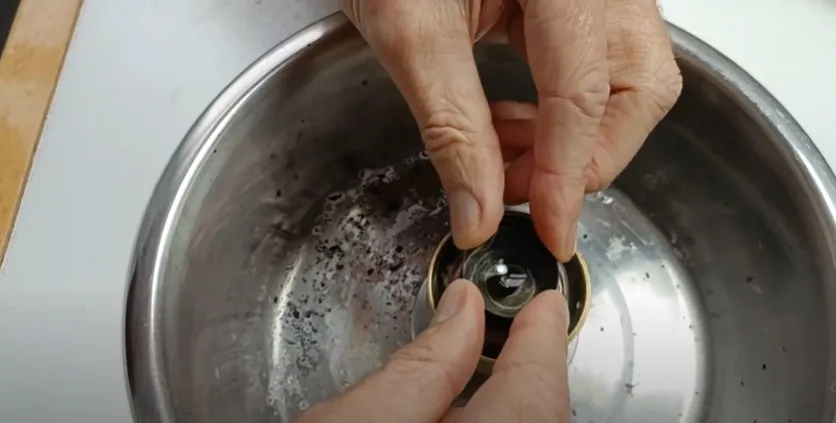
A few days ago, the Huygens Optics YouTube channel, published a video that includes an interview with Rick ter horst, as well as images of the place where he produces these small wonders and the elements he uses. It's not to be missed.
They say there are more stars than grains of sand. But it's incredible all that can be done with a little bit of beach!☉
Sources and related links
- Eye-Watering Images from Tiny Telescopes by Alexander J. Pertica
https://www.youtube.com/watch?v=IoM0CONf9Lc&ab_channel=InnovationandPartnershipsOffice - A SOLID 30 mm F/10 Schmidt Cassegrain
https://www.cloudynights.com/topic/406276-a-solid-30-mm-f10-schmidt-cassegrain/ - Why is this Space Telescope so Tiny?
https://www.youtube.com/watch?v=HxwhCmO90UQ&ab_channel=HuygensOptics - Free-space optical communication
https://es.wikipedia.org/wiki/Comunicaci%C3%B3n_%C3%B3ptica_por_el_espacio_libre - Lawrence Livermore, Tyvak Systems announce agreement to develop telescopes for nanosatellites
https://www.llnl.gov/news/lawrence-livermore-tyvak-systems-announce-agreement-develop-telescopes-nanosatellites - LLNL/Tyvak space telescope goes into orbit
https://www.llnl.gov/news/llnltyvak-space-telescope-goes-orbit - The LLNL/Tyvak space telescope goes into orbit
https://www.aaa.org.uy/2021/06/el-telescopio-espacial-llnl-tyvak-entra-en-orbita/ - Space Program Innovation, One Small Satellite at a Time
https://str.llnl.gov/2019-04/riot - Eye-Watering Images from Tiny Telescopes by Alexander J. Pertica
https://www.youtube.com/watch?v=IKsJSCyzIOA&ab_channel=InnovationandPartnershipsOffice
About the images
Credit: LLNL; Rick Ter Horst