On the origin of the name of the Kuiper Belt.
From 2006 to the present, the debate over the reclassification of Pluto as a dwarf planet arises and resurfaces from time to time. The truth is that Pluto is much more similar to the objects in the Kuiper Belt than to the other large bodies in the Solar System. Although it is the largest object in that Belt, it has half the diameter of Mercury.
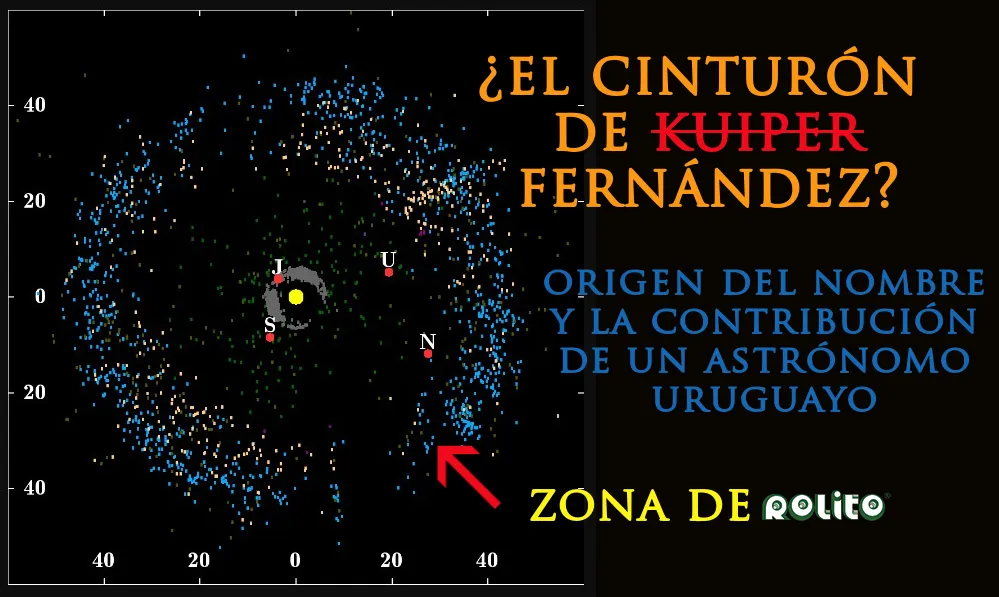
Professional astronomers have established some internal boundaries in the Solar System: the inner solar system, the asteroid belt (between Mars and Jupiter), the outer solar system, the trans-Neptunian objects (OTN; TNO for its acronym in English), the Kuiper Belt, the Oort Cloud.
TNOs are all those whose orbit is farther than Neptune's. The Kuiper Belt is a circular zone from 30 AU to 50 AU from the Sun. Sedna, another dwarf planet, is a TNO but is farther away than the belt.
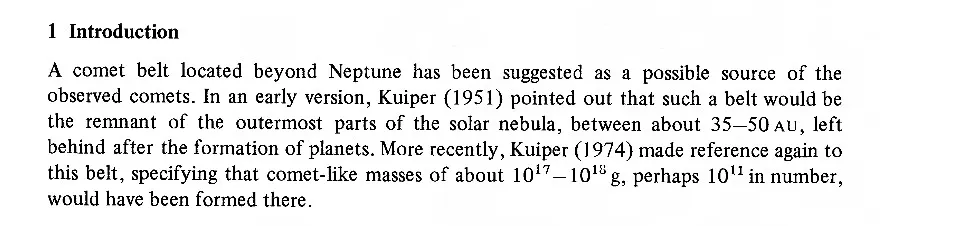
This zone, the Kuiper Belt, owes its name to astronomer Gerard Kuiper, who in the 1950s speculated that such a zone would have formed at the origin of the Solar System, although he assumed it would no longer exist. He thought, like other astronomers of the time, that Pluto was much larger than it really is, and that it would have "swept" the zone of those primordial debris towards the Oort Cloud. There is an earlier reference, from 1943, in which astronomer Kenneth Edgeworth hypothesized about an outer zone full of small bodies.
Jan Oort proposed the existence of a much more distant region, the source of comets, the Oort cloud. However, just as there are long-period comets, there are also short-period ones, like Halley's. But as comets were discovered, it was thought that the Oort cloud could not be the only source of comets.
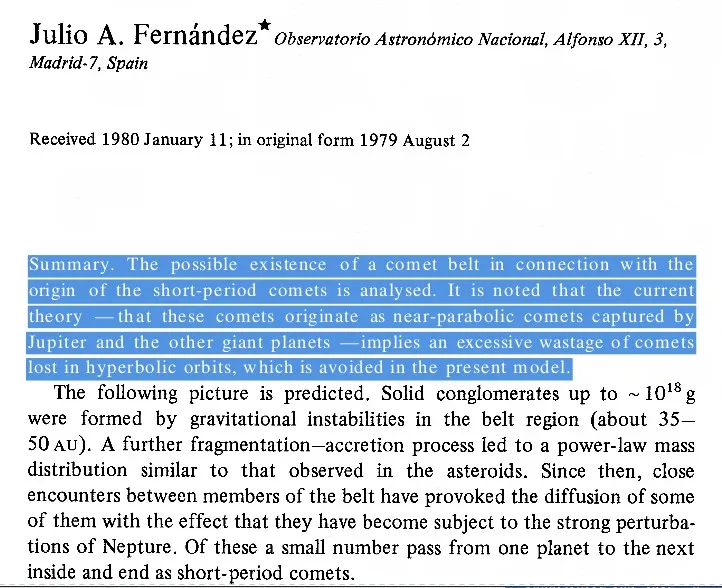
In an article published in Monthly Notices of the Royal Astronomical Society in 1980, Uruguayan astronomer Julio Fernández stated that for every short-period comet sent into the inner Solar System from the Oort cloud, 600 would have to be ejected into interstellar space. He speculated that a belt of comets between 35 and 50 AU would be required to account for the observed number of comets. In that research, Fernández mentions Kuiper as a precedent in his introduction.
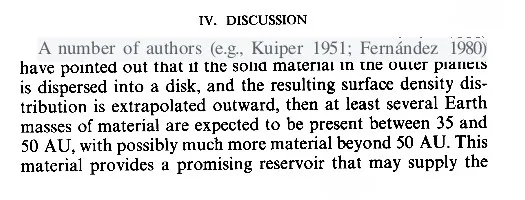
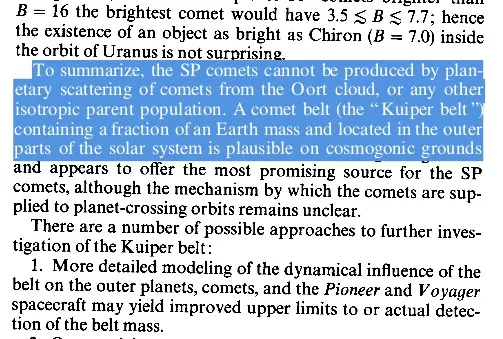
In 1988 a Canadian team (Duncan, Quinn and Tremaine) performed a series of simulations and found that the Oort cloud could not account for all short-period comets. With a "belt," as described by Fernández, added to the formulations, the simulations matched the observations. In that work published in ApJ they refer to Kuiper and Fernández, but call the zone the "Kuiper Belt."
THE NAME GAME
Does it make sense for the zone to be called that?
On his website, astronomy professor David Jewitt stated: "The problem with the Kuiper Belt is that Kuiper did not predict -in any objective reading- the object that bears his name. Kuiper's work refers to a set of primordial bodies that he assumed were scattered into the Oort Cloud by a massive Pluto, so if we take it literally, his work predicts that there would be nothing where we now see Kuiper Belt Objects (...). Kuiper, in fact, anti-predicted what we now call the Kuiper Belt."
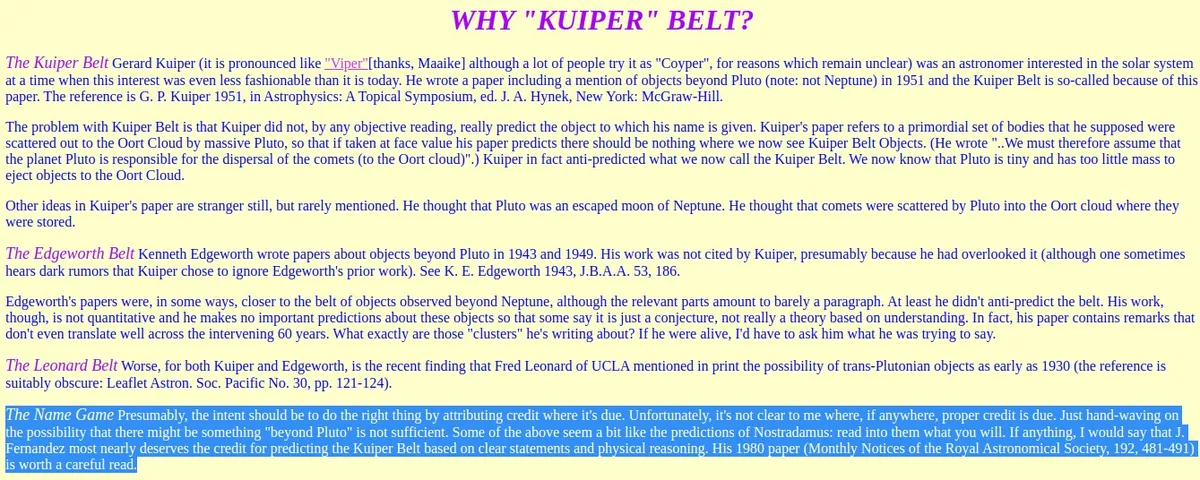
And then he adds, that if anyone could deserve the name it shouldn't be just for the hypothesis that something exists beyond Pluto. And he comments: "If anything, I would say that J. Fernández almost deserves the credit for predicting the Kuiper Belt based on clear statements and physical reasoning. His 1980 paper (Monthly Notices of the Royal Astronomical Society, 192, 481-491) deserves a careful read".
Finally, Jewitt mentions Stigler's law which is an axiom formulated by Stephen Stigler in 1980 that says "no scientific discovery is named after the person who discovered it first," which is valid even for that same axiom which was not discovered by Stigler.
It must be added that currently it is considered that short-period comets come from a zone called the "scattered disk" created with Neptune's migration. It is also worth saying that the Oort Cloud was proposed before Oort by Ernst Öpik.
If we held a vote in Latin America on whether the zone should be called the "Kuiper Belt" or the "Fernández Belt," perhaps the second option would win because astronomers from this part of the world might feel a greater cultural affinity with a Uruguayan than with a Dutchman.
If the vote were worldwide, they would probably choose to remove the current name, but use a nomenclature without proper names, like "Trans-Neptunian Belt."
In a fanciful vein, if we asked the Trans-Neptunian Objects themselves, it wouldn't be far-fetched (if the objects could talk) for them to answer us with a paraphrase or version of the verses popularized by the Uruguayan band Cuarteto de Nos:
♪I am who I am
I don't need identification
I know well where I come from and where I go
Because I am what I am
And not who you want me to be
You confuse me and I don't know what you intend
I already explained it to you, but it seems you don't understand
And that mistake is a big error
I am not the son ofHernándezFernández
What do I care what that paper says
I have nothing to do with him
And I won't lie even if they sue me for it
I am not the son ofHernándezFernández.♪
This story illustrates a part of human behavior, in search of prestige and merits that, in many cases, are not truly deserved. We rush to use eponyms (proper names) to name things or laws before it's due. Reviewing later and changing the names long after is difficult due to cultural inertia. More than modifying nomenclatures, what's important is to know the history.
Julio Fernández together with his colleague Gonzalo Tancredi were the ones who proposed the redefinition of planet that was finally voted on in 2006. Due to its dominance in the region, the name "Pluto's Belt" could well be used, although it cannot be ruled out that there are other larger or more massive objects. But since the belt starts at Pluto's orbit, I think the name is acceptable.
But, if it were up to me, I would call the zone the Rolitos Belt, while toasting -with ice- with my glass raised: "To your health, Fernández."☉
Sources and related links
- On the existence of a comet belt beyond Neptune
Fernandez, J. A.
https://ui.adsabs.harvard.edu/abs/1980MNRAS.192..481F/abstract - The Origin of Short-Period Comets
Duncan, M. ; Quinn, T. ; Tremaine, S.
https://ui.adsabs.harvard.edu/abs/1988ApJ...328L..69D/abstract - WHY "KUIPER" BELT?
http://www2.ess.ucla.edu/~jewitt/kb/gerard.html - Julio Ángel Fernández
https://es.wikipedia.org/wiki/Julio_%C3%81ngel_Fern%C3%A1ndez
Stigler, Stephen (1980). «Stigler's law of eponymy». Transactions of the New York Academy of Sciences 39: 147-158.
https://nyaspubs.onlinelibrary.wiley.com/doi/abs/10.1111/j.2164-0947.1980.tb02775.x
About the images
By WilyD from English Wikipedia, CC BY-SA 3.0, https://commons.wikimedia.org/w/index.php?curid=38097918