About the Voyager 1 photo and a poem.
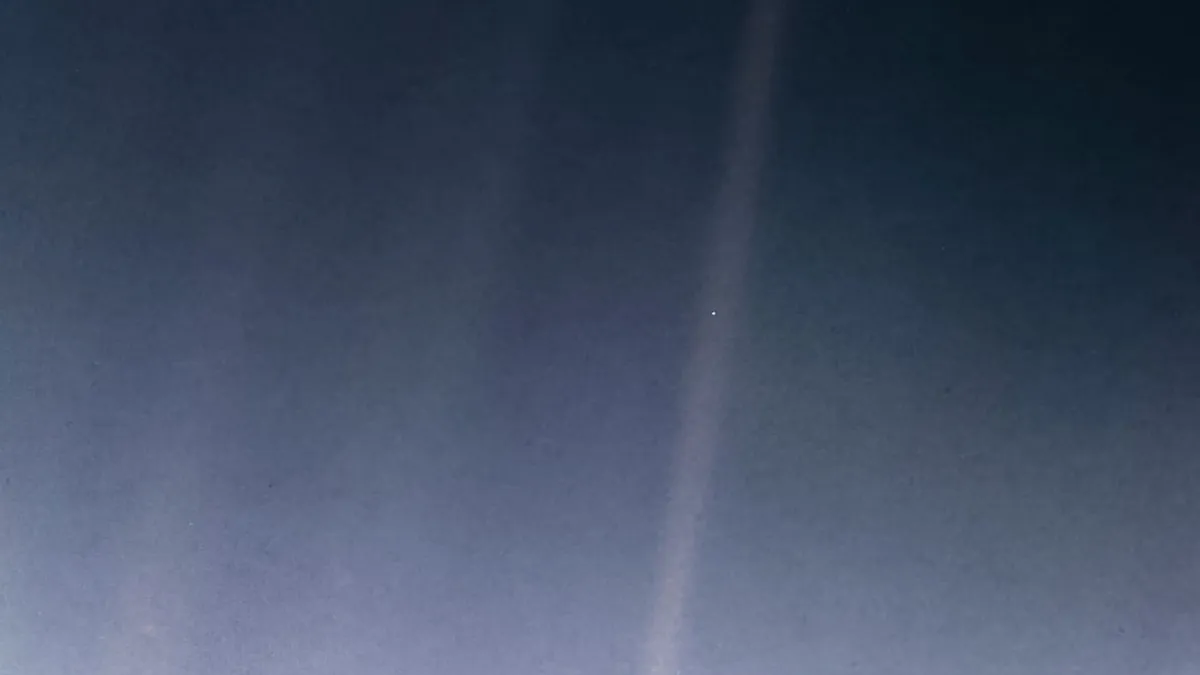
On February 14, 1990, NASA decided that Voyager 1 should take one last photo. The spacecraft had been launched in 1977 and was 40 astronomical units from the Sun. One last look back to achieve one of the most iconic photos of the space age. There, in a ray of light, a small pale blue dot shows the fragility of our world in the immensity of the cosmos. Carl Sagan had dreamed of that photo in 1981.
To commemorate this photo, I thought a good idea was to share a video-poem by Katie Mac. In 2019, the American astronomer published it in a Twitter thread as text. Later, with her faculty, they made a video with the narration of the poetry read by herself. The poem includes a reference to the famous photo and also has a nod to Sagan.
To this day, according to Google, no one had translated the poem into Spanish. Another task remains pending, perhaps for a small future project: to make another version of the video, in Spanish, read by a woman, an astronomer.
There are those who deny the existence of "natural art," since they postulate that art is a human doing. They say that works of art do not possess inherent beauty, but that beauty, in any case, is in the eyes of the beholder.
The Voyager 1 photo portrays natural objects, but it was made by people, using a camera on a spacecraft. And it was not taken for research purposes. From my point of view, it is a work of art. Its meaning?
There are many possible interpretations. But given the current state of the world, it is worth thinking that confinement did not start with the coronavirus. We are a speck of dust in a universe that seems to be made for giants that are nowhere to be found. The cosmos is an absurdity. And it forces us to coexist and take care of our home in space. Will we be capable?☉
Disorientation, by Katie Mac
I want to make you dizzy.I want you to look at the sky and understand, perhaps for the first time, the darkness that lies beyond the thin layer of the atmosphere, the infinite depths of the cosmos, a desolation in degrees.
I want the Earth to spin inside you and upset your balance, carry you east at over a thousand kilometers per hour toward the light, the darkness, and the light again.
I want you to see the Earth rising to meet you with the morning sun's rays.
I want the sky to stop you dead in your tracks on your way home tonight because you happened to look up and among all the bright pins you recognized one as the light from another world.
I want you to taste the iron in your blood and see its likeness in the rust-red sands of Mars's long, dry dunes, born from the same nebular dust that randomly fused with stellar debris into rocks, oceans, your own beating heart.
I want to reach into your consciousness and project it outward, beyond the light of other suns, to expand it like the universe, not invading the void, but growing larger, developing within itself.
I want you to see your world from six billion kilometers away, a tiny blue glint in the intense white light of an ordinary star in the darkness. I want you to try to make out the borders of your nation from that vantage point... and fail.
I want you to feel it, in your bones, in your breath, when two colliding black holes a billion light-years away send a tremor through spacetime that makes every cell in your body tense and stretch.
I want to make you feel nostalgia for long-dead stars, the ones that fused your carbon nuclei and those whose last thermonuclear death throes outshone the entire galaxy to send a single photon to your eye.
I want you to live forward but look backward, farther and deeper into the past, because in a relativistic universe you have no other choice. I want the billion-year-old starlight from a distant galaxy to be your reward.
I want to completely disorient you and let you navigate back by the stars. I want you to get lost, and find yourself again, not just here, but everywhere, in everything.
I want you to believe the universe is a vast, random, indifferent place, in which our species, our world, is utterly insignificant. And I want you to believe that the only response is to make our own beauty and meaning and share it while we can.
I want you to wonder what's out there. What dreams may come on waves of radiation across an endless expanse. What we may come to know, in time, and the splendors that will never, ever reach us.
I want it to mean something to you. That you are in the cosmos. That you are of the cosmos. That you are born of stardust and to stardust you will return. That you are a way for the universe to be in awe of itself.
Sources and related links
- ’Pale Blue Dot’ Revisited
https://www.nasa.gov/feature/jpl/pale-blue-dot-revisited - Katie Mac
https://www.astrokatie.com/disorientation - Disorientation, by Katie Mac
https://www.youtube.com/watch?v=2wT1-bRj9wI
About the images
Credit: NASA/JPL-Caltech