In India, it has already achieved first light.
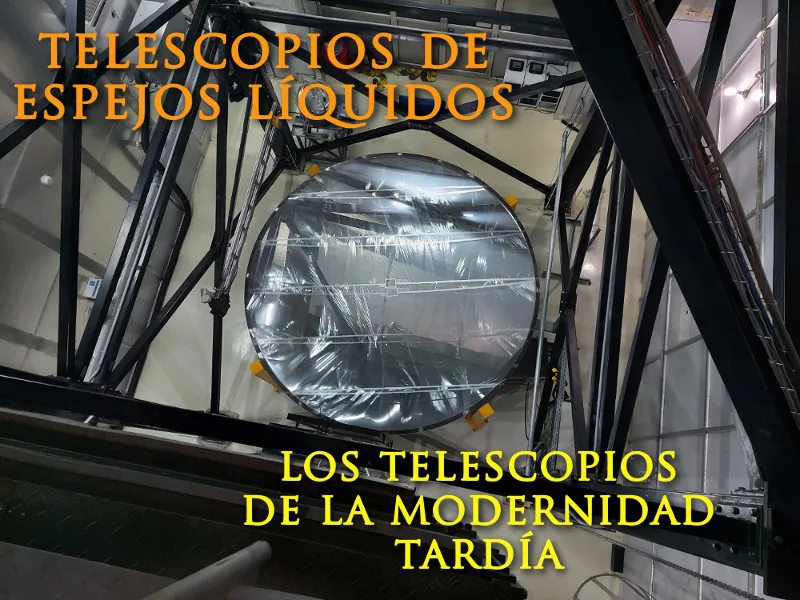
That calm waters can be used as mirrors is not new. But can a liquid mirror be used to make a telescope?
Telescopes consist of a mirror that has a parabolic shape, achieved by polishing glass with abrasive products. It is the shape that allows focusing all parallel light at a single point. Of course, it is also thanks to the glass being coated with a reflective material, like aluminum.
How to make a "water mirror" parabolic? By making it rotate. And no, water is not used, but mercury.
The idea is like this:
A rotating liquid surface takes the shape of a paraboloid under the constant pull of gravity and centrifugal acceleration, which becomes stronger with distance from the central axis. The parabolic shape occurs because the liquid surface sets its local surface perpendicular to the net acceleration it experiences, which in this case becomes stronger and more tilted with distance from the central axis. Consequently, a Liquid Mirror Telescope (LMT) can be made with a liquid mirror as the primary objective and a camera at the focal point of the paraboloid.
A major disadvantage is that they are zenithal, meaning they cannot be pointed at a part of the sky, but always point at the zenith. But thanks to Earth's rotation, LMTs scan a band of constant declination equal to the observatory's latitude. That is why it is possible to integrate images recorded over several nights to improve the limiting magnitude, or to subtract images taken on different nights to do a variability study, which is one of the main uses of these devices.
THE ILMT
A new liquid mirror telescope is being inaugurated, the 4-meter ILMT (International Liquid Mirror Telescope), in the Himalayas, at the Devasthal Observatory, campus of the ARIES Institute, in India, at an altitude of 2450 meters.
On a surface covered with mercury, with a thin transparent mylar film (which protects the mercury from the wind), light reflects to a point and passes through an optical corrector. Prof. Paul Hickson (University of British Columbia, Canada), an expert in this technology, explained that: "the rotation of the Earth causes the images to drift across the camera, but that motion is compensated electronically".
"By rotating once every eight seconds, the mirror floats on a film of compressed air about 10 microns thick," he added.
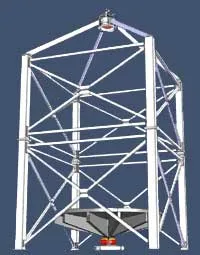
Components
The ILMT is formed by a rotating primary mirror, a focal structure, and a top end. The latter contains a CCD camera and an optical corrector.
The primary mirror is a 4m diameter container that rests on a rotating plate. Both are mounted on a three-point mount that aligns the rotation axis parallel to Earth's gravitational field. A thin layer (3 mm) of mercury is spread in the container. To guarantee good quality, the mercury must be stable. The aperture is f=2.
The rotating plate is a commercial air bearing driven by a synchronous motor controlled by a variable frequency power supply stabilized with a crystal oscillator.
The container is made of Kevlar, lightweight but rigid. The structure is very simple to hold the top end at the focal point.
The ILMT is equipped with a CCD camera whose sensor is a 4096x4096 pixel array. Since these telescopes cannot track objects in the sky, it is done electronically, by using a technique called Time Delayed Integration (TDI). Taking an image with a CCD is usually done in two steps. First, the array sensor is exposed to light from the source. During the exposure, photoelectrons are generated and stored in the sensor's pixels. The number of photoelectrons is proportional to the light flux arriving. Secondly, the number of photoelectrons in each pixel is counted: this step is called CCD readout. It is generally done by moving each column of the sensor array to an electronic device. In the TDI technique it is done slower. As a star passes through the telescope's field of view, its image crosses the sensor. The shifting of the columns is slowed down in such a way that the photons generated by the star are shifted across the sensor at the same speed as the object's image travels across the focal plane. Consequently, as soon as the star leaves the field of view, the number of photons generated is counted. Thus, TDI is a real-time technique. At every moment, the ILMT creates an image of the sky field passing through the zenith.
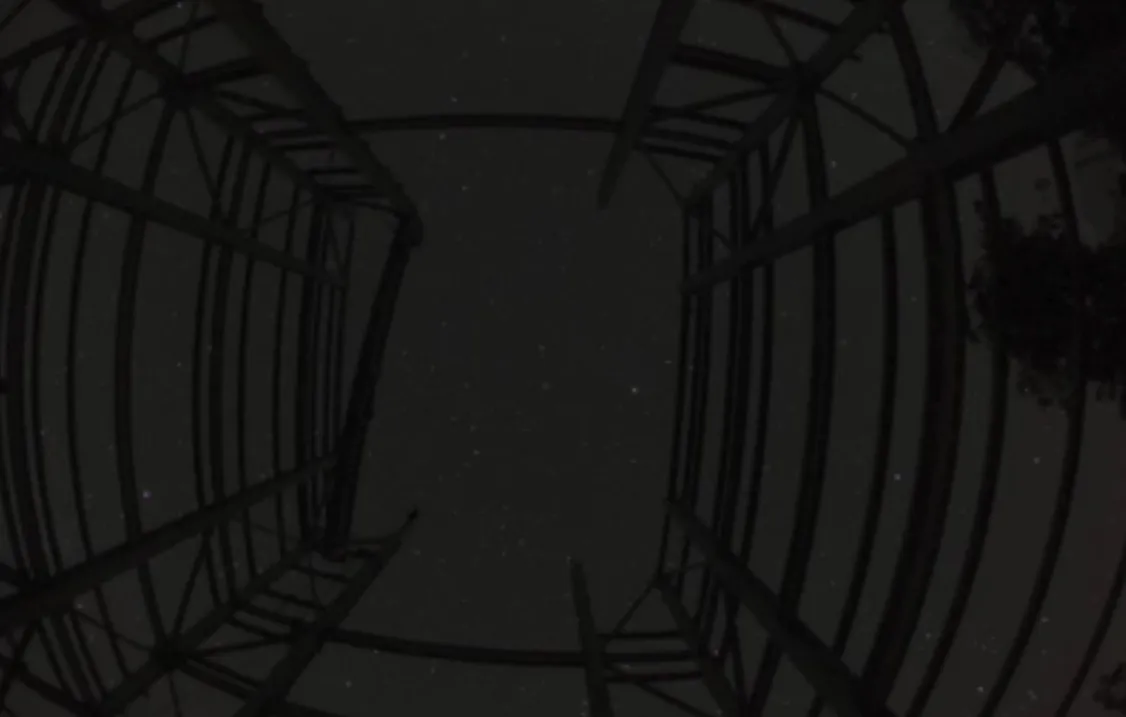
Test image taken when the ILMT was being built in 2015.
Corrector:
Since the primary is parabolic, off-axis there are aberrations (distortion, spherical and coma). For this purpose, an optical corrector is inserted before the CCD.
Cluster:
Data storage and processing is done in a set of computers (cluster) consisting of 27 workstations, ten of which include a 6-core AMD processor (3 GHz), 4 GB of RAM and 4 2 TB disks. One of the PCs is used as a database server. The cluster is in Poland.
FIRST LIGHT OF THE ILMT
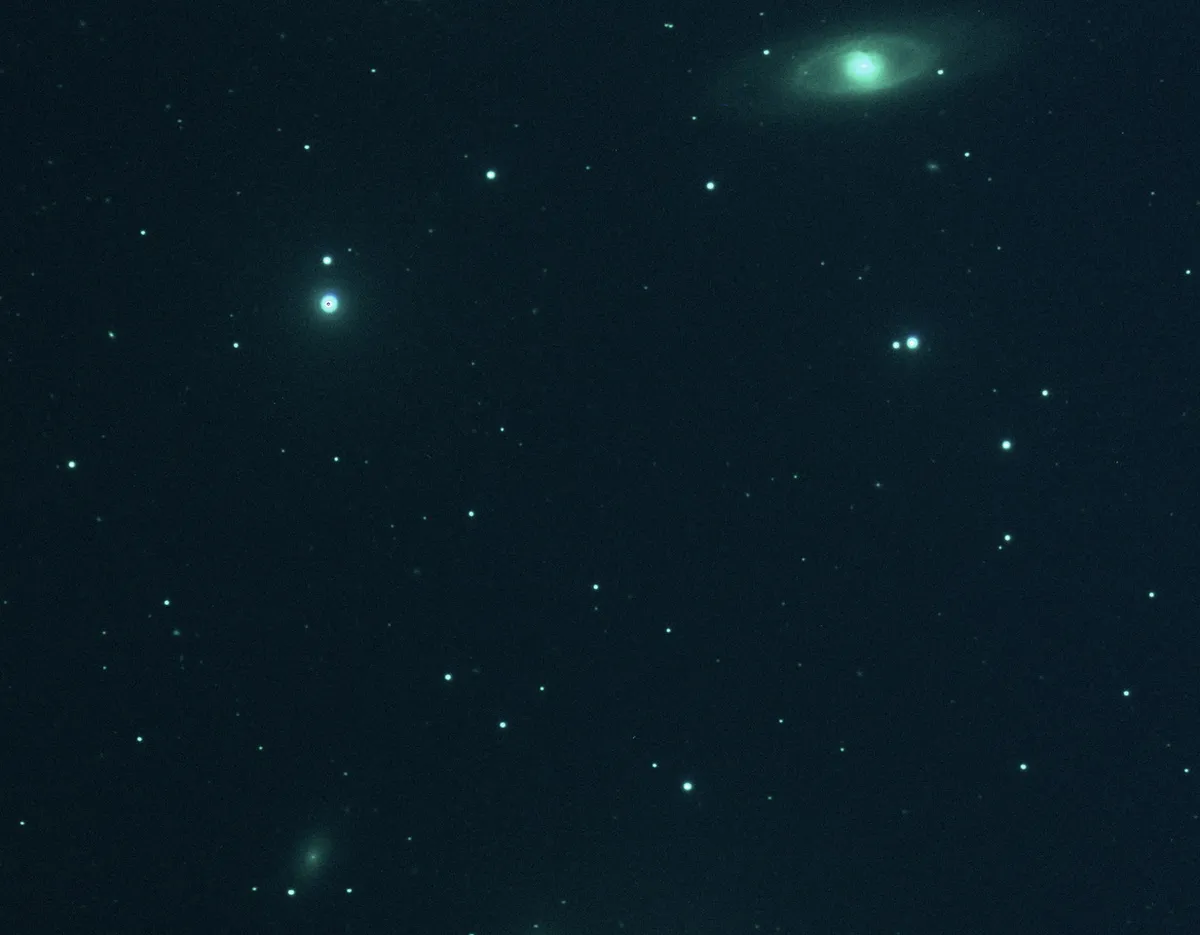
First light was achieved the second week of May 2022. Here is shown a composite made with different filters of a small portion of the sky. The green color was enhanced to highlight galaxies and other objects. Galaxy NGC 4274 can be seen at the top right.
BRIEF HISTORY OF LIQUID MIRROR TELESCOPES
The idea of using a rotating liquid to create a paraboloid was proposed by Isaac Newton, but the requirements, particularly the rotation speed and leveling prevented any serious attempt to create a prototype until the 19th Century. The first was by Skey (1872) who built a 35 cm telescope.
Advantages and disadvantages
A favorable characteristic of these devices is that their cost is much lower than other reflecting telescopes. A drawback is the use of mercury, which is toxic. Gallium could be used as a replacement, but it is more expensive. At low temperatures the evaporation rate of mercury is reduced. Magnetically deformable designs made from a suspension of iron and silver nanoparticles have been proposed.
Other liquid mirror telescopes
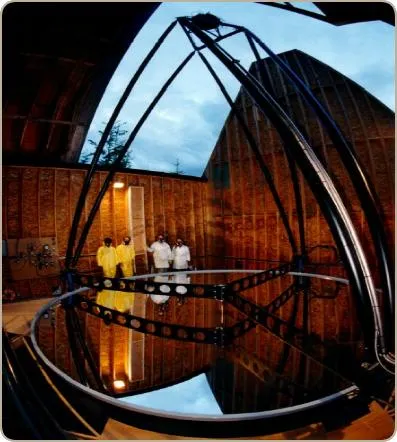
The idea of liquid mirrors and telescopes made that way is long-standing. Several observatories were made this way. The Large Zenith Telescope (image above) was in operation from 2003 to 2016. The NASA Orbital Debris Observatory operated from 1995 to 2002.
Given their usefulness in recording and studying transient phenomena, it is not surprising that these telescopes are now starting to be used more, in the era of liquid modernity, uncertainty, and transience. Although perhaps it is not so, and everything changes.☉
Sources and related links
- The World's Largest Liquid-Mirror Telescope Comes Online
https://www.universetoday.com/156246/the-worlds-largest-liquid-mirror-telescope-comes-online/ - ILMT
http://www.ilmt.ulg.ac.be/ilmt/
https://www.aries.res.in/facilities/astronomical-telescopes/ilmt - LZT
https://www.astro.ubc.ca/lmt/lzt/ - Liquid mirrors for new telescopes
https://elpais.com/diario/1995/12/13/sociedad/818809216_850215.html - India now has Asia's biggest liquid mirror telescope & reflecting telescope
https://www.youtube.com/watch?v=JWJWlGJ-AzI - Liquid Mirrors
https://www.astro.ubc.ca/lmt/lm/ - Indian, UBC astronomers celebrate first light at liquid-mirror telescope
https://science.ubc.ca/news/indian-ubc-astronomers-celebrate-first-light-liquid-mirror-telescope - UBC's Liquid-Mirror Telescope Pages
https://www.astro.ubc.ca/LMT/home.html
About the images
Credits ARIES/ILMT
Anna and Jean Surdej
LZT: P.K.Cnen