Fito Páez in a universe of spinning tops.
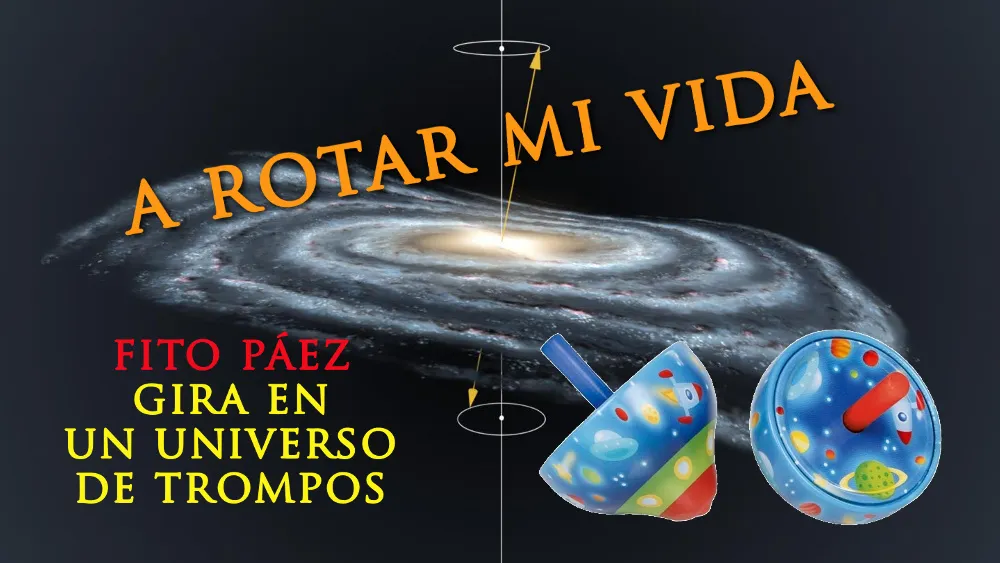
On June 1, 1992, Fito Páez released his album El Amor después del Amor. It was a great success, with many great songs. The last track on the album was "A rodar mi vida". It's been 30 years since that album. Earlier, in 1985, his second album, Giros, had a song of the same name.
With music as an excuse, let's talk about rotations. You know that the Earth turns on its own axis and takes 24 hours. Well, it takes a little less. In one day, the planet makes one turn (360º) plus 1º. That's why, over the course of a common year (not a leap year), we make 366 turns on this planetary merry-go-round.
♫There is a heaven and a state of coma the environment changes from person to person♫
Everything spins in the Universe. Mercury takes 58 Earth days to rotate; Venus does it in 243 days (which is almost the same as it takes to orbit). Mars does it in almost the same time as Earth. Jupiter and Saturn rotate in about 10 hours. Uranus and Neptune take about 16 hours.
The Sun also spins. Depending on whether it's measured at the equator or the poles, it takes between 24 and 28 days. The Milky Way rotates, at a rate of 220 million years to complete one turn on its axis.
The rotation of other galaxies has been measured, which led to postulating the existence of Dark Matter, since there is a discrepancy between what is measured and what Newton's theory dictates.
Since the 1970s, the Tully-Fisher Relation has been known, which states that the luminosity of a galaxy is proportional to its rotation speed.
♫Giros turn halfway and see what happens out there not everyone has springs♫
THE MOON ROTATES EVEN THOUGH IT SHOWS ONLY ONE FACE
There are still people who get confused. The Moon shows only one "face", if we can call it that, even though it rotates on its own axis. It's that the rotation and revolution have the same duration. So the Moon does not have a dark side.
♫My need is modified by others so my moon reaches you so I reach your moon♫
PULSARS: VERTIGINOUS OBJECTS
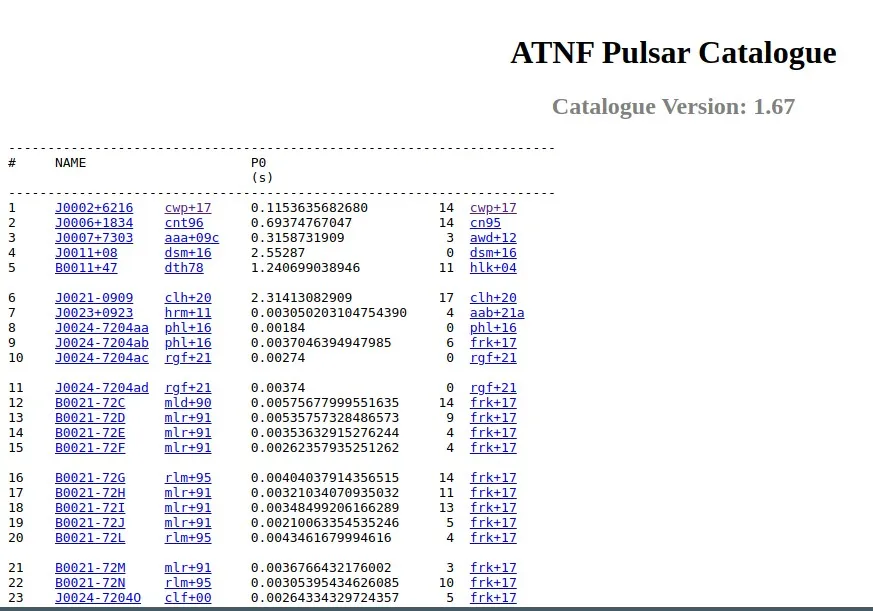
Pulsars are rotating neutron stars. They spin so fast that it's measured on scales of seconds. Here I show a table from a pulsar catalog. Its period is given in column P(0).
photographs of different places photographically so distant♫
BUT IS IT CERTAIN THAT EVERYTHING ROTATES?
According to Mach's Principle, yes: The inertia of any system is the result of its interaction with the rest of the Universe. In other words, every particle in the universe exerts an influence on all other particles.
But it is not known if this is true. If the Universe rotated, what would it rotate in relation to? It would have to be contained in a larger "space". In which case, the Universe would cease to be "all that is known", and that larger something would be. But if that "larger something" rotated, it should be contained in "something bigger" and so we would keep spinning the matter infinitely.
In the realm of the most minute, elementary particles, it cannot be said that they rotate, but they do have spin, which is a quantum property considered as angular momentum. Angular momentum is considered rotation.
♫Giros everything spins like a big ball everything spins you hardly notice♫
THE END OF THE SPINS
If Mach's Principle were true and since the Universe is expanding and nothing seems to stop it, then, at some point, within quintillions of years, everything will stop. The Cosmos will be an ocean of particles very far apart, immutable.
And then, instead of getting dizzy with this whirlwind of rotational movements, we will miss them. We can now imagine the future nostalgia of spinning. And we will sing that Fito song again, modified. ¡A rotar mi vida!.
Meanwhile, the musician begins his new tour, and I'm going to keep sleeping. I was dreaming about the Coriolis Effect. Bye, see you tomorrow!☉
Sources and related links
- Relative rotation rates of the planets cast to a single sphere (with apologies to Mercury/Neptune)
https://www.youtube.com/watch?v=exkeE6aIlpc - Study of 200,000 Galaxies Reveals the Entire Universe Might Have Been Spinning in One Direction Early On
https://www.universetoday.com/146342/study-of-200000-galaxies-reveals-the-entire-universe-might-have-been-spinning-in-one-direction-early-on/ - https://quantumgravityresearch.org/portfolio/the-rotating-godel-universe/
- Manchester, R. N., Hobbs, G.B., Teoh, A. & Hobbs, M., AJ, 129, 1993-2006 (2005)
https://www.atnf.csiro.au/research/pulsar/psrcat/
About the images
Credit: Gabriel Pérez Díaz, SMM (IAC)