The scientific data collected with the photographs.
In the mass media, emphasis is placed on the beauty of the images, on the remoteness in time and space of the portrayed objects, of the photographs that were released yesterday.
But the data collected by astronomers with the James Webb Space Telescope (JWST) are more than aesthetically pleasing brightness and colors.
WASP-96 b
For example, of the exoplanet WASP-96 b they made a transmission spectrum, done by comparing the starlight filtered through the planet's atmosphere as it moves in front of the star, with the starlight when the planet is not in front, from the observer's point of view. Each of the 141 data points (white circles) in the graph represents the amount of a specific wavelength that is blocked by the planet and absorbed by its atmosphere.
In this observation, the wavelengths detected with the NIRISS instrument range from 0.6 microns (red) to 2.8 microns (near infrared). The amount of light blocked varies from 13,600 parts per million (1.36%) to 14,700 (1.47%).
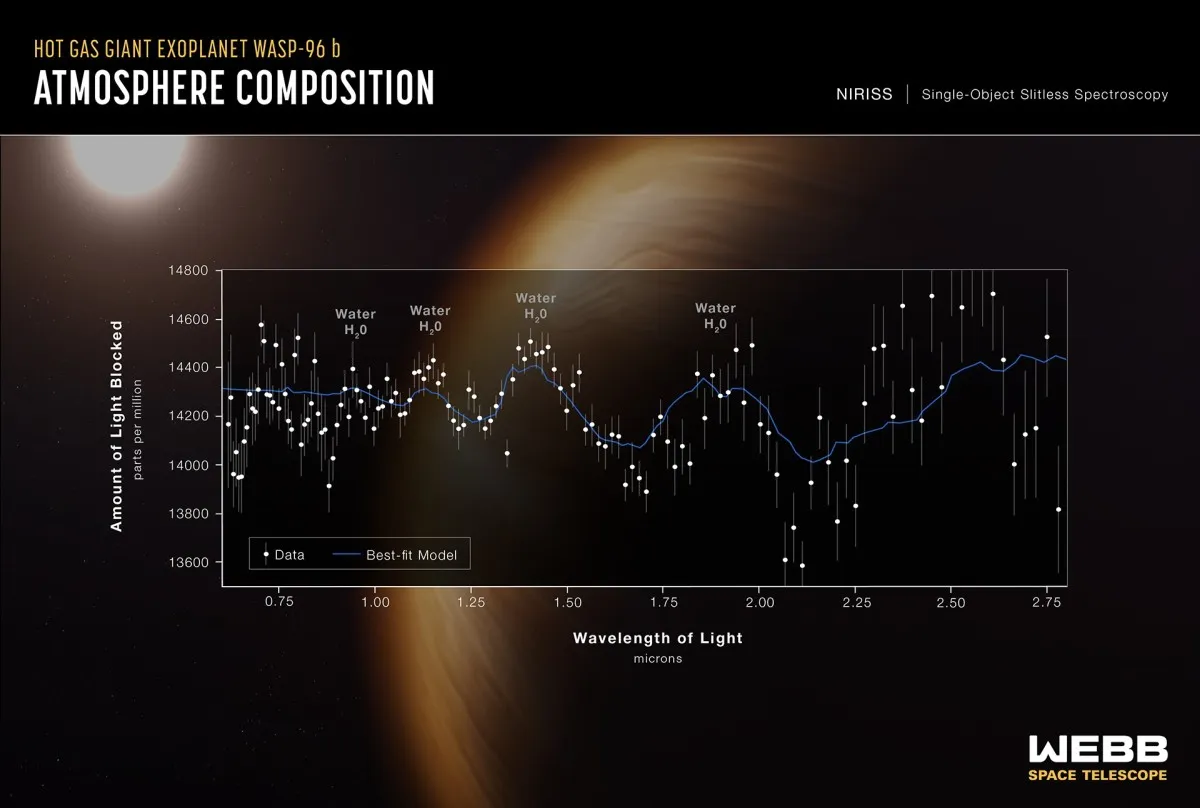
Researchers are able to detect and measure the abundances of key gases in the planetary atmosphere based on the absorption patterns, the locations of the peaks in the graph: each gas has a characteristic set of wavelengths it absorbs. The temperature of the atmosphere can be calculated based in part on the height of the peaks: the hotter, the higher the peaks.
A preliminary analysis of the spectrum indicates the presence of water vapor and clouds. The exoplanet is a hot gas giant orbiting a star like our sun just 1,150 light-years away, in Phoenix. The planet orbits very close to the star, at less than 1/20th of the Earth-Sun distance and completes an orbit in less than 3.5 Earth days.
STEPHAN'S QUINTET
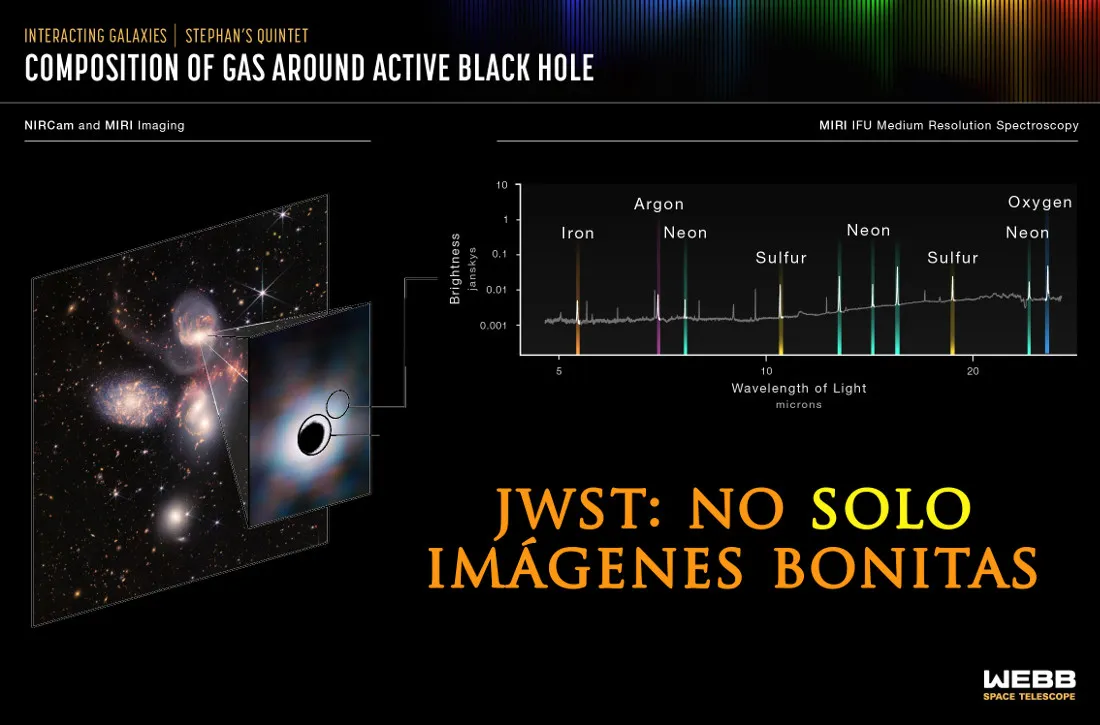
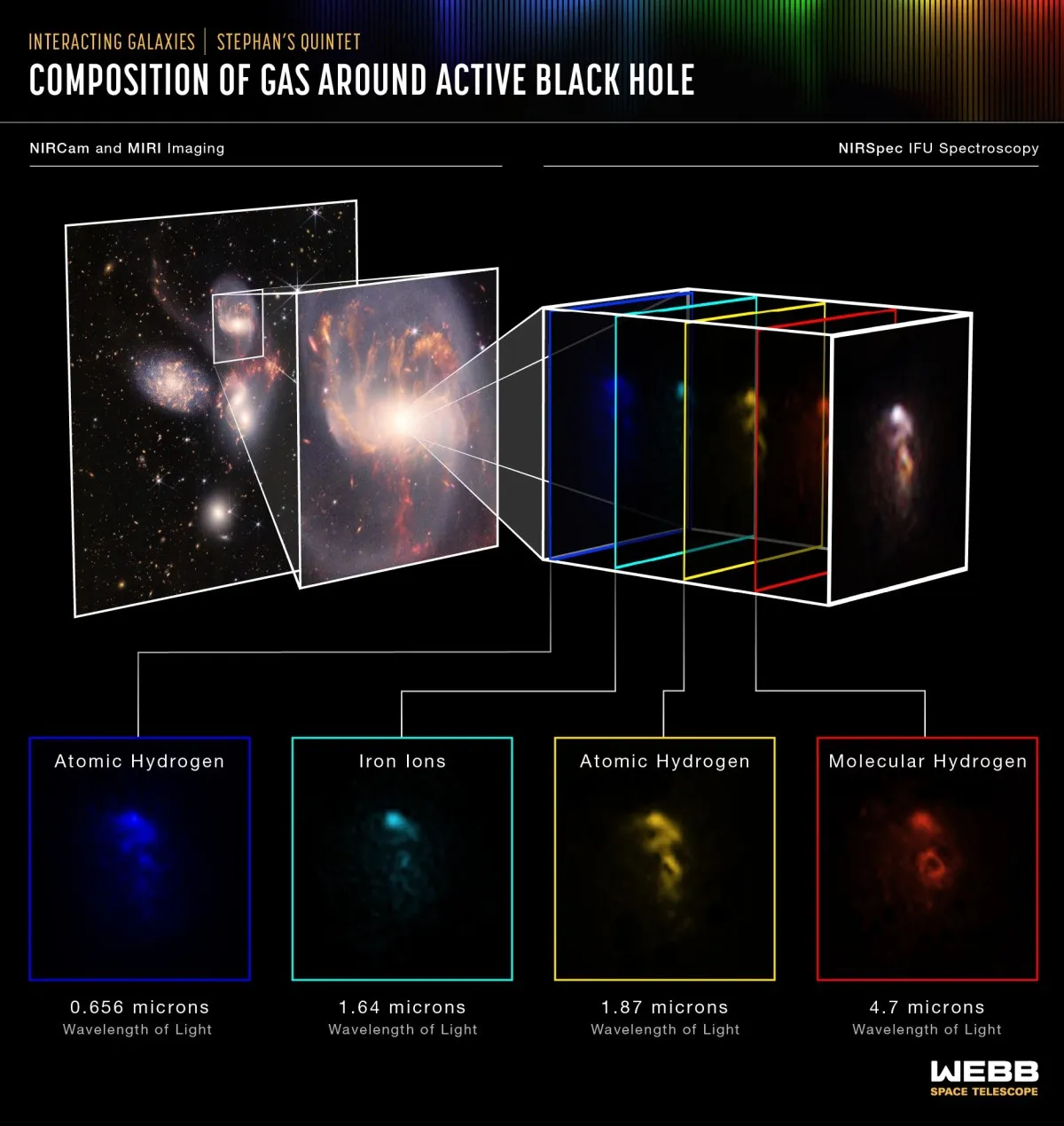
This group of five galaxies in Pegasus is also known as Hickson Compact Group 92 (HCG 92). Although there are five, only 4 are very close, while NGC 7320 lies farther away than the rest. The galaxy NGC 7319 (the top one) hosts an active nucleus, a supermassive black hole with 24 million times the mass of our Sun. With the MIRI instrument, astronomers can measure the brightness of the emission from hot gas that is being ionized by the powerful winds and radiation from the black hole.
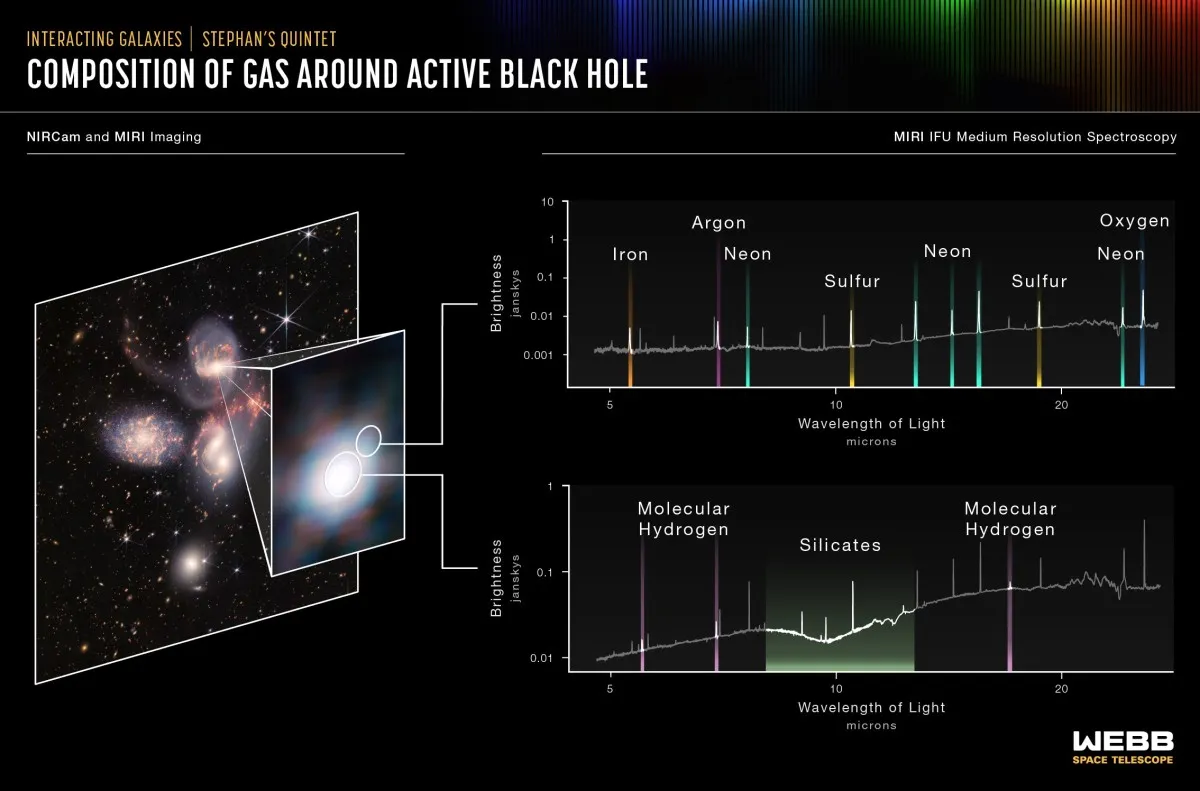
The spectrum above, of the black hole's outflow, shows a region filled with ionized gas, including argon, iron, neon, sulfur, and oxygen.
The spectrum below reveals that the black hole has a reservoir of colder gas, with large amounts of molecular hydrogen and silicon dust absorbing light from the central regions of the galaxy.
With the NIRSpec instrument astronomers can measure the emission lines from the black hole's outflow: atomic hydrogen (blue and yellow), iron ions in green, molecular hydrogen, in red.
SMACS 0723
The NIRSpec instrument has more than 248 thousand small apertures that can be opened individually to collect light from up to 150 objects simultaneously.
Of the hundreds of distant galaxies in the galaxy cluster SMACS 0723, 48 were observed at the same time in a field the size of a grain of sand. In the spectrum, three lines appear: one of hydrogen, followed by two of ionized oxygen. Where the pattern falls in each spectrum indicates to the researchers the redshift of the individual galaxies, revealing how long ago the light was emitted.
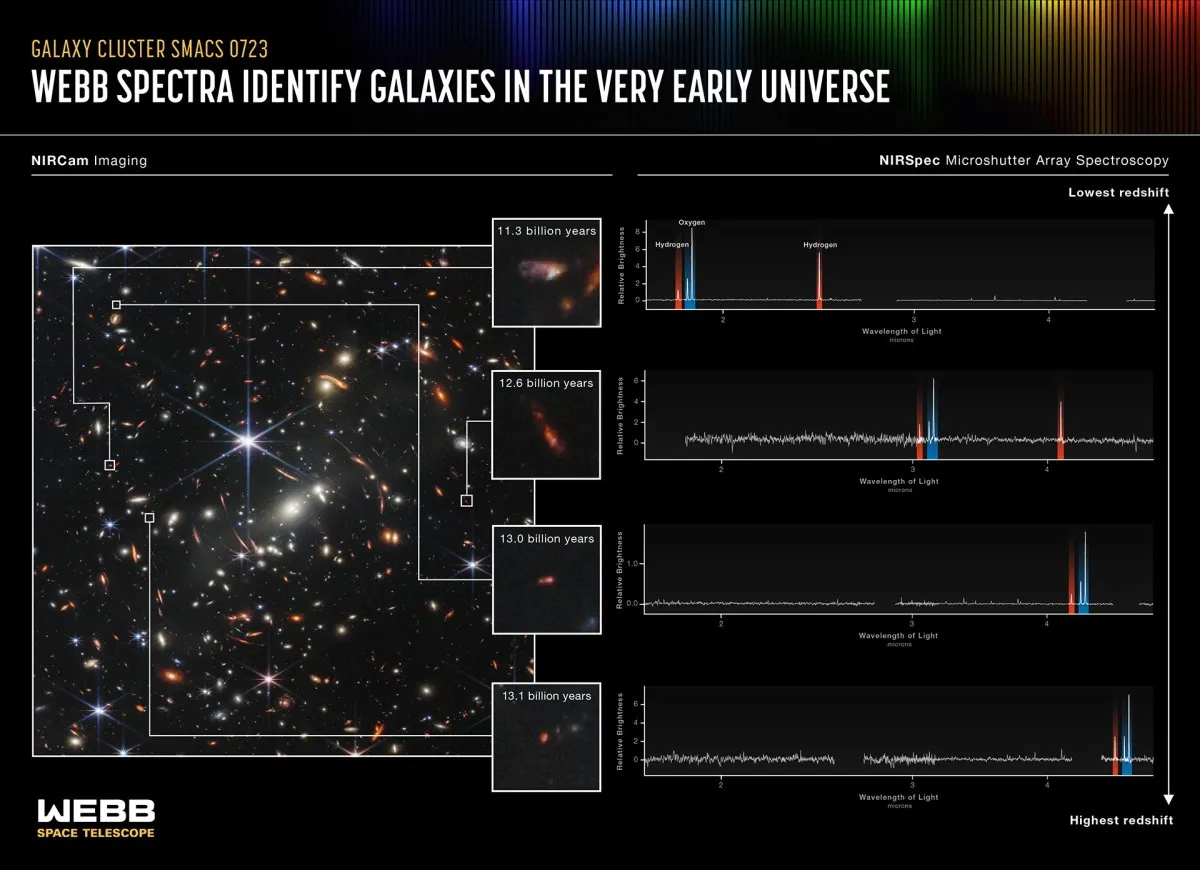
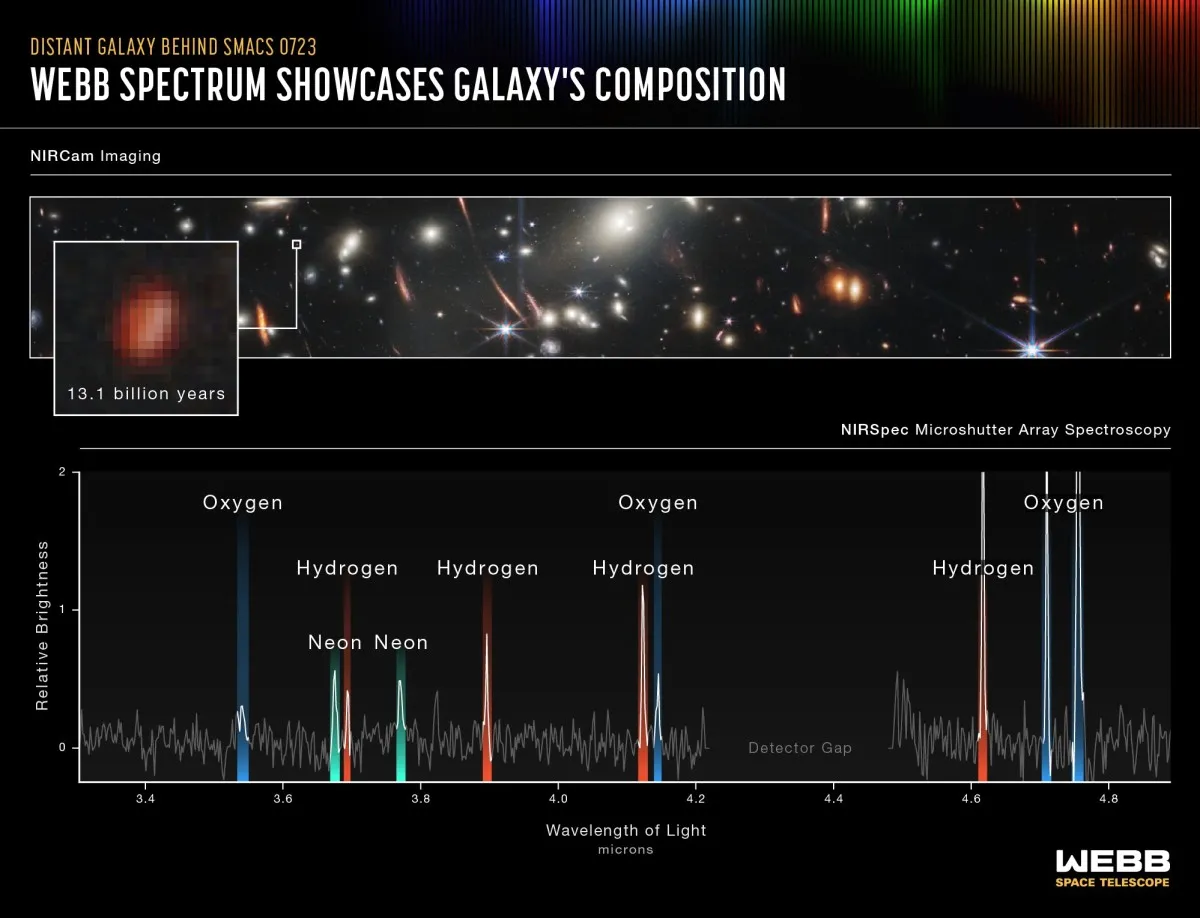
The light from the farthest galaxy traveled 13.1 billion years before Webb's mirrors captured it.
With these spectra, astronomers can know the chemical composition, temperature and density of the ionized gas of the galaxies. For example, this spectrum reveals the properties of its gas, indicating how stars are forming and how much dust they contain.
SCIENCE AND BEAUTY
Without a doubt, the new images are beautiful. But the instrument's main utility is not to take nice pictures to put on our computer or phone. NASA attracts the public with beautiful images, which perhaps awakens interest in science in many young people and makes congressmen and the American public happy who put 10 billion dollars of public funds into the budgets.
However, the telescope is much more than a camera. With its instruments, astronomers can learn the internal composition of astrophysical phenomena to understand how they develop.
After so much travel time, the light from these remote objects does not arrive tired and they can be portrayed as impeccable models on a cosmic catwalk. But what's important is not just the pretty face of the stars, but their interior.☉
Sources and related links
JWST https://webbtelescope.org/resource-gallery/images
About the images
Credits:
ILLUSTRATION: NASA, ESA, CSA, STScI