A news item and a review on calculating cosmic distances.
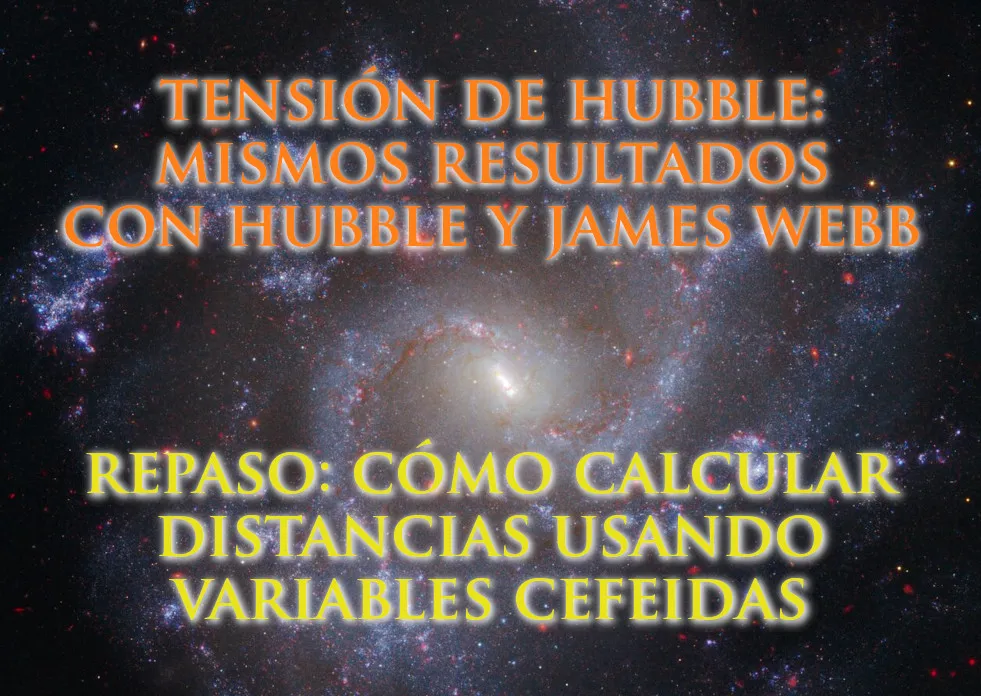
A few days ago, astronomers using the James Webb Space Telescope (JWST) published a paper in which they state that distance calculations made with Hubble observations were reviewed using data obtained with the new instrument and that the results match.
For decades there has been a problem called the "Hubble Tension" regarding the calculation of the Hubble-Lemaître constant or the expansion rate of the Universe. On one hand, the method that evaluates the Cosmic Microwave Background yields one value; while the "Distance Ladder" method gives another number, with a difference of almost 10%. One possible explanation was that the "ladder" method was not sufficiently precise.
The method in question measures the redshift of galaxies, from which the recession velocity can be calculated. The distance to galaxies is calculated using "standard candles", such as Cepheid variable stars. For the latter, one must observe that type of star and measure its luminosity (relative to the Sun) or apparent magnitude. If the telescope's resolution is not adequate, the result will not be optimal. Given JWST's better resolution, those data were reviewed, but the results were the same.
So solving the famous issue will be more difficult.
It's a good idea to take advantage of this news to review -superficially- how the method developed by Henrietta Leavitt and others on Cepheid variables is used.
The idea is that this type of variable star has a regularity between absolute magnitude (or luminosity) and period. So that, if the apparent magnitude (m) and the period (p) are measured, the absolute magnitude (M) can be calculated and then the distance (d) using the famous modulus formula.
How is it done, step by step?
I will use here a public outreach material from ESA-ESO as an example. It shows light curves of 12 variables in galaxy M100. I will use some elements from that material.
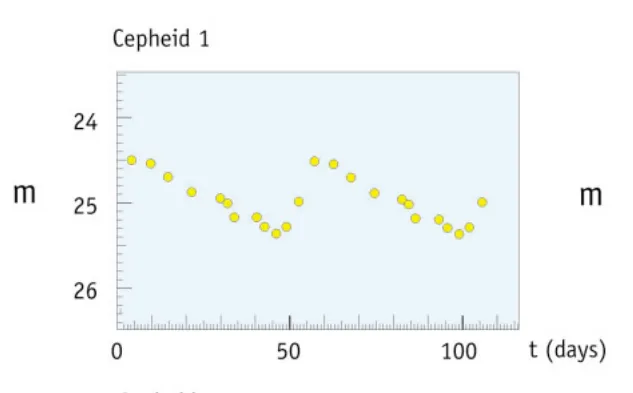
Here we see a light curve of a Cepheid variable star. On the vertical axis, its apparent magnitude is noted; on the horizontal axis, the period in days.
To calculate the absolute magnitude, this method only requires knowing the period. For that we look for on which days the maximum or minimum peaks occur. The difference will be the period.
With that value (p) we can calculate M (absolute magnitude) using this formula:
M = –2.78 log (P) – 1.35 [F1]
ATTENTION: there are two classes of Cepheid variable stars, Population I and Population II. Also, we will see in different information sources that the values used may be different from the formula above. That is because it depends on whether filters are used in the observations, according to the wavelength.
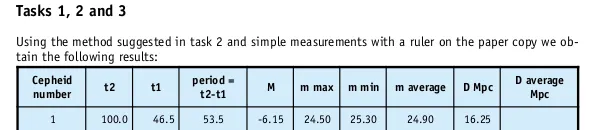
So, if from the previous graph, we obtain that the minimum magnitude occurs on days 46.5 and 100, the period will be 53.5 (the difference).
The maximum apparent magnitude seems to be at 24.5 and the minimum at 25.3. The average m is 24.9.
We use F1 to calculate M and we get: -6.15.
The distance modulus is D = 10^(m-M+5)/5, where m and M are the values of apparent and absolute magnitude, respectively.
If we replace m and M with the previous values, the result is expressed in parsecs. If they are millions, we can divide by one million to get the result in Megaparsecs (Mp).
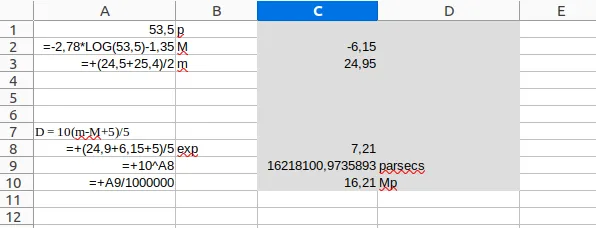
Here I show an image of a spreadsheet. On the left you see the calculation showing the formulas used. On the right, in the shaded part, you see the results of those formulas.
With the given period value, I used F1 to find M. Then I used the values of m min and max to calculate the average apparent magnitude.
To use the distance modulus, I wrote the formula and below I first calculated the exponent. Then I did the power and finally divided by one million.
The result is 16.21 Mp. Galaxy M100 (NGC 4321) is located 52.5 million light-years away, equivalent to the value obtained in this exercise.
According to the ESA exercise book, for that graph the values should be:
THE MILLION-DOLLAR QUESTION
How do we know if this method and the values and formulas used are correct?
There is a long and complex answer, discussed in some detail. I will give here the short answer:
There are two ways to consider the validity of this method:
On one hand, if many Cepheids from the same galaxy are observed, the results should be very similar. Additionally, for nearby stars (Delta Cephei, RS Puppis), the distance can be calculated with other methods, such as parallax.
In practice, professional astronomers do things more complicated. The explanation above is simplistic with the goal of understanding the method superficially. Issues like "extinction", that is, the interposition of dust clouds between the stars and the observers are necessary to correct. For educational purposes we can use a simple spreadsheet, astronomers burn the midnight oil studying and refining methods and use more complex algorithms and formulas. What we haven't said here is that, in addition, the "ladder" method requires other candles like Type Ia supernovae. Other methods are also used: RR Lyrae stars for globular clusters and the Tully-Fisher relation, among others.
Given the above, many significant enigmas remain to be unraveled: quantum gravity, dark matter and energy, the Hubble constant...and how to stretch the wallet to make ends meet...☉
Sources and related links
- Webb and Hubble telescopes affirm Universe’s expansion rate, puzzle persists
https://esawebb.org/news/weic2408/ - JWST Observations Reject Unrecognized Crowding of Cepheid Photometry as an Explanation for the Hubble Tension at 8σ Confidence
Adam G. Riess et al 2024 ApJL 962 L17
https://iopscience.iop.org/article/10.3847/2041-8213/ad1ddd - Cepheid Variable Stars & Distance Determination
https://www.atnf.csiro.au/outreach/education/senior/astrophysics/variable_cepheids.html - Using Leavitt's Law to Find Distances to Cepheid Variables
https://www.youtube.com/watch?v=8esWIinZJ0Y - delta Cephei
http://hyperphysics.phy-astr.gsu.edu/hbase/Astro/cepheid.html#c2 - How do astronomers use Cepheid luminosities to calculate distances?
https://www.astronomy.com/science/how-do-astronomers-use-cepheid-luminosities-to-calculate-distances/ - To find the distance of a Cepheid
https://people.ast.cam.ac.uk/~mjp/example_cepheids.html - Variable Stars: Cepheid Variables – One Key to Cosmic Distances
https://pressbooks.online.ucf.edu/astronomybc/chapter/19-3-variable-stars-one-key-to-cosmic-distances/ - Estimating Distances to Nearby Galaxies
http://spiff.rit.edu/classes/phys240/lectures/cepheid/cepheid.html - The ESA/ESO Exercise Series booklets English - Exercise 2
https://www.eso.org/public/spain/products/education/edu_0064/ - The ESA/ESO Exercise Series booklets Spanish - Exercise 2
https://www.eso.org/public/spain/products/education/edu_0032/
About the images
Image of NGC 5468. NASA, ESA, CSA, STScI, A. Riess (JHU/STScI)