If stars "die" when they run out of hydrogen, could they live forever if it is constantly replenished in an AGN?
Stars have sung the same song since the beginning of the universe: you are born, you fuse hydrogen into helium, you move off the main sequence and finally you are recycled into the cosmos as a molecular cloud. But, under the right conditions, stars can be immortal. The "Fountain of Youth" is not the one (supposedly) sought by Ponce de León in America, nor is it as painted by El Bosco. Paracelso would have a fit if he knew that the "stellar panacea" is hydrogen.
The Theory of Permanent Renewal
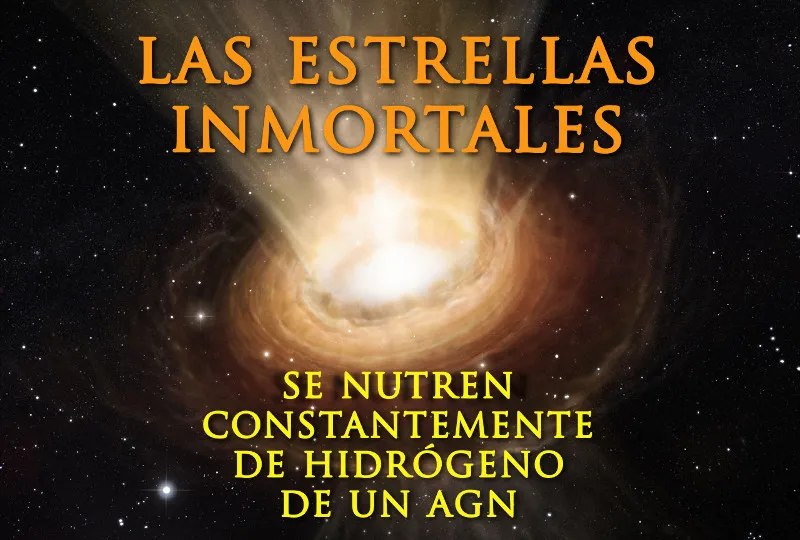
Many galaxies host an active nucleus (AGN), composed of a disk of gas and dust orbiting a supermassive black hole. Although it is an extreme environment, astronomers suggest that some stars in those disks would be immortal.
While these stars convert hydrogen into helium in their cores, they constantly replenish their hydrogen from the surrounding disk. As a result, they never run out of fuel, never leave the main sequence. They do not "die".
Now, a team led by Adam Jermyn explored how these stars can affect the evolution of the disk that surrounds them.
Drinking from the Fountain of Stellar Youth
Jermyn and his colleagues considered disks with short (0.1 million years) and long (10 million years) lifetimes, estimating that these disks could capture 1,000 and 20,000 stars, respectively, from the inner regions of their galaxies. The short-lived ones only contain enough mass to produce 300 of these immortal stars, while the long-lived ones can feed all their 20 thousand stars. In both cases, they are massive stars, about 300 solar masses and have convective cores. The constant churning brings fresh hydrogen to their cores and transports helium to the surface. From there, fierce stellar winds carry the helium-rich gas into the disk, increasing the abundance of that element near the black hole.
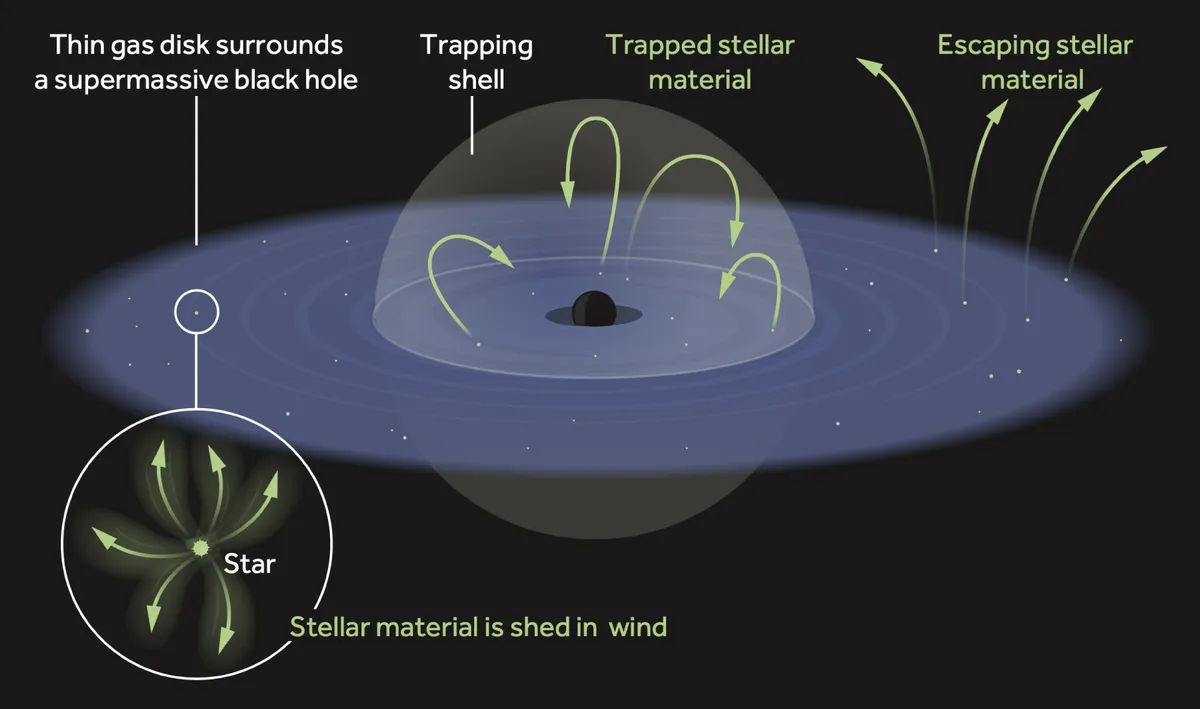
The consequences of this transport are not yet clear: it could rob the immortal stars of their superpowers, since they would burn hydrogen faster than it can be recovered. Measuring the abundance of helium in AGN could improve knowledge about the process.
It is also possible that, since AGN do not remain active forever, as the disk dissipates, the stars expel much of their mass, which "regenerates" the disk, giving it a new boost, until the stars return to the realm of stellar mortality and evolve into black holes.
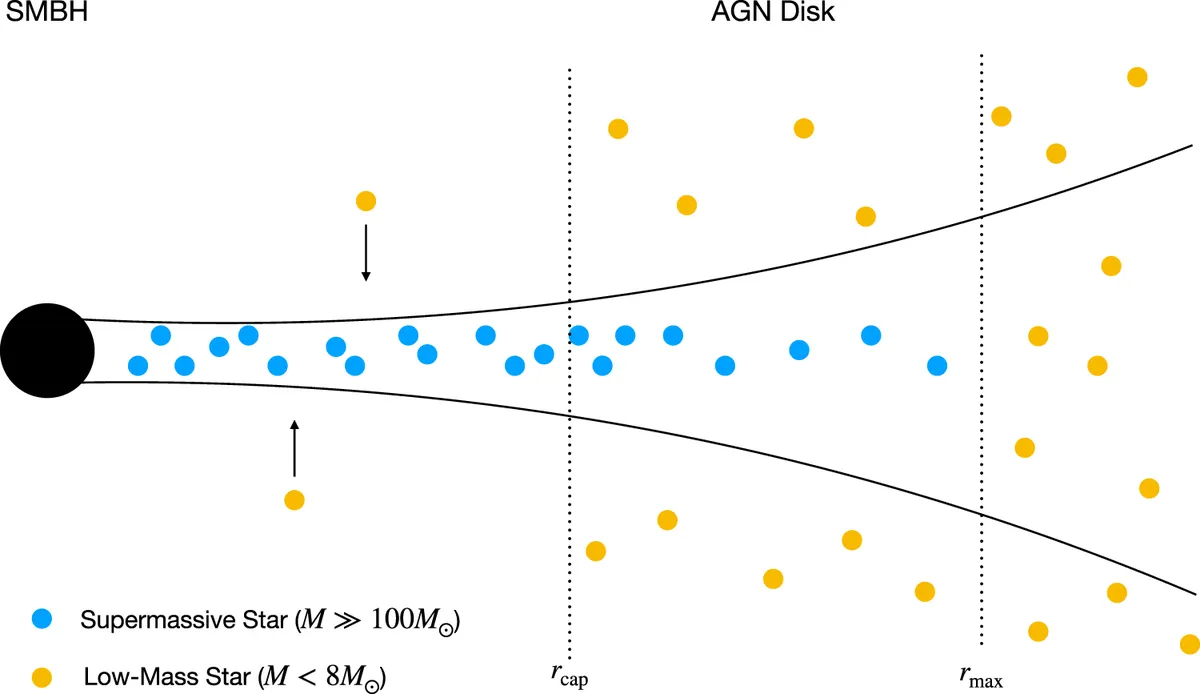
The disk around an active galactic nucleus (AGN) captures most stars within the rcap sector. Stars in the rmax zone grow and become immortal, while those outside the disk or beyond rmax accrete little gas. In blue, stars over 100 Solar masses. In orange, low-mass stars. Jermyn et al. 2022.
The authors of the work speculate about different possible scenarios, including the merger of black holes or neutron stars with immortal stars, giving rise to Thorne-Żytkow objects.
In any case, the term "immortal" is a figure of speech. The process of nurturing stars in AGN with material to fuse could last millions of years, billions, but not forever. The Universe's recipe includes entropy and accelerated expansion, ideal ingredients for a royal heat death.
The authors note that their estimates are uncertain, but it is clear that immortal stars can play an important role in the evolution of the central regions of a galaxy. Future work could explore the consequences of helium-enriched gas in the vicinity of a supermassive black hole. Immortality will be out of our reach, but at least we can live vicariously through these stars!
AGN could be thought of as operating rooms of a stellar surgeon who injects a little Botox into the stars. It rejuvenates the stars, like Hollywood celebrities. But also for stars, death suits them well.☉
Sources and related links
- “Effects of an Immortal Stellar Population in AGN Disks,” Adam S. Jermyn et al 2022 ApJ 929 133.
https://arxiv.org/abs/2203.06187
https://doi.org/10.3847/1538-4357/ac5d40 - The Life and Times of Immortal Stars
https://aasnova.org/2022/05/25/the-life-and-times-of-immortal-stars/
About the images
Illustration of the surroundings of a supermassive black hole at the center of an active galaxy.[ESO/M. Kornmesser]
Fig. 1-2: Jermyn et al. 2022.