From being one of the oldest sciences to the current GOLDEN ERA.
A few years ago, the IAU (International Astronomical Union) published a book on "Great Ideas in Astronomy". One of those ideas is that this science is one of the oldest.
I have noticed that some people misinterpret what that phrase means. That our ancestors could observe the night sky with the naked eye is not enough to call that "astronomy". At most, it could be considered recreational astronomy. But for a minimal definition of science, besides sensory perception, recording is needed. Data is a raw material for scientific research.
Thus, for a minimal scientific astronomy, writing and mathematics are needed to indicate times and distances or angles. The fact that ancient practices included astrology and religion does not prevent us from thinking that part of the task was scientific, at least in the systematic recording of celestial objects.
One of the oldest such star records is the Three Stars Each of the Babylonians, which divided the sky into three parts, and the MUL.APIN, which dates from 1000 Before the Common Era (BCE).
In the 2nd century BCE, Hipparchus made a catalog of 850 stars that would have been the basis for the later Almagest, with 1000 stars, by Ptolemy.
However, this "great idea" that astronomy is one of the oldest sciences, I think should be complemented with another: the three eras.
THE THREE ERAS OF ASTRONOMY AND ITS REVOLUTIONS
From the first records until the 17th century we can think of ancient astronomy. From there to the 20th century, modern astronomy. From the 20th century to the present, contemporary astronomy.
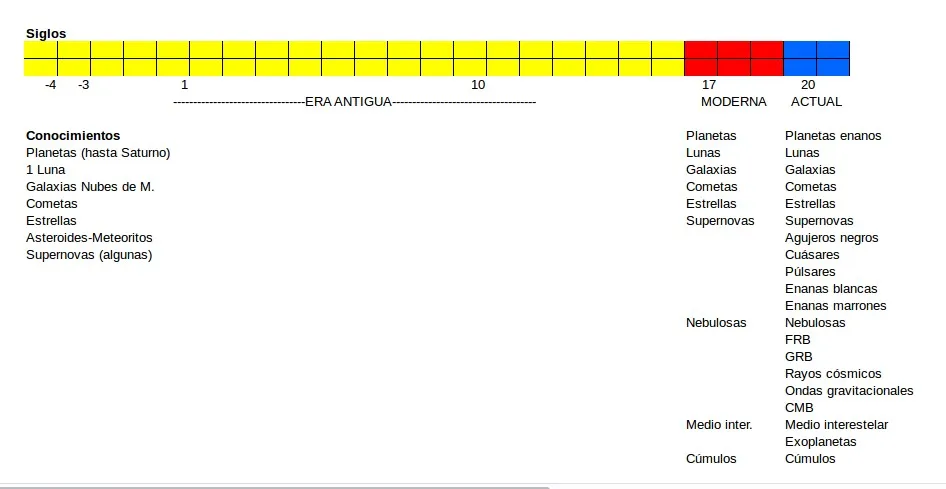
The first era spans thousands of years. What could be known and what could not during that period?
The ancients could only detect objects visible to the naked eye:
In the Solar System, the planets up to Saturn, the Sun and the Moon. Some comets.
Beyond: the Magellanic Clouds and some supernovae visible to the naked eye.
Stars: a great number could be seen, but they were only a small fraction of the Milky Way.
They could not observe:
-The rest of the moons of the solar system: The 4 largest of Jupiter were discovered by Galileo in the 17th century. In total, Jupiter and Saturn possess more than 120 moons.
-Uranus was discovered in the 18th century, Neptune in the following century and Pluto in 1930.
-The "spiral nebulae", later understood as galaxies.
-Globular clusters, pulsars, white dwarfs, brown dwarfs, black holes.
-FRBs, GRBs, cosmic rays, gravitational waves, CMB, interstellar medium.
If we could put all current knowledge, all known astronomical objects, into a single catalog (One Catalog to Rule Them All), then 90% or more of the entries would have been made since the 20th century.
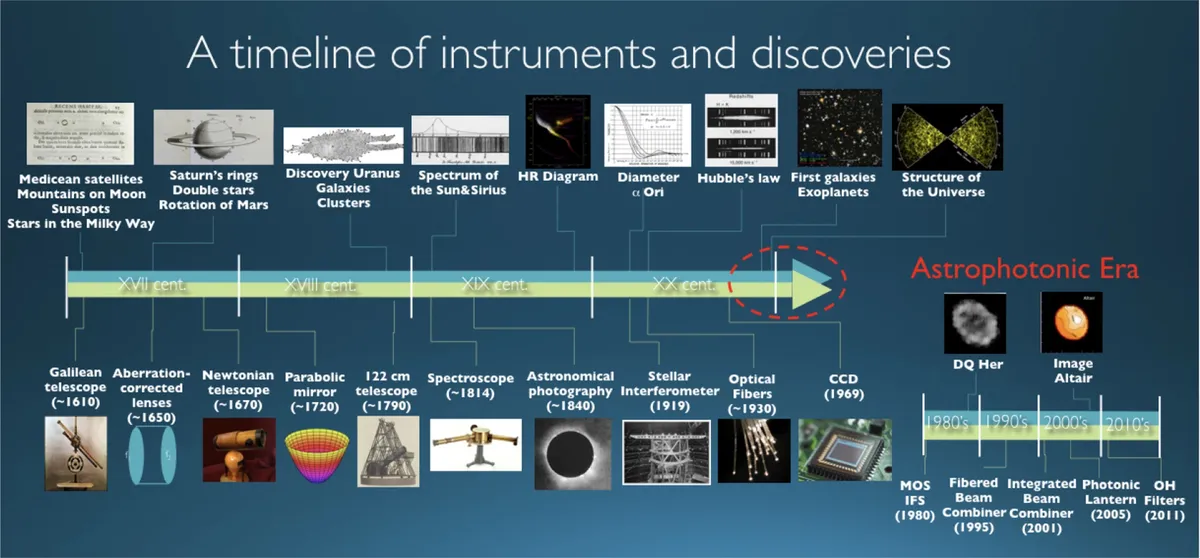
THE REVOLUTIONS
Starting with Copernicus and with the help of Galileo, Kepler and Newton, in the 17th century a paradigm shift began to move from Geocentrism to Heliocentrism.
Furthermore, with the use of telescopes, it became possible to observe fainter, more distant stars (of greater magnitude) and to discover deep-sky objects.
At the end of the 19th century, beginning of the 20th, analog photography emerged, as did spectroscopy, and nuclear theory was developed. A few decades later, digital photography, computing. Space missions and telescopes. Catalogs multiplied exponentially. The number of discoveries increased at a frenetic pace.
But it's not just greater quantity. Also since the 20th century there has been a paradigm shift, a revolution: from the Static Universe to the Expanding Universe. And we are still "riding the wave" of another revolution: from normal matter to dark matter, which is still an open chapter.
Of the Three Eras, we live in the GOLDEN ERA of astronomy. We have the privilege of living in the time of the greatest number of discoveries. In the era of scientific cosmology.
GRAND FINALE
I thought the topic was appropriate to end the year, considering that the data collected with the James Webb Space Telescope made news this 2022.
The great advance in astronomy was not due to us being smarter or more curious than the ancients: the difference is the instruments. Desire is not enough, you need hardware. And theoretical development.
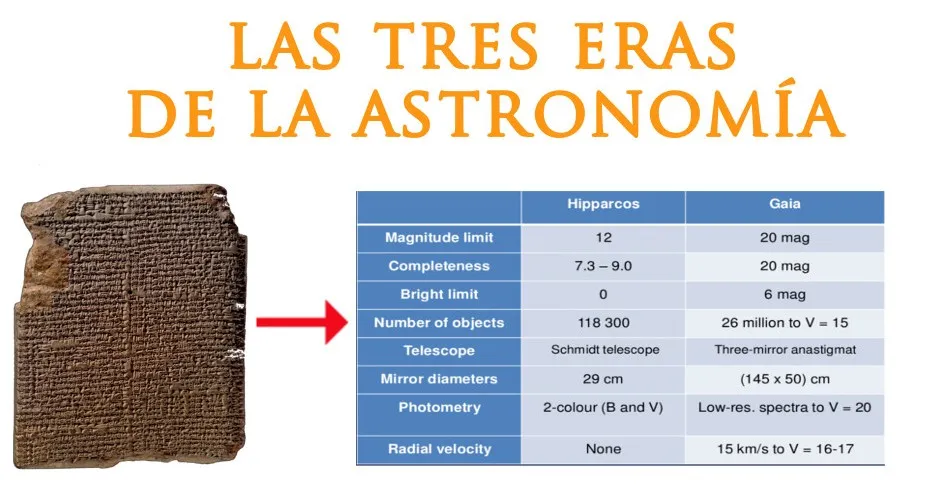
The European Space Agency (ESA) launched the Gaia mission, which is ongoing and is used by astronomers to measure positions and create a new stellar catalog. On its website, ESA says: "The final Gaia catalog will contain complete astrometric data (position, distance, motion) and photometric data (brightness and color) for more than a billion stars, as well as additional information including source classification and lists of variable stars, multiple systems, and stars that possess exoplanets. For more than 150 million stars there will be radial velocity measurements—the speed at which stars move away from or toward us."
In addition to telescopes, other devices allow astronomers to acquire analog data from the cosmos and record it in digital form (prisms, cameras, and computers). Its analysis is a real challenge due to the flood of data. Increasingly, professionals use neural networks to process information, and computational simulations are already commonplace.
In short, contemporary astronomy has almost nothing to do with the ancient one. Just as it is necessary to value our cultural heritage produced by different cultures throughout history, it is also necessary to understand the extraordinary advance of the present.
Paradigms in the past lasted millennia. Today, the Standard cosmological model—less than a century old, except for Newton's contributions—is already being questioned. This modern anxiety is a product of the acceleration of discoveries due to the increase in data.
If there are between 10^11 and 10^12 stars in our galaxy and a similar number of galaxies exists, then there will be between 10^22 and 10^24 stars in the cosmos. Almost everything remains to be discovered!
In the Universe, December 31 is not a special date. Nothing begins or ends. But for us, by our calendar, it marks the end of one revolution and the start of another. The revolution of the Earth around the Sun.
Virtually, then, I raise my glass to wish for a "revolutio", one more turn for everyone, a good year 2023. Cheers!☉
Sources and related links
- Minardi, S., Harris, R.J. & Labadie, L. Astrophotonics: astronomy and modern optics. Astron Astrophys Rev 29, 6 (2021). https://doi.org/10.1007/s00159-021-00134-7
https://link.springer.com/article/10.1007/s00159-021-00134-7 - A HISTORY OF ASTROMETRY - PART I
https://sci.esa.int/web/gaia/-/53196-the-oldest-sky-maps - Big Ideas in Astronomy: Astronomy Literacy Booklet Released by IAU Commission C1
https://iau.org/news/announcements/detail/ann19029/
About the images
By Anagoria - Own work, CC BY 3.0, https://commons.wikimedia.org/w/index.php?curid=23144261
Gaia vs Hipparcos http://rcsstewa.com/wp-content/documents/workshop/day2/2m.pdf