A social history of the stars, chapter 1.
Stars do not have biographies. They are not people, nor living beings. Stars do not live or die, they are inert objects like air or water. But they do have a "social life" worth knowing. We will begin here to tell the social history of the stars.
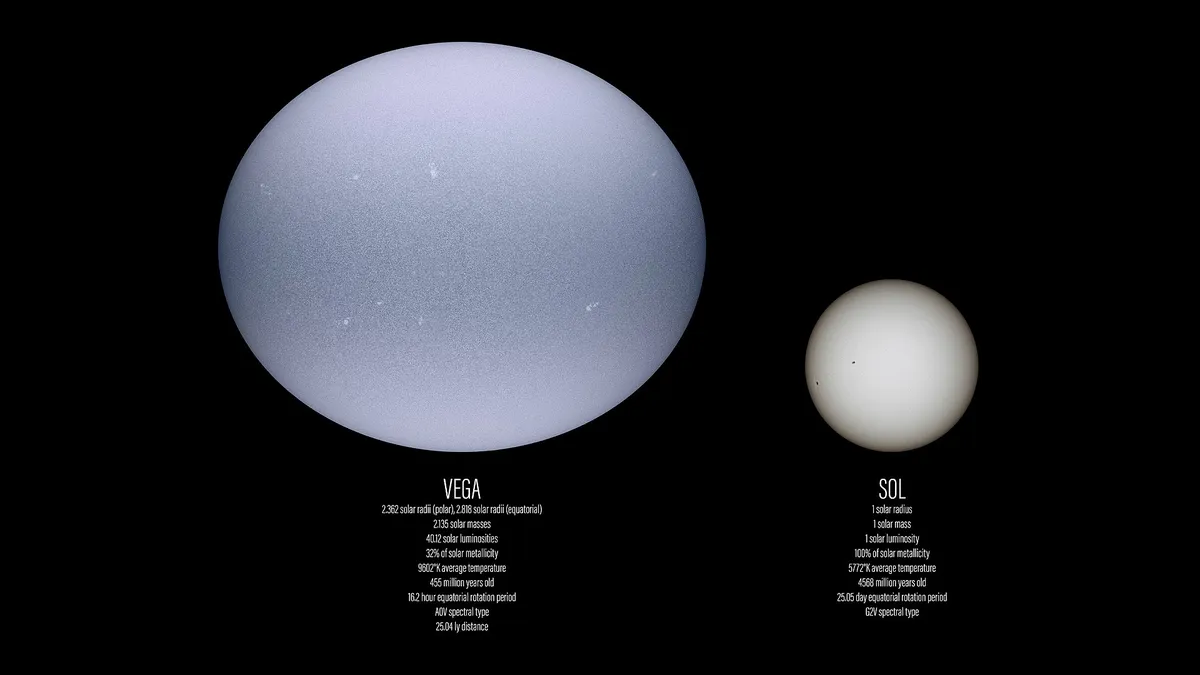
Vega is the brightest star in Lyra, which is why it is also known as Alpha Lyrae. It is the fifth brightest star in the night sky and the third in the northern hemisphere (after Sirius and Arcturus). It lies about 25 light-years away and has twice the mass of the Sun. Its spectral classification is A0V, with an absolute magnitude of 0.58, low metallicity and a visual magnitude of 0.03. Its celestial address is located at 18h 36m 56.33s; +38°47′01.291″.
Vega was the pole star in 12,000 BCE and will be again in 11 thousand years. Due to its brightness in the northern sky, it has been observed and recorded by ancient civilizations and used as a reference. Its name comes from Arabic and was translated as "the descending eagle/vulture".
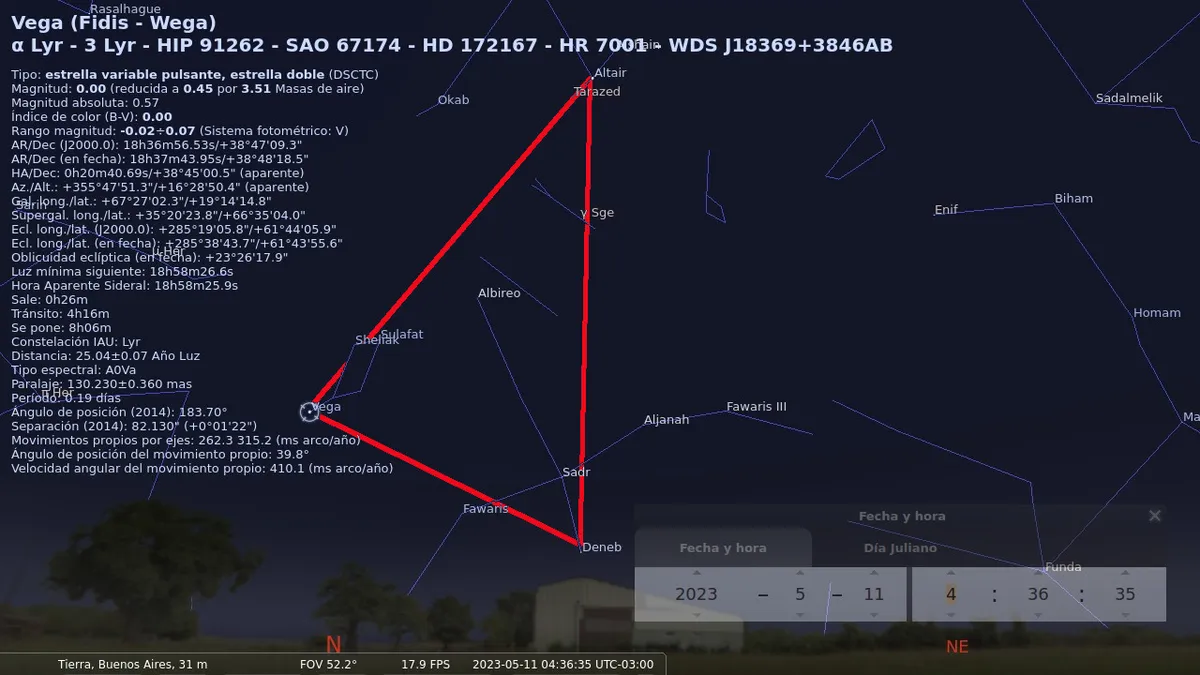
It is part of a famous asterism used in the northern hemisphere, the Summer Triangle, which imaginatively connects the star with two other very luminous ones: Deneb and Altair.
THE REFERENCE STAR
Perhaps because it is very bright, easy to see, and with an apparent magnitude very close to 0, it has been used as a reference.
In astronomy, photometric systems are used to measure the magnitude of an object as it passes through a filter. One of the best known is the UBV or Johnson system. The "zero point" in such a system is defined as the magnitude of an object that produces 1 count per second in the detector. It is used to calibrate and standardize the system. Vega has been used as the calibration star for the zero-point magnitude, although it has become common to use several stars instead of just one.
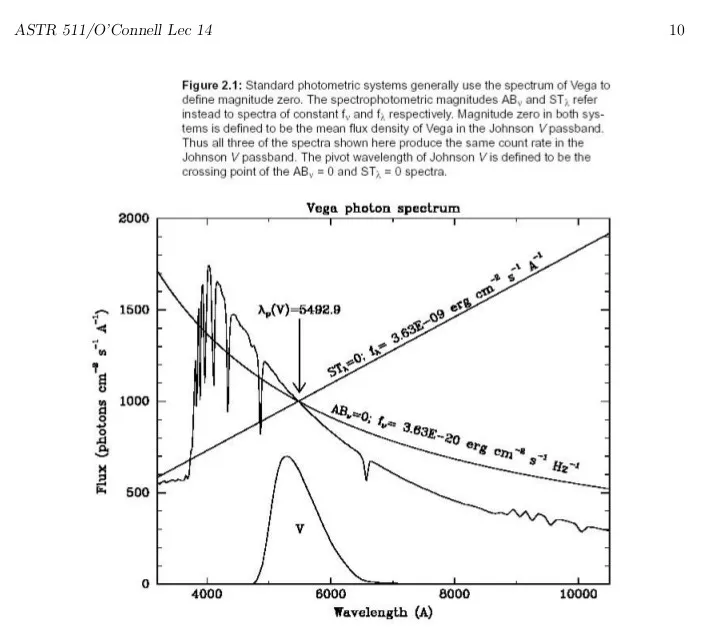
Standard photometric systems use Vega's spectrum to define magnitude zero. The AB and ST spectrophotometric magnitudes refer to the spectrum of flux density in frequency, fν, and wavelength, fλ, respectively. Magnitude zero in both systems is defined as the average density of Vega in the Johnson V band. Thus, the three spectra shown here produce the same rate in the V band. The pivot wavelength of the V band is defined as the intersection point of ABν=0 and STλ=0.
THE FIRST ASTROPHOTOGRAPH
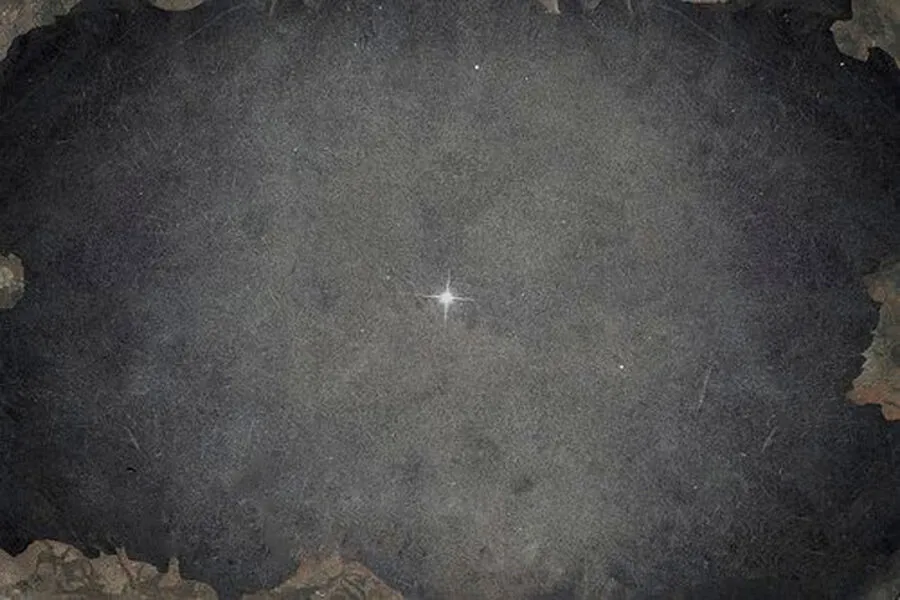
On the night of July 16-17, 1850, Vega was the first star -after the Sun- to be photographed. James Adams Whipple and William Bond used Harvard's 15-inch refractor to expose the star's light for 20 minutes onto a plate covered with photosensitive material.
THE FIRST SPECTRUM
In August 1872, Henry Draper selected Vega as the first to have its spectrum taken, revealing the classic hydrogen absorption lines known as the Balmer Series. That sequence of lines results when electrons in a hydrogen atom fall to level 2, close to the nucleus.
Based on its hydrogen lines, Vega was used to identify and classify similar stars and has served as a standard for zero-magnitude stars. It is, however, a Delta Scuti type variable.
THE FUTURE OF VEGA
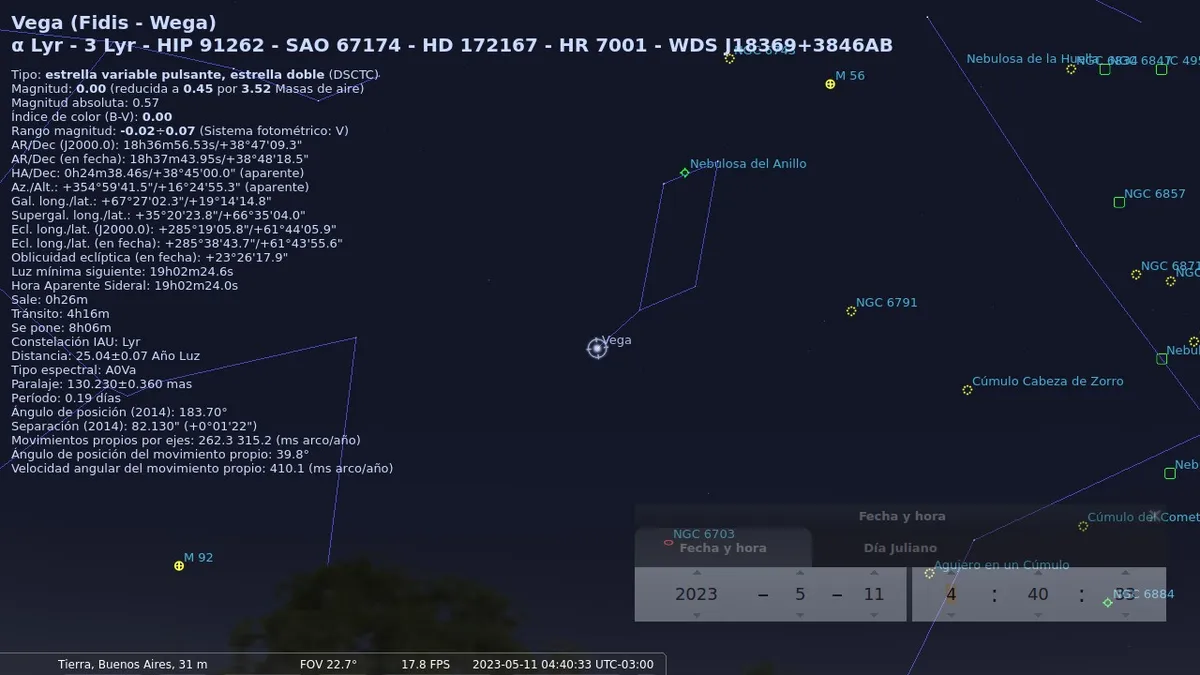
Very close to the star, it is easy to find a planetary nebula known as the Ring Nebula (M57). Vega's future is exactly that. Young stars rotate faster than old ones. Vega does so every 12.5 hours, while the Sun does so every 27 days. Due to this rotation, it is flattened at the poles and has a temperature difference between the polar and equatorial regions. It is about 455 million years old and has about the same amount left. Although it is much younger than our Sun, it is halfway through its equilibrium cycle, on the main sequence, just like the star we see during the day. Their destinies are similar: they will go through a planetary nebula phase and end up as white dwarfs.
It is known that there is a ring of dust and gas around the star, so it is possible that it has a planet or a proto-planet or the material for one to form.
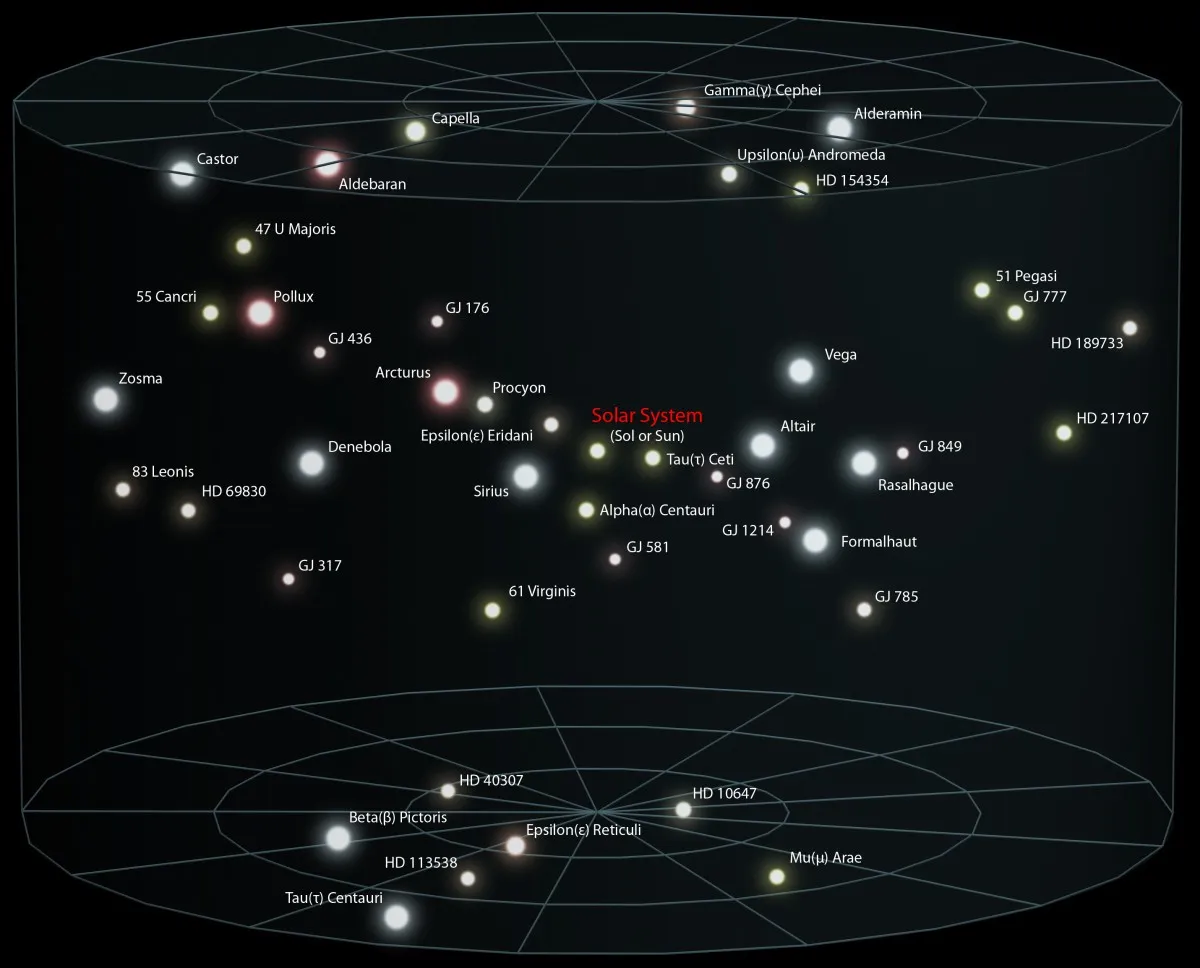
Vega is part of a stellar grouping, a group of gravitationally bound stars, the Castor Moving Group, which includes the star of Gemini, as well as Vega, Fomalhaut and others.
IN POPULAR CULTURE
There are records indicating that the Chevrolet Vega model owes its name to the famous star. There is a press advertisement, currently offered for sale on sites like eBay, advertising the model alluding to the star. It was also used as a reference in works such as This Immortal by Roger Zelazny.

In the literary novel and film version of Contact by Carl Sagan, the message received comes from the star Vega. In this regard, a couple of color details:
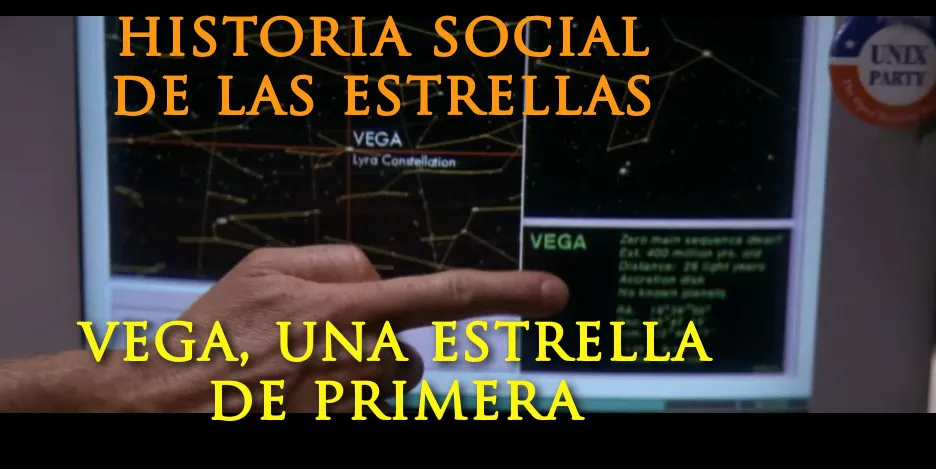
The image used at the beginning of the post, taken from the movie, shows the hand of one of the scientists pointing at Vega on a digital map. I always wondered if that hand movement, if that sequence, had some "hidden" meaning, as the gesture seems unnecessary or forced. Two things occurred to me: a certain resemblance to the hand -with the index finger extended- from the movie E.T. The Extra-Terrestrial. Or, a play on words with the protagonist's surname: Arrow-way.
By the way, in that movie, the blind scientist with high auditory ability is named Kent Clark, the reverse of Superman's alter ego.
THE AMERICAN IMPRINT
Paraphrasing George Orwell: "All animals are equal, but some animals are more equal than others." Stars belong to no one, or to everyone. But culturally we have used the stars unequally. American culture "appropriated" Vega, perhaps because it combines several elements in which they believe they see themselves reflected:
-It is a star easily visible in the northern hemisphere.
-It was thought of by the Arabs as an eagle, a symbol adopted by American culture.
The first daguerreotype and the first spectrum were made by scientists from that country. Chevrolet is an American factory. Sagan was an astronomer from that same country.
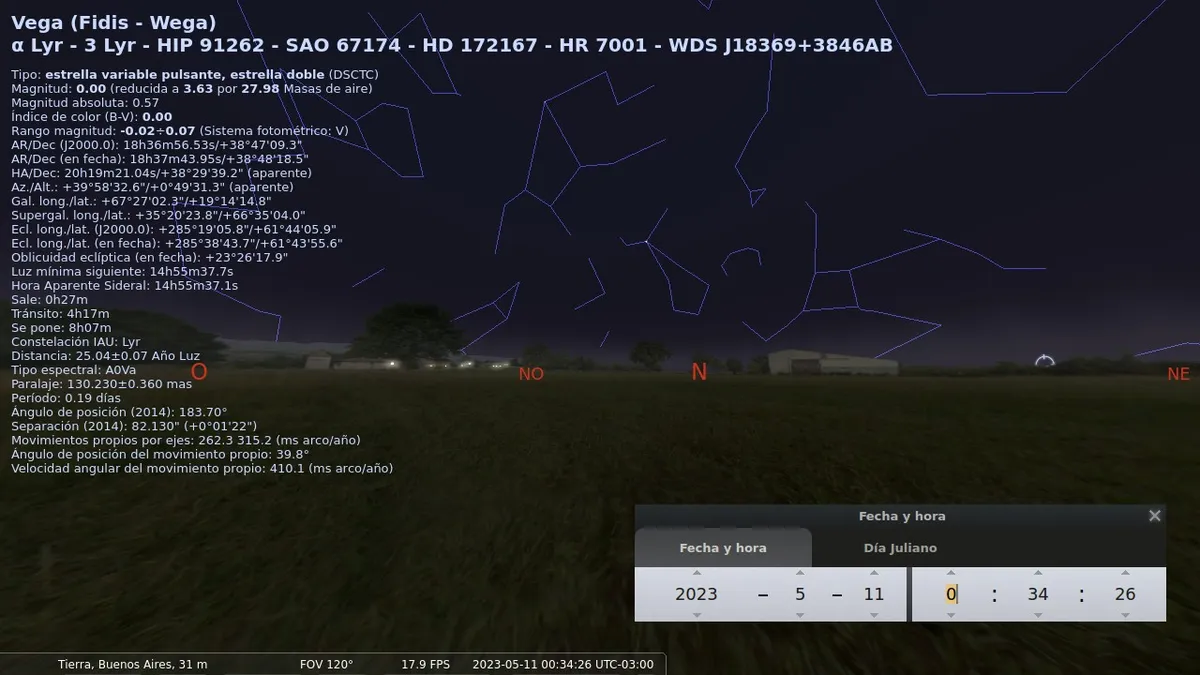
From the southern hemisphere, particularly from Argentina, a good time to observe Vega is in May. It rises around midnight and sets 8 hours later. Looking north, at some point we can see the "triangle" which in our case is not a summer one. The problem is that in large cities it is difficult to observe, as it rises little above the horizon.
It's good to remember, to conclude, that flags can have stars, but stars don't have flags.☉
Sources and related links
- VEGA, THE STAR AT THE CENTER OF EVERYTHING
https://skyandtelescope.org/astronomy-news/vega-the-star-at-the-center-of-everything/ - Castor Moving Group
https://en.wikipedia.org/wiki/Castor_Moving_Group - The Castor Moving Group: The age of Fomalhaut and Vega
D. Barrado y Navascues (MPIA)
https://arxiv.org/abs/astro-ph/9905243 - O'Connell. "Magnitude and Color Systems" (PDF). Caltech.
https://web.ipac.caltech.edu/staff/fmasci/home/astro_refs/magsystems.pdf - Zero point (photometry)
https://en.wikipedia.org/wiki/Zero_point_(photometry) - Am. J. Sci. III, XVIII, 420, 1879
https://archive.org/details/mobot31753002152962/page/420/mode/2up
Barker, George F. “On the Henry Draper Memorial Photographs of Stellar Spectra.”
Proceedings of the American Philosophical Society, vol. 24, no. 125, 1887, pp. 166–72.
JSTOR, http://www.jstor.org/stable/983130. Accessed 24 Dec. 2022
About the images
https://earthsky.org/astronomy-essentials/barnards-star-closest-stars-famous-stars/
Stellar neighborhood
By Fobos92 - Own work, CC BY-SA 3.0, https://commons.wikimedia.org/w/index.php?curid=18658646
Sun - Vega comparison
By Matúš Motlo - Own work, CC BY-SA 4.0, https://commons.wikimedia.org/w/index.php?curid=112665109