Traveling through the universe requires a great deal of time, even if you travel faster than light.
We have said here that it is unlikely that beings from other worlds visit us. This is so for two reasons:
1-The universe is very large. The distances between stars and between galaxies are enormous.
2-You cannot travel at the speed of light.
The consequence of these two premises is glimpsed with mathematics:
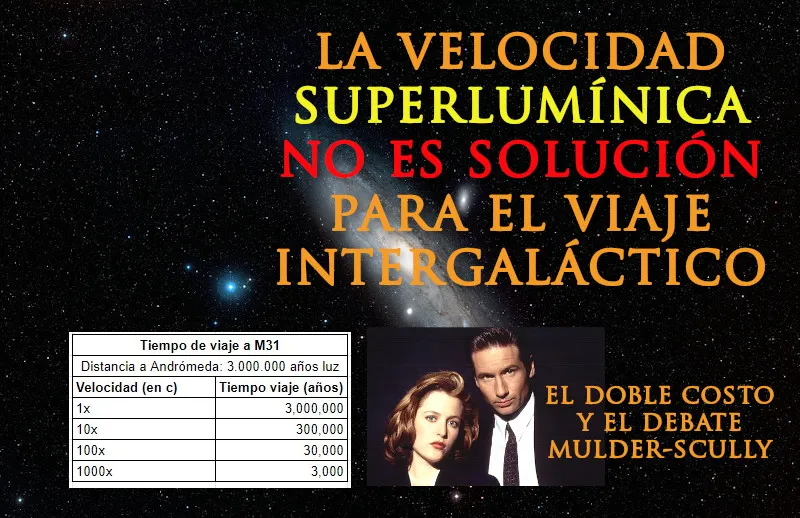
Even traveling at 99.999% of the speed of light, the travel time to the Andromeda Galaxy would be 3 million years.
Thus, the two characteristics of reality mentioned generate the problem of the double cost:
We know the relation v=d/t, by which velocity equals distance over time. If we keep the distance constant, then, by increasing the velocity, the time decreases. However, by increasing the velocity, the required energy also increases.
Therefore, one might think that when traveling to space, one pays one of two costs: either the energy cost is high, you travel fast and the travel time is short. Or the energy cost is low, you travel slow and the travel time is very high.
But given the distances and the speed, for most cases, what ultimately happens is that a lot of energy is spent and despite that, it takes a long time to travel. A double cost.
THE FOX MULDER SOLUTION
The X-Files had two main protagonists: Fox Mulder, who believed in myths and legends; and Dana Scully, who was a skeptic. These fictional characters serve as a model of thinking for real people. I read here and there that to solve the problem indicated before, the Fox Mulders of life use science as if it were magic. A phrase by Arthur Clarke in his novel "Childhood's End" is well known, in which he states that an advanced technology is indistinguishable from magic. The problem is that sometimes what is presented as science is actually a spell.
Thus, lovers of science and science fiction sometimes lose their sense of reality and are carried away by their desires. So they take as a written truth that certain theoretical developments would allow traveling faster than the speed of light. And Voilà!, problem solved.
The first drawback is that the supposed theoretical solution is impracticable, unless an unknown type of exotic matter exists, is discovered, and can be manipulated. As I said, it's magic. The second issue is the one I want to address here today: even if it were possible to travel faster than the speed of light, the problem IS THE SAME. That is: the solution solves almost nothing. Let's see.
REALITY, ACCORDING TO DANA SCULLY
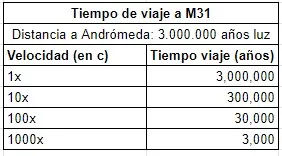
Given the relation between speed and time indicated before, then if we travel x times faster, we would take x times less. Therefore:
If we travel at 1x the speed of light from M31 to the Milky Way, the travel time would be 3 million years.
If we traveled at 10x, that is, ten times faster than the speed of light, we would take 10 times less: 300 thousand years.
If we travel at 100x, the travel time would be 30 thousand years.
If we travel at 1000x, the time would be 3 thousand years.
*Note: we are not considering relativistic effects for possible crew members.
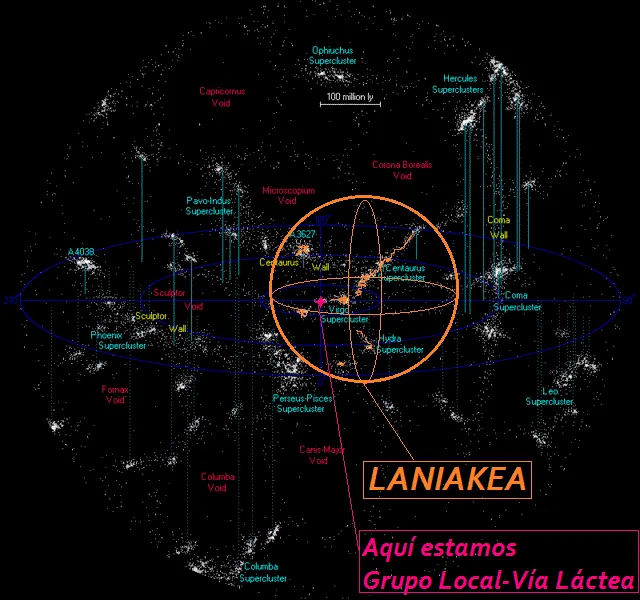
Let's remember that the faster you go, the more energy. In these three examples, the energy expenditure is impossible to calculate and despite that, the travel time remains very high. Andromeda is a nearby galaxy, as it is part of the Local Group. If traveling 1000 times faster than the speed of light is not a solution for traveling to a nearby galaxy, then it will not be a way out for all the more distant ones, that is, for 99.9999999999% of the universe.
THE PROBLEM OF TRAVEL TIME
What I have not specifically addressed in other posts is why the longer time makes long journeys impracticable.
If we think about manned travel, in addition to the energy to propel the ship, we would have to add that the greater the mass, the greater the energy required. If a crew is included, such biological beings will need a breathable atmosphere, food, water, and energy to use instruments.
If the travel time is greater than the average biological life, the crew would die during the journey. Cryogenic hibernation is fantastic for telling fictional stories, but not for maintaining biological life for thousands of years.
Beings from other worlds would have a biology different from ours and therefore, a longer or shorter lifespan. But living thousands or millions of years would turn them into gods. Postulating that is the same as praying. Additionally, if there are living beings on the ship, the acceleration and deceleration must be very slow, otherwise Newton's First and Third Laws would kill those creatures due to the enormous G-forces. This is important because, even if one could travel at the speed of light, in which case no time would pass for the astronauts, one could not travel at such speed for the entire journey, but only for a part.
If the ships were unmanned it would be more logical. Likewise, what is to be expected for intelligent beings is that such ships DO NOT HAVE LIGHTS. Why would they have them, except to attract the attention of ufologists?
There are several reasons linked to technological obsolescence (TO):
TO1: If the travel time is very long, it is to be expected that during the journey a much better technology will be developed, making the technology used in the travel obsolete.
OT2: 40 years ago we used floppy disks (floppy disks). 20 years ago, compact discs and later DVDs. Today we use SSDs and the cloud. If I gave you a floppy disk, would you know how to read that information? Now let's think the same but not with 4 decades of difference, but with 4 millennia.
OT3: inert objects do not die because they have no life. But they break. Onboard computers and instruments do not last forever. If the journey lasts hundreds or thousands of years or more, the devices will eventually stop working.
THE UNIVERSAL HIDE-AND-SEEK GAME
When I was a kid, my mother sent me to a gym whose teacher had unorthodox methods. He taught kung-fu, but first he would have his students go through exercises like the following: several students, in their martial arts clothes, barefoot, enter a room and stand apart. Then the light is turned off, the room goes dark. The goal is to move towards the opposite wall, without the others hearing us. By the sound, the others can detect us and if they do, it's enough for them to touch us for us to have to stand still. Those who manage to advance the most are the winners.
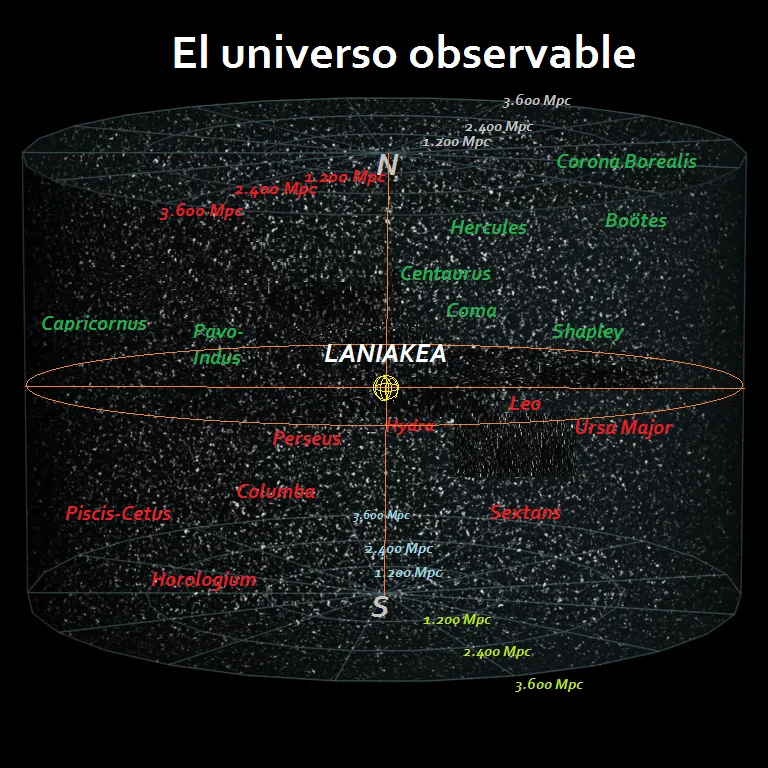
In the universe, we play the opposite: we want to "make contact." But the rules of the game make the task difficult for us: the universe is huge, we cannot travel at the speed of light. Even if we could, the travel times would be very high even to nearby galaxies. And on top of that, the universe is expanding.
CONCLUSION
The Fox Mulders of life offer supposed magical solutions and generate false expectations. If reality is different from what we know, we will find out. But even if we could travel faster than the speed of light, it is not a solution for intergalactic travel.
In Star Wars or Star Trek, traveling faster than light is as easy as pressing a button or giving an order to the furry companion of the Millennium Falcon. It's movie magic. It's fiction.
We Dana Scullys don't want to lie to people or to ourselves. We wish there was life out there, that we could discover intelligent beings. It would be great. But, how possible is it? Not very, unfortunately.
However, there is an optimistic consequence: if, as we have said on other occasions, the travelable sphere around Earth is, for example, 200 light-years, then the number of potential worlds with life and intelligent civilizations must be a very short list. Scientifically investigating such worlds, from a distance, in search of biological or technological markers is a much better method than praying or analyzing blurry images and implausible stories.
There must be a truth out there. But first we have to start at home.☉
Sources and related links
- Traveling through space faster than light is not science fiction: there are physicists working seriously on it
https://www.xataka.com/investigacion/viajar-espacio-rapido-que-luz-no-ciencia-ficcion-hay-fisicos-trabajando-seriamente-ello-1 - The "travelable sphere" of the universe
https://www.noticiasdelcosmos.com/2021/12/la-esfera-viajable-del-universo.html
About the images
By JA Galán Baho - Own work, CC BY-SA 4.0, https://commons.wikimedia.org/w/index.php?curid=49470400
By JA Galán Baho (original design by Andrew Z. Colvin) - Own work, CC BY-SA 4.0, https://commons.wikimedia.org/w/index.php?curid=35127424
By Andrew Z. Colvin - Own work, CC BY-SA 4.0, https://commons.wikimedia.org/w/index.php?curid=71065238
https://esahubble.org/images/heic1112f/
ESA/Hubble & Digitized Sky Survey 2. Acknowledgment: Davide De Martin (ESA/Hubble)