Hubble's Law and the velocity-distance relation.
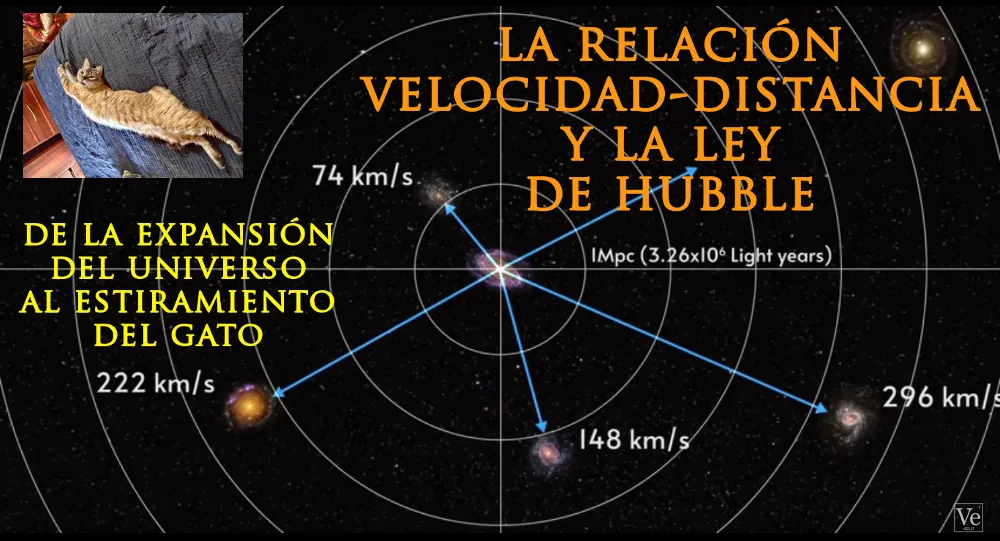
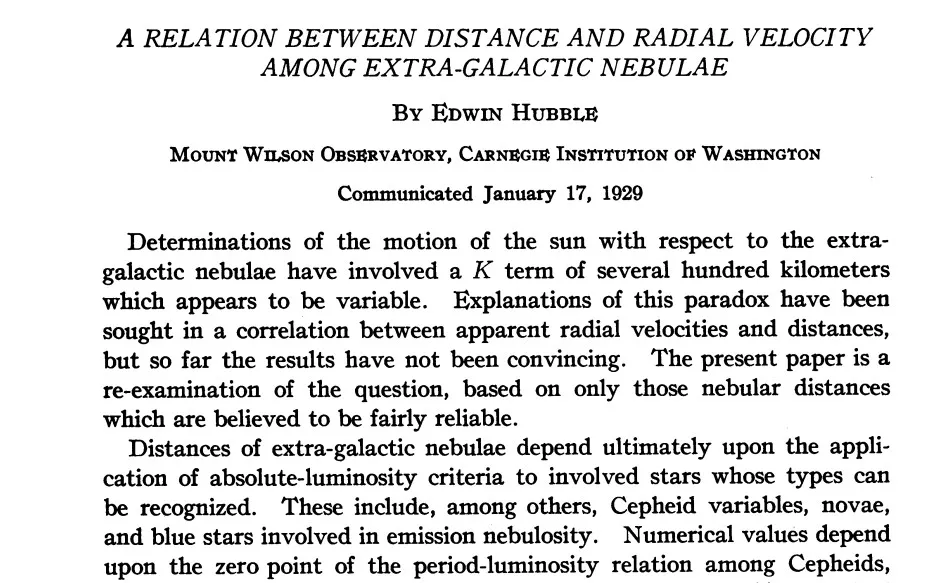
Edwin Hubble made extraordinary discoveries: he ended the debate about spiral nebulae, definitively detecting stars in those nebulae and calculating the distance, thanks to which -just a century ago- we knew there were other galaxies. He also made a first morphological classification of galaxies and found the famous velocity-distance relation. The latter was published on January 17, 1929.
Through methods for measuring distances, like Henrietta Leavitt's Cepheid variables, the distance to galaxies could be calculated, and through the Doppler effect, their recession velocity.
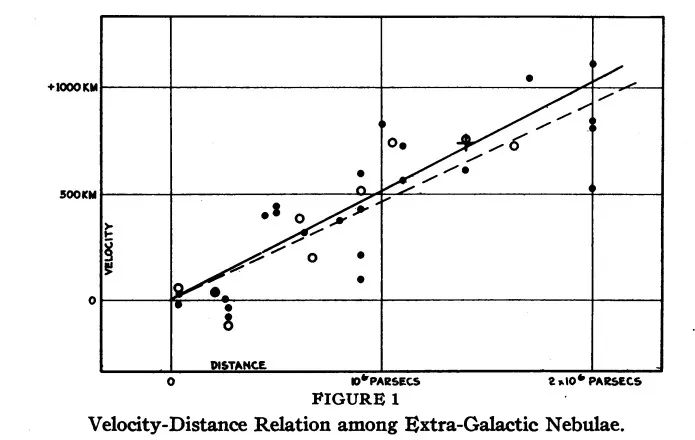
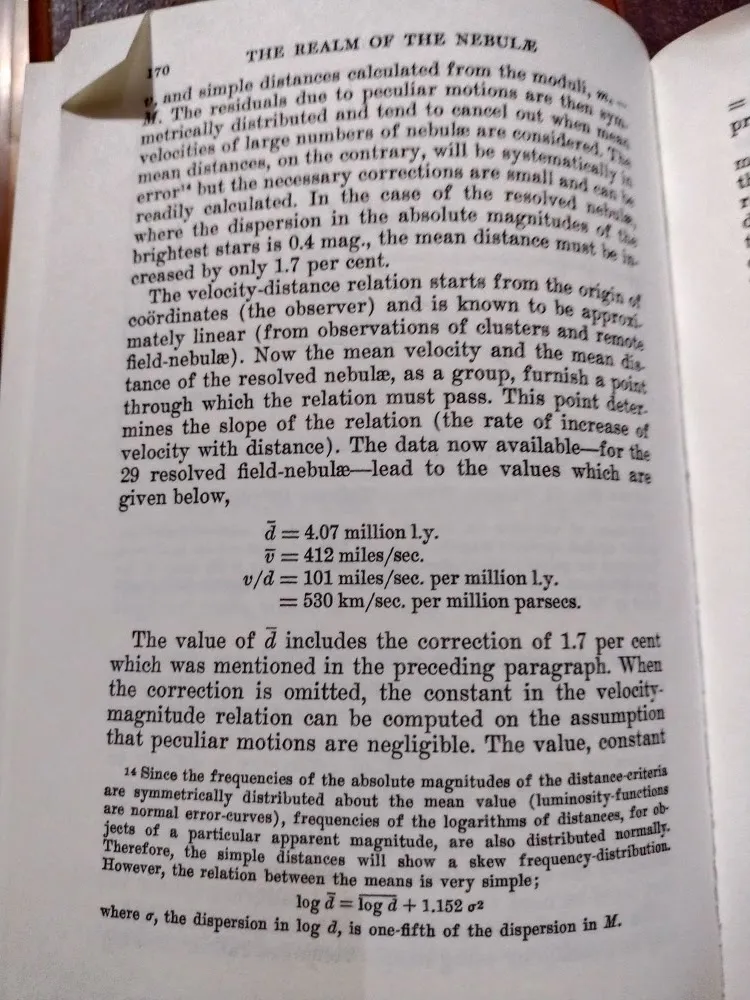
Hubble found that the farther away galaxies were, the greater the speed at which they moved away from each other. Taking a sample of 46 galaxies, he arrived at a constant value for that linear relation. That initial value was much larger than the one used today: 500 km/s/Mpc. A value much closer to the current ones was achieved by Hubble's successor, astronomer Allan Sandage in 1958: 75 km/s/Mpc. Today, that value is calculated with two methods that yield results 10% different, between 68 and 74 km/s/Mpc. 70 is usually used as an average value.
From the velocity-distance relation, Hubble's Law was developed, today known as the Hubble-Lemaître Law.
THE EXPANSION OF THE UNIVERSE
Contrary to what it may seem, Hubble in his famous 1929 paper did not attempt to explain that velocity-distance relation as an expansion of the universe. On the contrary, the universe model used by astronomers of the time was De Sitter's, which was static.
This forced a revision of the model. Then, Georges Lemaître recalled that he had made a proposal: a universe of radius increasing as a function of time. Below I indicate links to the articles by Hubble and Lemaître, as well as an explanatory text about the discovery of the expansion.
DIFFERENCE BETWEEN VELOCITY-DISTANCE RELATION AND HUBBLE'S LAW
I will take the definitions from Ian Ridpath's dictionary:
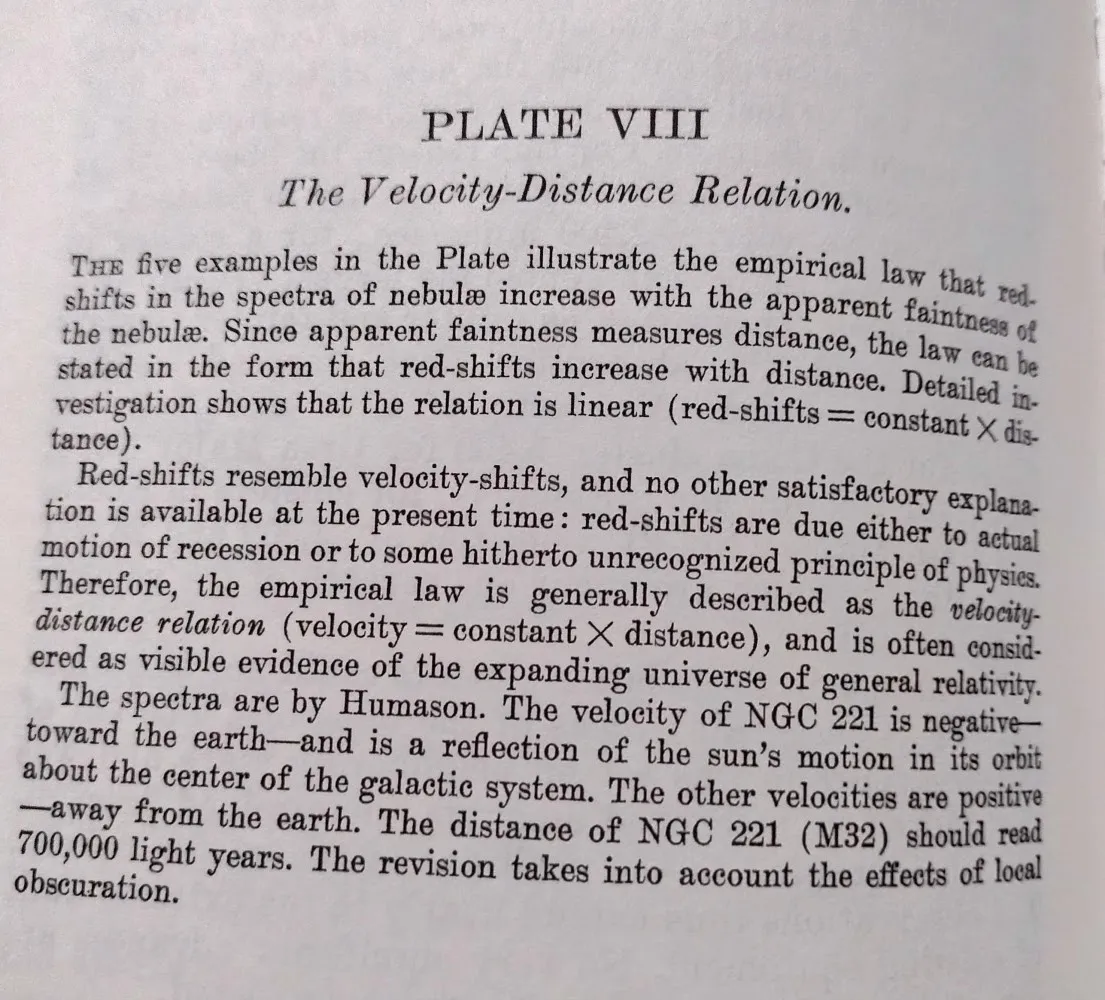
Velocity-distance relation: relation between the recession velocity of an extragalactic object and its distance from the observer. In a universe obeying the cosmological principle, the relation is precisely Hubble's Law. Unlike the redshift-distance and redshift-magnitude relations, the velocity-distance relation is not affected by space-time curvature.
Hubble's Law: Law governing the expansion of the Universe. According to this law, the apparent recession velocity of galaxies is proportional to their distance from the observer. In mathematical terms, v=H0*r, where v is the velocity, r is the distance and H0 is the Hubble constant.
Redshift-distance relation: Formula relating the observed redshifts of an extragalactic object to its distance in the expanding Universe. In Big Bang theory, this relation is linear and appears as a straight line on the Hubble diagram. The relation is not valid for objects so close that their mutual gravitational interactions affect their motions (for example, galaxies in a cluster), nor for objects so distant that the relation is affected by space-time curvature.
ANALOGIES FOR A SIMPLE EXPLANATION
Hubble's Law implies that, taking current data, galaxies that are 1 Megaparsec away (3.26 million light-years) recede at 70 km/s. Galaxies that are 2 Mpc away will do so at 140 km/s and so on. That is, there is a constant, H0, of value 70 km/s that accumulates for each Mpc.
It is common to use two analogies to explain the expansion of the universe and the different speed of galaxies as a function of distance. One of those analogies is the inflating balloon. We take a balloon, mark several points on it (which will be our galaxies) and then inflate it. Doing so, we should notice that the farthest points move away from the others more quickly than the rest. The other very used example is that of a cake growing in the oven, inflated by yeast.
These analogies have the problem that it is difficult to carry out the experiment and notice the different speed of recession.
THE SPREADSHEET UNIVERSE
I will use a spreadsheet to show how an elastic band would expand and how we could calculate its speed. First, it is necessary to make some clarifications:
1-In the following thought experiment, we will assume an elastic band stretches longitudinally, to the sides. The Universe expands in all directions.
2-An elastic band is made of known matter. The Universe is not known what it is made of.
This second clarification is fundamental to avoid mistaken ideas, like that of the rigid rod. I refer to the idea of using a very rigid rod to transmit information faster than the speed of light.
That said, let's get to our point:
Let's say I have an elastic band of length L. We will make marks on the elastic band. If L=10, we will mark after each unit. So we will have marks at L=1, L=2, etc.

Then we take the elastic band by its ends and pull "outward" for one second. Let's say the elastic band increased by 10%. If before it measured 10, now 11.
That unit we added was not added at the beginning of the elastic band, nor at the end, but all along the elastic band. To help us think, we can do something simple: we take what was added, 1 unit, and divide it into 10 parts (0.1).
Now we add those portions of 0.1 after each original mark. And it will look like this:

If we now calculate the "stretching" speed of the elastic band for each point, we will see that:
The original distance between point 1 and 2 was 1. Then, the distance became 1.1, since we added 0.1 before point 2.
If we do the same between 1 and 3, the distance will be 1.2; since we added two portions of 0.1 in between.
And so on. Note that the speed between 2 and 3 is the same as between 1 and 2, so the speed depends on the distance, not on the position. This means that for a galaxy located at 10, point 1 is the one moving away; while for point 1, galaxy 10 is the one farthest away.

HOMEWORK
I leave homework as school teachers do. Apply what you have learned here to the well-known phenomenon of Cat Stretching. Perhaps you will win an Ig Nobel Prize.☉

Sources and related links
- How One Supernova Measured The Universe
https://www.youtube.com/watch?v=ljoeOLuX6Z4&ab_channel=Veritasium - The discovery of the expansion of the universe
https://forum.lawebdefisica.com/blogs/jaime-rudas/316774-el-descubrimiento-de-la-expansi%C3%B3n-del-universo - A relation between distance and radial velocity among extragalactic nebulae
https://www.pnas.org/content/pnas/15/3/168.full.pdf - A homogeneous universe of constant mass and increasing radius accounting for the radial velocity of extragalactic nebulae
https://articles.adsabs.harvard.edu/cgi-bin/nph-iarticle_query?1927ASSB...47...49L
If I touch my friend with a stick more than one light-second long, does the information travel faster than the speed of light?
About the images
The Realm of the nebulae, Edwin Hubble, Yale University Press, 2013.