A study about nothing: The case of the failed supernovae.
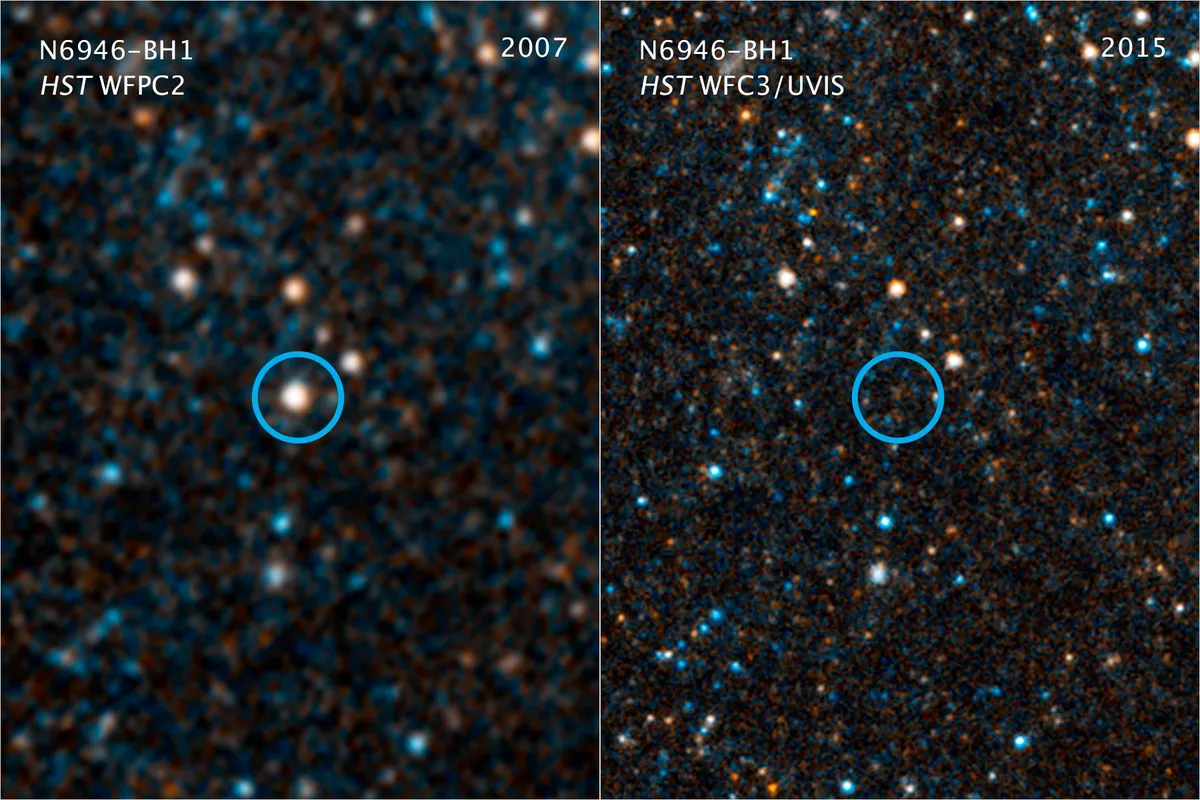
In 2015 the star N6946-BH1 disappeared. It was a red supergiant in a distant galaxy 20 million light-years away. Stars with more than 8 solar masses are supposed to lose their balance and collapse as Type II supernovae, due to core collapse. But those that are very massive might skip the supernova explosion and turn into black holes without the expected brilliance, like a happy birthday without cake or candles.
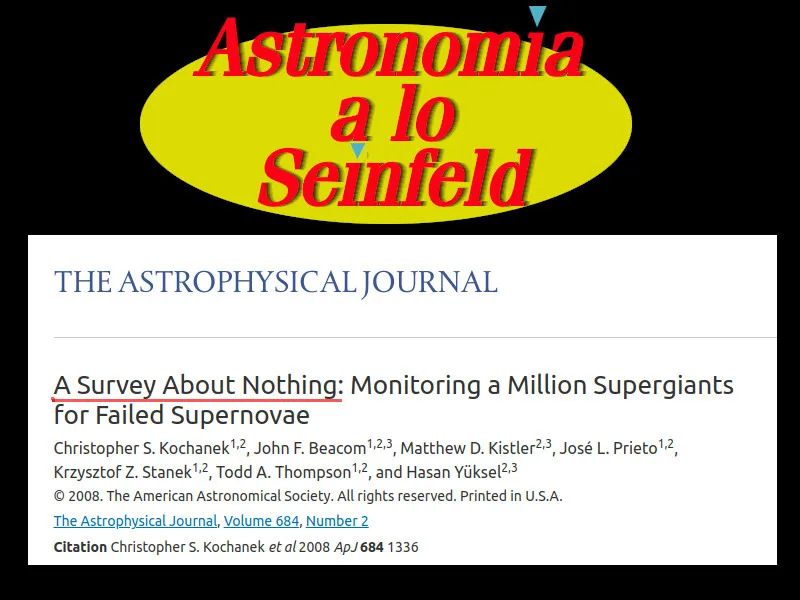
It was then suspected that there would be "failed supernovae". So astronomers set out to look for other cases: the search for disappeared stars as failed supernovae or, as a paper was titled back then, "a search for nothing", perhaps paraphrasing the TV show Seinfeld.
In 2021 a paper was published by a group of astronomers who used the Large Binocular Telescope (LBT) to observe 27 nearby galaxies (up to 10 Mpc) over the last 11 years. The result was a bit disappointing: yada, yada, yada, among the millions of stars, they only found 3 possible candidates, one of which was the star mentioned at the beginning. The others are N4736-OC1 and M101-OC1.
Although perhaps one should think about it another way: in a survey about nothing, they found almost nothing. On one occasion Jerry Seinfeld wondered: "If a book about failure doesn't sell, is it a success?".
Type II Supernovae
There are several subcategories of supernovae of this type: Type II-L ones show a linear decline in their light curve after the brightness peak. Type II-P ones have a smoother decay, with a "plateau" in the curve. The authors of the 2021 paper note in their paper that according to limited samples, up to 59% of core-collapse supernovae are hydrogen-rich Type II-P, with red giant stars as progenitors. However, the most massive ones observed have between 16 and 18 solar masses, which is significantly lower than the theoretical maximum mass for that type of star at 25 M☉. So the issue is twofold: we need to know more about what happens with red supergiant stars of 18-25 M☉ and confirm, if it seems so, that they can collapse without being supernovae.
The paradox of this story is that the most massive stars should not go unnoticed. But it seems they can, that they can collapse without a brilliant final luminous explosion. However, their lack of brightness makes them noticeable again.
If astronomers continue to not find the failed supernovae, perhaps they should apply George Costanza's philosophy from the last episode of the 5th season: do the opposite and look in the least likely places. Surely something failed will finally happen.☉
Sources and related links
- Not All is Lost: Failed Supernovae Shed Light on Massive Star Evolution
https://astrobites.org/2021/04/24/not-all-is-lost/ - A Survey About Nothing: Monitoring a Million Supergiants for Failed Supernovae
Christopher S. Kochanek et al 2008 ApJ 684 1336
DOI 10.1086/590053
https://arxiv.org/abs/0802.0456 - N6946-BH1
https://en.wikipedia.org/wiki/N6946-BH1 - The search for failed supernovae with the Large Binocular Telescope: a new candidate and the failed SN fraction with 11 yr of data
https://arxiv.org/abs/2104.03318
About the images
By NASA/ESA/C. Kochanek (OSU) - https://photojournal.jpl.nasa.gov/catalog/PIA21467, Public Domain, https://commons.wikimedia.org/w/index.php?curid=59476125